
These website SEO tips cover the three layers that actually move rankings: technical health, on-page relevance and backlinks. Most lists stop at keywords and meta tags. This guide adds what to measure, the one decision rule that saves the most wasted effort, and the mistakes that quietly cap a site’s traffic.
Rankings only help if visitors actually stay once they arrive; see this guide to reduce website bounce rate for the four causes that most often undo good SEO work.
The content management system behind your site shapes how fast you can act on these tips; see our guide to CMS marketing for how to pick and measure the right platform.
Key Takeaways
- Most pages never earn traffic at all. Ahrefs analysed about 14 billion pages and found 96.55% get zero traffic from Google. The usual causes: no search demand, no backlinks, or a mismatch with what searchers want.
- Page speed is still a real gap. HTTP Archive’s Web Almanac, built on millions of real sites, found only 48% of mobile pages and 56% of desktop pages pass Google’s Core Web Vitals thresholds.
- Most pages skip an easy win. Ahrefs’ meta description study of 20,000 keywords found 25.02% of top-ranking pages have no meta description at all.
- Backlinks still track with rankings. Backlinko and BuzzSumo analysed 912 million blog posts. Content over 3,000 words earns 77.2% more backlinks on average than content under 1,000 words, though this is a correlation, not a guarantee.
- Rank position decides most clicks. Backlinko’s analysis of 4 million Google results found the #1 organic result captures 27.6% of all clicks. The top three results together capture 54.4%, so moving up even a few positions is worth more than it looks.
In this guide
- Website SEO Tips: Closing the Gap Generic Lists Leave
- How Website SEO Actually Works
- What Differs By Layer: How Each One Is Built
- How to Lead With Each Layer
- Titles and Meta Descriptions: The Fastest Website SEO Tips to Apply
- What Website SEO Tips Must Measure
- The One Decision Rule: Fix Indexing Before Anything Else
- Common Mistakes That Waste SEO Effort
- A Real Case: What Fixing Core Web Vitals Actually Changed
- Frequently Asked Questions About Website SEO Tips
- Where to Go Next With These Website SEO Tips
Website SEO Tips: Closing the Gap Generic Lists Leave
Most website SEO tips lists repeat the same ten items: use keywords, write meta descriptions, build backlinks. None of that is wrong. But it skips the order these fixes should happen in, and what to measure once they are live.
This guide fixes both gaps. It covers how search engines actually process a page, and what differs between the technical, on-page and backlink layers. It also covers how to lead with each layer, what to measure, and the one decision that saves the most wasted effort.
A few ground rules first. Backlinko’s word-count and backlink figures are correlations drawn from large datasets, not proof that length itself causes rankings. HTTP Archive and Ahrefs pull from their own crawl databases, each with its own scope. None of these figures are permanent; search algorithms and page quality both shift constantly.
How Website SEO Actually Works
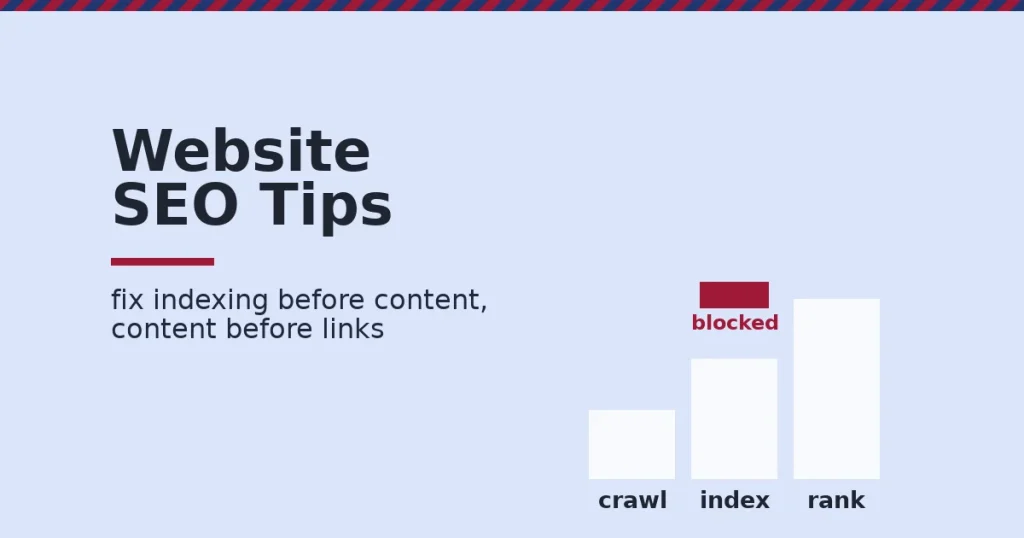
Search engines move a page through three stages before it can rank: crawl, index and rank. A failure at any stage caps everything after it, no matter how good the content is.
Crawl is when a search engine’s bot finds and reads a page. Broken links, blocked pages and slow servers all interfere here. Index is when the engine stores the page as a candidate to show in results. A page can be crawled but never indexed if it looks thin, duplicate or low value.
Rank is where the engine decides which indexed pages answer a specific query best. This is where on-page relevance, backlinks and user signals compete against every other indexed page on the same topic.
Website SEO Tips in One Sentence: Fix the Earliest Failing Stage
What do effective website SEO tips have in common? They fix the earliest stage that is failing first, because a backlink cannot help a page that is not even indexed.
That is why a technical audit should come before a content rewrite, and a content rewrite before a backlink campaign. Working out of order wastes effort on a stage that cannot pay off yet.
Most beginners skip straight to backlinks, because link building sounds like the advanced, exciting part of SEO. It rarely is the right starting point. A link pointing at a page that is not even indexed does nothing, so check indexing first, every time.
What Differs By Layer: How Each One Is Built
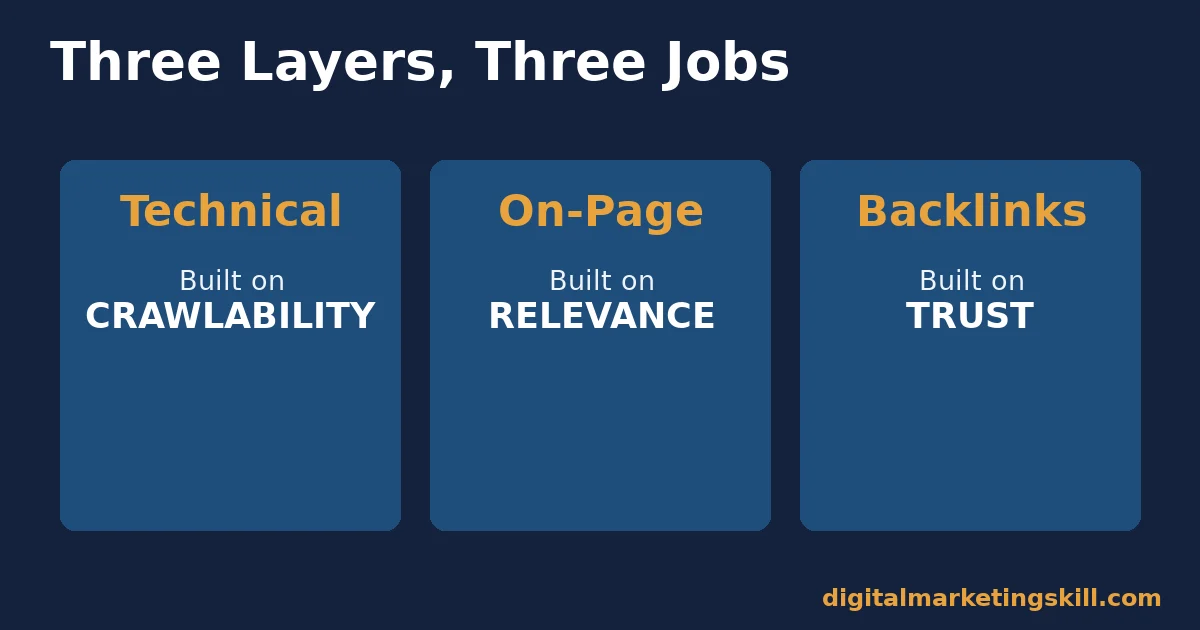
Each SEO layer is built to fix a different kind of failure. Treating them as one checklist wastes the specific strength each layer has.
Technical SEO: Built on Crawlability and Speed
Technical SEO exists to make sure a search engine can reach, read and load a page quickly. Google’s own guidance says Core Web Vitals are used by its ranking systems, though it also says Search still aims to show the most relevant content even when page experience is weaker.
Speed problems are common and measurable. HTTP Archive’s Web Almanac performance chapter found only 48% of mobile pages and 56% of desktop pages pass all three Core Web Vitals thresholds. The targets, per web.dev’s own published guidance, are 2.5 seconds for loading, 200 milliseconds for interaction and 0.1 for visual stability.
On-Page SEO: Built on Matching Search Intent
On-page SEO exists to prove a page actually answers the query it targets, through its title, headings and body content. A technically fast page with the wrong answer still fails to rank.
Length alone is not the goal. Backlinko’s analysis of 11.8 million Google results found the average top-10 result runs about 1,447 words. The study is explicit that this is a correlation, not a direct ranking factor. Matching intent also matters beyond typed search: the same direct, well-structured answers that satisfy a search query tend to perform well in voice search optimization too, since both reward a clear answer over a padded one.
Backlinks: Built on External Trust
Backlinks exist because a search engine cannot fully judge quality from a page alone, so it also weighs how many other sites vouch for it with a link. Backlinko and BuzzSumo’s analysis of 912 million blog posts found 94% of all blog posts have zero external links pointing to them at all.
Guest posting is a common way to earn links, but expectations should stay realistic. An Ahrefs analysis of 239 guest posts found the average referral traffic per post was only about 50 visits, meaning the real payoff is usually the backlink itself, not direct clicks.
How to Lead With Each Layer
Once the failure behind a layer is clear, the fix is usually a specific, measurable change, not a vague “do more SEO” effort.
Technical SEO: Lead With the Core Web Vitals Report
Check Search Console’s Core Web Vitals report before anything else. Fix pages flagged as “poor” first, since they are the clearest, most measurable technical win available.
On-Page SEO: Lead With the Exact Search Query
Write the title and opening paragraph around the exact phrase a searcher types, then confirm the page genuinely answers it in full, not just in the first sentence.
Backlinks: Lead With Content Worth Citing
Publish the kind of page other sites want to reference, such as original data, a clear framework or a genuinely useful tool, before investing in outreach. Outreach works far better on content that deserves the link.
Internal Links: Lead With Your Strongest Pages
Link from your highest-traffic pages to the pages you most want to rank. A link from a page search engines already trust passes more value than a link from a page nobody visits.
Internal linking is free and entirely within your control, unlike backlinks from other sites. It is one of the fastest website SEO tips to apply, because it needs no outreach and no new content, only a few minutes editing existing pages.
Audit your top ten pages once a quarter and add at least one link from each to a page you want to rank higher. This single habit often moves rankings faster than months of outreach emails.
Titles and Meta Descriptions: The Fastest Website SEO Tips to Apply
Titles and meta descriptions are the cheapest website SEO tips to act on, because they need no new content and no backlinks, only a rewrite. Google’s own documentation says snippets are primarily created from the page content itself, with the meta description used only sometimes, and warns that keyword-list style descriptions are less likely to be shown.
Write each title and description as if it has to win a click against nine other results on the same page. Name the specific benefit or answer, not a generic label like “Home” or “Blog Post,” since Backlinko’s click data shows how much is riding on position and presentation together.
A practical test: read your title and description out loud next to your top two competitors’ listings for the same query. If yours does not sound more specific or more useful, rewrite it before touching anything else on the page.
What Website SEO Tips Must Measure
Rankings alone do not show whether SEO work is paying off. A full set of website SEO tips needs a measurement layer too.
Six Metrics That Show Real Progress
- Click-through rate. The share of impressions that turn into a click, tracked in Google Search Console. A low CTR at a high position often points to a weak title or meta description.
- Average position. Where a page typically ranks for its target queries. Track it alongside CTR, since position and clicks do not always move together.
- Core Web Vitals pass rate. The share of a site’s pages meeting all three thresholds. A rising rate shows technical fixes are reaching more of the site, not just one page.
- Indexed page count. How many of a site’s pages Google has actually indexed. A gap between published and indexed pages points to a crawl or quality problem.
- Referring domains. The number of unique external sites linking to a site, not the raw link count. One domain linking fifty times counts far less than fifty separate domains.
- Organic traffic by landing page. Which specific pages earn search visits, not just the site total. It shows exactly where to focus the next round of fixes.
How to Read These Metrics Together
Read the metrics in the order search engines use them. A low indexed page count points to a crawl problem. Indexed pages with a low average position point to an on-page or backlink gap. A good position with a low CTR points to the title and meta description.
This order matters because fixing the wrong layer first wastes time. A team that rewrites titles on pages still stuck outside the index sees no change, then wrongly concludes that titles do not matter.
Track one change at a time, and compare four weeks before a change with four weeks after. Search engines take time to re-crawl and re-rank, so expect a lag before a fix shows up in the data.
The One Decision Rule: Fix Indexing Before Anything Else
If these website SEO tips reduce to one rule, make it this one. Confirm a page is indexed before spending any more time on it, because no amount of content or backlink work helps a page nobody can find in search results.
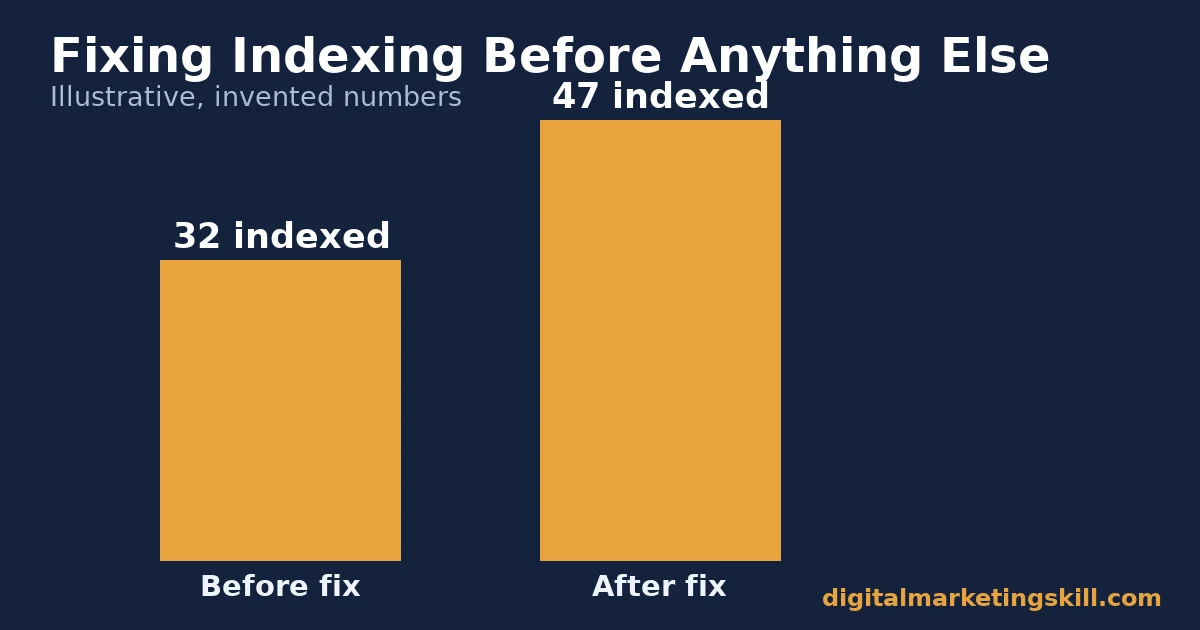
Here is an illustrative example, with invented numbers. A site publishes 50 blog posts, but a crawl audit finds only 32 are indexed. The team pauses new content for two weeks and fixes the crawl blockers behind the other 18. Within a month, 15 of those pages get indexed, and total organic traffic rises by about 40%, without a single new post.
The lesson generalises beyond this example. Unindexed pages are invisible to search, no matter how well they are written. Fixing indexing first protects every hour already spent on content.
This also explains why some sites plateau despite publishing consistently. Volume alone does not fix an indexing problem, and a growing pile of unindexed pages just multiplies the wasted effort each month.
Common Mistakes That Waste SEO Effort
These website SEO tips would be incomplete without the mistakes that repeat across almost every site.
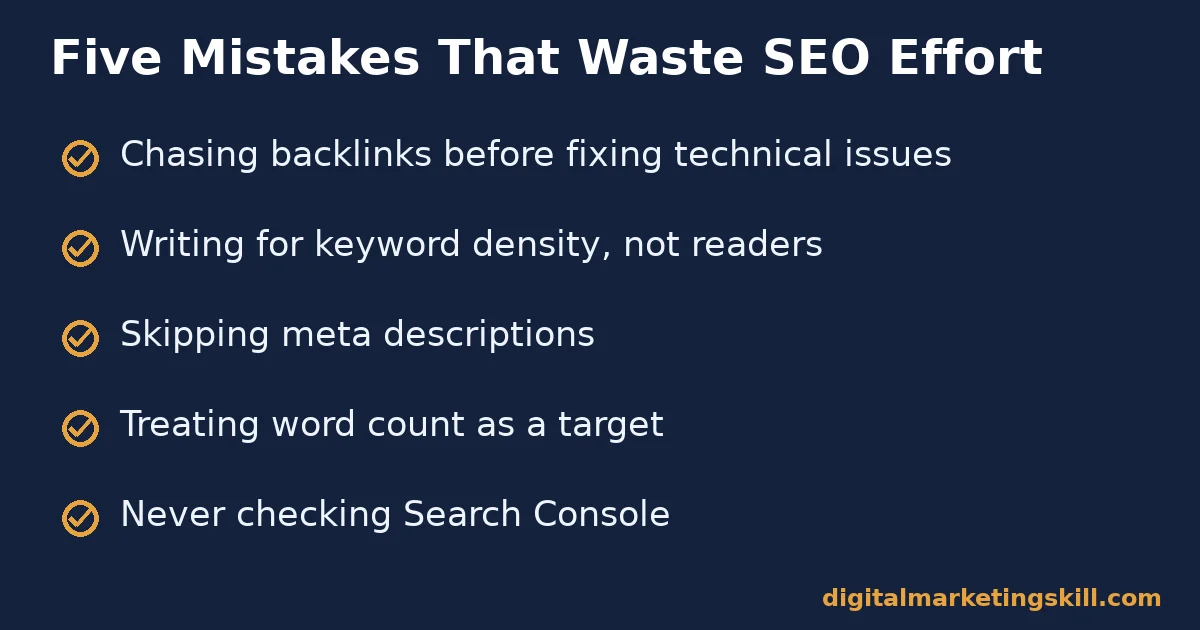
- Chasing backlinks before fixing technical issues. A link to a slow, unindexed page earns little. Fix crawlability first.
- Writing for keyword density instead of the reader. Modern search systems reward content that actually answers the query, not repeated phrases.
- Skipping meta descriptions. Ahrefs’ study of 20,000 keywords found 25.02% of top pages have none at all, and found that search engines rewrite 62.78% of the descriptions sites do write. Writing a clear, specific one still matters, even if it sometimes gets rewritten.
- Treating word count as a target. Length correlates with rankings in aggregate data, but a padded page rarely outranks a shorter, more useful one.
- Never checking Search Console. Rankings guessed from a browser search are misleading, because results are personalised. Search Console shows real impressions and clicks.
A Real Case: What Fixing Core Web Vitals Actually Changed
Google’s web.dev has published several Core Web Vitals case studies with named, measurable outcomes. Vodafone Italy improved its largest contentful paint score and reported an 8% increase in sales. Tokopedia improved the same metric and reported a 23% improvement in average session duration.
These cases show a real, named correlation between technical fixes and business metrics, each from one company’s own reported data. Treat them as a pattern worth testing on your own site, not a guaranteed percentage, since every site starts from a different baseline.
Other published web.dev cases follow the same pattern. Nykaa improved its loading score and reported 28% more organic traffic. Cdiscount improved all three Core Web Vitals and reported a 6% revenue uplift. Flipkart’s Core Web Vitals work came with a 2.6% lower bounce rate, and AliExpress reported about 15% lower bounce rate after improving its visual stability and loading scores.
None of these companies published a controlled experiment isolating Core Web Vitals from every other change made at the same time. Read them as real, named evidence that speed work tends to pay off, not as a formula that guarantees a specific percentage for any other site.
Frequently Asked Questions About Website SEO Tips
What are the most important website SEO tips for beginners?
Start with technical health: confirm your pages are indexed and pass Core Web Vitals. Then match each page’s title and content to a real search query, and only then invest time in earning backlinks.
How long does SEO take to show results?
Most sites see meaningful movement within two to four months of consistent technical, on-page and content work, because search engines need time to re-crawl, re-index and re-rank pages.
Do I need backlinks if my content is good?
Usually yes. Backlinko and BuzzSumo’s research found 94% of blog posts have zero external links, and backlinks remain one of the clearest external trust signals search engines use.
Is keyword density still important for SEO?
Not in the way it used to be. Modern search systems reward content that clearly answers a query, with the target phrase appearing naturally, not repeated artificially throughout the page.
What is a good Core Web Vitals score?
A page passes when it meets all three thresholds: loading within 2.5 seconds, responding to interaction within 200 milliseconds, and keeping visual shifts under 0.1. Each is measured at the 75th percentile of real visits.
Should I write longer content for better SEO?
Not automatically. Length correlates with backlinks and rankings in large datasets, but a shorter page that fully answers the query usually outperforms a padded longer one.
How do I know if my website SEO tips are actually working?
Track click-through rate, average position, indexed page count and referring domains together. A rise in all four over a few months is a far stronger signal than any single ranking check.
Does site speed really affect rankings?
Yes, though it is one signal among many. Google confirms Core Web Vitals feed its ranking systems, and several published case studies link faster loading times to measurable gains in traffic, conversions or revenue.
How many backlinks does a new website need?
There is no fixed number. What matters more is the number of unique referring domains. How relevant those sites are to your topic also matters more than the raw count of links pointing at your site.
Can I do website SEO tips myself without hiring an agency?
Yes, especially the technical and on-page layers, which rely on free tools like Search Console and web.dev’s own measurement tools. Backlink building takes more time but is still achievable without outside help.
What tools do I need to start applying website SEO tips?
Google Search Console and a free Core Web Vitals checker cover the technical basics. A simple spreadsheet works for the on-page and link layers. Track your target queries, titles and backlinks there while you are starting out.
Where to Go Next With These Website SEO Tips
Website SEO tips only work in the right order: fix indexing and technical health first, match content to real search intent second, and earn backlinks to content that deserves them third. Start with a free Search Console crawl check before changing anything else.
Keep Building From Here
Our guide on what digital marketing is sets SEO inside the wider channel mix, and our walkthrough on building a content marketing guide covers the content side of ranking well. You can also browse the Digital Marketing Skill Institute homepage for more SEO and content guides.
None of these website SEO tips require a large budget to start. A Search Console account, a content calendar and a short list of pages worth linking to are enough to begin fixing all three layers this month.
If you want structured, guided practice instead of piecing an SEO strategy together alone, Digital Marketing Skill Institute teaches it hands-on. The Master Diploma in Digital & AI Marketing includes an AI-Powered WordPress and SEO Specialist track among its four AI-powered tracks, across ten courses in total, with a Full Stack option for completing all four.
The diploma includes unlimited 1-on-1 coaching and mentoring, plus a U.S. Project Internship with a verified U.S. Work Reference Letter. It is dual US and UK accredited, and recognised in more than 100 countries.
The programme is 100% online, so you can apply these website SEO tips from anywhere in your country. Browse more guides on the Digital Marketing Skill Institute blog, or when you are ready, apply for the Master Diploma.
Every figure in this guide was checked against its original source before publication. Figures marked as illustrative are invented examples, not real results.
