
Digital marketing interview questions fall into four real categories, not one long list to memorise. Interviewers ask about your background, your tools, your strategic thinking and how you work with others. This guide groups the questions that way. It shows how to answer each type, and gives you a way to check whether your answers are actually landing.
Key Takeaways
- Marketing roles reward real experience. O*NET reports that 80% of new hires for marketing manager roles need a bachelor’s degree. The role sits in “Job Zone Four,” which needs several years of related work.
- Demand is strong. O*NET projects marketing manager roles to grow “much faster than average.” It counts about 34,000 openings a year.
- Measuring results is the hardest part of the job. HubSpot’s State of Marketing research found that measuring marketing ROI is marketers’ top obstacle. 73% say budgets face more scrutiny than before.
- Interviewers test how you measure success. Google’s own guidance on hiring an SEO recommends asking “how will you measure success.” The answer separates real experience from guesswork.
- Generic answers are the easiest to spot. A specific example, with a number and a lesson learned, consistently outperforms a textbook definition in a digital marketing interview.
In this guide
- What Most Digital Marketing Interview Questions Lists Get Wrong
- What Interviewers Are Actually Evaluating
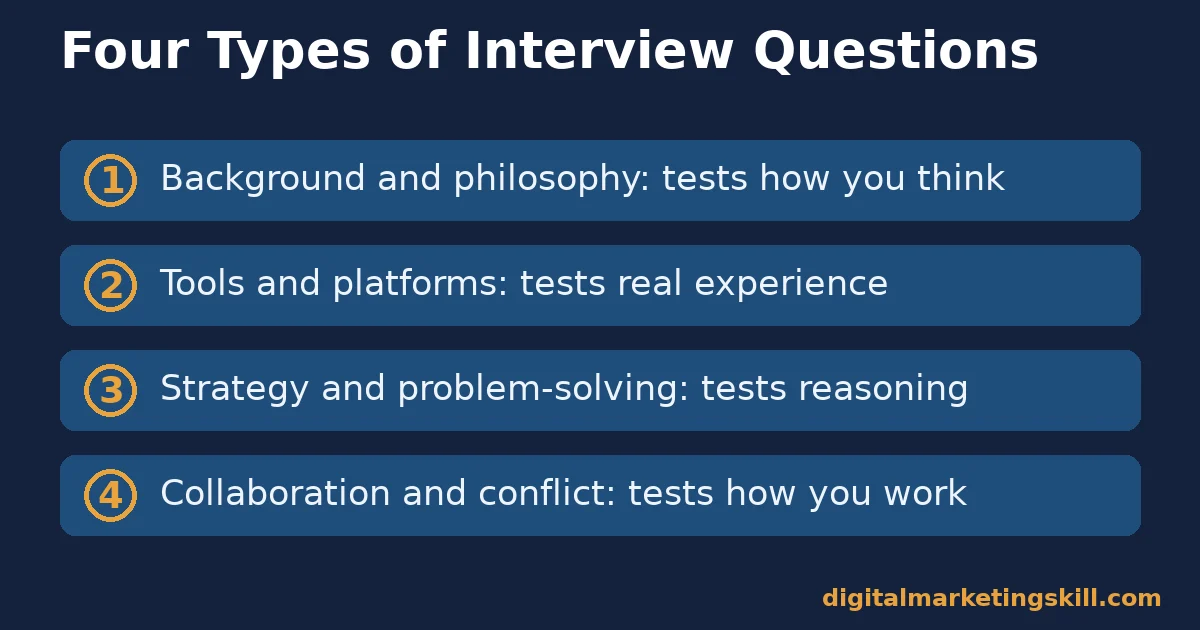
- The Four Types of Digital Marketing Interview Questions
- How to Answer Each Type of Digital Marketing Interview Question
- Background and Philosophy: Lead With a Clear Definition, Then a Story
- Tools and Platforms: Name Specific Tools and What You Did With Them
- Strategy and Problem-Solving: Use the STAR Method Every Time
- Collaboration and Conflict: Show the Resolution, Not Just the Disagreement
- Interview Questions Change as Your Career Does
- Practising All Four Types Together
- How to Know Your Interview Answers Are Working
- The One Rule: Never Answer Without a Real Example
- A Real Case: Turning Interview Prep Into a Job Offer
- Frequently Asked Questions About Digital Marketing Interview Questions
- Build the Experience Your Answers Will Lean On
What Most Digital Marketing Interview Questions Lists Get Wrong
Most lists of digital marketing interview questions are just lists. They name ten or twenty questions with no explanation of what the interviewer is actually testing. As a result, candidates end up memorising answers instead of understanding the question behind the question.
So this guide groups digital marketing interview questions into four categories, based on what each one is designed to reveal. Once you see the category, the right kind of answer becomes obvious. That holds true even for a question you have never heard before.
A quick note on the evidence. The wage and growth figures come from O*NET, the US Department of Labor’s own occupational database. Treat them as US-focused context, not a global guarantee, since hiring patterns and titles vary by country. The hiring advice is a synthesis of public hiring guidance, not a single study.
Why does this level of preparation matter so much right now? The role you are interviewing for is in real demand. O*NET projects marketing manager roles to grow “much faster than average.” It counts roughly 34,000 openings a year in the United States alone. 80% of new hires in the role need a bachelor’s degree.
What Interviewers Are Actually Evaluating
An interviewer rarely cares about the literal words in your answer. They are testing three things at once. Do you understand the concept? Have you actually done the work? Can you reason through a problem out loud?
Google’s own guidance on hiring an SEO makes this explicit. It recommends asking a candidate for “examples of past work” and “how will you measure the success of your work.” That same logic applies across digital marketing hiring, not just SEO. The same page also warns that “no one can guarantee a number-one ranking.” Keep that in mind if a candidate overpromises results.
This matters because marketing roles are judged on outcomes that are genuinely hard to measure. HubSpot’s own research found that proving marketing ROI is marketers’ biggest obstacle. 73% say their budgets face more scrutiny than in the past. An interviewer who has felt that pressure wants to know you can handle it too.
Search engine optimisation roles show the same pattern from a different angle. O*NET’s data on search marketing strategists puts the median wage for the wider market research and marketing specialist group at $78,760 a year. Growth is also rated “much faster than average.” Employers filling these roles have real budget and real urgency behind the interview.
The Four Types of Digital Marketing Interview Questions
These four categories cover almost every digital marketing interview question you will face. Each one tests something different, so the right answer looks different too. Learn to spot which category a question belongs to, and unfamiliar digital marketing interview questions stop feeling unpredictable.
Background and Philosophy Questions: Built to Test How You Think
Questions like “what is digital marketing” or “what is your digital marketing philosophy” sound basic. They actually test whether you can explain a familiar idea clearly under pressure. A confused explanation here signals a confused thinker, even if your experience is strong.
These questions also reveal your priorities. Two candidates can both correctly define digital marketing, but one will lead with channels and the other with customer outcomes. Interviewers notice which one you choose first. Google’s own guidance on helpful, people-first content frames good marketing around who the audience is and why the work was made, which is a useful lens for this kind of answer too.
Tools and Platform Questions: Built to Verify Real Experience
Questions about specific software, such as Google Analytics, Google Ads or a content management system, test real use. They separate candidates who have studied the field from candidates who have worked in it. Naming a tool is easy. Describing what you actually did inside it is not.
This category is also where interviewers probe depth. A candidate who says “I used Google Ads” gets a follow-up question. A candidate who says what they built, tested and changed inside Google Ads rarely does. The answer already shows the work.
Strategy and Problem-Solving Questions: Built to See You Reason
Questions about building a strategy, handling a failed campaign or choosing between inbound and outbound marketing test reasoning. They are not asking for memorised steps. The interviewer wants to watch you think through trade-offs in real time.
These are the questions where a textbook answer fails fastest. Reciting the stages of a marketing funnel proves you read about funnels, while explaining why you chose one channel over another for a specific budget proves you can run one. Our guide to core content marketer skills covers the thinking behind many of these strategy-type digital marketing interview questions in more depth.
Collaboration and Conflict Questions: Built to Predict How You’ll Work
Questions about disagreements with a team or an unsuccessful campaign test something no portfolio can show: how you behave under friction. Hiring managers ask these because a skilled marketer who is difficult to work with still creates real cost.
The honest version of these questions matters more than the polished one. An interviewer who hears a conflict with no real tension usually assumes the story is invented. The same goes for a resolution with no real effort behind it.
How to Answer Each Type of Digital Marketing Interview Question
Each section below mirrors the category above it. The goal in every case is the same: replace a general claim with a specific, checkable detail. Because these fixes map directly onto the four types of digital marketing interview questions, you can prepare one answer per category instead of twenty separate scripts.
Background and Philosophy: Lead With a Clear Definition, Then a Story
Open with a short, accurate definition in your own words, not a copied one. Follow it immediately with one sentence about how that definition shows up in your actual work. That way, the interviewer hears understanding and experience in the same breath.
Keep the definition under three sentences, because a long, rehearsed-sounding answer to a simple question often reads as nerves rather than knowledge. Our wider digital marketing interview preparation guide covers how to structure the rest of the conversation around this opening.
Tools and Platforms: Name Specific Tools and What You Did With Them
Name the exact tool, then describe one concrete task you completed inside it, with a number if you have one. “I used Google Analytics to find that 40% of our traffic dropped off on the checkout page” says far more. Compare that with a vague line like “I’m experienced with analytics tools.”
If you are early in your career, name tools from coursework or personal projects honestly, and say so. Interviewers respect accurate scope far more than inflated claims that collapse under one follow-up question.
Group your tools by what they actually do for you, not by brand recognition. An analytics tool, an ad platform and a content management system each answer a different kind of follow-up question. Knowing which bucket a tool belongs to helps you answer faster under pressure.
Strategy and Problem-Solving: Use the STAR Method Every Time
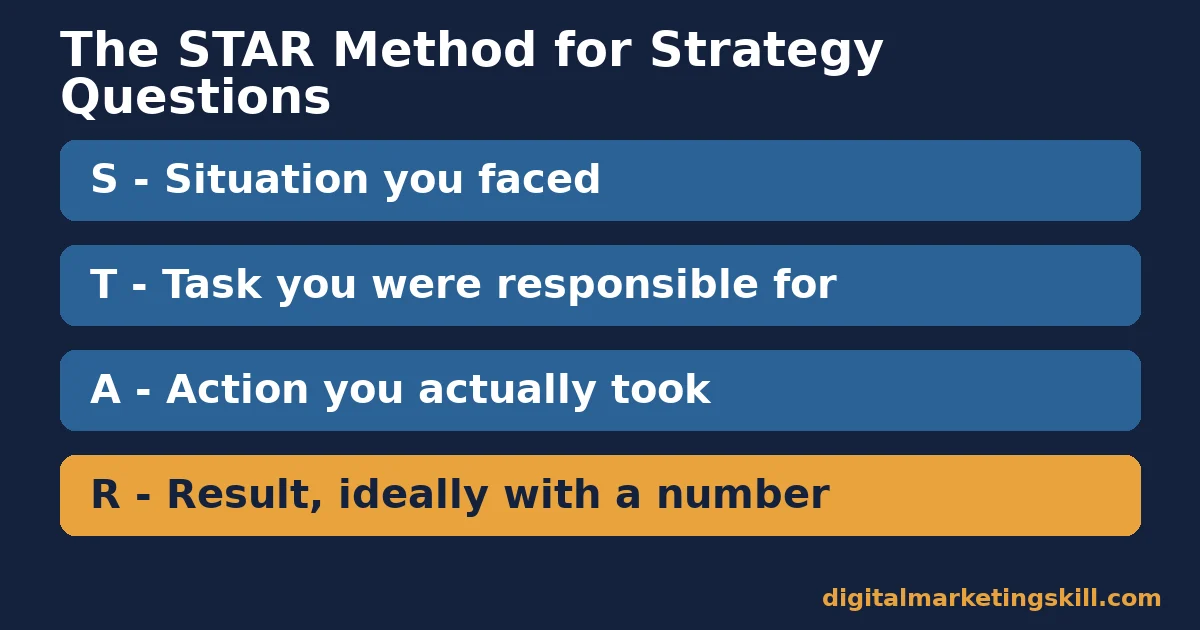
Structure every strategy answer the same way. Name the Situation you faced, the Task you were responsible for, the Action you actually took, and the Result, ideally with a number. This structure forces a specific example instead of a general opinion.
When a campaign failed, say so plainly, then spend most of your answer on what you changed afterward. Interviewers trust a well-explained failure more than a suspiciously perfect track record.
The same structure works for questions about building a strategy from scratch. Name the research step, the audience decision, the channel choice and the result, in that order. That lets the interviewer follow your reasoning, not just your conclusion.
Collaboration and Conflict: Show the Resolution, Not Just the Disagreement
Describe the disagreement honestly, including what the other side believed and why it was reasonable. Then explain the specific action that resolved it, not just the fact that it eventually got resolved.
Avoid framing yourself as the only reasonable person in the story. An answer that credits the team’s input alongside your own usually sounds more credible. Real teamwork rarely has one hero.
Keep the stakes proportional to the story. A minor scheduling disagreement dressed up as a major conflict reads as inexperience, while a genuinely hard disagreement, told plainly, tends to build trust instead of losing it.
Interview Questions Change as Your Career Does
The mix of digital marketing interview questions you face shifts as you gain experience. The US Bureau of Labor Statistics puts the median age for market research analysts and marketing specialists at 38.5, spanning everyone from recent graduates to senior leads, which is a reminder that candidates at every stage sit across the interview table from each other.
Practising All Four Types Together
Do not practise one category in isolation. Interviewers mix question types within the same conversation. A candidate who is strong on tools but weak on teamwork still stalls out partway through.
So run through one question from each of the four categories in a single practice session, back to back. That sequence mirrors a real digital marketing interview far more closely than ten questions from one category in a row.
How to Know Your Interview Answers Are Working
You can check your own interview readiness before you are ever in the room. Each measure below is defined in one sentence, with a note on how to read it.
Treat these four checks the same way a hiring manager treats a candidate’s claims. Look for the specific detail, not the general impression.
None of these checks require a real interview to run. You can score yourself against all four of the digital marketing interview questions categories using nothing but a practice partner and a timer.
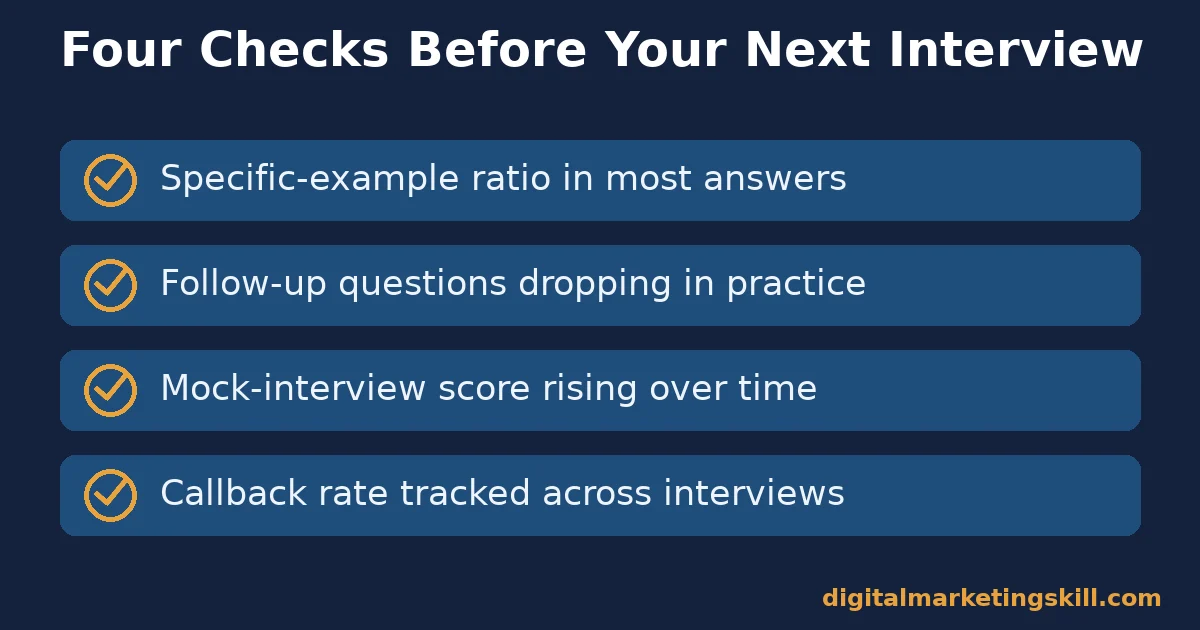
Four Checks That Show You Are Ready
- Specific-example ratio. This is the share of your answers that include a real number or outcome, rather than a general claim. Aim for a concrete detail in most of your answers, not just your favourite one.
- Follow-up question rate. This is how often an interviewer asks you to clarify or expand on an answer. A rising rate during practice usually means your first answers are too vague.
- Mock-interview score. This is a simple self-rating, or a rating from a mentor, after a practice session. Track it over multiple sessions rather than judging a single run.
- Callback rate. This is the share of interviews that lead to a second round or an offer. It is a lagging measure. Still, a consistently low rate across several interviews usually points to the same weak answer type each time.
Read these together. A good specific-example ratio with a low callback rate usually points to a different problem. Targeting the wrong roles is a common cause, not a flaw in your answers.
The One Rule: Never Answer Without a Real Example
If you only change one habit before your next interview, make it this one. Every answer, across all four categories, should contain one concrete example. That could be a campaign, a number, a tool, or a specific moment of conflict.
Here is an illustrative example, with invented numbers. A candidate answers “how do you measure success” with a general statement about tracking KPIs. A stronger version names the exact KPI, the tool used to track it, and one decision that changed because of what the data showed. The second answer takes ten more seconds. It lands completely differently too.
A Real Case: Turning Interview Prep Into a Job Offer
Grace, a Master Diploma graduate, moved to the United States. She was stuck in short-term roles because she lacked what employers call “local experience.” She has said that a structured project with a verified work reference gave her specific, checkable examples. That experience helped her interview for a Digital Marketing Manager role, and she got it.
That is one documented, individual result, not a guaranteed outcome for every candidate. But treat it as evidence that concrete, verifiable experience changes how an interview answer lands, which is the same principle behind every fix in this guide.
Frequently Asked Questions About Digital Marketing Interview Questions
What is the most common digital marketing interview question?
Some version of “what is digital marketing” or “describe your digital marketing philosophy” comes up in nearly every interview. Of all the digital marketing interview questions in this guide, it is the one every candidate should be able to answer without hesitation. Answer with a short definition in your own words, then one sentence connecting it to real work you have done.
How do I answer “describe your most successful campaign” with no major wins yet?
Use the smallest real result you have, even from a class project or a personal account, and apply the STAR method. A small, honestly explained result outperforms a vague description of a bigger one you cannot detail.
Should I memorise answers to digital marketing interview questions?
Memorise the structure, such as STAR, rather than the exact words. A memorised script tends to sound rehearsed and breaks down the moment a follow-up question arrives. The structure travels across every category of digital marketing interview questions, while a fixed script only covers the one question you rehearsed.
What tools should I be ready to discuss in a digital marketing interview?
Be ready to discuss whichever tools you have genuinely used, such as Google Analytics, Google Ads or a content management system. Naming a tool you cannot describe in detail usually costs more credibility than simply not mentioning it. Pick two or three tools you know well and prepare one specific story for each, rather than a long list of names with no detail behind them.
How do I answer a question about a failed campaign?
State what happened plainly, without over-explaining the failure, then spend most of your answer on what you changed afterward. Interviewers are testing your response to failure, not judging the failure itself.
What is the biggest challenge digital marketers mention in interviews?
Measuring return on investment comes up often, and for good reason. HubSpot’s research found it is marketers’ top obstacle, and most say budget scrutiny has increased. Content-side research backs this up too: Content Marketing Institute and MarketingProfs found measuring effectiveness is also a top content challenge, among content teams specifically. Naming this challenge, with how you handle it, shows real industry awareness.
Do digital marketing interview questions differ by seniority?
Yes. Entry-level interviews lean on background and tools questions. Senior roles add more strategy and collaboration questions, since O*NET classifies marketing management roles as needing several years of related experience.
How long should an answer to a digital marketing interview question be?
Aim for 60 to 90 seconds for most questions, long enough to cover the STAR structure without losing the interviewer’s attention. So if you find yourself still talking after two minutes, the answer likely needs a tighter example, not more detail.
What should I research before a digital marketing interview?
Research the company’s actual marketing channels, not just its products. Look at its website, social accounts and recent campaigns, because that homework lets you reference something specific instead of speaking about digital marketing in the abstract. So when a question comes up about their own strategy, you already have a real example to point to instead of guessing.
Build the Experience Your Answers Will Lean On
Every fix in this guide works best when you have real, specific experience behind it, because no interview framework can substitute for an answer you can genuinely back up. If you want to build that experience properly, Digital Marketing Skill Institute teaches it hands-on inside the Master Diploma in Digital & AI Marketing.
The program runs four AI-powered tracks built from ten execution-first courses in total. A Full Stack option covers all four tracks. It comes with unlimited 1-on-1 coaching and mentoring, plus a U.S. Project Internship that ends with a verified U.S. Work Reference Letter, exactly the kind of checkable example this guide recommends.
The diploma is dual US and UK accredited and recognised in more than 100 countries. The whole program runs 100% online, so you can build real, interview-ready experience wherever you live, anywhere in your country.
So before your next interview, prepare your digital marketing cover letter, build a marketing portfolio and check that your resume matches the examples you plan to give for each type of digital marketing interview question. See real outcomes on the reviews page. When you are ready, apply for the Master Diploma or start from the Digital Marketing Skill Institute homepage.
Every figure in this guide was checked against its original source before publication. Figures marked as illustrative are invented examples, not real results.
