

Content marketer skills are the abilities that turn a published post into steady visits, leads and sales. Good writing is only the entry ticket. The skills that decide traffic are matching search demand, spreading each post across channels, refreshing what already ranks and reading the numbers. Together, they make every hour of writing earn more readers.
Key Takeaways
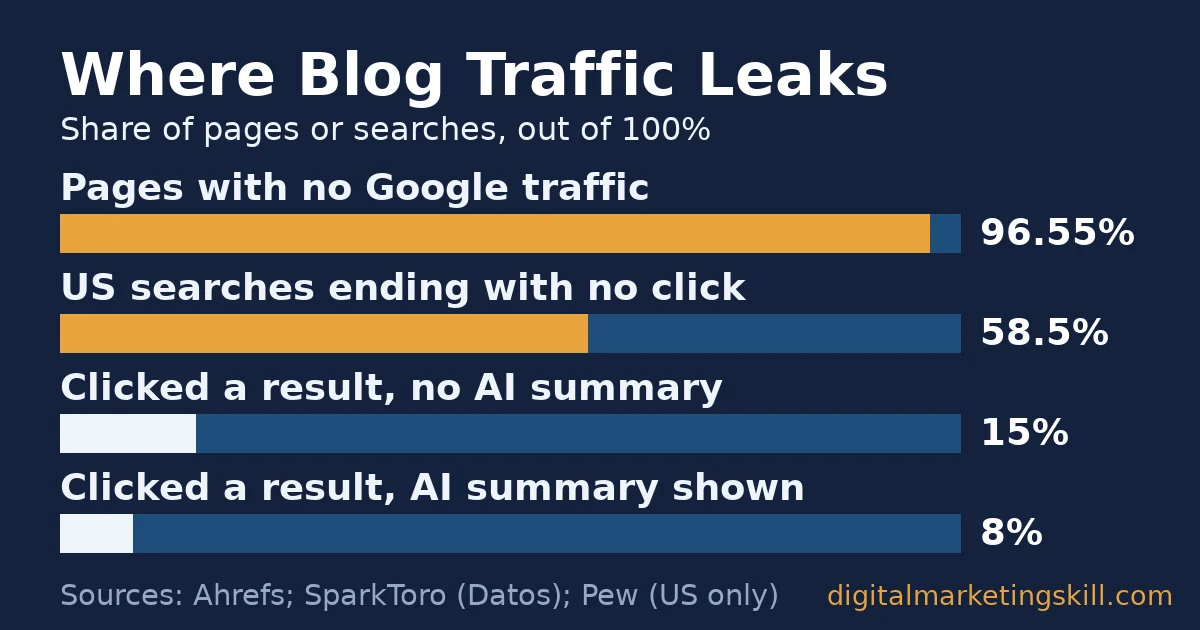
- Most pages never earn a search visit. An Ahrefs study of about 14 billion pages found that 96.55% get no traffic from Google, mostly because of low demand or no links.
- Search sends fewer clicks than many writers assume. SparkToro’s zero-click study found that 58.5% of US Google searches ended without a click to any website.
- Old posts carry the load. HubSpot reported that 76% of its monthly blog views and 92% of its monthly blog leads came from older posts.
- Writing alone is a flat market. The US Bureau of Labor Statistics projects no growth for writers and authors, so distribution and analysis skills add real value.
- The most useful rule here: refresh a post that already earns impressions before you publish a new one. Refreshed pages start with links and data in place.
In this guide
- Why Most Content Marketer Skills Lists Miss the Traffic Problem
- How a Blog Post Actually Earns Traffic: Demand, Distribution and Proof
- Content Developer vs Content Marketer: Two Jobs With Different Skills
- Content Marketer Skills to Lead With, Role by Role
- How to Measure Content Marketer Skills With Five KPIs
- The One Decision Rule: Refresh Before You Publish Something New
- Three Mistakes That Waste Content Marketer Skills
- A Four-Week Plan to Practise Content Marketer Skills
- What Content Marketer Skills Look Like in Practice
- Frequently Asked Questions About Content Marketer Skills
- Build Content Marketer Skills With Guided, Real-World Practice
Why Most Content Marketer Skills Lists Miss the Traffic Problem
Most lists of content marketer skills read like a job advert. They name writing, SEO, social media and analytics, and then they stop. What they rarely explain is how each skill moves a post from zero readers to steady traffic. They also skip the harder question: which skill should you learn first?
That gap matters because the traffic problem is severe. Ahrefs analysed about 14 billion pages in its search traffic study. It found that 96.55% of them receive no traffic from Google at all. Another 1.94% get between one and ten visits a month. In short, most pages on the web get published and then ignored.
This guide fills that gap in a fixed order. First, it explains how a post actually earns traffic. Then it separates two roles that older advice mixes up, the content developer and the content marketer. After that, it shows what each role should lead with. Finally, it gives you five metrics, one decision rule, a four-week plan and a short FAQ.
Ground rules. Every figure below comes from a named source we opened. We also say when a number is US-only or comes from a vendor. The search data is a snapshot, not a permanent ranking, because platforms change often. And where we explain why a pattern appears, treat that as an informed inference, not a settled fact.
How a Blog Post Actually Earns Traffic: Demand, Distribution and Proof
A blog post earns traffic through three gates. Demand means real people search for, or care about, the problem the post solves. Distribution means the post reaches those people through search, social feeds, email or other sites. Proof means readers and search engines trust the page enough to click, stay and link to it.
Miss any one gate and traffic stalls. Ahrefs names three main reasons pages fail: no search demand, no backlinks, and a mismatch with what searchers wanted. A backlink, a link from another website to yours, works like a public vote of confidence.
The search gate has also narrowed: SparkToro’s zero-click search study used clickstream data from Datos, a Semrush company. It found that 58.5% of US Google searches and 59.7% of EU searches ended with no click. For every 1,000 US searches, only 360 clicks reached a website outside Google.
AI summaries push the same way. A Pew Research Center analysis tracked the browsing of 900 US adults. Users clicked a traditional result in 8% of visits that showed an AI summary. Without a summary, they clicked in 15% of visits. The panel was US-only, so treat it as a direction rather than a global rate.
My reading is simple: search still matters, but a post that relies on search alone is fragile. So the content marketer skills that protect traffic open the other two gates as well. That means owned channels such as email, plus proof that wins the click.
Content Developer vs Content Marketer: Two Jobs With Different Skills
Older advice treated the content developer and the content marketer as one person, and it bundled all content marketer skills into one list. In practice they are two jobs, even when one person does both. The developer owns what is on the page. The marketer owns who sees it and what happens next.
The Content Developer: Built for Depth and Accuracy
A content developer researches, writes and structures the post. Their core skills are finding the real question behind a search and checking facts at the source. They also organise each page so readers can scan it. Finally, they need a working grasp of on-page SEO: the titles, headings, links and descriptions that tell search engines what a page covers.
Writing is valuable, but the market for writing alone is flat. The BLS Occupational Outlook for writers and authors projects 0% employment change over the next decade. It lists a median pay of $76,910 and says 65% of writers are self-employed. Those are US figures, but the signal travels: pure writing is a crowded lane.
Strong writing still sits at the centre of the job, of course. If your drafts feel flat, our guide to copywriting skills for beginners covers headlines, hooks and calls to action.
The Content Marketer: Built for Reach and Measurement
A content marketer plans topics, distributes posts and measures the results. Their core skills are channel planning, repurposing, email, basic analytics and reporting. They decide which posts deserve promotion and which need a refresh. They also decide which posts to merge or retire.
Employers are asking for exactly this mix. HubSpot’s State of Marketing report surveyed more than 1,500 marketers. It ranks automation and AI prompting, cross-team communication, and data and analytics as the most valuable skills. Meanwhile, the BLS projects 7% growth for market research analysts, the analytical side of marketing, which is much faster than average.
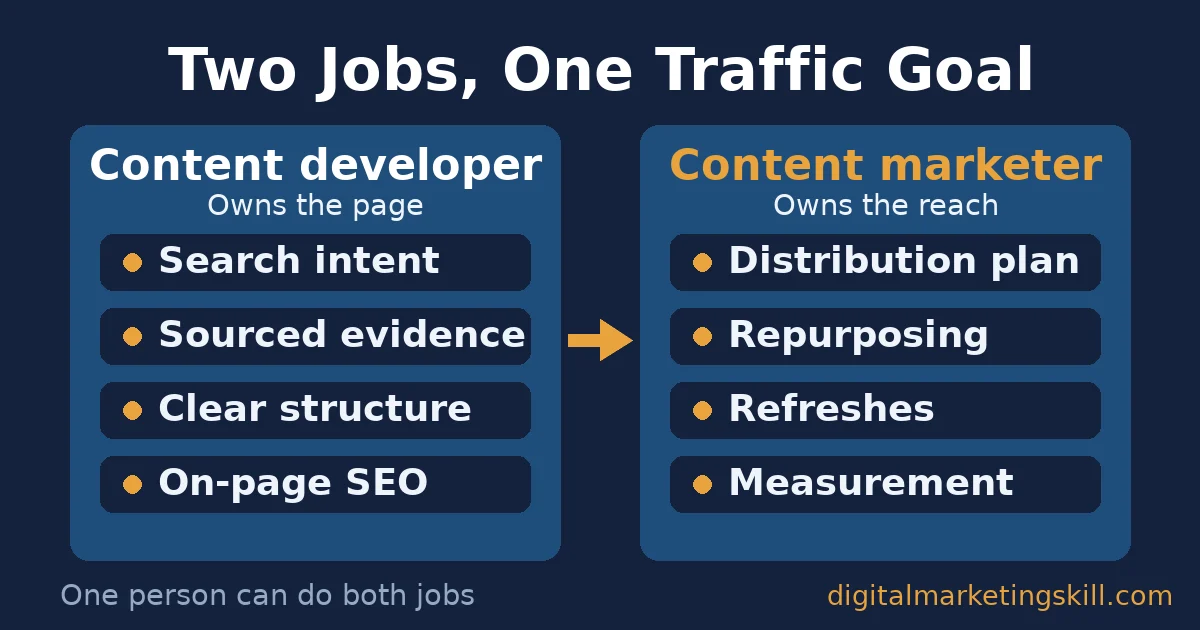
So the strongest profile is a writer who can also distribute and measure. If you are a content developer, add the marketer’s skills one at a time. If you are a content marketer, learn enough research and writing to brief and edit well.
Content Marketer Skills to Lead With, Role by Role
Knowing the two roles is only half the job, because you also need to know which content marketer skills each role should build first. That first skill shapes every post you publish afterwards, so choose it on purpose.
The Content Developer: Lead With Search Intent and Evidence
Search intent is the reason behind a search, such as learning, comparing or buying. So start every post by reading the top results for your topic. Ask what they have in common. If every result is a step-by-step guide, a personal essay will struggle, however good the writing.
Next, build the page for people rather than algorithms. Google’s guidance on creating helpful, people-first content asks who wrote a page, how they made it and why it exists. Google calls the “why” question perhaps the most important one. It also warns against writing on many topics just to attract search visits.
Then add proof that others cannot copy. That means a named source for every statistic, a worked example, or a real result you have permission to share. Proof earns links, and links are one of the three gates Ahrefs describes. For the on-page side, see our checklist for optimising a blog post for search engines.
- Check demand first. Confirm people search for the topic before you write, because polish cannot fix a topic nobody wants.
- Match the format. Copy the shape of the pages that rank, such as a list or a comparison. Then beat them on depth.
- Source every number. Link the original study and say what it does not show, so readers can trust the page.
The Content Marketer: Lead With Distribution and Refreshes
For the content marketer, the first skill is distribution. Plan where each post will go before anyone writes it. A simple plan is one email to your list, two or three social posts cut from the strongest points, and links from two related posts on your own site. Our guide to repurposing one piece of content into many formats shows the method step by step.
Repurposing is already common practice. HubSpot’s marketing statistics page reports that 48% of social media marketers share similar content across platforms with minor changes. By contrast, 34% create unique content for each platform. The same page lists blog posts as the third most popular content format, used by 38% of marketers.
The second skill is refreshing. HubSpot’s historical optimisation experiment found that 76% of its monthly blog views came from older posts. Those older posts also produced 92% of its monthly blog leads. When the team updated and republished old posts, organic search views rose by 106% on average. That is one company’s blog, and HubSpot sells marketing software, so read it as a strong example rather than a law.
In other words, your archive is an asset. Refreshing ten posts a month can often grow traffic faster than publishing ten new ones. That is because refreshed posts already have links, history and impressions. For more channel ideas, our round-up of content promotion strategies covers outreach, communities and paid boosts.
How to Measure Content Marketer Skills With Five KPIs
Content Marketing Institute’s B2B research surveyed 1,015 mostly North American marketers, with Storyblok as sponsor. It found that 33% name measuring content effectiveness as a top challenge. The fix is a short list of metrics, each with a clear meaning, so you can see which content marketer skills are paying off.
- Impressions. Search Console counts an impression each time your page appears in a result a user sees. Rising impressions show growing relevance.
- Click-through rate (CTR). Google’s Search Console metric definitions describe CTR as clicks divided by impressions. A low CTR on a busy post points to a weak title or description.
- Engaged sessions. Google Analytics counts a session as engaged when it lasts more than 10 seconds, has a key event or includes two or more page views. That beats raw visits as a quality signal.
- Key events per post. A key event is an action that matters to your business, such as a sign-up or enquiry. This metric links content to results rather than attention.
- Refresh lift. Compare a post’s clicks for the four weeks before and after an update. That shows which refreshes paid off.
Read these metrics together, not alone. For example, high impressions with a low CTR is a packaging problem. High CTR with few engaged sessions is a page problem instead. Each pattern points to a different fix, which stops you from rewriting posts that already work. Our guide on how to measure content marketing goes deeper on reporting.
The One Decision Rule: Refresh Before You Publish Something New
If you remember one thing from this guide, make it this rule. Before you write a new post, check whether an existing post already earns impressions for that topic. If it does, refresh it first. Publish something new only when no page of yours is in the running.
Refreshed pages start ahead, because they already have links, a place in the index and data you can learn from. New posts start at zero, and the Ahrefs study shows how often zero is where they stay.
Here is a worked example with illustrative, invented numbers. A post earns 4,000 impressions a month at an average position of 12. Its CTR is 1%, so it brings 40 clicks. You rewrite the title and opening, add two sourced sections and link to it from three related posts.
Now suppose the refresh lifts the post to position 6 and its CTR to 4%. The same 4,000 impressions would then bring 160 clicks, four times as many.
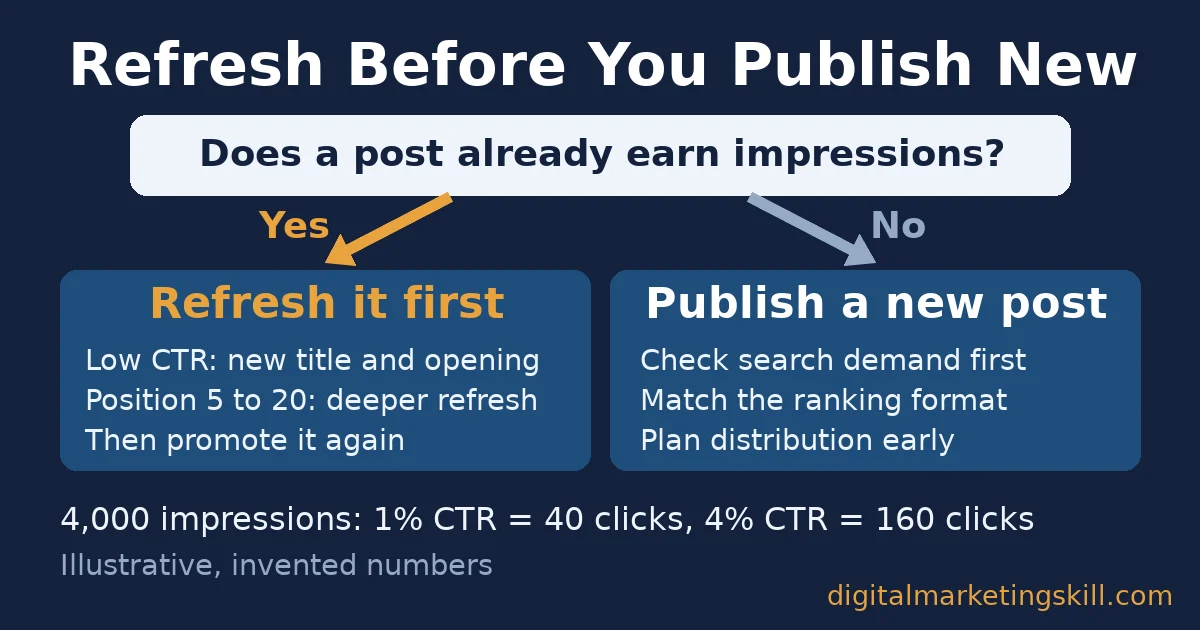
Use a simple triage when you apply the rule. First, a post with impressions but a low CTR needs a better title and opening. Second, a post ranking between positions 5 and 20 needs a deeper refresh. Third, a post with no impressions after several weeks needs a new angle, or a merge into a stronger page on the same topic.
Three Mistakes That Waste Content Marketer Skills
Even strong content marketer skills can go to waste when the workflow around them is wrong. These three mistakes appear again and again in content audits, and each has a simple fix.
- Publishing without a next step. Content Marketing Institute’s B2B research found that 40% of marketers name prompting action as a top content challenge, which makes it the most common one in the survey. So give every post one clear action, such as a sign-up, a download or a related guide.
- Writing for the wrong intent. Ahrefs lists intent mismatch as one of the main reasons pages get no search traffic. Before you draft, check that your format matches the pages that already rank for the topic.
- Promoting once and moving on. A single social post reaches a small share of your followers for a short time. Instead, schedule each post for email, social and internal links, and then promote it again after every refresh.
Each fix costs less time than writing a new post. That is why the best content marketer skills are often habits, not talents: small routines that make every published page work harder.
A Four-Week Plan to Practise Content Marketer Skills
Content marketer skills grow through practice, not reading, so this plan uses one blog, free tools and about five hours a week. By the end, you will have a before-and-after result you can show.
- Week 1: Audit. Connect Search Console and Google Analytics. Then list your ten posts with the most impressions and note each one’s CTR and engaged sessions.
- Week 2: Refresh. Pick the post with the most impressions and the weakest CTR. Rewrite its title, opening and one section, and add a sourced statistic.
- Week 3: Distribute. Send the refreshed post to your email list, cut three social posts from it and add two internal links from related pages.
- Week 4: Measure. Compare clicks, CTR and key events with week 1. Write down what changed, what did not and what you will try next.
Repeat the cycle with the next post on your list. After three rounds, you will have three documented results. That record of content marketer skills in action is often more persuasive to an employer or client than a certificate alone.
What Content Marketer Skills Look Like in Practice
Real results show content marketer skills working together, even when students describe them in their own words. Oluwatosin Jegede, a Digital Marketing Skill Institute student, left a Google review that appears on our student reviews page. They wrote: “Now I have skills to monetize, sell any product, drive traffic, generate converting leads that have a positive ROI on any business.”
Email is often the distribution skill that turns traffic into income. Olajire Jacob wrote that, fresh from the course, they were “charging an average of $500 to set up email marketing flows for clients in the US, UK & Ca.” They later scaled to $5K a month. These are individual, self-reported results, not typical or guaranteed outcomes, so please read our earnings disclaimer.
Two limits apply. Reviews do not show how many hours each student put in. They also cannot isolate one skill from the rest. Still, both cases point the same way: traffic and income came from pairing content with promotion, email and measurement.
Frequently Asked Questions About Content Marketer Skills
What skills does a content marketer need?
A content marketer needs research, writing, on-page SEO, email and social distribution, repurposing and basic analytics. Together, these cover demand, reach and proof.
Is a content marketer the same as a content writer?
No. A content writer mainly creates the page, while a content marketer also plans topics, distributes posts and measures results. In small teams, one person often does both jobs.
Which content marketer skill should a beginner learn first?
Learn search intent first. A post that matches what people search for has a chance to rank, but excellent writing on a topic nobody wants earns almost no traffic.
How long does it take for a blog post to get traffic?
Google’s SEO Starter Guide says some changes take effect in a few hours, while others take several months. So judge a new post after several weeks of Search Console data, not a few days.
Can AI replace content marketer skills?
AI speeds up drafting and research, and HubSpot reports that about 94% of marketers plan to use it for content creation. However, judgment about sources, angle and distribution still decides whether a post earns traffic.
How do I prove my content marketer skills without a job?
Start a blog or newsletter and publish several sourced posts. Promote each one through at least two channels, then record impressions, clicks and sign-ups so an employer or client can see real results.
Build Content Marketer Skills With Guided, Real-World Practice
You can learn these skills alone, but guided practice is faster because someone checks your work. The Digital Marketing Skill Institute teaches them through the Master Diploma in Digital & AI Marketing. It is a 100% online program built on nine practical courses, including AI-powered SEO, email automation, social ads and Google Ads.
You also get unlimited 1-on-1 coaching and mentoring, plus real project work inside a U.S. company. The diploma is dual US and UK accredited and recognised in more than 100 countries, so you can study from anywhere in your country. Wherever you live, the method is the same: pick one post, apply one skill, measure it, then expand.
Ready to start? Apply for the Master Diploma, browse more guides on the Digital Marketing Skill Institute blog, or visit the DMSI homepage to see how the program works.
Every figure in this guide was checked against its original source before publication. Figures marked as illustrative are invented examples, not real results.
![9 Amazing Digital Marketing Skills to Make Money Online [With Proof]](https://digitalmarketingskill.com/wp-content/uploads/2019/07/9-Amazing-Digital-Marketing-Skills-to-Make-Money-Online-With-Proof-17.png)