
A digital marketing cover letter is not a formality. 83% of hiring managers say they read most cover letters they receive, and even at companies that don’t require one, 73% read them anyway. A tailored letter, written for the specific role, is one of the few parts of an application you fully control.
Key Takeaways
- 83% of hiring managers read most cover letters they receive; even at companies that don’t require one, 73% still read it anyway (Resume Genius, 625 US hiring managers).
- 45% of hiring managers read the cover letter before the resume (Resume Genius).
- 49% of hiring managers say a strong cover letter can get an otherwise weak candidate an interview. 18% say a weak one can sink a strong candidate (Resume Genius).
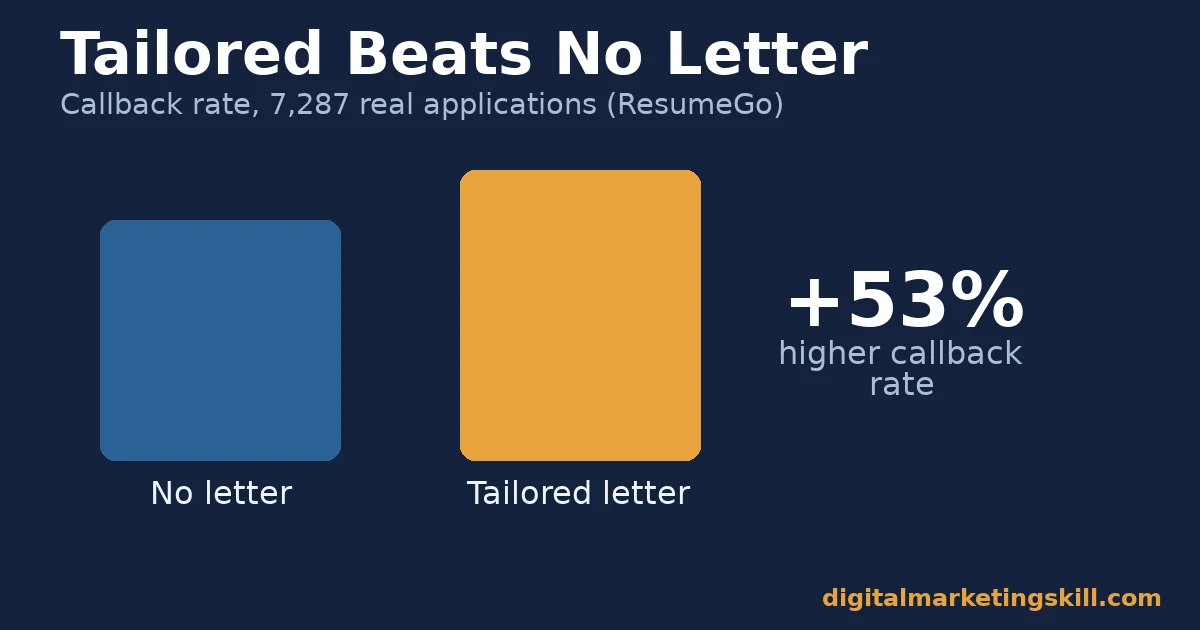
- In a controlled study that sent 7,287 applications to real job postings, tailored cover letters earned a 53% higher callback rate than applying with no cover letter at all (ResumeGo).
- 58% of hiring managers say they have received an AI-generated resume or cover letter from a candidate (Resume Genius Hiring Insights Report, 1,500 US hiring managers).
In this guide
- The Digital Marketing Cover Letter Gap
- How a Digital Marketing Cover Letter Actually Gets Read
- What Differs by Career Stage
- How To Lead With Each Stage, Not Default to a Template
- Measuring Whether Your Cover Letter Is Working
- The One Decision Rule
- A Real Case: 7,287 Applications, Three Letter Types
- Frequently Asked Questions About Digital Marketing Cover Letter
- Turn Your Cover Letter Into a Repeatable Skill
The Digital Marketing Cover Letter Gap
Most advice treats a cover letter as a formatting exercise. Three paragraphs, a greeting, a sign-off. That misses the real question a hiring manager is asking. Does this person understand the role, and can they prove it quickly?
This is a snapshot of current hiring survey data, not a universal rule. Some recruiters skim cover letters in seconds. Others, per Resume Genius’s own data, read them before the resume. Treat every figure here as a signal, not a guarantee.
The real gap: most cover letters restate the resume in sentence form. A digital marketing cover letter that works does the opposite. It picks one or two things the resume cannot show, like reasoning or fit, and proves them directly.
A well-built digital marketing cover letter also does something a resume structurally cannot: it carries a voice. Two candidates with near-identical resumes can read completely differently once their cover letters sit side by side, because tone and judgment show up in prose in a way a bulleted list never captures.
That difference sounds small on paper. In practice, it is why some letters get read in full. Others get skimmed and dropped within seconds.
The gap matters more in digital marketing specifically than in some other fields. The role itself is about proving you can communicate and persuade with limited space and limited attention. A cover letter that restates a resume fails the exact skill the job is asking you to demonstrate.
How a Digital Marketing Cover Letter Actually Gets Read
A cover letter passes through three checkpoints before it changes a hiring decision.
The Keyword Pass
Some applicant tracking systems scan cover letter text alongside the resume, the same mechanism Jobscan’s own scanner is built to test. Matching the exact job title and two or three core skills from the listing helps a letter clear this first filter, the same way a resume does.
Exact wording matters more than most applicants expect. Jobscan’s State of the Job Search report, based on a survey of 442 job seekers and 2.5 million tracked applications, found a 10.6x higher interview rate when a resume’s job title matched the listing exactly. The same exact-match logic applies to a cover letter’s opening line.
This step is mechanical, not persuasive. It decides whether a human ever sees the letter. Skipping it to focus purely on tone is a common, avoidable mistake. Clearing it only earns the letter a chance to be read.
Not every company’s system scans the letter text itself. Some only scan the resume and treat the letter as a separate, unparsed attachment. You rarely know which setup a given employer uses. Matching the listing’s language in both documents costs little, and it protects against either case.
Then the Human Skim
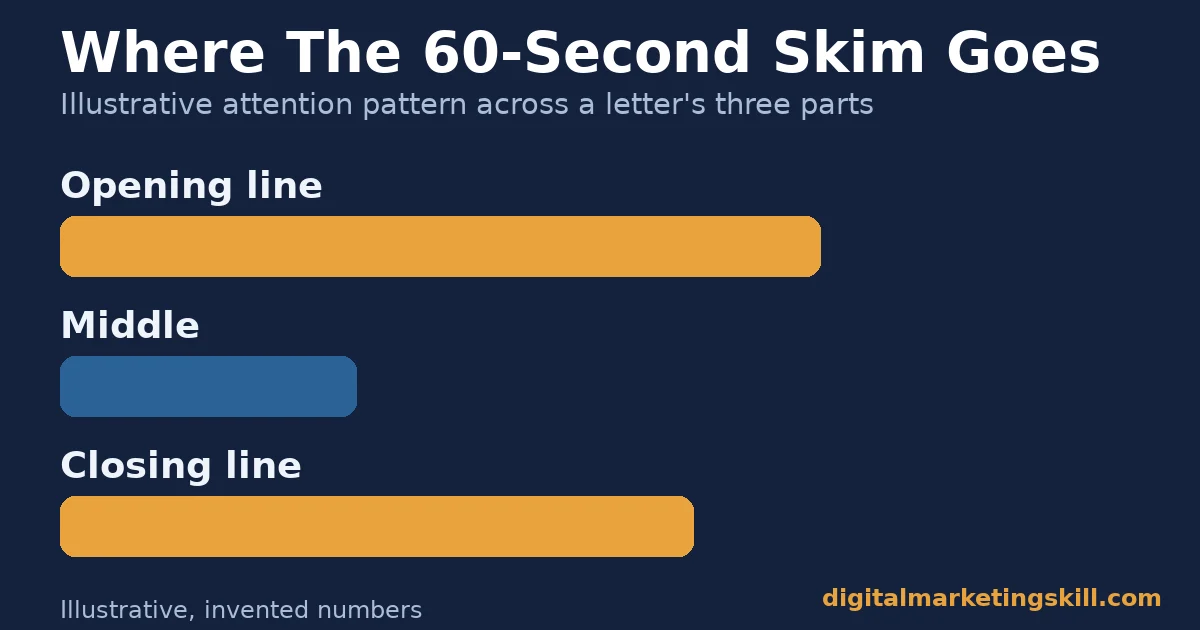
Hiring managers who read cover letters spend roughly 30 to 60 seconds on a first pass. In that window, they scan the opening line and the closing line, not every sentence in order. A weak opening line costs you most of that window.
The middle paragraph matters too, but it earns a different kind of attention. If the opening line holds, the middle comes next. That is where a hiring manager checks whether your claim is backed by something specific, and a vague paragraph here can undo a strong opening within a sentence or two.
Then the Decision Weight
The letter rarely decides alone, but it carries real weight. Resume Genius’s survey found 49% of hiring managers say a strong letter can push a weak application into an interview. 18% say a weak one can sink a strong candidate. Neither number is neutral.
Put together, those two figures describe a letter that cuts both ways. It is not a safe, low-stakes formality that can only help a little. A genuinely weak letter actively works against an otherwise competitive application almost one time in five.
That risk is also the reason a blank or copy-pasted letter can be worse than no letter at all. A missing letter reads as neutral. Sending a careless one sends a signal.
What Differs by Career Stage
A digital marketing cover letter has a different job depending on who is writing it. The same template for every stage wastes its best use.
Entry-Level: Built For Proof of Initiative
With little paid experience to list, the letter’s job is proof you can learn and act without being told. A real campaign you ran for a club, a small business or your own project counts more here than a credential.
A self-initiated project proves something a credential cannot. It shows you started something without being assigned to it. That is exactly the trait most entry-level job descriptions describe as “self-starter,” without ever explaining how to prove it. A digital marketing cover letter that names a real, specific project does that proving for you.
If no single project stands out, combine two or three small ones into a short narrative. A narrative with a beginning, an action and a result reads as more deliberate than a list. This holds even when the underlying work is modest.
Career Changers: Built For the Bridge
A resume alone often cannot explain why a project manager is applying for a social media role. The letter is where you draw that line yourself, in plain language, before a hiring manager has to guess at it.
Left unexplained, that gap reads as a mystery. A hiring manager who has to solve it usually just moves on to the next application instead.
Experienced Marketers: Built For Results
Past a certain point, the resume already proves competence. The letter’s job shifts to proving fit and judgment. Why this company, this role, this moment, backed by one specific result that matches what the listing asks for.
Generic enthusiasm reads as weaker, not stronger, at this stage. An experienced candidate who cannot explain why this specific role fits raises a quiet question about judgment. That question stands even when the resume itself is strong.
How To Lead With Each Stage, Not Default to a Template
Knowing the job of each stage only helps if the opening line reflects it. Here is where to start.
Each stage below gets one opening-line pattern and one small, true example. Swap in your own facts, but keep the structure: a specific claim first, context second.
Entry-Level: Lead With One Real Project
Open with the project, not your excitement about the role. “I grew a student club’s Instagram from 200 to 2,000 followers in a semester” earns more attention than “I am passionate about marketing.” If you do not yet have a project to cite, this guide to landing a first digital marketing job without experience covers how to build one fast.
Career Changers: Lead With the Connection
Name the old role and the new one in the same sentence. Then state the skill that transfers. Hiding the career change rarely works; a hiring manager will see the resume regardless, so naming it yourself controls the framing.
For the fuller transition story, see this guide to transitioning into digital marketing from an unrelated career.
Experienced Marketers: Lead With a Number
Open with the specific result, not the job title. “I took a client’s email list from a 12% to a 28% open rate over six months” tells a hiring manager more in one line than a paragraph of adjectives.
Pick the result that most closely matches what the job listing actually asks for, not simply your proudest achievement. A strong result in the wrong skill area still reads as a mismatch, even when the number itself is impressive.
Measuring Whether Your Cover Letter Is Working
A cover letter is hard to A/B test directly, but these signals still tell you whether it is pulling its weight. Track them the same way you would track any other part of your job search, in a simple log rather than from memory.
Response rate with vs without a letter is the share of applications that get any reply when you send a tailored letter, compared to applications sent without one. ResumeGo’s own data showed a 53% gap between the two.
Interview conversion rate is the share of applications that convert into an interview. If your resume alone already converts well but adding a letter does not move that number, the letter likely needs rework, not removal.
See this guide to a resume that passes both screens if the gap seems to sit there instead.
Time to first response is how many days pass before you hear back. A tailored letter that references something specific and current about the company occasionally speeds this up, since it signals real interest over a mass application.
Log all three numbers for every application where you send a digital marketing cover letter. Do the same for every application where you do not. After 15 to 20 applications split roughly evenly, a pattern usually becomes visible, even without a formal experiment.
Reading the Log Over Time
Over time, this log does more than judge one letter. It shows which roles, industries or company sizes respond best to your current positioning, so later rounds of applications can be more targeted instead of broader. As a result, the log usually becomes more useful the longer you keep it, not less.
The One Decision Rule
Write a fully tailored cover letter for any role you would actually accept. Skip it, or keep it generic, for roles you are only testing. Tailoring takes real time, so spend it where an offer would matter.
Illustrative, invented numbers: imagine applying to 20 roles in a month. A generic letter for all 20 might take two hours total and add little. A tailored letter for the 6 roles you actually want, about 15 minutes each, adds one and a half hours and targets the applications most likely to convert.
The rule scales down as well as up. If you are only applying to two or three roles because they are the only genuine fits available, tailor all of them. The rule is about matching effort to intent, not about hitting a fixed ratio.
A Real Case: 7,287 Applications, Three Letter Types
ResumeGo sent 7,287 real applications to job postings on major job boards. It split them across three groups: no cover letter, a generic one, and one tailored to the specific role. Tailored letters produced a 53% higher callback rate than sending no letter at all.
Its limits matter. The study used fictitious applicant profiles with controlled resumes, not real candidates applying for jobs they wanted. It also covered a wide mix of industries, not marketing specifically.
The gap it found between tailored and untailored effort is still the clearest controlled evidence available on the question.
Treat the 53% figure as directional, not as a number your own results should match exactly. Your callback rate depends heavily on your resume, your target roles and the current hiring demand in your field, none of which the study controlled for.
For digital marketing applicants specifically, the real gap is likely wider still. The role itself asks you to prove you can write persuasively inside real constraints, so a generic letter works against the exact skill you are applying to demonstrate. In short, treat this study as a floor on the value of tailoring a digital marketing cover letter, not a ceiling.
Frequently Asked Questions About Digital Marketing Cover Letter
What Formatting Helps a Digital Marketing Cover Letter?
A plain, single-column format with standard fonts clears both the ATS scan and the human skim. A designed template with columns, icons or graphics works against you here. Save the visual design for a portfolio page. A digital marketing cover letter is read as text first.
This surprises some candidates who assume a marketing role rewards visual flair in every document. The letter’s job is different from a design portfolio’s job, and judging it by the wrong standard is an easy, avoidable error.
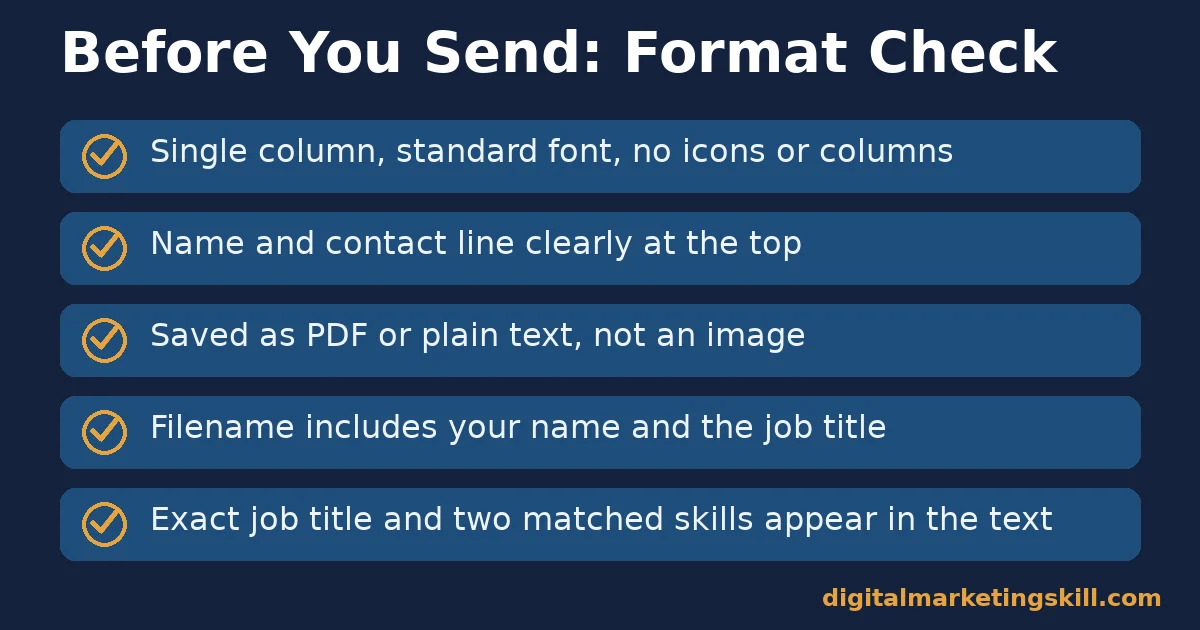
Keep one blank line between paragraphs and a clear name and contact line at the top. Save it as a plain-text file or PDF, not an image, so it stays readable by every system it passes through. A filename with your name and the role, rather than a generic “cover letter final,” also helps a human reviewer sorting through a folder of applications later.
How long should a digital marketing cover letter be?
Short enough to read inside a hiring manager’s first 30 to 60 second skim. Three focused paragraphs, built around one real result or project, beat a longer letter that restates the whole resume. Running a draft through a plain-language tool like Hemingway or a grammar checker like Grammarly catches the over-long sentences and small errors that make a short letter feel longer, or less careful, than it is.
A good test: read the letter out loud in under a minute. If it takes noticeably longer, the letter is too long for the window a hiring manager is actually giving it. Cutting the second-weakest sentence first, rather than trimming every sentence slightly, usually tightens a letter faster than a general edit pass.
Should I use AI to write my cover letter?
Use it to structure a draft, not to invent your experience. 58% of hiring managers say they have already received an AI-generated resume or cover letter, per the Resume Genius Hiring Insights Report, so an unedited AI draft no longer reads as unusual, just unconvincing if the facts inside it are generic. Keep every claim true, and rewrite the draft into your own voice before sending it.
Do I still need a cover letter if the application says it’s optional?
Usually yes. 83% of hiring managers say they read most cover letters even when not required, and nearly half read it before the resume. Skipping it removes a chance to shape the first impression yourself.
What is the biggest mistake in a digital marketing cover letter?
Restating the resume in sentence form. A hiring manager has already seen the resume, or is about to. The letter’s only job is to add something the resume cannot show: reasoning, fit or a short story behind a result.
A close second mistake is leading with the company’s achievements instead of your own. “I admire your growth” says nothing a hiring manager can evaluate.
Should a career changer explain the gap in a digital marketing cover letter?
Yes, briefly and directly. Naming the transition yourself, in one or two sentences, reads as confidence. Avoiding it reads as something to hide, even when there is nothing to hide at all.
Does a cover letter matter more for junior or senior digital marketing roles?
Both, for different reasons. Junior candidates use it to prove initiative without much work history. Senior candidates use it to prove judgment and fit, since their resume has already proven basic competence. The common thread across both stages is the same: the letter proves something specific the resume could not show on its own.
Can a strong cover letter make up for a weak resume?
Partially. 49% of hiring managers say a strong letter can get a weak application an interview. It cannot substitute for missing core skills the role actually requires. It buys you a conversation, not a guarantee.
Should I address a digital marketing cover letter to a specific person?
Yes, whenever you can find a name on the job posting, the company site or LinkedIn. A specific name signals you researched the company. “To Whom It May Concern” signals the opposite, even in a well-written letter. Researching the company this closely pairs well with how recruiters actually decide who to contact on LinkedIn.
Turn Your Cover Letter Into a Repeatable Skill
A strong digital marketing cover letter is a skill you build the same way you build any marketing skill. By practising it on real campaigns, with real feedback, not just reading advice.
Where That Practice Comes From
The Master Diploma in Digital & AI Marketing at Digital Marketing Skill Institute is built around four AI-powered tracks, totalling ten execution-first courses. They are AI-Powered Social Media Management and Advertising, AI-Powered Lead Generation and Email Automation, AI-Powered Google Specialist, and AI-Powered WordPress and SEO Specialist, with a Full Stack option for completing all four.
Every track includes unlimited 1-on-1 coaching and mentoring, so the results you put in your next cover letter are reviewed before you send it. Every track also includes a U.S. Project Internship with a verified U.S. Work Reference Letter, giving you a real result to open with.
The diploma is dual US and UK accredited and recognised in more than 100 countries. The whole program runs 100% online, so you can build this portfolio from anywhere in your country.
See the full curriculum on the Master Diploma program page, read outcomes on the reviews page, or go straight to the application page when you are ready to apply.
Wherever you live, a letter built on a real result is harder to write and far more effective than one built on adjectives. That is exactly the kind of result a structured program at digitalmarketingskill.com is built to produce.
Every figure in this guide was checked against its original source before publication. Figures marked as illustrative are invented examples, not real results.
