
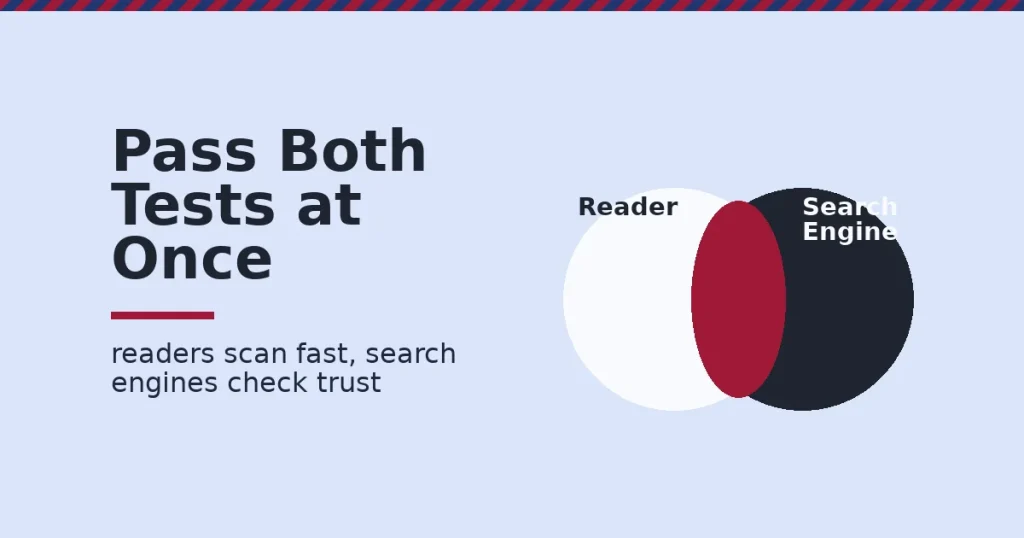
Quality content is not one thing. Readers judge it by whether they can scan it fast and get an answer. Search engines judge quality content by a separate set of helpfulness and trust signals. This guide treats both tests on their own terms, then names the one habit that satisfies both at once.
Key Takeaways
- Readers barely read. Visitors have time to read roughly 20% to 28% of the words on an average page. That is based on a Nielsen Norman Group analysis of 45,237 page views from 25 users, built on research published in the ACM Transactions on the Web.
- Scanning follows a fixed pattern. In a separate Nielsen Norman Group eye-tracking study of 232 users, readers moved across the top of a page, then down the left side, in an F-shaped pattern.
- Trust outranks the other quality signals. Google states plainly that of its E-E-A-T factors, trust is the most important. The others mainly exist to build it.
- Comprehensiveness correlates with rank position. Backlinko’s analysis of 11.8 million search results found that raising a page’s Content Grade score by one point roughly matched moving up one ranking position among the top 30 results.
- Backlinks still decide who climbs highest. In the same study, the number one result averaged 3.8 times more backlinks than positions 2 through 10.
In this guide
- What Most Quality Content Advice Gets Wrong
- How Quality Content Gets Judged, in Practice
- Three Signals That Define Quality Content
- How to Strengthen Each Signal
- The Metrics That Actually Show Quality Content
- The One Rule for Prioritizing Quality Content Fixes
- A Real Case: What 11.8 Million Search Results Showed About Quality Content
- Frequently Asked Questions About Quality Content
- Build Quality Content, Then Build the Skill to Repeat It
What Most Quality Content Advice Gets Wrong
Most checklists for quality content mix two different audiences into one list: clear, concise, credible, original, well-formatted. The problem is simple. Readers and search engines run different tests, and a single checklist hides which one you are failing.
A checklist also hides the order of operations. Fixing the wrong test first wastes effort. A page with a brilliant opening but no sourcing will still fail a trust check. A page with perfect sourcing but a buried answer will still lose most of its readers in the first screen.
The fix is not a longer checklist. Name which test a page is failing, then apply the matching fix below.
Quality improvements still pay off. In Semrush’s own content marketing research, 79% of surveyed businesses reported an increase in content quality after adopting better writing tools. That gain only shows up, though, once you know which test you are improving.
A reader decides in seconds whether your page is worth scanning further. A search engine decides, often weeks later, whether your page is worth ranking above a competitor’s. Optimizing only for one test can quietly fail the other.
So this guide splits quality content into two jobs: passing the reader’s scan, and passing the search engine’s helpfulness and trust test. Each needs its own fix. Only one habit, genuine topical depth, moves both at once. If you are starting from a blank page, see how to approach content creation before you write a word.
How Quality Content Gets Judged, in Practice
A reader’s test happens almost instantly. With roughly 20-28% of a page’s words actually read, your headline, opening sentence and subheadings carry most of the weight. Everything below the fold competes for a shrinking share of attention.
Readers also scan in a predictable shape. The original F-pattern eye-tracking research found people read across the top, then drop down the left edge scanning for the next useful phrase. Content that front-loads the key point in each section survives that pattern. Content that saves the point for the end does not.
A search engine’s test is slower and different. Google’s own self-assessment asks whether a page offers original analysis, whether it would be worth bookmarking, and whether someone researching the site would see it as a trusted authority. None of those questions reward keyword density or format tricks.
Underneath that self-assessment sits E-E-A-T: experience, expertise, authoritativeness and trust. Google is explicit that trust matters most, and that the other three factors mainly exist to build it. A page can be well-written and still fail this test if nothing in it is verifiably accurate or sourced.
These two tests rarely move together. A page can hold a reader’s attention through confident tone and strong formatting while still containing a factual error a search engine’s helpfulness check would flag. Equally, a thoroughly sourced page can lose most visitors in the first screen if its opening buries the answer. Quality content, in practice, means passing both tests at once, not picking the easier one.
Three Signals That Define Quality Content
The “experience” part of E-E-A-T adds a third dimension beyond expertise and trust. Google’s guidance distinguishes a writer who has actually used a product or done a task from one who only researched it secondhand. A page that shows specific, first-hand detail, a real number, a real screenshot, a real outcome, signals experience in a way generic advice cannot fake.
None of the three signals below is optional. Each one fails a different kind of visitor, human or algorithm. Treat them as three separate checks on every page, not as interchangeable proxies for one idea of quality.
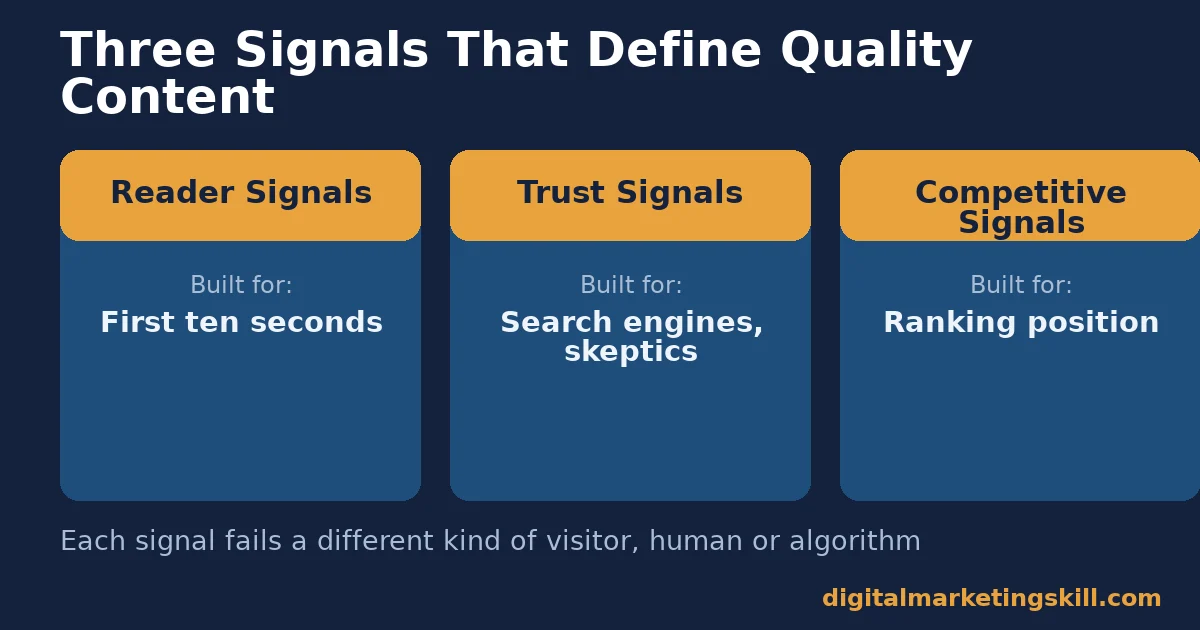
Reader Signals: Built For the First Ten Seconds
Reader signals include time on page, scroll depth and whether someone finishes a section. They are fast, cheap to measure, and honest about your opening. Most analytics tools already track them, so the barrier to using reader signals is rarely the data; it is remembering to check it regularly.
The blind spot is that reader signals say nothing about accuracy. A page can hold attention with a confident tone and still contain outdated or incorrect information. Reader signals tell you whether people stayed, not whether what they read was true. A high-scrolling page can still be wrong; a well-sourced page can still lose everyone before paragraph two.
Trust Signals: Built For Search Engines and Skeptics
Trust signals include sourcing, author expertise, factual accuracy and whether claims can be verified. These are what Google’s self-assessment and E-E-A-T guidance test directly. Unlike reader signals, trust signals rarely show up in a dashboard; they have to be judged by reading the page itself with a skeptical eye.
The blind spot is that trust signals alone do not guarantee anyone reads far enough to notice them. A meticulously sourced page with a weak opening can still lose most of its visitors in the first screen. A great source buried on paragraph nine helps nobody who left on paragraph two. Move the strongest source closer to the top, even if that means restructuring the piece around it.
Competitive Signals: Built For Ranking Position
Competitive signals compare your page against what already ranks: topical comprehensiveness, structure, and the backlinks pointing at it. Backlinko’s research ties both comprehensiveness and backlinks to rank position. Unlike the other two signals, you cannot judge a competitive signal by looking at your own page alone; it only makes sense next to a competitor’s.
The blind spot is that competitive signals are relative, not absolute. A page can be objectively good and still rank low if competitors cover the topic more completely, or hold far more referring links. Quality here is a moving target, set by whoever ranks above you right now.
Revisit the comparison every few months. A page that led its topic a year ago can quietly fall behind without a single word changing.
How to Strengthen Each Signal
Reader Signals: Lead With the Answer, Then the Structure
Put the direct answer in the first two sentences, before any throat-clearing. Then break the body into short sections. Add a descriptive subheading every 150-250 words, so a scanning reader can find the part that matters to them without reading the rest. Planning each piece against a content calendar also keeps the opening promise consistent across a series.
A common mistake is treating the headline as marketing copy instead of a promise. If the headline claims more than the body delivers, scroll depth drops fast, because readers notice the gap within the first paragraph and leave. Test the headline against the opening sentence before publishing: if they do not match, rewrite one of them.
Trust Signals: Lead With Named, Checkable Sources
Attribute every statistic to a named source a reader could verify themselves, including its sample size or scope where available. Avoid vague claims like “studies show,” since Google’s self-assessment explicitly checks whether content is written by someone who demonstrably knows the topic.
The same discipline applies to creating engaging content; engagement built on an unverifiable claim rarely survives scrutiny. When a figure comes from a survey, name the sample size and who ran it. Readers and reviewers both trust a number they can trace.
Competitive Signals: Lead With Topic Coverage, Then Links
Before publishing, list every subtopic a thorough answer should cover. Check your draft against that list. A recurring content audit is the easiest way to find gaps in older pages. Comprehensiveness is the lever you control directly. Backlinks arrive later, earned by content worth citing.
A second mistake is treating comprehensiveness as length. A page can be long and still miss the subtopics that matter most, while a tighter page that covers every relevant angle can outrank it. Coverage, not word count, is the signal worth chasing. Build the subtopic list from what already ranks for the query, not from guesswork.
The Metrics That Actually Show Quality Content
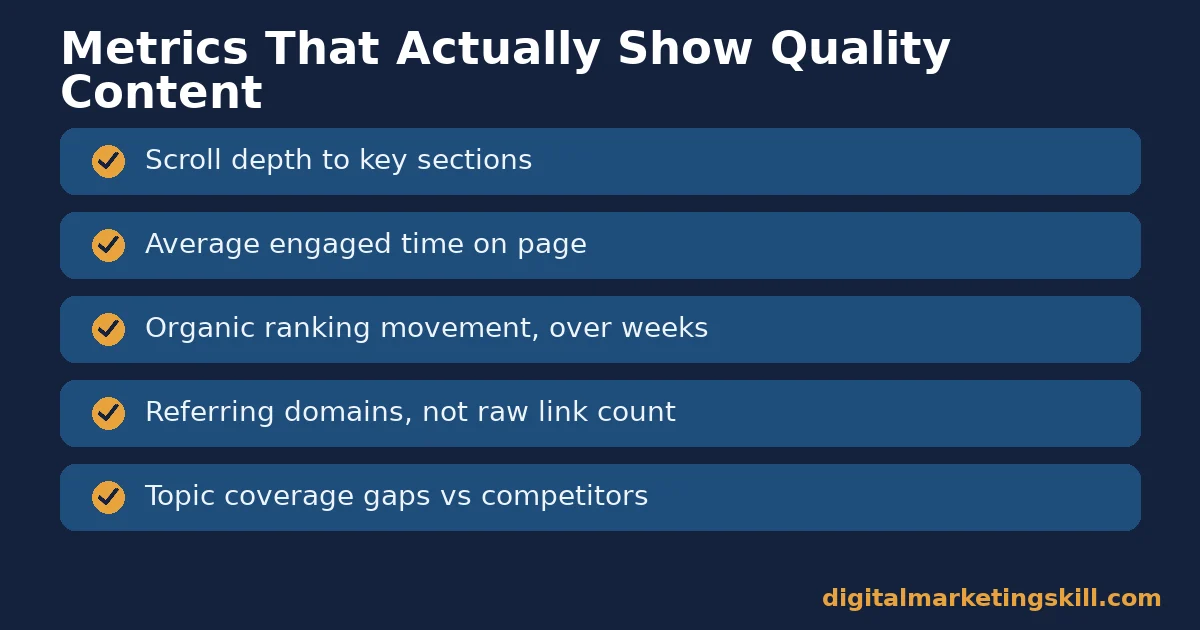
- Scroll depth: the percentage of visitors who reach key sections, such as the middle and the conclusion. A steep drop near the top flags a weak opening, not a weak topic.
- Average engaged time: time spent actively on the page, not just time the tab stayed open, as defined in Google Analytics’ engagement metrics documentation. Compare it to your own page’s past average, not a generic benchmark.
- Organic ranking movement: position changes for your target query over weeks, not days. Short-term swings are normal and rarely meaningful.
- Referring domains: the number of distinct sites linking to the page, not the raw link count. Multiple domains signal broader trust than many links from one source.
- Topic coverage gaps: subtopics competitors cover that your page does not. Close the largest gaps first, since they are the easiest wins.
Read scroll depth and engaged time together first. A page with strong engaged time but shallow scroll depth usually has a weak structure, not weak content. Fix the subheadings before you rewrite the body.
Track all five metrics on a fixed schedule, not just after a rewrite. A single snapshot tells you where a page stands; a repeated check tells you whether your quality content habit is actually working over time.
Pick one metric from each family, reader and competitive, and review both every month. A page that improves on one but stalls on the other still has unfinished work, even if the overall traffic trend looks encouraging.
The One Rule for Prioritizing Quality Content Fixes
If a page is new, fix reader signals first: the opening, the structure, the scan path. If a page is established but stuck in rankings, fix competitive signals first: topic coverage and referring domains.
The reasoning is simple. A new page has no ranking history to defend, so the immediate risk is visitors bouncing before they read anything useful. An established page has already proven it can hold some attention. Its ceiling is usually set by what it is missing compared to competitors, not by its opening paragraph.
Illustrative, invented example: picture two pages targeting the same topic. Page A is brand new with no traffic history. A confusing opening would lose most visitors before any ranking signal could even form.
Page B, meanwhile, has ranked steadily for a long stretch but stalled at position 8. For Page B, closing a topic gap competitors cover is more likely to move the needle than rewriting its introduction again.
This rule is not permanent for either page. Once Page A earns steady traffic, its next ceiling becomes competitive, not reader-facing. Once Page B closes its topic gaps, a refreshed opening can still squeeze out a few more engaged readers. Revisit the rule every few months instead of applying it once and moving on.
A Real Case: What 11.8 Million Search Results Showed About Quality Content
Keep a simple log for each page: the date checked, scroll depth, engaged time and ranking position. A log turns a vague feeling that a page “needs work” into a defensible reason to act.
Backlinko’s analysis of 11.8 million Google search results tested several popular assumptions about quality content at once. Word count was one of them. The average top-10 result ran 1,447 words, but the study found no direct relationship between word count alone and ranking position.
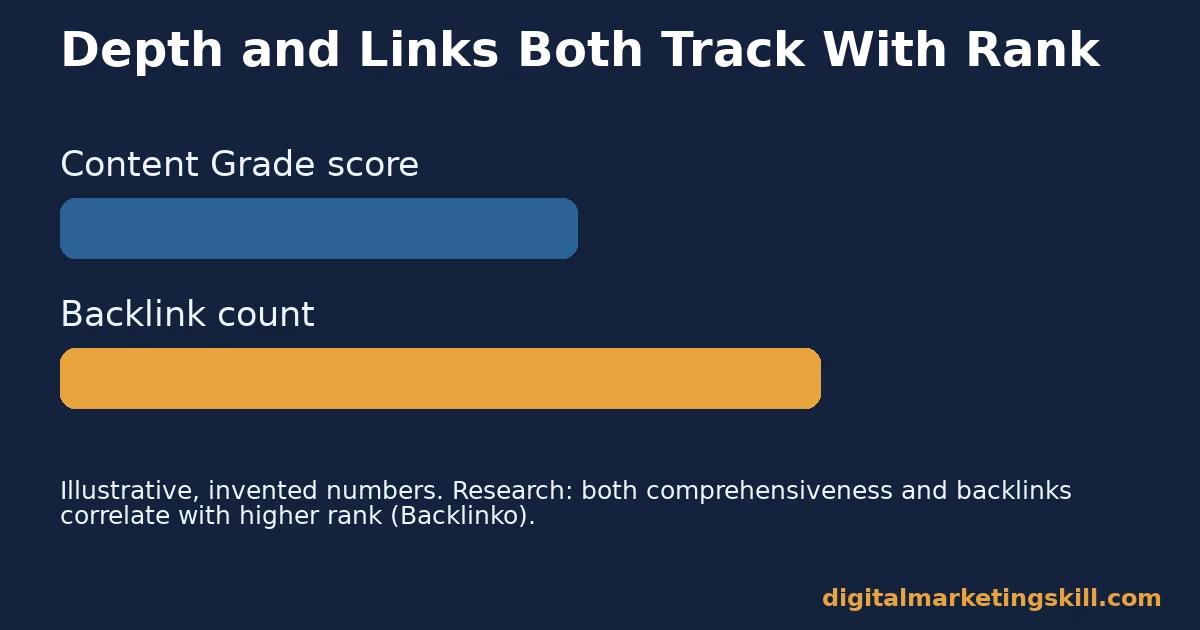
Comprehensiveness measured differently told a clearer story. Using a third-party Content Grade score for topical depth, each one-point increase in that score roughly matched a one-position improvement among the top 30 results. That is a meaningfully strong pattern.
A Content Grade score compares a page’s topic coverage against pages already ranking for the same query, not a fixed checklist. That is why comprehensiveness is relative.
Backlinks mattered even more for climbing within page one. The number one result averaged 3.8 times more backlinks than the results in positions two through ten. Pages linked from more distinct domains also outperformed pages with many links from one source.
Limits worth stating plainly: this is a correlational study of search results, not a controlled experiment. It cannot prove that adding links or depth to any single page will produce the same lift. Treat the patterns as a planning guide, not a formula.
So track comprehensiveness and backlinks separately. A topic gap can close this week; referring domains take longer.
Frequently Asked Questions About Quality Content
What makes content high quality to Google specifically?
Google judges quality content through its people-first self-assessment and E-E-A-T guidance. It asks whether a page offers original analysis, whether it would be worth bookmarking, and whether the site would be seen as a trusted authority by someone who researched it. Trust is the factor Google calls most important.
How long should quality content be?
There is no required length. Backlinko’s 11.8-million-result study found no direct relationship between word count and ranking, even though the average top-10 result ran about 1,447 words. Write enough to cover the topic completely, then stop.
Do readers actually read the whole page?
Rarely. Research based on 45,237 page views found visitors have time to read only about 20-28% of a page’s words during an average visit. Front-load the answer and use scannable subheadings, so the part they do read carries the point.
Is quality content the same as comprehensive content?
Comprehensiveness is one part of quality content, not the whole of it. A page can cover a topic thoroughly and still fail the reader’s test with a weak opening, or fail the trust test with unverifiable claims. All three signals, reader, trust and competitive, need attention.
Do backlinks matter more than content quality?
They measure different things. Comprehensive content correlates with reaching the first page in Backlinko’s study, while backlinks correlate more strongly with climbing to the very top positions within it. Neither replaces the other.
How do I check my content’s quality before publishing?
Run it against Google’s own self-assessment questions. Is it original? Would you bookmark it? Does it avoid easily-verified factual errors? Is it written by someone who demonstrably knows the topic? Then check scroll depth and engaged time after publishing to see how readers actually respond.
Why does quality content sometimes rank lower than shorter, weaker pages?
Usually because the weaker page has more referring domains pointing at it. Backlinko’s research found backlinks correlate more strongly with top rankings than content depth alone. A thorough page without links can still lose to a thinner page with stronger trust signals built over time.
Can AI-written content be quality content?
It can, if it still passes both tests. Google’s guidance judges content by whether it is helpful and trustworthy, not by how it was produced. The risk with AI drafts is generic phrasing that skips the first-hand detail that signals real experience, so edit for specifics before publishing.
Build Quality Content, Then Build the Skill to Repeat It
Passing both the reader’s test and the search engine’s test consistently takes practice, not luck. The Digital Marketing Skill Institute’s Master Diploma in Digital & AI Marketing is built from four AI-powered tracks, totaling ten execution-first courses: AI-Powered Social Media Management and Advertising, AI-Powered Lead Generation and Email Automation, AI-Powered Google Specialist, and AI-Powered WordPress and SEO Specialist, with a Full Stack option for learners who complete all four.
The AI-Powered WordPress and SEO Specialist track covers exactly this kind of content work: structuring pages for real readers while meeting search engines’ helpfulness and trust standards. Every track includes unlimited one-on-one coaching and mentoring, a U.S. Project Internship with a verified U.S. Work Reference Letter, and dual US and UK accreditation recognised in more than 100 countries.
You can apply from anywhere in your country and study 100% online. Start with the digital marketing blog for more practical guides, browse real outcomes on the reviews page, or go straight to the Master Diploma program page to see the full curriculum.
Wherever you live in your country, you can apply at digitalmarketingskill.com/apply/. Learn more about the institute at https://digitalmarketingskill.com/, or start again any time from https://digitalmarketingskill.com/.
Every figure in this guide was checked against its original source before publication. Figures marked as illustrative are invented examples, not real results.
