
Create shareable content by designing for one reaction, not many. A reader has to feel something strong enough to pass it on. Research on nearly 7,000 published articles found high-arousal emotions like awe drive far more sharing than calm positivity. Format and headline matter, but the emotional trigger decides whether anyone shares.
This guide names that trigger directly. It draws on the data named throughout, not vague “best practice” advice, from the Digital Marketing Skill Institute.
Key Takeaways
- High-arousal emotions such as awe, anger, or anxiety drive far more sharing than calm positivity alone. This is per Wharton research on nearly 7,000 articles.
- Headlines of about 11 words and 65 characters perform best. Instructional headlines now outperform explicitly emotional ones, according to BuzzSumo’s analysis of 100 million headlines.
- Consumers are 2.4 times more likely to call user-generated content authentic than brand-created content. 93% say UGC is very helpful when deciding what to buy, per EveryoneSocial’s research summary.
- A single well-targeted listicle can draw hundreds of thousands of shares. That scale is the exception, not the baseline. Judge your own content against its own past results, not a viral outlier.
- To create shareable content consistently, you need a repeatable system, not a lucky post. The fixes below build exactly that system.
In this guide
- The Gap Most Shareability Advice Ignores
- Why People Actually Share Content
- What Differs Across Shareable Content
- How To Create Shareable Content
- Common Mistakes That Block Shareable Content
- Measuring Whether Content Is Actually Shareable
- The One Decision Rule For Shareable Content
- A Real Case: One Listicle, Hundreds of Thousands of Shares
- Frequently Asked Questions About How to Create Shareable Content
- Your Next Step
The Gap Most Shareability Advice Ignores
Most “how to go viral” lists hand you a format checklist: post a listicle, add an image, use a meme. None of that explains why one listicle spreads and a near-identical one does not. The real answer sits underneath the format, in the specific emotion the content triggers.
For example, two brands can publish nearly identical how-to guides on the same topic, in the same format, on the same day. One gets shared widely; the other barely moves. The difference usually is not quality. It is that one piece gave readers a clear, nameable reason to pass it along, and the other did not, even with equally solid research behind both.
Two ground rules apply before the data. These are patterns from large datasets, not a guarantee for any single post. “What gets shared” also shifts as platforms and audiences change, so treat this as a snapshot of current behavior, not a permanent formula.
So before copying any format below, spend a minute naming your own audience’s specific identity signal. A finance audience shares content that signals competence. A parenting audience often shares content that signals empathy. The format matters less than matching it to what your specific readers want to say about themselves to their own friends and colleagues.
Why People Actually Share Content
Sharing is a social act, not just a reaction to good content. When someone shares a post, they tell their own network something about themselves. It says they are informed, funny, caring, or in the know. The content is just a prop for that signal.
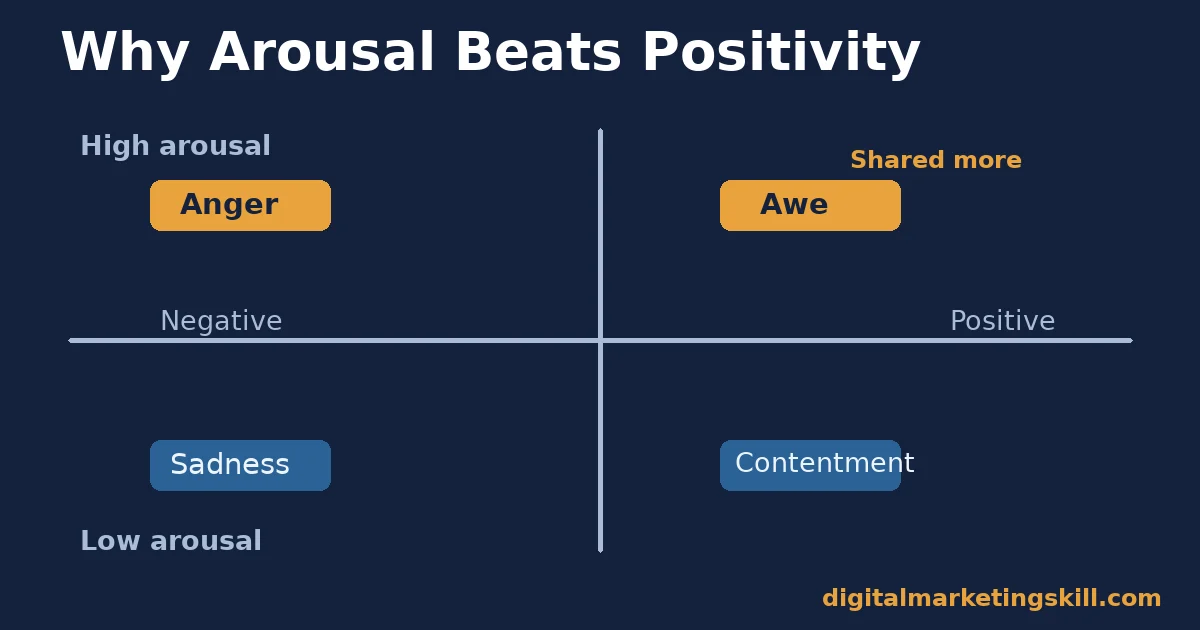
That is why emotional intensity matters more than emotional positivity. Wharton researchers Jonah Berger and Katherine Milkman studied nearly 7,000 New York Times articles. High-arousal emotions, awe, anger, and anxiety, predicted more sharing than low-arousal emotions like sadness. That held even after they controlled for how useful or surprising the content was.
In other words, a mildly interesting article will not travel far. An article that makes someone feel something strongly, in either direction, has a real shot.
The Self-Presentation Layer Behind Every Share
Psychologists call this self-presentation: people curate what they share the same way they curate what they wear or say out loud. A sarcastic meme signals wit, a heartfelt story signals empathy, and a data-backed guide signals expertise.
When you create shareable content, you are really creating a tool other people can use to say something about themselves. Content that offers no clear identity signal, that is neither funny, useful, nor moving, gives people nothing to say by sharing it, so it quietly gets scrolled past.
What Differs Across Shareable Content
Five elements decide whether people create shareable content or content that quietly sits unseen. Each one is built around a different trigger, so each needs a different fix, and skipping one usually caps how far an otherwise strong piece can travel.
Headlines: Built For Curiosity, Not Just Clicks
A headline’s job is to signal the emotional payoff inside, not to describe the topic. BuzzSumo’s headline analysis found that instructional phrasing now outperforms explicitly emotional phrasing. That is a shift from a few years earlier, when sensational headlines dominated.
Emotion: Built For Arousal, Not Just Positivity
Calm, pleasant content underperforms because it gives the reader no urgency to act. High-arousal emotions push people to act right away, including sharing. Low-arousal emotions like contentment or sadness leave them passive instead.
Format: Built For Fast Scanning, Not Deep Reading
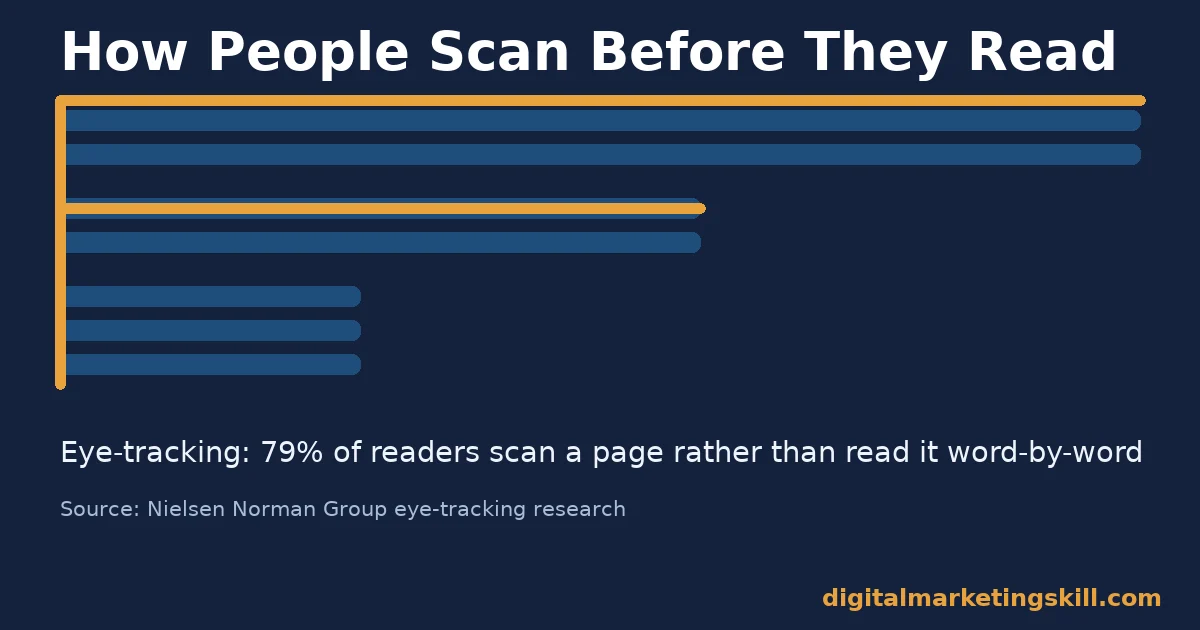
Listicles, infographics, and short videos win because they signal, before a click, how much effort reading them will take. Eye-tracking research from Nielsen Norman Group, based on 232 users, found 79% scan a new page. Only a small share read it word-by-word. A clear, scannable format removes the hesitation that stops a scan from becoming a share.
User-Generated Content: Built For Proof, Not Promotion
Branded claims trigger skepticism by default, because the audience knows the brand is talking its own book. Content made by real customers carries none of that built-in doubt. That is why consumers are 2.4 times more likely to call it authentic than brand-created content, per EveryoneSocial’s research summary.
Story: Built For Connection, Not Promotion
Humans are wired to follow a narrative, not a list of features. A story about one specific person creates a connection a generic benefit statement cannot. When a reader sees themselves in that person’s situation, the content stops feeling like marketing and starts feeling like something worth passing along.
How To Create Shareable Content
Each element above has a mirrored fix. The pattern repeats: design for the specific trigger, not for a generic “good content” standard. Fix the elements in the order they block you, not in the order they are listed here, since one weak link can cap everything else.
Headlines: Lead With a Clear Payoff
Write the headline last, after you know exactly what the piece delivers. Then state that payoff plainly in roughly 11 words. Test one instructional version (“how to,” “the way to”) against one curiosity version before publishing. The better performer depends on your specific audience and topic.
Emotion: Lead With a Specific Feeling
Pick one target emotion before you write a single sentence, instead of aiming vaguely for “engaging.” If the goal is awe, use a real number or result that genuinely surprises. If the goal is useful urgency, name a cost of inaction. A piece built around one clear feeling outperforms one that tries to be everything.
Format: Lead With the Scan, Not the Scroll
Structure the piece so a reader understands its value from headings and visuals alone, before reading a single paragraph. Use numbered lists, short paragraphs, and one visual every few hundred words so skimmers become readers instead of bouncing immediately.
User-Generated Content: Lead With Real Customers, Not Stock Photos
Ask real customers for photos, short videos, or quotes about specific results. Feature them with credit instead of writing a testimonial yourself. A branded UGC campaign built around a simple hashtag or tag-to-enter contest usually beats asking once and hoping. HubSpot’s own UGC research puts the payoff plainly: 79% of people say UGC highly impacts their purchasing decisions.
Story: Lead With One Person, Not a Statistic
Instead of opening with an industry statistic, open with a single person’s situation: what they struggled with, what they tried, and what changed. Keep the statistic for the middle of the piece, where it backs up the story instead of replacing it. A reader remembers a person long after they forget a percentage.
Common Mistakes That Block Shareable Content
A few recurring mistakes quietly cap how far content can spread, even when every tactic above is applied correctly elsewhere. Fixing these does not require a bigger budget, just a sharper, more honest review pass before anything ships, which is often the fastest, cheapest way to create shareable content from material your team already has sitting on hand.
Trying to Trigger Every Emotion at Once
Content that tries to be funny, moving, and informative in one post usually lands none of the three. Pick one target emotion and let the rest of the piece support it, rather than compete with it. A secondary tone can still exist, but only one should lead.
Publishing Text-Only Content on Visual-First Platforms
A strong idea with no supporting image or video gets scrolled past on platforms built around visuals. Pair every key point with a visual that reinforces it, not a generic stock photo that adds nothing. This single fix alone helps a surprising amount when teams try to create shareable content on a tight deadline.
Burying the Share Prompt
Even content people genuinely enjoy often goes unshared simply because sharing never occurred to them. A short, direct prompt near the end, “share this with someone who needs it”, measurably increases share rate at almost no cost. Place the prompt where a reader naturally pauses, right after the payoff, not buried below unrelated links.
Measuring Whether Content Is Actually Shareable
Track a short list of numbers instead of just watching follower counts climb. Each one tells you something different about whether content is truly spreading on its own.
Choosing the Right Shareability KPI
Which number matters most depends on what you are optimizing for, not on which one is easiest to screenshot. A reach goal leans on share rate and amplification rate. An authority goal leans on earned backlinks. A community goal leans on save rate and direct replies, since those show people engaging quietly rather than broadcasting.
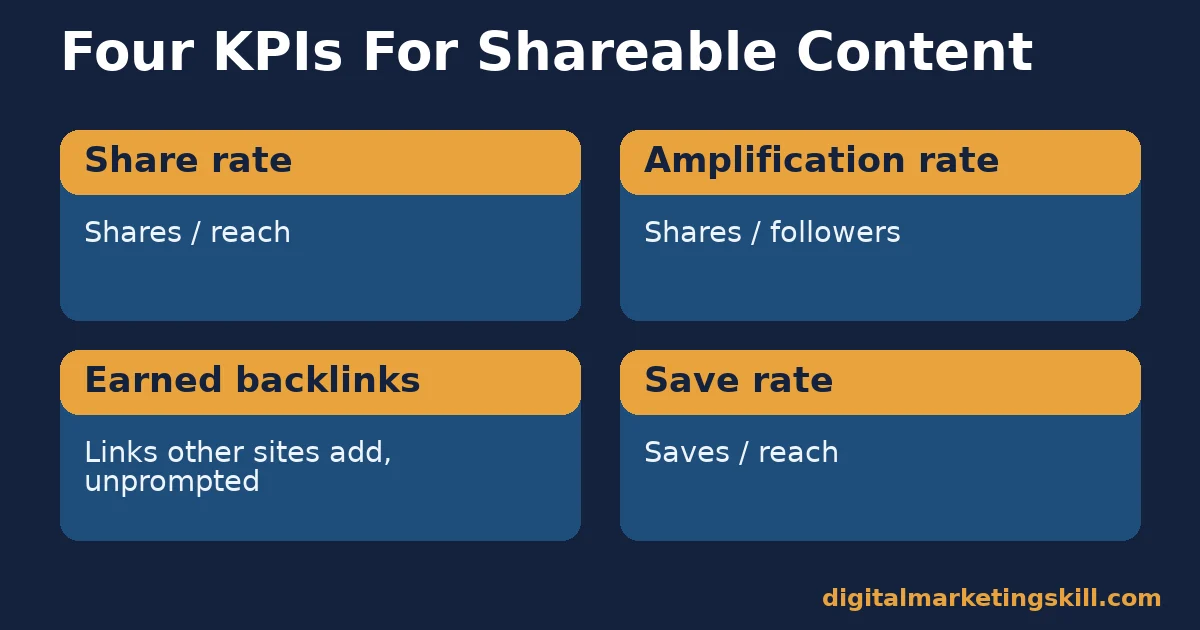
- Share rate is shares divided by reach. It is the most direct signal that people found the content worth passing on, not just worth a quick like.
- Amplification rate is shares divided by total followers. Rising amplification with a flat follower count means existing fans are doing more of your distribution for you.
- Earned backlinks are links other sites choose to add to your content, unprompted. This is the clearest sign your content was useful enough that someone referenced it as a source.
- Save rate is saves divided by reach. A high save rate with a lower share rate usually means content is useful for later, not for showing off. That still signals real value.
Where Shares Actually Happen
Typical users actively use roughly 6.5 social platforms a month, per GWI data cited by DataReportal, which means a single piece of content rarely spreads on just one app. Track share rate per platform separately rather than as one blended number, since a format that shares well on one network can underperform on another built around different content.
The One Decision Rule For Shareable Content
Decision rule: before publishing, name the single emotion the piece centers on, in one word. If nobody can name it, the piece is not ready. It needs a sharper angle, not a better headline.
Run this check out loud in a two-minute review, not as a private assumption. If two reviewers name two different emotions, the piece is still unfocused, even if both answers sound reasonable on their own. Settle on one word together before the piece goes any further.
Illustrative, invented example: a team drafts two versions of the same how-to guide. Version A states a surprising number in the opening line and ends with a clear next step. Its target emotion is “useful urgency.” Version B covers the same steps but opens with background history.
Nobody on the team can name Version B’s target emotion in one word. Under the rule, Version A ships. The team rewrites Version B around a clearer emotional hook first.
A Real Case: One Listicle, Hundreds of Thousands of Shares
The New York Times published “52 Places to Go,” a simple numbered travel listicle. It drew roughly 522,000 shares, among the most shared pieces that publication has produced, according to BuzzSumo’s analysis of top-performing content. The format was plain: a number, a clear promise, and one image per destination.
That scale is not typical. It describes one piece from one major publication at one point in time, so treat it as proof that format and simplicity can work at scale, not as a guaranteed result for your own content.
The lesson that transfers is the structure, not the raw share count: a clear number, a specific promise, and one supporting visual per point.
For Contrast: A Guide With No Clear Hook
Illustrative, invented example: imagine a second travel guide covers the same 52 destinations but opens with the history of the travel industry before reaching any destination. It has no single emotional hook and no number in the headline. Even with equal research and photography, it draws a small fraction of the shares, because nothing in it gives a reader a quick reason to pass it on.
Frequently Asked Questions About How to Create Shareable Content
What is the fastest way to create shareable content on a small budget?
Start with user-generated content. It costs little beyond a contest or a request, and it already carries more trust than brand-made content. Pair it with a clear, instructional headline rather than an expensive production budget.
Do I need a large following before content starts getting shared?
No. Share rate is a ratio of shares to reach, so a small account with highly relevant content can post a healthier share rate than a large account posting generic material. Growth usually follows consistent shareability, not the other way around, which is good news for anyone starting from zero.
Does every post need to be emotional to get shared?
No, but it does need a specific, nameable reaction, whether that is surprise, usefulness, or recognition. Flat, purely informational posts with no emotional angle are the ones that tend to sit unshared.
How to create shareable content on Facebook specifically?
Lead with a strong image or short video, since visual formats stop the scroll faster than text alone. Keep the caption short, name the payoff in the first line, and add a clear prompt to comment or share.
How to create savable content people return to later?
Build content around a checklist, a reference guide, or a framework someone will want again, not a one-time read. Clear formatting and a strong visual summary make saved content easy to find and reuse later.
Why does some content stop getting shared even if it used to perform well?
Audience habits and platform algorithms both shift over time. A format that worked well before can quietly stop working, with no warning. Review your own share-rate data regularly instead of assuming an old formula still applies.
Is user-generated content more effective than content a brand makes itself?
It is more trusted, not automatically more effective for every goal. Branded content still has a place for explaining products clearly. UGC consistently outperforms it on authenticity and purchase influence.
What makes infographics shareable when they contain real data?
An infographic spreads when it simplifies a genuinely useful number into one clear visual, with the source named in small text. Infographics that cram in too many statistics at once lose the single clean takeaway that made the format worth sharing.
Can older content be reworked to create shareable content without a full rewrite?
Often, yes. Check whether the piece already has a useful core fact or story buried inside it, then rebuild only the headline, opening line, and one visual around that core. A full rewrite is rarely necessary if the underlying value was always there, waiting for a sharper angle.
Do memes still work to create shareable content, or are they overused?
Memes still work when they connect to a current, genuine shared experience rather than a forced trend. A meme that feels inserted for attention tends to flop. One built around something your specific audience already jokes about tends to land, because it signals that the brand actually pays attention.
How long should shareable content be?
Length matters less than pacing. A short post with no payoff gets ignored as easily as a long one with no structure. Match the length to the format: a quick tip can be one paragraph, while a full guide can run much longer if every section earns its place and keeps the reader moving.
Your Next Step
The Digital Marketing Skill Institute’s Master Diploma in Digital & AI Marketing teaches exactly this: how to create shareable content consistently rather than by luck.
The AI-Powered Social Media Management and Advertising track covers content strategy, platform-specific formats, and paid amplification in depth. It combines with the other three AI-powered tracks through the Full Stack option for a complete, ten-course program covering lead generation, Google, and WordPress and SEO skills as well.
Every track includes unlimited one-on-one coaching and mentoring, a U.S. Project Internship with a verified U.S. Work Reference Letter, and dual US and UK accreditation recognised in more than 100 countries, 100% online. More than 115,384 students have already trained with the Institute. You can join them from anywhere in your country.
Why Feedback Beats a Format Checklist
Instead of guessing which headline or emotion will land, you get direct feedback on your own drafts. Coaches who have already helped other creators learn to create shareable content review your work directly. That feedback loop, not another generic checklist, turns occasional viral luck into a repeatable skill.
Explore the full Master Diploma program, read more student reviews, browse the digital marketing blog for more practical guides, or go straight to the application page to start. Wherever you live, you can start learning to create shareable content on digitalmarketingskill.com, with coaches who review your actual drafts instead of handing you one more generic checklist.
Every figure in this guide was checked against its original source before publication. Figures marked as illustrative are invented examples, not real results.
![9 Amazing Digital Marketing Skills to Make Money Online [With Proof]](https://digitalmarketingskill.com/wp-content/uploads/2019/07/9-Amazing-Digital-Marketing-Skills-to-Make-Money-Online-With-Proof-17.png)






