
A digital nomad visa is a legal permit. It lets a remote worker live in a foreign country while working for an employer or clients based elsewhere. Compare each digital nomad visa by its income rule, its cost, its length, and its tax rule. Then match that profile to your own situation before you apply.
Key Takeaways
- Trackers that publish a clear method count roughly 59 countries with a working digital nomad visa scheme, according to CitizenRemote’s country-by-country audit.
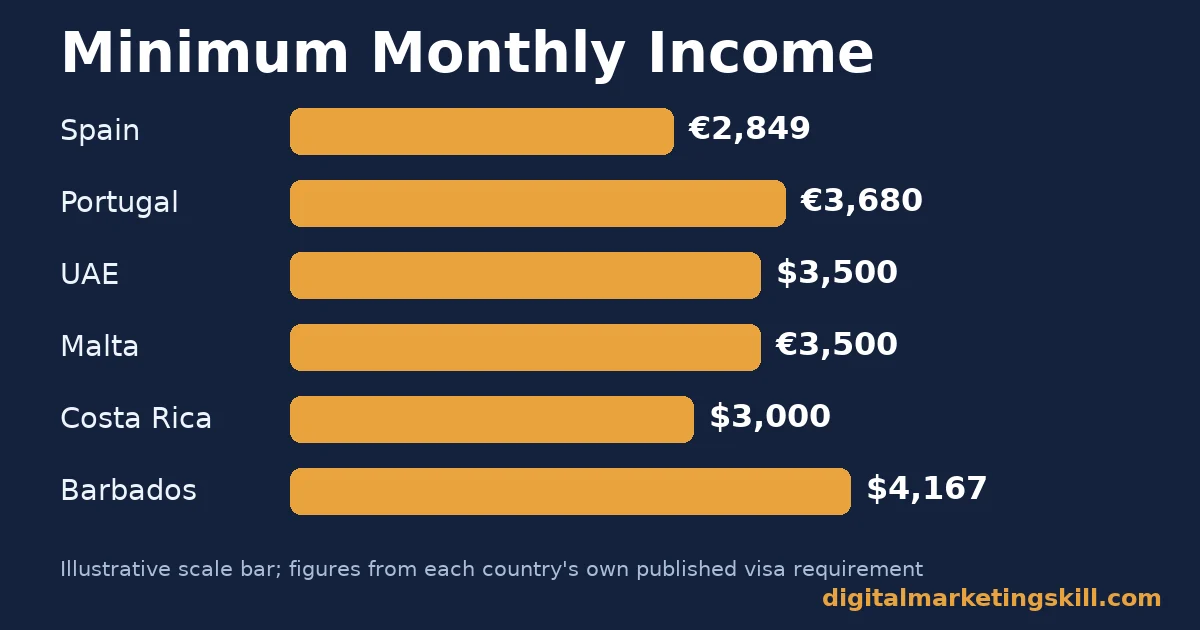
- Minimum income rules range from about €2,849 a month in Spain to $4,000+ a month for a family applying to Costa Rica. “Cheap” and “accessible” are not the same thing.
- Visa length typically runs 12 months and is renewable. Spain’s track can extend to 5 years total. Thailand’s newer visa allows multiple entries across 5 years.
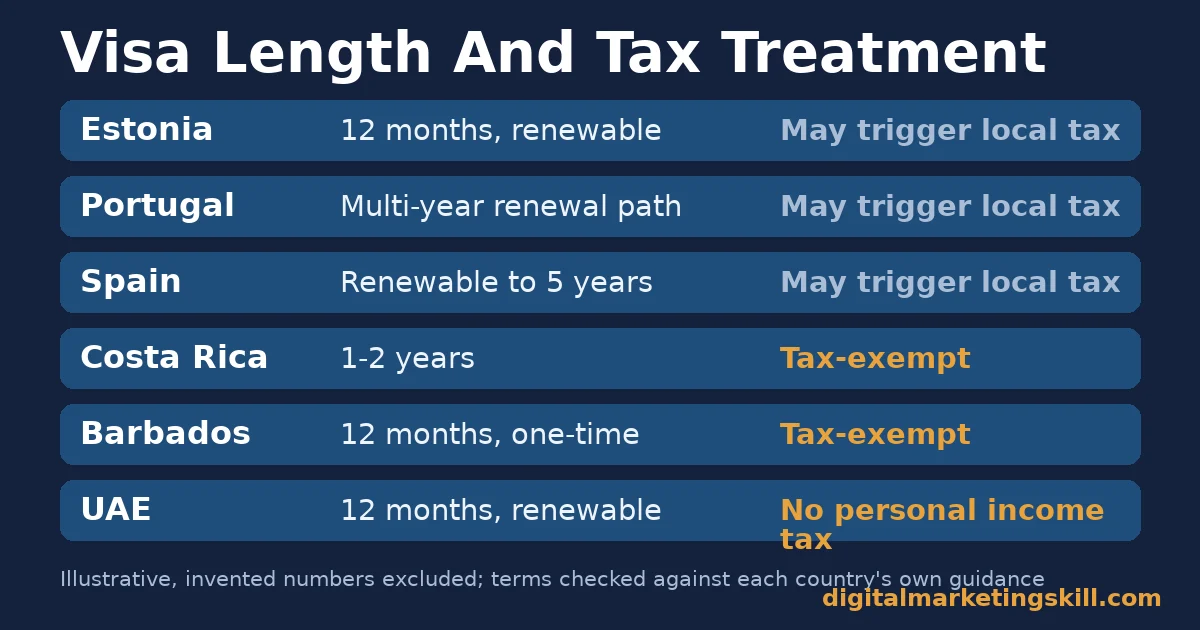
- Tax rules are not uniform. IMI Daily’s tax-residency analysis finds Croatia, Costa Rica, Barbados, Dominica and the UAE either exempt visa income from local tax or already charge no personal income tax. Portugal, Spain and Malta can trigger local tax residency instead.
- Application fees swing from about $100 in Estonia to $2,000 per applicant in Barbados, before health insurance.
In this guide
- Why Most Digital Nomad Visa Searches Stall Out
- How A Digital Nomad Visa Actually Works
- What Differs By Country
- How To Match Your Situation To The Right Visa
- Measuring Whether A Digital Nomad Visa Is Worth It
- The One Decision Rule Worth Writing Down
- Countries Without A Digital Nomad Visa, And What Remote Workers Use Instead
- A Realistic Case, And Its Limits
- A Quick Checklist Before You Apply
- Frequently Asked Questions About Digital Nomad Visas
- Build The Remote Skill Set Before You Book The Flight
Why Most Digital Nomad Visa Searches Stall Out
Here is what usually happens. Someone finds a ranked list of “top digital nomad visa countries.” They pick the prettiest one. They start the paperwork. Three weeks in, they learn their income does not clear the published floor once the exchange rate or the savings add-on is counted. They restart from zero, having lost weeks they did not need to lose.
The gap is not information. It is matching. A digital nomad visa is a filter, not a prize. Pick a visa whose real rules fit your income type, your savings, and your tax comfort. A short filtering pass up front, built around four variables, avoids that whole detour.
Every visa office tests the same three things, just in different amounts: can you support yourself without local work, can you prove it on paper, and will your stay create a tax problem for their government. Treat the figures below as a checked snapshot, not a permanent ranking. Thresholds are usually indexed to local wages and move most years.
How A Digital Nomad Visa Actually Works
A digital nomad visa is its own immigration category. It is separate from a tourist visa. It is separate from a work permit tied to a local employer. Governments built this category because remote workers were already staying on tourist visas and spending money locally, without paying local tax. Officials decided to formalize that arrangement, and in some cases tax it.
Almost every digital nomad visa checklist asks for the same three proofs. First, proof of remote income: a contract, pay stubs, or client invoices showing the work is paid from outside the host country. Second, proof of funds: a bank statement or a savings threshold.
Third, proof of health insurance that meets a minimum coverage amount, commonly $50,000 to $100,000. A clean background check and proof of a place to stay round out most applications. None of these three proofs is optional, no matter how strong the other two look on paper.
A digital nomad visa does not grant everything. You cannot take a local job on it. You cannot bill local clients either. Permanent residency is not automatic. Spain’s version offers a path toward long-term residency after several renewals. Barbados’s Welcome Stamp is the opposite: one year, and it does not renew into residency.
The Application Steps, In Order
The application steps repeat across most countries. First, confirm your income source actually qualifies; a local client or local employer usually disqualifies you, even if the work is done online. Second, gather your proof documents in the exact format the consulate wants. A bank statement in the wrong currency is the most common reason a qualified application stalls.
Third, buy health insurance that names the host country by name and meets its minimum coverage figure. Fourth, submit through the right channel. Some countries require their consulate in your home country; some run an online portal you can file from anywhere. Check this detail before you assume you need to travel to apply. Skipping this check wastes a week that a five-minute search would have saved.
What Differs By Country
Four things decide whether a digital nomad visa is realistic for you: the income floor, the proof method, the fee, and the tax exposure. Here is how three countries test each one differently.
Portugal: Built For Long, Low-Cost Stays
Portugal’s D8 digital nomad visa sets its income floor at four times the national minimum wage. GetGoldenVisa’s published figure puts that at roughly €3,680 a month, plus proof of about €11,040 in savings. The visa suits people who want a multi-year European base. It renews into a residence permit and can lead toward permanent residency over time.
Costa Rica: Built For Fast, Flexible Approval
Costa Rica’s digital nomad visa, as detailed by IMI Daily, asks for $3,000 a month in stable remote income for one person, or $4,000 a month with dependents. That income is exempt from Costa Rican tax for the stay. It is a simpler, faster option for one or two years in Central America.
It sits apart from the country’s separate Rentista visa, which instead asks for $2,500 a month in passive income held in a local bank. The two programs are often confused because both target the same lifestyle, but they test completely different kinds of income.
UAE: Built For Zero Income Tax
The UAE’s Virtual Working Programme, tracked by CitizenRemote, asks for roughly $3,500 a month in income. That sits close to Malta’s published Nomad Residence Permit rule and well below Barbados’s.
The real draw is structural, not a special clause: the UAE charges 0% personal income tax to everyone, visa or not. A digital nomad visa holder there pays no local tax on remote earnings simply because the tax does not exist. No other country on this list removes the tax question quite that cleanly.
How To Match Your Situation To The Right Visa
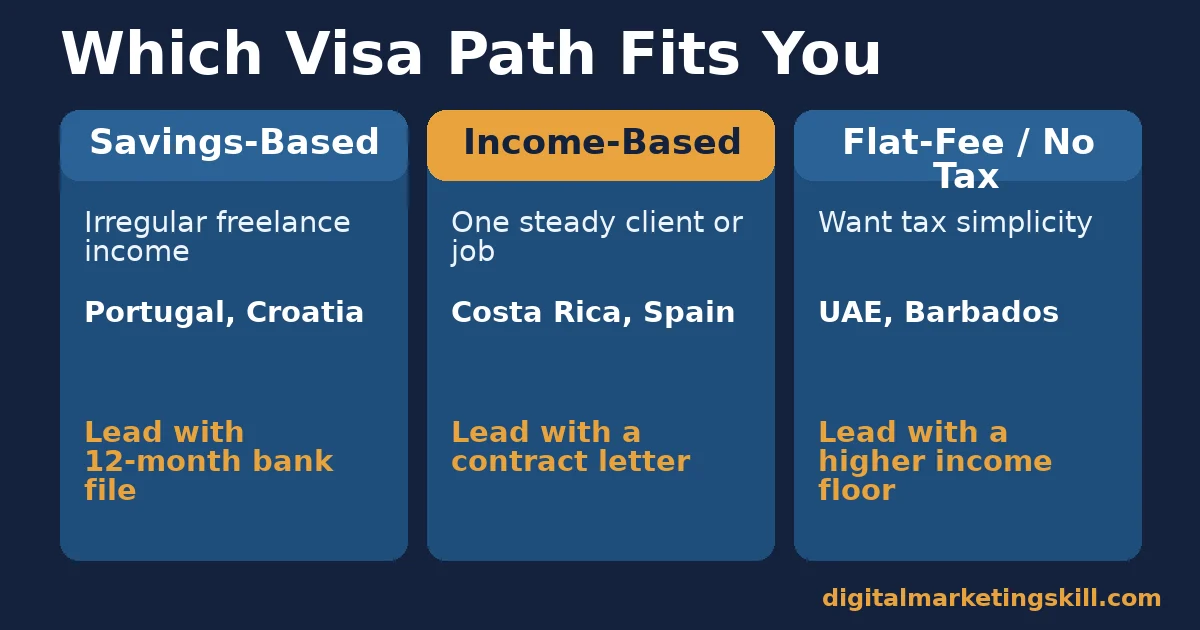
Knowing what differs is half the job. The other half is being honest about which column you fit, then leading your application with the evidence that column needs.
Portugal: Lead With Savings Proof, Not Just Salary
If your income is irregular, month-to-month freelance work, Portugal rewards a different kind of proof. Its combined income-and-savings test favors a steady 12-month bank balance over one glossy contract. Build a simple spreadsheet of the past 12 months’ client payments before you apply. That habit also helps when building trust with freelance clients in general. Portuguese consulates reportedly ask for exactly this kind of paper trail.
Costa Rica: Lead With A Clean Remote-Contract Letter
Costa Rica’s process moves faster for one clear, named income source. A single employer or primary client letter is simpler to verify than ten scattered invoices. If most of your income comes from one retained client, the kind of relationship you build when you land and keep freelance clients on purpose, this is the profile Costa Rica approves quickly.
UAE: Lead With A Higher Income Floor, Not Tax Paperwork
The UAE’s tax benefit is structural, so there is no exemption form to file. The real work is clearing the income floor itself, roughly $3,500 a month, with employer or business documents. Applicants from countries with complex tax treaties often pick the UAE specifically to remove tax filing from the picture.
No single clause grants a special break; the absence of the tax does the work. None of this runs smoothly without the right remote-work tool stack to prove you are actually working while abroad, so set that up first.
Measuring Whether A Digital Nomad Visa Is Worth It
Three numbers tell you more than a country’s reputation ever will.
Effective monthly cost is the one-time fee plus mandatory health insurance, divided by the visa’s length in months. Estonia’s roughly $100 state fee, spread across 12 months, works out to under $10 a month before insurance. Barbados’s $2,000 fee spread the same way is over $166 a month before insurance. Barbados then exempts your income from local tax entirely, which can still make it the better deal.
Net income after local tax is what remains once you subtract any tax the host country charges a visa holder. In Croatia, Costa Rica, Barbados and the UAE, this number equals your gross income, because each exempts visa holders or has no personal income tax.
In Portugal, Spain and Malta, it can run lower once you cross into local tax residency. Get a written answer from a local immigration lawyer before you assume either way. A verbal assurance from a visa agent is not the same as a written tax opinion.
Approval timeline, counted in weeks from a complete application to a decision, moves with consulate workload more than country policy. Treat any published “4 to 8 weeks” estimate as a floor, not a promise.
The One Decision Rule Worth Writing Down
Decision rule: pick the visa whose proof method matches the income you can actually document. Check tax treatment second. Check lifestyle appeal last. A beautiful coastline means nothing if your paperwork gets rejected at the embassy.
Illustrative, invented numbers: a freelance digital marketer earns an irregular $3,800 a month across four clients, with $9,000 in savings. On paper, that clears Portugal’s roughly €3,680 floor and Costa Rica’s $3,000 floor.
But Portugal also wants about €11,040 in savings, which this person does not have. Costa Rica’s test is income-only. In this illustrative case, Costa Rica is the better match right now. Portugal might become realistic later, once savings catch up.
Countries Without A Digital Nomad Visa, And What Remote Workers Use Instead
Not every popular destination has built a dedicated digital nomad visa. Treating every country the same way is a common mistake. Thailand’s Destination Thailand Visa, reported by Afar Magazine, asks for roughly $15,000 in proof of funds and grants multiple entries over 5 years, at 180 days per stay.
Before this program existed, remote workers commonly used Thailand’s standard 60-day tourist visa, extendable once by 30 days, as a workaround. That workaround sits on thinner legal ground than a purpose-built digital nomad visa, because tourist visas were never written with remote income in mind.
Indonesia’s Remote Worker Visa sets a higher income floor, around $60,000 a year, and allows stays of up to 2 years. Before it existed, nomads in Bali commonly used the Visit Visa, good for 60 days and extendable twice by 60 days each.
The same pattern repeats worldwide. Where no digital nomad visa exists, people default to tourist-visa extensions. That default is riskier, not cheaper, because working visibly on a tourist visa can risk a future entry ban.
The Nomad Population Is Growing Faster Than The Rules
Scale matters too. MBO Partners’ Digital Nomads Trends Report counted 18.5 million Americans self-identifying as digital nomads, up 153% from the pre-pandemic baseline. That figure is US-only and self-reported. Only 53% of respondents met the survey’s full criteria for the label.
The honest takeaway is simple: digital nomad visas are not rare. The population applying for them is growing faster than most immigration offices have adapted their rules. That is exactly why terms shift most years, and why a fresh check before you file matters.
A Realistic Case, And Its Limits
Illustrative, invented numbers: a remote social media manager earns $4,200 a month from one US-based retainer client. She applies for Costa Rica’s digital nomad visa with one contract letter, one bank statement, and proof of health insurance. The application clears in nine weeks.
The limits of this example matter. It assumes one stable client relationship, which is not universal among freelancers with multiple, variable clients. It does not reflect how timelines shift during periods of high consulate demand. Treat it as a pattern to test against your own paperwork, not a guarantee of your own timeline.
A second, equally illustrative scenario looks different. A freelance SEO consultant has six active clients, none large enough alone to anchor an application, the kind of spread covered in this guide on moving from a full-time job into freelancing.
She has to build a 12-month income-and-savings file instead of a single letter. That file takes longer to assemble, but it is not a weaker application once it is complete. The method, not the headline country, makes an application resilient to a reviewer’s scrutiny.
A Quick Checklist Before You Apply
Before you file anything, run through four checks. First, confirm the income floor against your actual, documentable earnings, not your best month. Because consulates ask for evidence, not intentions, a strong application starts with numbers you can already prove today.
Second, check whether the country taxes visa income. So if tax exposure matters to your situation, rule out countries that trigger local tax residency before you fall in love with the lifestyle photos.
Third, add up the real cost: application fee, health insurance, and any translation or notarization fees the consulate lists. Therefore a visa that looks cheap on the homepage can still cost more overall than one with a higher sticker price.
Fourth, read the renewal terms, not just the first grant length. For example, a 12-month visa that renews easily can support a multi-year stay, while a longer first grant with no renewal path cannot. As a result, the renewal rule often matters more than the headline duration.
Finally, keep a copy of every document you submit. If an embassy asks a follow-up question, having your file ready saves weeks compared to rebuilding it from scratch. A simple folder, organized by document type, is usually enough. Do this before you book any flight, not after.
Frequently Asked Questions About Digital Nomad Visas
Is a digital nomad visa the same as a work visa?
No. A digital nomad visa lets you live in a country while working remotely for an employer or clients based outside that country. It generally does not let you take a local job or bill local clients.
How long does a digital nomad visa typically last?
Most run around 12 months and are renewable. Terms vary widely. Spain’s track can extend toward 5 years total if you keep renewing. Thailand’s newer visa allows multiple entries over 5 years without a fresh application each time. Barbados’s Welcome Stamp is a single 12-month stay with no built-in extension. Always check the renewal rule, not just the first grant length.
Do I have to pay income tax while on a digital nomad visa?
It depends on the country. Croatia, Costa Rica, Barbados, Dominica and the UAE either exempt visa income from local tax or charge no personal income tax at all. Portugal, Spain and Malta can trigger local tax residency depending on how long you stay. Confirm with a local immigration lawyer before you assume either way.
What is the cheapest digital nomad visa to apply for?
Based on published state fees, Estonia’s digital nomad visa is among the least expensive, at roughly $100. You still need to meet its income rule and buy qualifying health insurance separately.
Can I apply for a digital nomad visa with irregular freelance income?
Yes. Build a 12-month paper trail of client payments instead of relying on one invoice. Countries that test savings alongside income, such as Portugal, tend to be more forgiving of irregular income than countries that ask for one clean client letter. If your income swings more than 30 or 40 percent month to month, lead with a savings-based country first.
Does a digital nomad visa lead to permanent residency?
Sometimes. Portugal’s D8 visa can lead toward long-term residency after multiple renewals, as long as you keep meeting the income and savings tests. Shorter programs like Costa Rica’s or Barbados’s are built as a temporary stay, not a residency pathway. If settlement is the real goal, filter for that directly instead of assuming any digital nomad visa eventually converts into one.
Do digital nomad visa countries require health insurance?
Nearly every country checked for this guide, including Portugal, Spain, Croatia, Malta, the UAE, Barbados and Estonia, requires proof of health insurance that meets a minimum coverage amount.
Build The Remote Skill Set Before You Book The Flight
A digital nomad visa only solves where you can legally live. It does not solve whether your income is stable, remote, or in-demand enough to survive the move. That is a skills problem.
Digital Marketing Skill Institute’s Master Diploma in Digital & AI Marketing is built to solve it: four AI-powered tracks, built from ten execution-first courses, with a Full Stack option for completing all four. The tracks are AI-Powered Social Media Management and Advertising, AI-Powered Lead Generation and Email Automation, AI-Powered Google Specialist, and AI-Powered WordPress and SEO Specialist.
Every student gets unlimited 1-on-1 coaching and mentoring. Every student also gets a U.S. Project Internship with a verified U.S. Work Reference Letter. The diploma is dual US and UK accredited and recognised in more than 100 countries, 100% online. That means the proof-of-income letter a digital nomad visa application asks for is backed by real client work, not a guess.
Start Where You Are
Whether you are applying for a digital nomad visa from home or already living abroad anywhere in your country, the skills transfer the same way. Remote marketing work does not care which visa stamp is in your passport. It cares whether the work gets delivered on time.
Explore the program on the Master Diploma page. Read real outcomes on the reviews page. Browse more guides on the blog hub. When you are ready, apply here. Learn more at digitalmarketingskill.com, wherever you live, and start building the portfolio a visa officer actually wants to see at digitalmarketingskill.com.
Every figure in this guide was checked against its original source before publication. Figures marked as illustrative are invented examples, not real results.
