
A TikTok content creator is someone who posts video often enough, and well enough, to grow a real audience and get paid for it. Growth comes from matching TikTok’s actual ranking signals and its real monetization rules. It does not come from chasing every trend. This guide covers the algorithm, posting cadence, and the three payout paths that work right now.
Key Takeaways
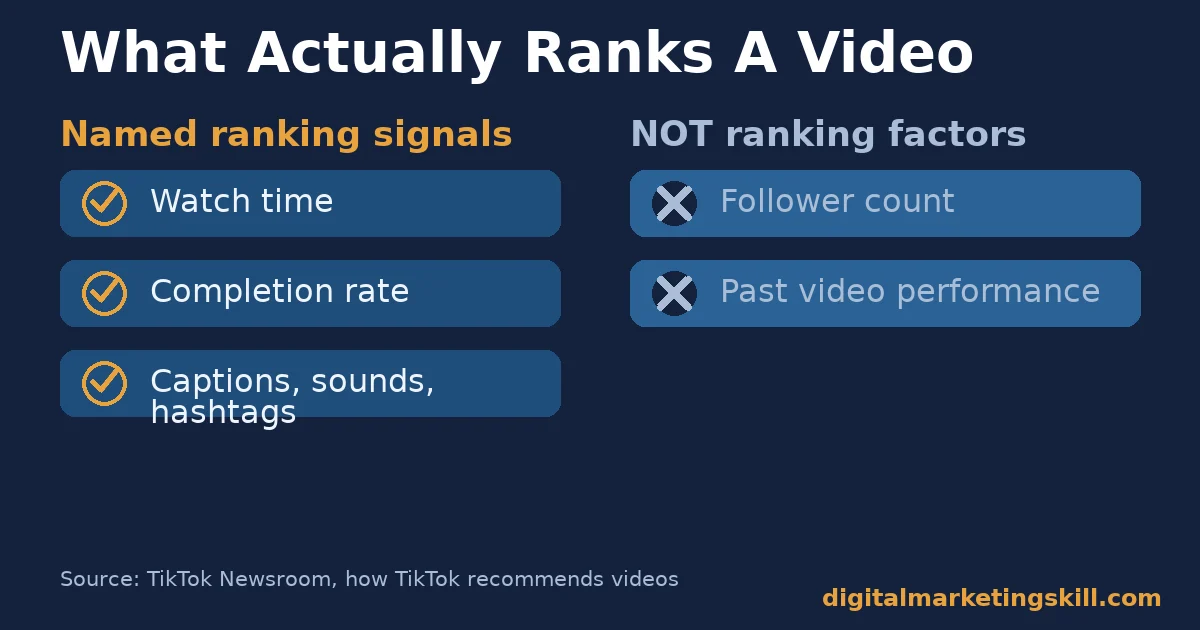
- TikTok names watch time, completion rate, and video information (captions, sounds, hashtags) as ranking signals, according to TikTok’s own Newsroom explanation. Follower count and past video performance are not named as direct ranking factors.
- The Creator Rewards Program’s published terms require 10,000 followers and 100,000 video views in the last 30 days. Eligible videos must run one minute or longer and reach 1,000 qualified views to start earning.
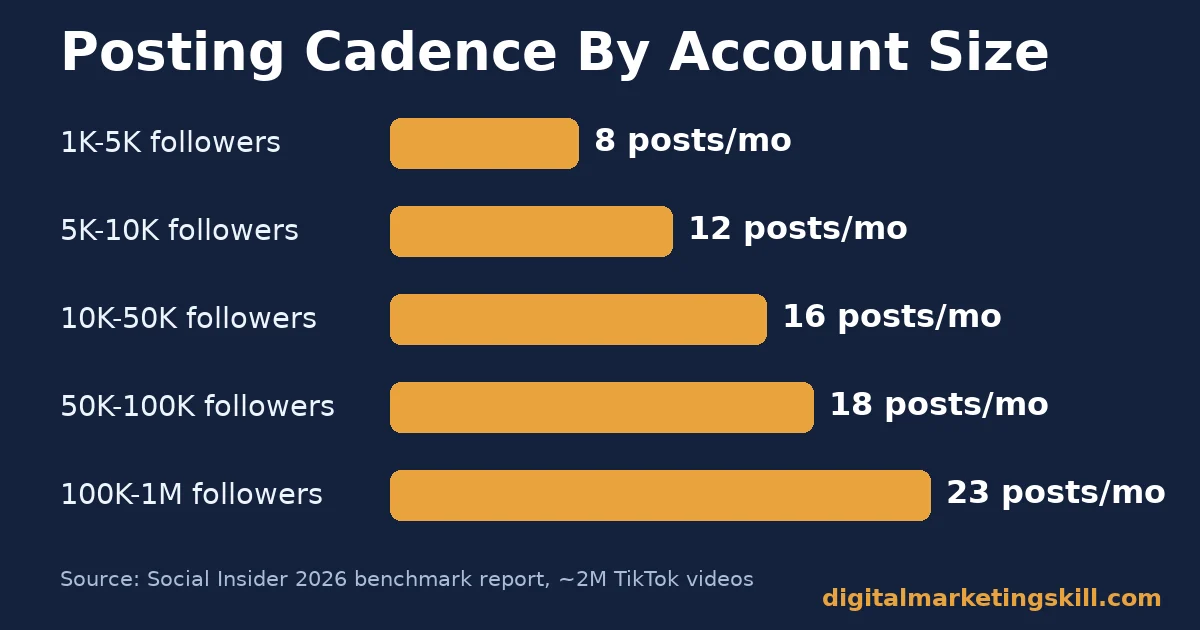
- Posting cadence scales with account size. Accounts with 1,000 to 5,000 followers post about 8 times a month on average. Accounts with 100,000 to 1 million followers post about 23 times a month, according to Social Insider’s current benchmark report.
- Average engagement rate across TikTok rose from 3.85% to 4.20% year over year, a roughly 9% increase, per the same Social Insider report.
- Engagement rate is not flat by account size. Accounts with 1,000 to 5,000 followers average about 4.40% engagement. That is higher than accounts with 50,000 to 100,000 followers, which average about 3.75%.
In this guide
- Why Most TikTok Content Creator Advice Misses The Point
- How The For You Algorithm Actually Ranks Videos
- Posting Cadence And Video Length, By Account Size
- Three Ways A TikTok Content Creator Gets Paid
- Matching The Payout Path To Where An Account Stands
- Common Mistakes That Stall A TikTok Content Creator’s Growth
- The One Decision Rule Worth Writing Down
- Measuring Growth Beyond Follower Count
- A Realistic Case, And Its Limits
- A Quick Checklist Before You Post
- Frequently Asked Questions About Becoming A TikTok Content Creator
- Build The Content Skills Before You Chase The Algorithm
Why Most TikTok Content Creator Advice Misses The Point
TikTok’s ad tools alone reach 1.59 billion users, so the competition for attention is real. Most advice for a new TikTok content creator says the same three things: post daily, follow trends, and use trending sounds. None of that is wrong. But it skips the part that actually decides whether a video spreads.
That missing part is how TikTok’s ranking system reads the first few seconds of watch behavior. This guide treats growth as a measurable system, not luck. It explains what TikTok itself says about ranking, lays out realistic posting cadence at each account size, and shows which of the three monetization paths fits a given account today.
Treat every figure here as a checked snapshot from a named source, not a permanent ranking. Platform rules and thresholds change over time.
How The For You Algorithm Actually Ranks Videos
TikTok’s own Newsroom explanation is the most direct source available. It names watch time and completion rate as central signals. Did a viewer finish the video? Did they watch it more than once? It also names video information, meaning captions, sounds, and hashtags, as a ranking input.
The same explanation is explicit about what does not directly drive ranking. Follower count is not named as a direct ranking factor. Whether a creator’s past videos performed well is not named either. That single fact undercuts a lot of common advice. A brand-new TikTok content creator with zero followers can still get a video in front of a large audience, as long as the video itself holds attention.
What This Means For a New Creator
Every video gets tested with a small initial audience, regardless of follower count. If that small audience watches to the end, TikTok tests it with a larger one. If they scroll away in the first two seconds, the video stops spreading. This is why the opening of a video matters more than almost anything else a new TikTok content creator can control.
Most creators spend their editing time on the middle of a video. A better use of that time is the first two seconds, since that is the section TikTok actually tests first. A weak opening never gets a second chance with a larger audience, no matter how strong the rest of the video is.
Posting Cadence And Video Length, By Account Size
Social Insider’s current benchmark report is built from close to 2 million TikTok videos across more than 214,000 profiles. It found posting frequency rises with account size. Accounts with 1,000 to 5,000 followers post about 8 times a month.
The pace roughly doubles to 16 times a month once an account reaches 10,000 to 50,000 followers. It climbs again to about 23 times a month at 100,000 to 1 million followers.
The same report found posting frequency rose by roughly 40% across all tiers compared with the year before. That suggests the platform rewards a higher baseline of output than it used to. There is no single “ideal” number. The realistic target is the next tier up from where an account sits today, not a jump to daily posting overnight.
Video length is less settled. TikTok has extended its maximum allowed video length to 10 minutes. That is a sign the platform wants more long-form content tested on it. It does not mean every video should run long. Length should match the story, the same principle covered in this guide to video marketing for beginners, not a fixed rule.
Three Ways A TikTok Content Creator Gets Paid
Three separate paths exist. Each has its own eligibility rule and its own kind of reliability.
Creator Rewards Program: Built For Steady Video Output
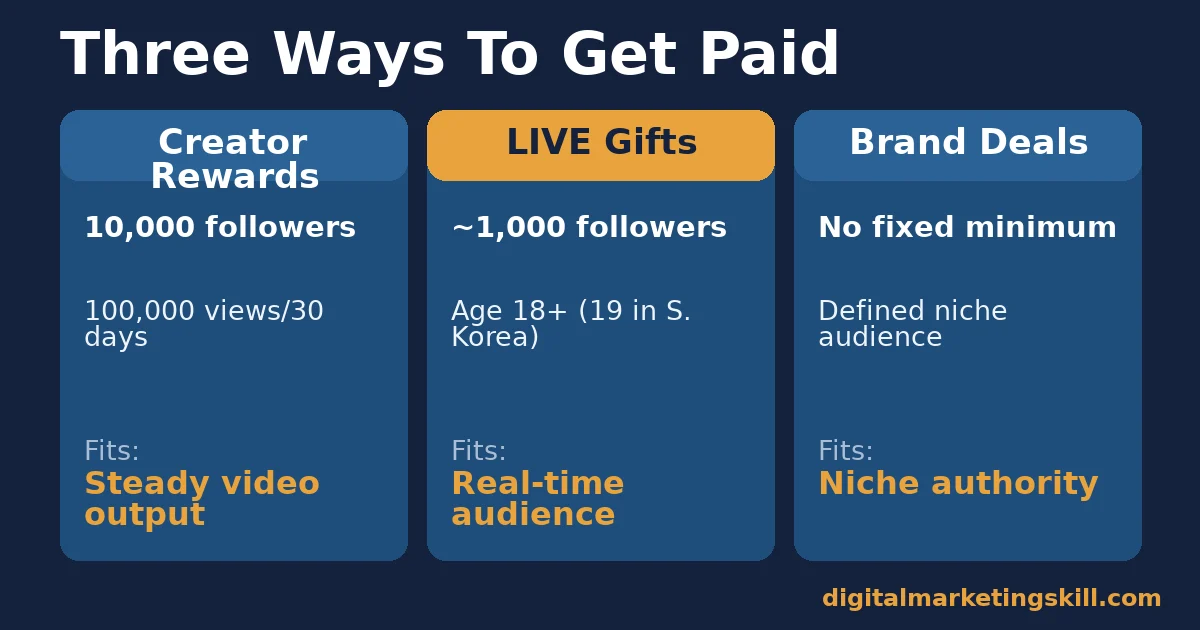
The Creator Rewards Program’s published terms require 10,000 followers and 100,000 video views in the last 30 days to qualify. Once in, individual videos must run one minute or longer and reach 1,000 qualified views before they start earning. Duets, Stitches, and Photo Mode posts are excluded.
TikTok states this program can pay out meaningfully more per video than its earlier Creator Fund. It does not publish a fixed rate per view, though. Any specific per-view number you see elsewhere is a third-party estimate, not an official figure.
LIVE Gifts: Built For Real-Time Audiences
Going LIVE and receiving Gifts, per TikTok’s own LIVE support page, requires roughly 1,000 followers, though TikTok notes this can vary by region. It also requires a minimum age of 18, or 19 in South Korea, to send or receive Gifts.
This path rewards creators who can hold an audience in real time through conversation and interaction. That is a different skill from editing a polished short video, and it suits a different kind of personality than scripted, edited content does.
Some creators do both well; many find one path fits them far more naturally than the other. It sits alongside the other paths covered in this guide to making money on TikTok.
Brand Partnerships: Built For Niche Authority
TikTok’s Creator Marketplace, now folded into its TikTok One brand-partnership platform, lets brands search creators by follower range, region, and performance metrics. Brands then send campaign briefs a creator can accept or decline inside the app.
This path pays the most per post for creators with a clearly defined niche audience. Brands are buying access to that specific audience, not just view count. Niche authority is really a personal brand that brands are paying to borrow. That is why the influencer and creator paths often overlap.
Matching The Payout Path To Where An Account Stands
A brand-new account under 1,000 followers cannot access any of the three paths yet. The only real goal at that stage is consistent posting. Study which openings hold attention past the first two seconds.
An account between 1,000 and 10,000 followers can start testing LIVE sessions. This builds the real-time audience skill, while the account is still too small for Creator Rewards. An account that crosses 10,000 followers and 100,000 monthly views can apply for Creator Rewards. At that point, treat video length and posting cadence as a deliberate system, not a guess.
An account with a clear, narrow niche, regardless of exact follower count, should pursue brand partnerships in parallel. Niche authority is what the Creator Marketplace actually sells to brands. The same authority is what turns a creator into a working social media influencer, rather than just a poster.
Common Mistakes That Stall A TikTok Content Creator’s Growth
Three mistakes show up again and again in a TikTok content creator’s account when it stalls below 1,000 followers for months. Each one is fixable once it is named.
Burying The Hook In The First Few Seconds
Many new creators spend the opening seconds on a logo, an intro clip, or a slow pan before getting to the point. This habit often comes from habits learned on other platforms, where a slower build is more acceptable.
TikTok’s ranking system tests exactly those first seconds with a small audience. A slow open fails that test before the actual content ever gets a chance. Moving the strongest line, image, or question to the very first frame is usually the single highest-leverage edit a creator can make.
Posting In Bursts, Then Going Quiet
A creator who posts five videos in one week, then nothing for a month, resets the account’s momentum each time. Consistent, moderate output beats sporadic bursts, because the algorithm has fresh data to test on a predictable schedule. The benchmark cadence figures above are a floor to aim for steadily, not a target to hit once and abandon.
Chasing Every Trend Instead Of A Niche
Jumping on every trending sound or format can produce short bursts of views, but it rarely builds a clearly defined audience. Brand partnerships and a durable following both reward a recognizable niche. A creator who posts consistently within one topic area, even using trending formats inside that topic, builds an audience that a trend-chasing account never does.
The One Decision Rule Worth Writing Down
Decision rule: optimize for completion rate before you optimize for reach. A video that holds 90% of viewers to the end with a small audience will outgrow a video that loses half its viewers in the first three seconds with a large one. TikTok’s own ranking signals reward the first video more on every subsequent test.
Illustrative, invented numbers: imagine two creators each post a video to an initial test audience of 300 viewers. Creator A’s video keeps 85% of viewers watching to the end. Creator B’s keeps 40%. TikTok is far more likely to push Creator A’s video to the next, larger test audience, even though both videos started with the same reach.
Within a few test rounds, Creator A’s view count can outpace Creator B’s by a wide margin. That gap comes purely from the completion-rate signal compounding, round after round.
Measuring Growth Beyond Follower Count
Follower count is the easiest number to watch, but it is not the most useful one for a TikTok content creator deciding what to change next. It is a lagging number: it tells you what already happened, not what to try tomorrow. Three other numbers tell a creator more about what is actually working.
Completion rate is the share of viewers who watch a video to the end. It is the single metric closest to the signal TikTok itself names as central to ranking. A video with a low completion rate but a high view count is usually a video that reached a lot of people in its first test, then lost most of them, which caps how far it can spread further.
Average watch time adds context to completion rate. A 15-second video with 90% completion and a 60-second video with 90% completion send a similar signal, but the longer video is holding attention for four times as long in absolute terms, which can matter for the newer, longer-form push TikTok has been testing.
Engagement rate, comments and shares relative to views, signals something completion rate cannot: whether a video is worth talking about, not just worth finishing. Social Insider’s tiered benchmarks above give a rough target by account size, but the more useful comparison is a creator’s own videos against each other, not against a stranger’s account in a different niche.
Put The Three Numbers Together Each Month
Track these three numbers for every video over a month, then sort by completion rate. The videos at the top of that list share a pattern, usually in their opening seconds or their core idea. That pattern is worth repeating deliberately, rather than hoping the next video happens to work the same way by luck.
A Realistic Case, And Its Limits
Illustrative, invented numbers: a new TikTok content creator posts three times a week for two months. Each video runs under 30 seconds, built around a single clear hook in the first two seconds. By month three, the account crosses 10,000 followers and qualifies for Creator Rewards.
The creator then shifts to five posts a week, to match the next account-size tier’s typical cadence.
Where This Example Breaks Down
The limits of this example matter. It assumes every video holds attention well, which is not universal. Most new creators see a wide range of outcomes between their best and worst videos, often within the same week of posting.
The example also does not reflect niche-specific competition, which can slow growth in crowded categories. A beauty or finance account competes against a much deeper pool of established creators than a niche hobby account does.
The same posting discipline can produce very different timelines for two accounts doing everything else the same way. Treat the illustrative case as a pattern to test against your own results, not a guaranteed timeline to expect.
A Quick Checklist Before You Post
Before you publish anything, run through four checks. First, confirm the opening two seconds state a clear hook, not a slow introduction. A strong hook matters more than any other single edit you make.
Second, check whether your account size matches a realistic posting cadence from the benchmarks above. So if you are posting far above or below your tier’s typical rate, adjust toward it gradually rather than all at once.
Third, confirm which monetization path actually fits your current follower count and niche. Therefore chasing Creator Rewards eligibility before you have a niche audience often wastes effort that brand partnerships would reward instead.
Fourth, track completion rate for every video you post, not just views or likes. As a result, you will see which openings actually work, instead of guessing from vanity metrics alone. Keep a simple running log, even a basic spreadsheet, so the pattern becomes visible across weeks instead of getting lost between individual posts.
Frequently Asked Questions About Becoming A TikTok Content Creator
How many followers does a TikTok content creator need to get paid?
It depends on the path. The Creator Rewards Program requires 10,000 followers and 100,000 video views in the last 30 days. Going LIVE for Gifts requires roughly 1,000 followers, though this can vary by region. Brand partnerships have no fixed follower minimum; a smaller, clearly defined niche audience can still attract paid deals.
Does follower count affect how far a video spreads?
Not directly. TikTok’s own Newsroom explanation names watch time, completion rate, and video information as ranking signals. It does not name follower count or past video performance as direct ranking factors. Every video gets an initial test audience regardless of account size.
How often should a new TikTok content creator post?
There is no single ideal number, but benchmark data shows cadence rising with account size. It runs roughly 8 posts a month at 1,000 to 5,000 followers, up to roughly 23 posts a month at 100,000 to 1 million followers. Aim for the next tier up from your current posting pace, not a sudden jump to daily output.
What video length works best on TikTok now?
TikTok has extended its maximum video length to 10 minutes, but that does not mean longer is automatically better. Length should match the story a video is telling. What matters most for ranking is whether viewers watch to the end, not the raw duration.
Is the TikTok Creator Rewards Program the same as the old Creator Fund?
No. The Creator Rewards Program replaced the earlier Creator Fund. TikTok states it can pay out meaningfully more per eligible video, though it does not publish a fixed rate per view. Any specific per-view dollar figure you see online is a third-party estimate, not an official TikTok number.
Can a TikTok content creator get paid without going viral?
Yes. Brand partnerships through the Creator Marketplace reward a defined, engaged niche audience over raw view count. LIVE Gifts reward real-time audience interaction rather than video reach. Viral spread is one path to income, not the only one.
Build The Content Skills Before You Chase The Algorithm
Becoming a TikTok content creator is a content and marketing skill, not luck. Digital Marketing Skill Institute’s Master Diploma in Digital & AI Marketing is built to teach exactly this kind of execution: four AI-powered tracks, built from ten execution-first courses, with a Full Stack option for completing all four.
The AI-Powered Social Media Management and Advertising track in particular covers the platform strategy, content planning, and analytics skills a serious content creator needs beyond posting instinct. Every student gets unlimited 1-on-1 coaching and mentoring, plus a U.S. Project Internship with a verified U.S. Work Reference Letter.
The diploma is dual US and UK accredited and recognised in more than 100 countries, 100% online. That means the skills apply whether you are building a personal brand or managing social accounts for clients.
Start Where You Are
Whether you are posting your first video or already have an audience anywhere in your country, the underlying skill set is the same. Understand the platform’s actual signals. Build a repeatable system. Treat content as a craft to measure and improve.
Explore the program on the Master Diploma page. Read real outcomes on the reviews page. Browse more guides on the blog hub. When you are ready, apply here. Learn more at digitalmarketingskill.com, wherever you live, and start turning content skill into a real income at digitalmarketingskill.com.
Every figure in this guide was checked against its original source before publication. Figures marked as illustrative are invented examples, not real results.
