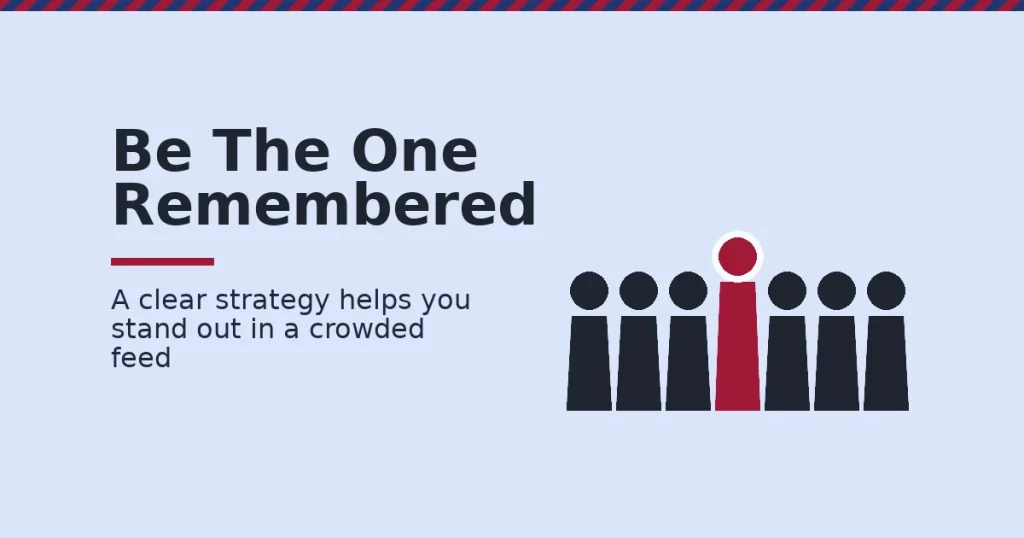
A personal branding strategy decides whether people remember you after they scroll past. Most professionals post without one, so their content blurs into everyone else’s. This guide covers the mechanism behind a personal brand. It covers the tactics that build one deliberately, how to measure it, and one real case with the numbers behind it.
Key Takeaways
- It changes career outcomes. An academic study of 477 professionals across two cultures found personal branding predicts greater career satisfaction. That link was fully explained by how employable people felt as a result.
- The audience is already there. LinkedIn has more than 1 billion members in over 200 countries. So most professional audiences are already reachable, without building a platform from scratch.
- People scan before they read. Nielsen Norman Group’s eye-tracking study of 232 users found readers scan in an F-shaped pattern. A profile or post has only seconds to prove its value.
- Recommendations outperform self-promotion. A global Nielsen survey of more than 28,000 respondents across 56 countries found 92% trust recommendations from people they know, above any advertising.
- Repurposing compounds reach. A documented case of one solo creator’s strategy shows the pattern clearly. A single piece of writing, broken into 10 to 20 smaller pieces, built three separate audiences over a few years.
In this guide
- What Most Personal Branding Advice Gets Wrong
- How a Personal Branding Strategy Actually Works
- What Differs by Career Stage
- What a Personal Branding Strategy Is Not
- 10 Tactics for a Personal Branding Strategy That Works
- Common Personal Branding Strategy Mistakes
- How to Measure a Personal Branding Strategy
- The Most Useful Rule: Optimise for Perceived Employability, Not Visibility
- A Four-Week Plan to Start a Personal Branding Strategy
- A Real Case: How One Solo Creator Built Three Audiences From One Piece of Writing
- Frequently Asked Questions About Personal Branding Strategy
- Start With One Sentence, Then Build the System
What Most Personal Branding Advice Gets Wrong
Most advice says the same three things. Post consistently. Be authentic. Engage with others. None of it is wrong, but it skips the actual mechanism. A personal brand forms in other people’s minds, not on your profile.
This guide names that gap first. Then it builds a personal branding strategy around it: what makes people remember you, the tactics that create that memory on purpose, and how to tell if it is working.
A quick ground rule first. The academic study below used self-reported survey data from 477 people. So read its finding as a strong association, not a guaranteed outcome for everyone. The solo-creator case is self-reported in a published case write-up, not an audited result. Treat every number here as evidence, not a promise.
How a Personal Branding Strategy Actually Works
A personal brand is not what you say about yourself. It is what other people say about you when you are not in the room. Harvard Business Review describes it as an intentional, strategic practice of defining and expressing your own value. A personal branding strategy exists to shape that conversation on purpose, instead of leaving it to chance.
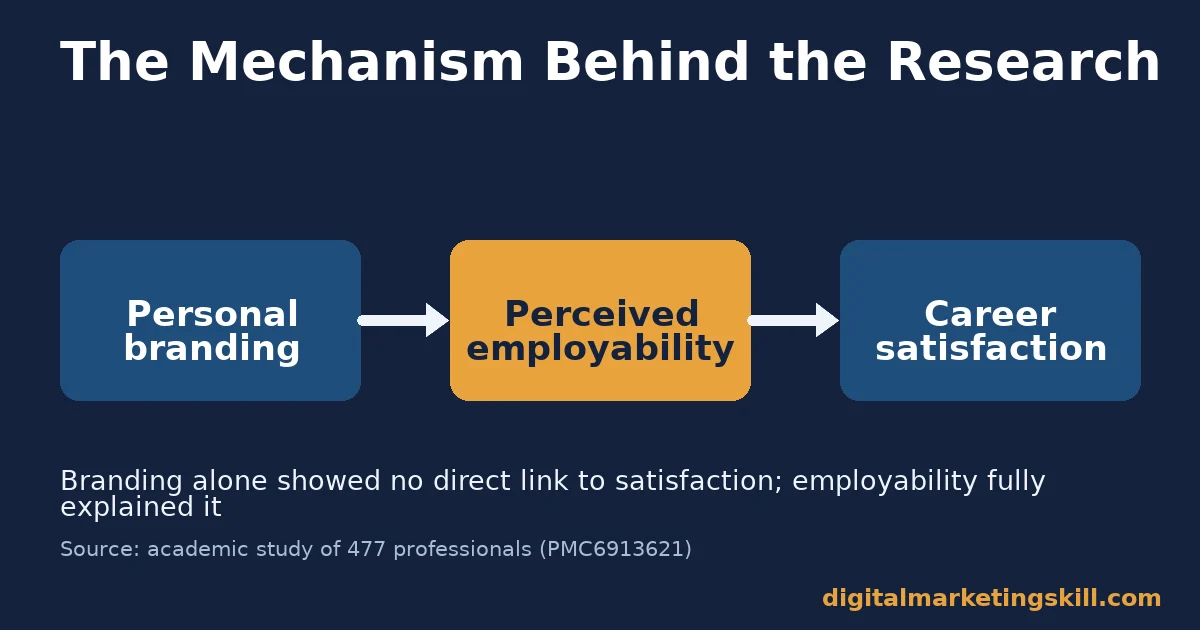
Research backs this up directly. A study of 477 professionals across Western and Asian work cultures found that personal branding leads to greater career satisfaction. But that link runs through only one path: it first raises how employable other people see you as. Branding without that perceived employability showed no direct link to satisfaction on its own.
Perceived Employability Is the Real Mechanism
This matters because it tells you what to optimise for. Posting for its own sake does not move the outcome. Content and behaviour that visibly demonstrate skill, judgement or results are what shift how employable someone appears. That shift, in turn, is what drives the career benefit.
People Scan a Profile Before They Read It
Nielsen Norman Group’s eye-tracking research recorded how 232 users looked at web content. It found an F-shaped scanning pattern: across the top, then down the left side. A profile or post gets the same treatment. The first line, the photo and the headline carry most of the weight before anyone reads further.
What Differs by Career Stage
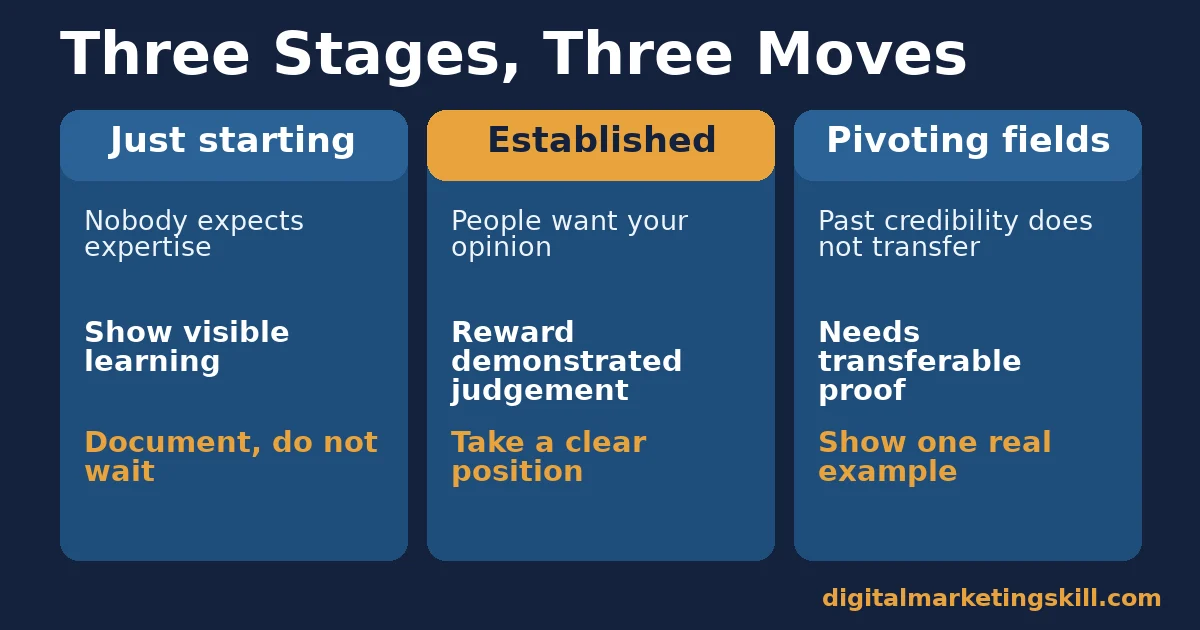
A personal branding strategy is not one-size-fits-all. Someone starting out, someone established, and someone pivoting fields all need people to believe something different about them, so each needs a different first move.
Just Starting: Built on Curiosity and Proof of Learning
Early on, nobody expects you to be the expert. What works instead is visible learning. Share what you are studying, the questions you are working through, and small wins as they happen. This builds curiosity about where you are headed, and it costs nothing to start.
The mistake at this stage is waiting to “have something to say.” Documenting the learning itself is the content, and it is honest, which audiences notice.
Established: Built on Demonstrated Judgement
Once you have real experience, the job changes. People want your opinion, not your learning process. Case studies, frameworks you use and clear positions on debates in your field do more here than general tips. Specificity is what separates a memorable expert from a forgettable one.
The risk at this stage is staying too safe. Vague, agreeable content rarely gets remembered, while a specific, well-argued position does, even when some readers disagree with it.
Pivoting Fields: Built on Transferable Proof
Changing direction is the hardest branding problem, because your past credibility does not automatically transfer. People who knew you as a specialist in one field do not automatically assume your skills apply elsewhere, even when they genuinely do.
The fix is naming the transferable skill directly. Then show it applied to the new field with a real example, rather than assuming people will make the connection themselves. A short case study of one project in the new field does more here than a general statement of interest.
What a Personal Branding Strategy Is Not
Before the tactics, a few quick clarifications save wasted effort. A personal branding strategy is not the same thing as self-promotion, constant visibility or a polished, curated image. Confusing these leads people to either avoid branding entirely or to overcorrect into content nobody trusts.
It is not constant self-promotion. Content that only announces achievements, with no useful information inside it, reads as promotional and gets scrolled past. The most effective personal branding content teaches, demonstrates or shares a real perspective, with the promotional benefit arriving as a side effect, not the headline.
It is not about posting every day. Volume alone does not build recognition, and a flood of low-value posts can actually reduce how memorable any single one is. One well-made post a week that demonstrates real capability outperforms five generic ones.
It is not a fixed, polished persona. Audiences notice and distrust a brand that never shows uncertainty, disagreement or a mistake. A credible personal branding strategy allows for genuine opinions and the occasional admission that something did not work, because that honesty is part of what makes the rest of the content trustworthy.
10 Tactics for a Personal Branding Strategy That Works
The tactics below apply the career-stage differences above. Use what fits where you are, rather than copying all ten at once.
Five Tactics for the Foundation
- Pick two platforms, not five. Spreading thin content across many platforms builds less recognition than consistent content on the one or two where your audience already spends time.
- Write one sentence that defines your angle. If you cannot state what you want to be known for in one sentence, your audience cannot either. Revisit it every few months as your expertise grows.
- Keep the same photo, name format and tone everywhere. Recognition compounds across repeated exposure, so a profile that looks different on every platform resets that recognition each time.
- Lead every post with the useful part. Given the F-shaped scanning pattern, the first line carries more weight than anything else you write. Put the point, not the preamble, first.
- Treat your bio as a one-line pitch. Most visitors read the bio before anything else. State who you help and how, not a list of job titles.
Five Tactics for Momentum
- Build a repeatable content system. Turn one piece of original thinking into several formats: a short post, a longer explainer, and a visual summary, instead of starting from a blank page each time.
- Reply before you post. Genuine comments on other people’s content build recognition faster than posting into silence, especially before your own audience exists yet.
- Share a specific result, not a general claim. “I helped a client cut cost per lead by a third” is remembered; “I’m passionate about marketing” is not. Our guide to what makes content genuinely high quality covers this in more depth.
- Take a position, carefully. A clear, well-reasoned opinion on a real debate in your field builds more recognition than content that agrees with everyone.
- Review what actually worked each month. Revisit your last ten posts, note which ones got real engagement and why, then do more of what is working rather than guessing again.
Common Personal Branding Strategy Mistakes
Even motivated professionals undercut their own personal branding strategy with a few repeated mistakes. Check your last ten posts or updates against this list.
- Branding as a job title, not a value. “Marketing Manager” tells people what you do, not what you are good at or what problem you solve. Lead with the value, not the title.
- Copying someone else’s voice. Borrowed phrasing and formats are forgettable because the audience has seen them before, from someone else. Your actual experience is the only thing competitors cannot copy.
- Disappearing for months, then posting once. A single post after a long gap rarely reaches anyone, because recognition is built through repeated, spaced exposure, not a single event.
- Only posting when you have a big announcement. Waiting for milestones means most of your actual expertise, the small decisions and lessons along the way, never gets shared at all.
- Never asking for anything. Content that never states what you want, whether that is a conversation, a referral or an application, leaves interested people with no next step.
How to Measure a Personal Branding Strategy
Follower count feels like the obvious metric, but it does not show whether people remember or trust you. The metrics below get closer to the actual goal.
Five Metrics That Show Whether It Is Working
- Profile views from search. LinkedIn’s own profile analytics show people actively looking you up by name, which is a stronger signal than a passive follow.
- Inbound messages and introductions. People reaching out unprompted, or being introduced by others as “the person who knows X,” is the clearest sign a brand has formed.
- Engagement rate, not follower count. A smaller, engaged audience that comments and shares is doing more branding work than a larger, silent one.
- Repeat engagement from the same people. The same names commenting over months show a developing relationship, not a one-off view.
- Opportunities that name you specifically. A job offer, invite or client lead that references something you posted is direct evidence the strategy reached someone.
Reading These Signals Together
Review these monthly, not after every post. A single post rarely tells you much on its own, since engagement on any given day depends on factors outside your content, such as when your audience happens to be online.
If profile views are flat, your content is not reaching new people, so revisit your platform choice or your hook. If views are healthy but inbound messages stay at zero, your content is not demonstrating anything specific enough to act on. And if both are healthy but opportunities never follow, the gap is usually a missing, clear call to action.
The Most Useful Rule: Optimise for Perceived Employability, Not Visibility
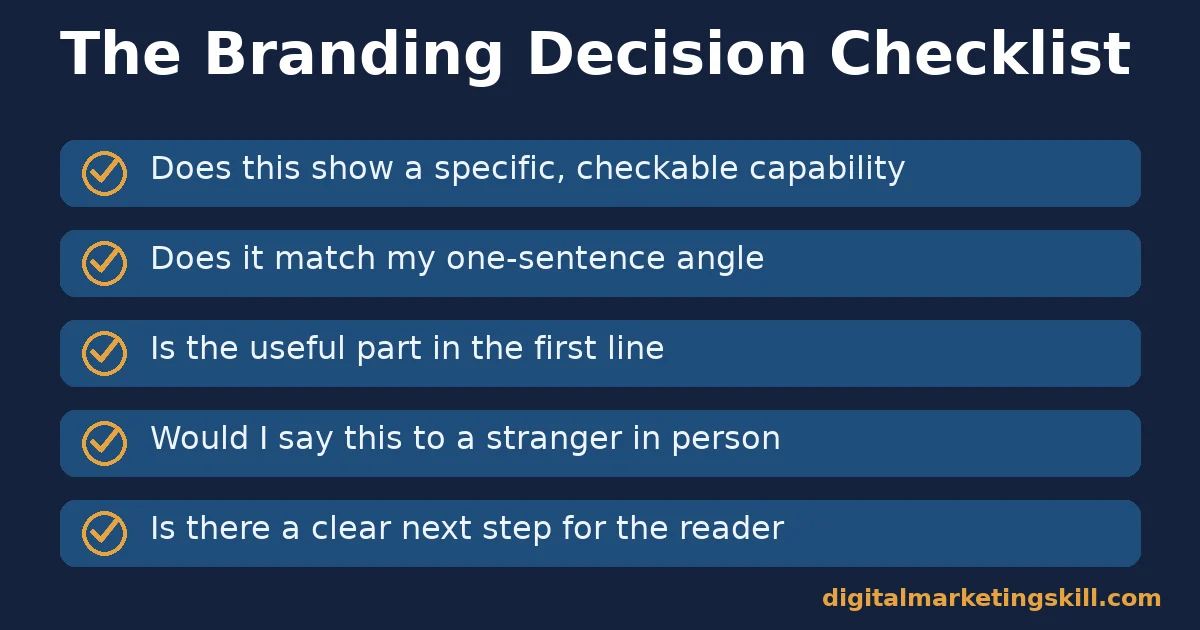
Take one decision rule from this guide: before you post, ask whether this specific piece of content makes you look more capable of doing the thing you want to be known for. Visibility without that signal rarely converts into real opportunity.
Here is an illustrative example, with invented numbers. A marketer posts three times a week for six months with general tips and motivational quotes, gaining 2,000 followers but no inbound messages. She switches to sharing specific campaign breakdowns with real numbers, still posting three times a week. Within two months, with a similar follower count, she receives four inbound client inquiries that reference specific posts.
The lesson is not that frequency does not matter. It is that frequency without a demonstrated-capability signal built little beyond follower count, while the same frequency with that signal converted into real opportunity.
A Four-Week Plan to Start a Personal Branding Strategy
You do not need a full rebrand to start. This plan takes about an hour a week and works on any platform you already use.
- Week one: write your one-sentence angle. Define what you want to be known for, then rewrite your bio and headline to match it.
- Week two: audit your last ten posts. Note which ones demonstrated a specific result or opinion, and which were generic. Keep what worked as your template.
- Week three: build one repurposing system. Pick one piece of real work or thinking, and break it into three to five smaller pieces for the platform you chose.
- Week four: reply before you post. Spend time commenting genuinely on others’ content, then publish your own piece with a specific, checkable claim inside it.
At the end of the month, review profile views and inbound messages against the month before. Keep whatever moved those numbers. Then repeat the plan with a new angle or format each month, building on what already worked rather than starting over.
A Real Case: How One Solo Creator Built Three Audiences From One Piece of Writing
A published case write-up by Growth in Reverse documents how one solo creator, Justin Welsh, built a personal brand across LinkedIn, X and a newsletter. The write-up calls his method a hub-and-spoke model: one newsletter issue, broken into 10 to 20 smaller pieces, distributed across platforms over four to six weeks.
Within the timeframes the case reports, LinkedIn following reached roughly 360,000 over about three and a half years. X following reached over 315,000 in around 16 months. The newsletter reached roughly 77,000 subscribers in its first year. The write-up also describes a consistent content template: name a problem, explain the usual solutions, show their shortcomings, then offer an alternative with concrete steps.
Treat the specific figures as self-reported in a published case write-up, not an audited result. Other sources report different totals at different points, which is common for fast-growing accounts. The transferable lesson is the repurposing system itself, not the exact numbers: one piece of real thinking, distributed in many formats, built recognition across three separate audiences rather than one.
Frequently Asked Questions About Personal Branding Strategy
What is a personal branding strategy?
A personal branding strategy is a deliberate plan for shaping what other people think of you professionally. It covers which platforms you use, what you are known for, and the content and behaviour that demonstrate it consistently.
Do I need a personal brand if I am not an entrepreneur?
Yes. The academic research behind this guide studied employed professionals, not just founders, and found the same link between personal branding and career satisfaction through perceived employability.
How long does it take to build a personal brand?
There is no fixed timeline. The case in this guide describes growth over several years, with the fastest gains following a change in content, not simply more time spent posting.
Which platform is best for a personal branding strategy?
The platform where your specific audience already spends time professionally. Spreading effort across many platforms at once usually builds less recognition than consistent presence on one or two.
Should I post every day to build a personal brand?
Frequency helps, but only alongside content that demonstrates real capability. The illustrative example in this guide shows that frequency alone, without that signal, built followers but no real opportunities.
How do I know if my personal branding strategy is working?
Track profile views from search, inbound messages, engagement rate and opportunities that specifically reference your content. Rising follower counts alone do not confirm any of this.
What is the biggest mistake in personal branding?
Posting generic, agreeable content that never demonstrates a specific, checkable capability. It feels safe, but the research and the case in this guide both point to specific, demonstrated expertise as the actual driver of results.
Can I build a personal branding strategy if I am introverted?
Yes. A personal branding strategy does not require constant self-promotion or being on camera. Written posts, thoughtful comments on others’ work, and sharing specific results all build recognition without requiring a performative or extroverted style.
Should my personal brand be different from my employer’s brand?
They can coexist, but they serve different purposes. Your employer’s brand sells its product; your personal brand is what follows you between roles and projects. Keep your content honest about your role and avoid speaking for your employer without permission, but still build your own name alongside it.
Start With One Sentence, Then Build the System
A personal branding strategy works when it starts with a clear answer to one question: what do you want to be known for? Write that sentence, pick the one or two platforms where your audience already is, and build a repeatable system for turning your real work into content.
For the content side of this system, see our guide to building a content marketing strategy. For getting that content in front of more people once it exists, read our guide to social media content promotion.
If you want guided, hands-on practice building a personal brand and the marketing skills behind it, Digital Marketing Skill Institute teaches it inside the Master Diploma in Digital & AI Marketing. The programme runs four AI-powered tracks built from ten execution-first courses, with a Full Stack option to complete all four.
It also includes unlimited 1-on-1 coaching and mentoring, plus a U.S. Project Internship with a verified U.S. Work Reference Letter. And it is dual US and UK accredited, recognised in more than 100 countries.
The programme is fully online, so you can build your own personal branding strategy from anywhere in your country. Explore more guides on the Digital Marketing Skill Institute blog, and when you are ready, apply for the Master Diploma or start from the Digital Marketing Skill Institute homepage.
Every figure in this guide was checked against its original source before publication. Figures marked as illustrative are invented examples, not real results.