
Chatbot marketing uses automated two-way conversation on a website, app, or messaging platform. It generates leads, qualifies prospects, and supports customers the moment they ask. Done well, it replaces slow forms with instant dialogue. Done badly, it frustrates people who just wanted a plain answer. This guide shows where chatbot marketing works, where it fails, and how to measure it honestly.
Key Takeaways
- 30% of consumers say they would rather work with an AI agent than wait for a person when speed matters more than nuance (Salesforce).
- 67% of consumers are already willing to let AI handle routine tasks like order tracking and personalised recommendations (Zendesk).
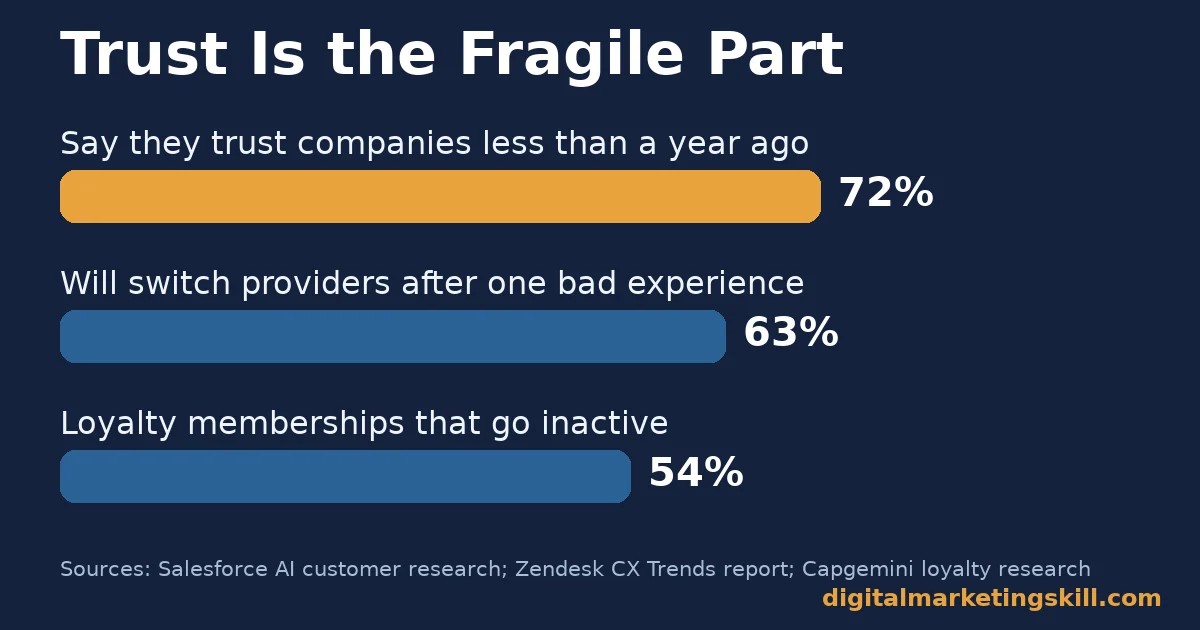
- 63% of consumers will switch to a competitor after a single bad service experience, up 9 points in a year (Zendesk).
- 54% of loyalty programme memberships go inactive and 28% of members abandon a programme without ever redeeming a reward (Capgemini).
- Over 200 million businesses now run customer and marketing conversations through WhatsApp Business every month, per Meta’s own figures reported through DataReportal.
In this guide
- What Most Chatbot Marketing Advice Misses
- How Chatbot Marketing Actually Works
- What Differs by Use Case
- Lead Generation: Built for Replacing the Form
- Lead Qualification: Built for Filtering, Not Closing
- Appointment Booking: Built for Offline Businesses
- Loyalty Engagement: Built for a Programme People Forget
- Content Distribution: Lead With the Update, Not the Archive
- Customer Support: Lead With Deflection, Not Replacement
- Reviews and Feedback: Lead With the Low-Friction Ask
- How to Build a Chatbot Marketing Strategy
- Common Chatbot Marketing Mistakes to Avoid
- How to Measure a Chatbot Marketing Programme
- The One Decision Rule Worth Following
- A Real Case: What Good Chatbot Deflection Looks Like
- Frequently Asked Questions About Chatbot Marketing
- Where to Go From Here
What Most Chatbot Marketing Advice Misses
Most articles on chatbot marketing just list use cases: lead capture, bookings, loyalty, contests. Few explain which use case pays off first. Almost none say what happens when the bot gets it wrong.
That gap matters, because trust is the fragile part of this channel. 72% of consumers say they trust companies less than they did a year ago, according to Salesforce. A single poor automated reply can push someone straight to a competitor.
Two limits are worth stating up front. First, most public figures on chatbot performance come from a vendor’s own customers or a self-reported survey. That tends to favour willing early adopters over the average small business. Second, consumer sentiment toward AI agents moves quickly. A research house can show rising comfort with AI in one survey wave and rising distrust in the next. Treat every number below as a snapshot, not a settled fact. The rest of this guide covers the mechanism, where use cases genuinely differ, how to build a strategy, how to measure it, and one decision rule that stops a programme from overreaching.
How Chatbot Marketing Actually Works
A marketing chatbot sits inside a wider marketing automation setup. It is not a separate channel from email and lead scoring; it is another trigger inside the same system. Three layers do the work.
First, a trigger: a page visit, a cart abandonment, a typed question, or a tap on a messaging app. Second, logic: either a fixed script (sometimes called a click bot) or a model using natural language processing to read free text. Third, a handoff. The conversation routes to a nurture sequence, a booking calendar, a human agent, or simply closes if the question is answered.
This differs from a contact form in two ways: speed and personalisation. A form sits static until a human reads it later. A chatbot asks a qualifying question the instant someone lands, then branches based on the answer. That immediacy is why 67% of consumers already say they are ready to delegate simple tasks, like tracking an order, to an AI assistant, per Zendesk.
Scripted Bots vs. AI-Driven Bots
Scripted and AI-driven bots solve different problems. Conflating the two is a common planning mistake. A scripted bot only follows the branches you built. It is cheap, predictable, and breaks the moment a visitor types something unscripted. A natural-language bot reads free text using machine learning and improves over time. That makes it better for open-ended support questions, but it needs ongoing review of its training data. Picking the wrong type for the job is why one bot feels brilliant and another feels broken inside the same company. A simple test helps here. If the task has a fixed, small number of possible answers, a scripted bot is usually enough. If the question could be phrased a hundred different ways, a natural-language bot earns its extra setup cost.
What Differs by Use Case
Lead Generation: Built for Replacing the Form
Lead capture is the most common entry point because it solves a problem everyone has: forms feel like a chore. A lead-generation bot greets a visitor, asks one or two qualifying questions, and routes the answer into a nurture path or a sales queue. For a business where a human follows up anyway, this is the lowest-risk starting point. The bot only has to ask, not resolve.
Read also: Lead Generation Tactics: How to Pick and Measure the Right One
Lead Qualification: Built for Filtering, Not Closing
Qualification bots go one layer deeper. Instead of just capturing contact details, they ask case-specific questions to estimate how close a visitor is to buying. The answers split the traffic: warmer leads go to a demo booking, colder ones go to a slower nurture sequence. The job here is filtering, not persuading. Keep the bot short and factual rather than salesy.
Appointment Booking: Built for Offline Businesses
Booking bots matter most for businesses that run on a calendar: clinics, salons, consultants, in-store demos. The bot’s only job is matching an open slot to a visitor’s preferred time, without a phone call. Because the task is narrow and the outcome is binary (a slot is booked or it isn’t), this is one of the easiest use cases to measure and one of the least likely to frustrate anyone.
Loyalty Engagement: Built for a Programme People Forget
Most loyalty programmes have an attention problem, not a rewards problem. Capgemini’s research into loyalty behaviour found 54% of memberships go inactive, and 28% of enrolled members never redeem a single reward. A chatbot on a messaging app can remind a member of their points balance, nudge them to use a reward before it expires, or turn redemption into a short interactive quiz. That targets the forgetting problem directly, instead of adding another incentive on top of an incentive nobody remembers. The programme itself was not broken. The reminder channel was.
Content Distribution: Lead With the Update, Not the Archive
A content-distribution bot’s value is proactive notice, not search. Instead of making a follower hunt for a new article or episode, the bot pushes the update inside a thread the person already checks daily, then lets them ask for more detail. The mistake is treating the bot as a static menu of old content. The fix is treating every message as a notification, not a catalogue page.
Customer Support: Lead With Deflection, Not Replacement
Support bots work best as a first filter for repetitive, high-volume questions: shipping status, account balance, opening hours. That frees people for harder cases. The common failure is using a support bot to replace human contact entirely. A well-run setup leads with deflection: resolve what is genuinely simple, and hand off everything else to a person within one or two messages, not five.
Reviews and Feedback: Lead With the Low-Friction Ask
Getting a review is harder than it should be. The standard ask (click a link, open a new page, write a paragraph) adds friction right when goodwill is highest, just after a problem gets solved. A bot can ask for feedback inside the same thread, which removes a step instead of adding one. The lesson applies beyond reviews: whenever a chatbot use case struggles, check whether it removes friction from an existing habit, or asks the customer to form a new one.
How to Build a Chatbot Marketing Strategy
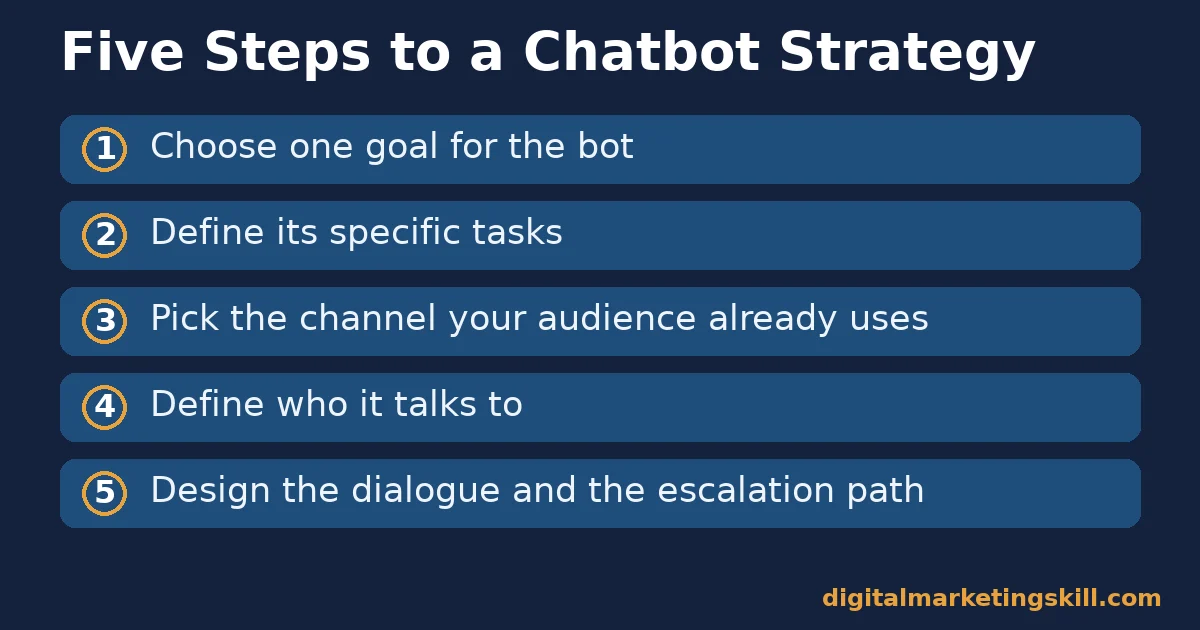
A strong chatbot does not start with the technology. It starts with five decisions, made in order. Skipping any one of them is usually why a “we tried a chatbot and it didn’t work” story happens.
1. Choose One Goal
Decide the single outcome the bot exists to produce before you touch a builder: more qualified leads, fewer repeat support tickets, higher loyalty redemption. A bot built to do everything at once usually does nothing well. Every added function adds a new way for the conversation to break.
2. Define Its Specific Tasks
Write down the exact actions the bot must perform: ask a qualifying question, check a calendar, pull an order status, answer a fixed list of frequently asked questions. Keep the first version narrow. You can expand scope once it is stable.
3. Pick the Right Channel
A bot on your own website behaves differently to one inside a messaging app. WhatsApp and similar platforms already carry a large share of business-to-customer conversation. Meta’s own figures, reported through DataReportal, put monthly WhatsApp Business usage above 200 million companies. Choose the channel your audience already checks daily, instead of building a new habit from scratch.
4. Define Who It Talks To
A bot optimised for the technology but not the audience fails fast. Before writing a line of dialogue, answer three questions: what your customers already know, why they are likely to start the conversation, and what they expect the bot cannot do. This is the same groundwork behind a buyer persona. You are designing for a specific person, not a generic visitor. Skip this step and the bot’s questions end up generic too, which makes every answer feel slightly off-target even when the logic behind it is sound.
5. Design the Dialogue and the Escalation Path
Write the opening line, the information-gathering questions, and, critically, what the bot says when it does not understand. People care about this more than marketers assume. Close to three-quarters want to know when they are talking to an AI agent, and people stay in the conversation longer when there is a clear, visible path to a human, per Salesforce. Build that escalation path before launch, not after the first complaint.
Common Chatbot Marketing Mistakes to Avoid
Trying to Automate Everything at Once
The most common mistake is launching one bot to handle lead capture, support, loyalty, and feedback at the same time. Every added function multiplies the ways a conversation can go sideways. A visitor who hits a dead end on their first bot interaction forms a lasting impression of the whole brand. Start with one job. Make it reliable. Then expand.
Hiding the Path to a Human
A close second mistake is burying the escalation option, usually to inflate the bot’s containment rate. This backfires. People who feel trapped by a bot do not just abandon the conversation; they often abandon the brand. That lines up with the 63% of consumers who say they will switch providers after one bad experience, per Zendesk. Make “talk to a person” visible from the first message, not the fifth. A visible exit does not make the bot look weak. It makes the whole experience feel safer to use.
Leaving the Script Stale
A chatbot is not “set and forget.” Product lines change. Pricing pages move. FAQ answers go out of date. A bot repeating stale information damages trust faster than a human making the same mistake, because people expect software to be accurate. Put someone on a monthly review of the bot’s top conversation paths, and update the content the way you would update a landing page.
How to Measure a Chatbot Marketing Programme
Three numbers tell you whether a bot is working. Containment rate is the share of conversations the bot resolves without a human, read against your own support team’s ticket volume, not a vendor’s demo numbers. Qualified-lead rate is the share of bot conversations that convert into an opportunity a salesperson accepts; it tells you whether the bot filters correctly rather than just chatting. Escalation satisfaction is the rating given specifically to conversations that started with the bot and ended with a human. A low score here means your handoff, not your script, is the weak point. Review all three together, not one at a time, since a single number read alone can look healthy while the overall experience is quietly failing.
Track all three monthly. A rising containment rate paired with falling escalation satisfaction usually means the bot is holding onto conversations it should be passing along. There is a fourth, softer metric worth watching too: message-to-resolution length, or how many exchanges a typical conversation needs before the visitor gets an answer or a handoff. When that number climbs even while containment rate looks stable, it is an early warning sign. Usually a policy changed somewhere and nobody updated the script.
The One Decision Rule Worth Following
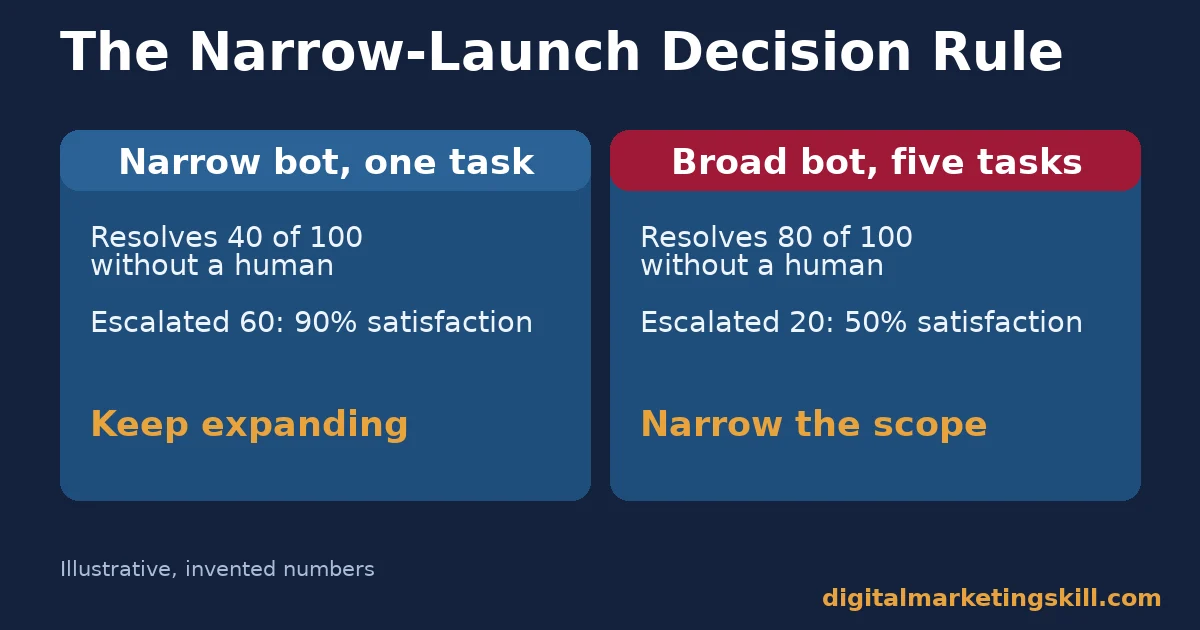
Launch a chatbot for exactly one narrow, well-defined task before adding a second one. Here is an illustrative, invented example. Picture a business testing a booking bot for one product line. If it resolves 40 of 100 conversations without a human, and keeps a 90% satisfaction score on the escalated 60, that is a successful narrow launch worth expanding. If it resolves 80 of 100 but satisfaction on the escalated 20 drops to 50%, the bot is overreaching. The fix is narrowing its scope, not adding more training data.
A Real Case: What Good Chatbot Deflection Looks Like
A beauty and wellness company using Zendesk’s AI tools resolved 44% of incoming customer requests through automation, cut average resolution time by 87%, and lifted customer satisfaction to 92%, according to Zendesk. The company did not try to automate every request type. It targeted the repetitive ones first, the same narrow-scope principle behind the decision rule above.
On the marketing side, Domino’s Pizza built its ordering bot around one job only: placing and tracking an order inside a chat window. It works through channels like Facebook Messenger, rather than also handling loyalty, support, and feedback in the same thread.
A third public example is the insurance brand Lemonade’s assistant Maya, which shows the same discipline applied to tone rather than task. Maya guides a visitor through one job: collecting the information needed for an insurance quote. She does it in a consistent, friendly voice that matches the brand, rather than upselling unrelated products mid-conversation. All three cases point the same way. Chatbot marketing performs best when it does one job completely, rather than several jobs partially.
Frequently Asked Questions About Chatbot Marketing
What is chatbot marketing in simple terms?
It is using an automated conversation, on a website or messaging app, to do a marketing job a form, email, or static page would otherwise do: capturing a lead, qualifying interest, booking a slot, or answering a common question.
Is chatbot marketing only for large companies?
No. The narrowest use cases, like a booking bot for one service or a lead-capture bot on one landing page, are cheap to build with no-code tools. They do not need a dedicated development team.
Do chatbots actually increase conversions?
They can, when scoped to one task and paired with a visible path to a human. Gains depend on the use case and the handoff quality, so measure containment rate and qualified-lead rate on your own traffic rather than assuming a general industry figure applies to your business.
What is the biggest risk with chatbot marketing?
Overreach. A bot that tries to resolve more than it is capable of produces frustrated users, who then distrust the brand. That is costly, given that 63% of consumers already say they will switch providers after one bad experience.
Should a chatbot replace human customer service?
No. It should filter the repetitive, high-volume questions so people can focus on harder ones, with a fast, visible handoff for anything it cannot resolve.
Which channel should a chatbot marketing strategy start on?
Start wherever your audience already spends time daily. That might be your own website, or a messaging app your customers already use for other businesses, rather than a brand-new platform habit.
How is AI changing chatbot marketing?
Natural language processing lets a bot read free-form text instead of forcing a visitor down a fixed menu. That makes the conversation feel closer to a real exchange, and reduces the “I don’t understand that” dead ends common to older scripted bots. It also raises the maintenance bar, since the underlying model needs regular review as products, policies, and customer phrasing change.
Can a small business run chatbot marketing without a developer?
Yes, for the narrower use cases. A single-purpose bot built with a no-code tool for lead capture or booking does not need custom development. Complexity, and the need for technical support, rises mainly with natural-language bots handling open-ended questions.
Does chatbot marketing work the same way on every messaging platform?
No. A bot on your own website can be as elaborate as you like, because you control the interface. A bot inside a third-party messaging app has to work within that platform’s rules on opt-in, message frequency, and response windows, so test the experience inside the actual app before assuming a website script will transfer directly.
Where to Go From Here
Chatbot marketing sits inside a much larger digital and AI marketing toolkit, alongside automation, lead generation, and paid and organic channels. Picking one use case, launching it narrow, and measuring it honestly is the same discipline that runs through every channel in that toolkit, not just this one.
If you want structured, hands-on training in how these pieces fit together, the Master Diploma in Digital & AI Marketing at Digital Marketing Skill Institute is built around four AI-powered tracks. Together they cover ten execution-first courses, including AI-Powered Lead Generation and Email Automation and AI-Powered Social Media Management and Advertising, with a Full Stack option for completing all four. Every track includes unlimited one-on-one coaching and mentoring, plus a U.S. Project Internship with a verified U.S. Work Reference Letter. The program is dual US and UK accredited, recognised in more than 100 countries, and fully online. You can study and apply it anywhere in your country.
See the full Master Diploma program, read outcomes on the reviews page, or browse more guides on the blog. Wherever you live, you can apply here to get started, or learn more at digitalmarketingskill.com.
Every figure in this guide was checked against its original source before publication. Figures marked as illustrative are invented examples, not real results.
