
WhatsApp marketing uses the world’s largest messaging app to reach customers directly. But there is a catch: you can only message someone after they message you first. This guide covers the 24-hour reply window that shapes every tactic, the moves that actually earn opt-ins, and the metrics that show if your WhatsApp marketing works.
Key Takeaways
- WhatsApp’s reach is enormous. Meta states the app now has over three billion people on the platform. That is more than any other messaging service (Meta, About Meta).
- Businesses cannot cold-message. A 24-hour reply window opens only when a user messages first. It resets with each new message. Outside it, only pre-approved template messages can be sent (Meta for Developers).
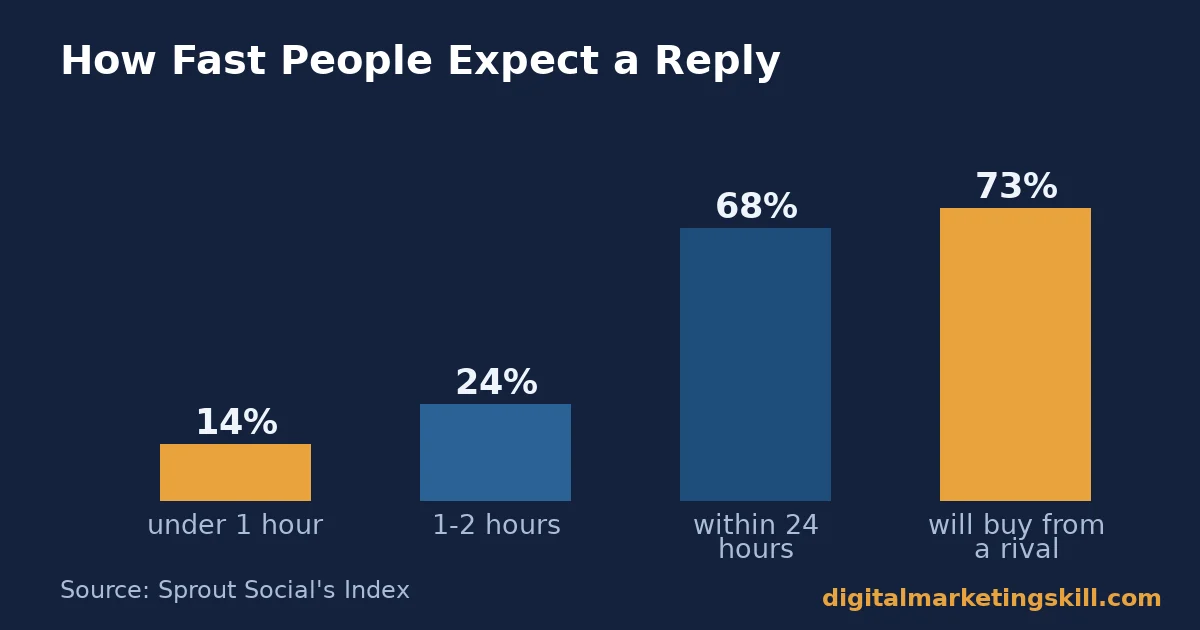
- Speed buys loyalty. 73% of people say they will buy from a rival if a brand does not respond to them. 68% expect a reply within 24 hours (Sprout Social’s Index).
- Personal beats generic. 88% of people are more likely to buy when a brand’s engagement feels personal and sent right away (Twilio, State of Customer Engagement).
- Preference varies by region. In Twilio’s global messaging survey, 47% of people who want to message a brand prefer native text. Only 18% prefer WhatsApp. So check which channel your own audience actually uses.
In this guide
- What Most WhatsApp Marketing Advice Gets Wrong
- How the WhatsApp Business Messaging Window Actually Works
- WhatsApp Marketing Differs by What Your Business Leads With
- How to Lead With Each Type of WhatsApp Marketing
- How to Measure WhatsApp Marketing
- The One Decision Rule: Never Let a Window Close Unanswered
- A Real Case: How Status Ads Changed the Channel’s Economics
- Frequently Asked Questions About WhatsApp Marketing
- Next Step: Audit Your Reply Window Before You Add New Tactics
What Most WhatsApp Marketing Advice Gets Wrong
Most WhatsApp marketing guides describe it like email with a green icon. Build a list. Send messages. Track opens. That framing misses the one rule that changes everything else. You cannot message a customer on WhatsApp until they message you first. Once they do, you only have a limited window to reply for free.
This guide treats that rule as the starting point, not a footnote. It covers how the messaging window works, what to do differently for a support-led business versus a promotion-led one, and how to measure real results. It closes with a real case of a brand built around the window.
A few ground rules first. Meta’s own numbers describe the platform, not any single business’s results on it. The Twilio and Sprout Social figures are self-reported survey data. Read them as a signal of consumer expectations, not a guarantee for your business. Treat every statistic here as a snapshot, not a permanent ranking.
How the WhatsApp Business Messaging Window Actually Works
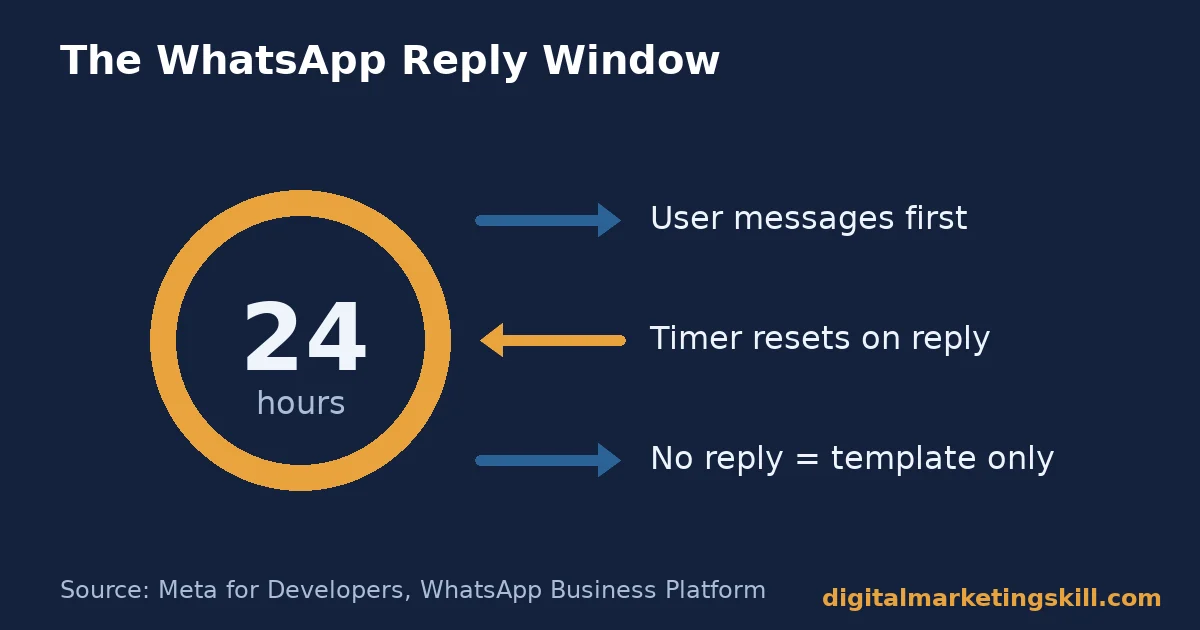
Every WhatsApp marketing tactic sits on top of one mechanic: the reply window. When a user sends your business a message, a 24-hour timer starts. While that timer runs, you can reply with any free-form message. Text, images, documents, whatever fits the conversation. If the user messages again before the timer runs out, the clock resets to a fresh 24 hours (Meta for Developers).
Once the window closes with no reply from the user, you cannot send another free-form message. You can only send a pre-approved template message. There are three categories: marketing, utility and authentication. Meta also changed how these are billed. It now charges per template message delivered, instead of once per conversation window. So sending more templates costs more directly than before (Meta for Developers, pricing).
The Window Is Also a Consent Mechanism
The practical effect is that WhatsApp marketing only works on an opted-in, warm audience. You cannot buy a phone list and message it cold, the way you might with email. Someone has to message your business first. Or they must clearly opt in to templates. Without one of those two steps, you cannot reach them at all.
That restriction is a filter, not just friction. It means your WhatsApp audience, however small at first, already chose to talk to you. The businesses that do well on this channel treat that opt-in as something to earn and protect, not a box to tick once.
Status Updates Run on a Separate 24-Hour Clock
WhatsApp Status, the disappearing photo-and-text feed, runs on its own 24-hour cycle. Anything you post vanishes a day later, the same mechanic Instagram Stories uses. Meta has also started running ads inside the Status feed. These ads prompt people to message the brand directly, extending the same “message us” logic into a broadcast format.
For WhatsApp marketing, this means Status is a top-of-funnel tool. Use it to stay visible to contacts who already have you saved. The reply window is where the real conversation and conversion happen.
WhatsApp Marketing Differs by What Your Business Leads With
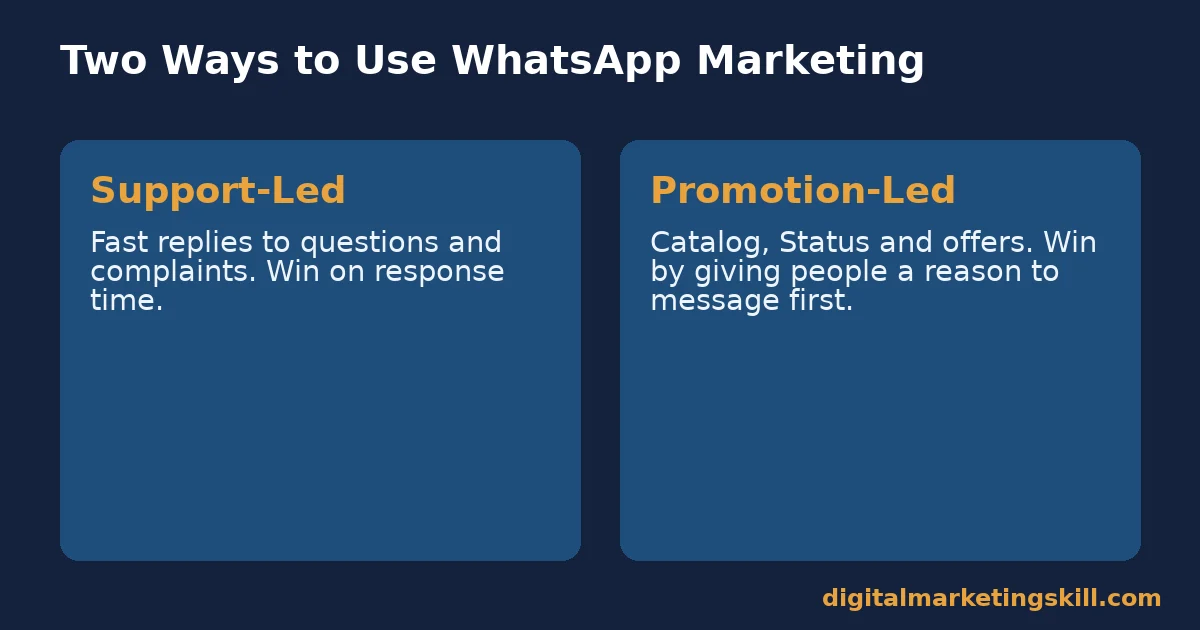
Not every business should use WhatsApp the same way. The tactics for a support-led business differ from the tactics for a promotion-led one. Identify which one describes you before picking tactics.
Support-Led Businesses: Built for Fast, Specific Replies
If most of your customer contact is questions, orders or complaints, WhatsApp marketing is really WhatsApp service with a marketing side effect. Customers message you because they need something resolved. The 24-hour window matters because every reply inside it is free and instant.
These businesses succeed when they treat response time as a core metric. Sprout Social’s Index found that 24% of people expect a reply within one to two hours. Another 14% expect one within an hour. Anything slower risks losing the sale to a faster rival, a risk covered in more depth in our guide to customer retention strategies.
Promotion-Led Businesses: Built for Status, Catalogues and Offers
If your business sells products with visuals, from fashion to food to before-and-after services, WhatsApp marketing leans on the catalog and Status features. Customers browse your catalog inside the app. They message with questions about a specific item. That message opens the 24-hour window for you to close the sale.
These businesses succeed by giving people a reason to message first. A catalog, a limited-time offer on Status, or a giveaway that requires a message to enter: each one converts a passive follower into an active conversation. That conversation is the only thing that opens your reply window. For the wider promotional mix this sits inside, see our guide to social media marketing.
How to Lead With Each Type of WhatsApp Marketing
The sections below mirror the two business types above. Pick the one that matches your business and start there. Trying to run both playbooks at once usually means doing neither well.
Support-Led: Lead With Automated First Response
Set up an auto greeting that shows you got the message within seconds, even if a real reply comes later. This does not replace a human reply. But it closes the gap between “message sent” and “someone is looking at this.”
Pair auto greetings with saved quick replies for your five most common questions. Write good answers once, then reuse them. That is what lets a small team hit fast response times without burning out on repetitive typing.
Promotion-Led: Lead With an Opt-In Catalogue and a Reason to Message
Build your product catalog inside WhatsApp Business, so browsing never requires leaving the app. Then give people an explicit reason to send that first message. Try “message us for sizing,” “message us to claim this week’s offer,” or a simple poll on Status that invites a reply.
Keep every promotional message tied to something the person can act on right inside the chat. A promotion that sends someone back to a website defeats the point of being inside a messaging app. It can still work alongside a wider email marketing strategy for customers who prefer that channel.
How to Measure WhatsApp Marketing
WhatsApp marketing should be measured as a conversation channel, not a broadcast one. Each metric below is defined in one sentence, with a note on how to read it.
Five Metrics That Show Real WhatsApp Performance
- First-response time. The time between a customer’s first message and your first reply. Compare it against the one-to-two-hour expectation that roughly a quarter of people hold, per Sprout Social’s Index.
- Window use rate. The share of opened 24-hour windows where you sent at least one reply before it closed. A low rate means messages are going unanswered.
- Opt-in rate. The share of people shown a prompt to message your business who actually send that first message. This shows whether your “reason to message” works.
- Template click-through rate. For marketing templates sent outside the free window, the share of recipients who reply or click. Since templates are now billed per message, this shows if the spend converts.
- Conversation-to-sale rate. The share of opened conversations that end in a completed order or booking. This ties WhatsApp marketing back to revenue, not message counts.
Reading These Numbers Together
Start with window use. If it is low, you are losing free replies, so fix staffing or your auto-tool setup before spending on templates. If use is fine but opt-in rate is low, the problem sits upstream: too few people are given a reason to message you. Only once both are solid should you focus on template click-through and conversion.
The One Decision Rule: Never Let a Window Close Unanswered
If you take one rule from this guide, make it this one. Track every open 24-hour window. Treat an unanswered one as a lost chance, not just a missed message. Every window that closes without a reply is a customer who messaged you, opted into a conversation, and got nothing back.
Here is an illustrative example, with invented numbers. A small online store gets 40 WhatsApp messages a day. It only replies to 25 of them inside the 24-hour window, because replies are handled manually and inconsistently.
The owner adds an auto greeting plus a daily end-of-shift check for unanswered chats. Window use rises from 63% to 94%. The extra sales from those answered chats alone cover the small cost of the auto-tool.
The lesson is about where the leverage sits. These are people who already messaged first, the hardest step on this channel. The same leverage shows up when you look at how to increase website traffic from warm channels generally. Losing them to a slow reply wastes the one advantage WhatsApp marketing gives you over cold outreach.
A Real Case: How Status Ads Changed the Channel’s Economics
For most of WhatsApp’s life as a business tool, there was no way to pay to reach new people on it. Every contact had to come from an opt-in, a saved number or a link. Meta’s own announcements confirm a rollout of ads inside the Status feed. That changed things, letting businesses pay to prompt a first message instead of waiting for one on its own.
The design keeps the same underlying rule intact. The ad itself cannot let a business send free-form messages to a stranger. It only prompts the viewer to send the first message, which is what opens the 24-hour window described earlier. In other words, Meta built a paid layer on top of the existing consent mechanic, rather than replacing it.
The case matters for strategy, not just features. It shows that even as WhatsApp marketing adds paid options, the core mechanic stays the same: a user-initiated conversation inside a time-limited window. Treat new features as new ways to trigger that first message, not a way around it.
Frequently Asked Questions About WhatsApp Marketing
Can a business message a customer first on WhatsApp?
Only with a pre-approved template message, and usually only after the customer has opted in. Free-form messages can only go out inside the 24-hour window that opens once the customer messages first.
What is the 24-hour rule in WhatsApp marketing?
It is the reply window. Once a customer messages your business, you have 24 hours to reply with any free-form message. The timer resets each time they send another message. It closes for good once 24 hours pass with no new message from them.
Is WhatsApp marketing free?
Replying inside an open 24-hour window is free. Sending template messages outside that window is billed. Meta now charges per message delivered, rather than once per conversation window.
How is WhatsApp marketing different from email marketing?
Email can be sent cold, to anyone with a valid address. WhatsApp marketing cannot. A customer must message you first, or clearly opt in to templates, before you can reach them at all. The audience is smaller, but far more consented.
What should a small business post on WhatsApp Status?
Post content that gives a reason to message: a limited-time offer, a new product, or a short poll. Since Status disappears after 24 hours, it works best as a steady habit, not a one-off post.
How fast should a business reply on WhatsApp?
As fast as the business can sustain. Sprout Social’s Index found that a quarter of people expect a reply within one to two hours. Most expect one within 24 hours at the latest. Treat 24 hours as the ceiling, not the target.
Do WhatsApp marketing messages need customer consent?
Yes. Template messages need the recipient to have opted in. Free-form replies are only possible after the customer has messaged first. There is no path to messaging someone who has done neither.
Next Step: Audit Your Reply Window Before You Add New Tactics
WhatsApp marketing works when every open conversation gets a timely answer. Start by checking how many of your 24-hour windows close unanswered this week. Fix that number before adding Status ads, catalogs or new templates. None of those tactics matter if the conversations they start go quiet.
If you want structured, hands-on practice with channels like this, the Master Diploma in Digital & AI Marketing at Digital Marketing Skill Institute runs four AI-powered tracks. These include AI-Powered Social Media Management and Advertising and AI-Powered Lead Generation and Email Automation, totalling ten courses, with a Full Stack option to complete all four.
It includes unlimited 1-on-1 coaching and mentoring and a U.S. Project Internship with a verified U.S. Work Reference Letter. The diploma is dual US and UK accredited and recognised in more than 100 countries.
The programme is fully online, so you can study from anywhere in your country. Browse more guides on the Digital Marketing Skill Institute blog, read real outcomes on reviews, or when you are ready, apply for the Master Diploma from the Digital Marketing Skill Institute homepage.
Every figure in this guide was checked against its original source before publication. Figures marked as illustrative are invented examples, not real results.
![9 Amazing Digital Marketing Skills to Make Money Online [With Proof]](https://digitalmarketingskill.com/wp-content/uploads/2019/07/9-Amazing-Digital-Marketing-Skills-to-Make-Money-Online-With-Proof-17.png)






