
Conversational marketing replaces the static form and the slow email thread with real-time, two-way dialogue. It runs on live chat, messaging apps, or a chatbot. It meets a buyer the moment they have a question, instead of making them wait for a reply. This guide covers how it works, where it beats a traditional funnel, and where a human still wins.
Key Takeaways
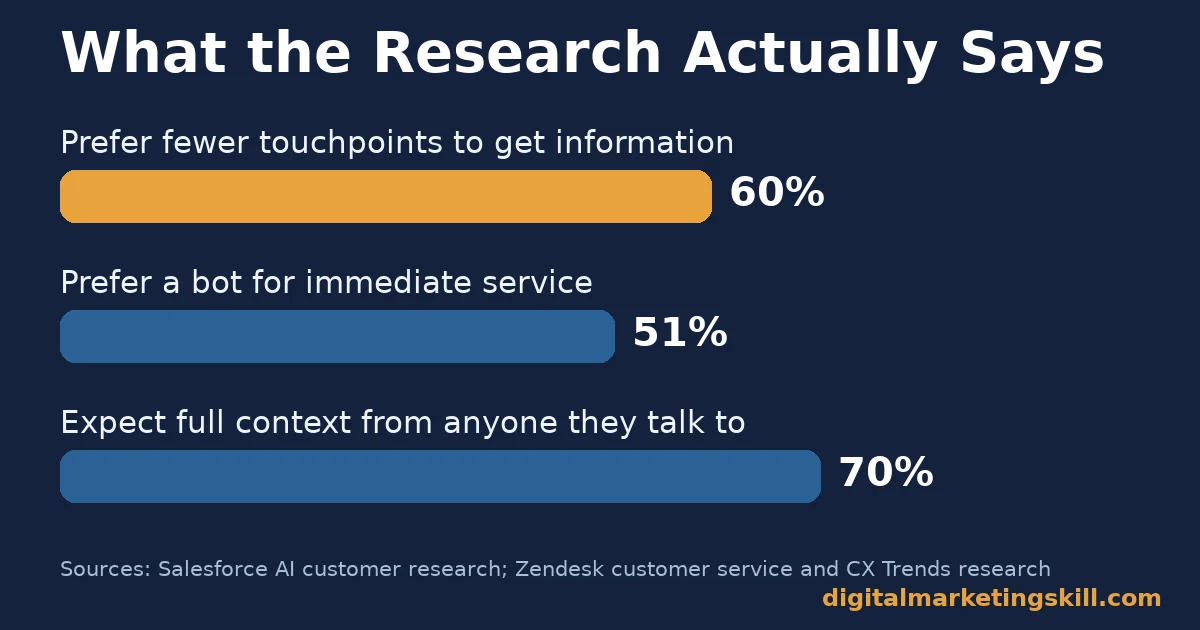
- 60% of consumers prefer using fewer touchpoints to get information or finish a task, which favours one live conversation over a multi-step form (Salesforce).
- 51% of consumers say they prefer interacting with a bot over a human specifically when they want immediate service (Zendesk).
- 70% of customers expect anyone they interact with to already have the full context of their situation, which a disconnected chat tool breaks immediately (Zendesk).
- 69% of consumers expect consistent interactions across departments, which conversational marketing can break if chat and email stay disconnected (Salesforce).
- Over 200 million businesses now run customer and marketing conversations through WhatsApp Business every month, per Meta’s own figures reported through DataReportal.
In this guide
- What Most Conversational Marketing Advice Misses
- How Conversational Marketing Actually Works
- What Differs by Channel
- Live Chat: Built for High-Intent, Time-Sensitive Questions
- Chatbots: Built for Repetitive, High-Volume Questions
- Social Media DMs: Built for Discovery, Not Decisions
- Messaging Apps: Built for Conversations People Already Have Open
- Personalisation: Lead With What the Visitor Already Told You
- Human Handoff: Lead With a Visible, Fast Escalation
- How to Build a Conversational Marketing Programme
- Common Conversational Marketing Mistakes
- How to Measure Conversational Marketing
- The One Decision Rule Worth Following
- A Real Case: Deflection That Actually Worked
- Frequently Asked Questions About Conversational Marketing
- Where to Go From Here
What Most Conversational Marketing Advice Misses
Most conversational marketing guides sell the channel, not the trade-off. They list the tools: live chat, chatbots, messaging apps. Few explain when a real-time conversation actually out-performs a traditional funnel, and when it just adds noise.
Two limits are worth naming early. First, public conversion figures for conversational channels almost always come from companies already running a mature programme. That flatters the average business considering the switch. Second, “conversational” does not mean “instant and unstaffed.” A live chat widget nobody answers for six hours is worse than a well-written form, because it sets an expectation and then breaks it.
Bot, Human, or Both
Not every conversational channel needs a person behind it. Not every one should run fully unattended either. A scripted bot follows fixed branches. It is predictable and cheap, but breaks the moment a visitor asks something outside the script. A human on live chat can improvise, but costs staff hours.
Most working programmes blend both. A bot handles the predictable first layer. A person takes the fast handoff for anything it cannot resolve. The split is not fixed. A pricing page often needs more human coverage than a product FAQ page, because the stakes are higher there.
How Conversational Marketing Actually Works
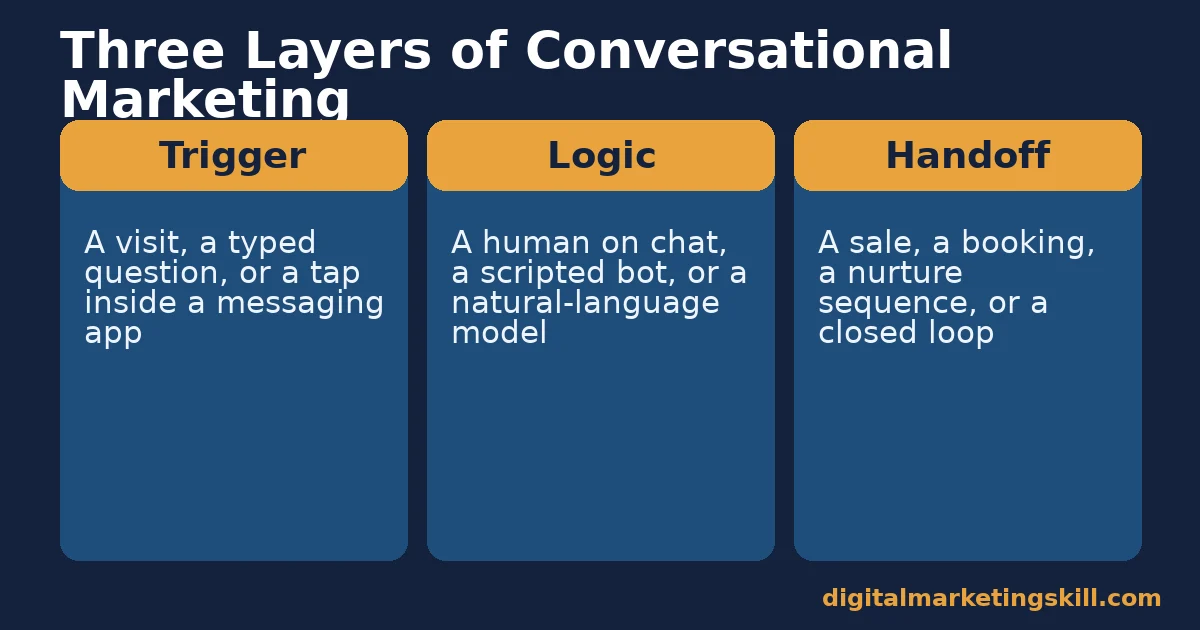
Conversational marketing has three layers, the same as any automated dialogue system. First, a trigger: a visit, a typed question, or a tap inside a messaging app. Second, a logic layer: a live human on chat, a scripted bot, or a model using natural language processing to read free text. Third, a handoff: to a sale, a booking, a nurture sequence, or a closed loop if the question is answered.
What separates it from older inbound marketing is sequencing. A traditional funnel captures an email address first, then starts a conversation later, often days later. Conversational marketing starts the conversation first. It only asks for contact details once genuine interest is confirmed. That order matters. 60% of consumers already say they prefer fewer touchpoints to get information, according to Salesforce. Every extra step between a question and an answer is friction a buyer did not ask for.
The trigger that starts a conversation matters more than most teams realise. A generic “chat with us” bubble that fires on every page, the instant someone lands, produces a flood of low-intent conversations. A trigger tied to real intent works better. Think dwell time on a pricing table, or a second visit to the same product page. Narrower triggers produce fewer, more relevant conversations.
What Differs by Channel
Live Chat: Built for High-Intent, Time-Sensitive Questions
Live chat, staffed by a person, works best for the questions a buyer asks right before deciding: a pricing edge case, a compatibility question, a delivery deadline. The value is a real answer from someone who can improvise. The cost is staffing. A chat widget with no one behind it is a liability, not a feature. It invites a question, then ignores it.
Chatbots: Built for Repetitive, High-Volume Questions
Chatbot marketing solves a different problem: volume. A scripted or AI-driven bot answers the same ten questions for the thousandth visitor as well as it did for the first, without a wait. The trade-off is nuance. 51% of consumers say they prefer a bot specifically for immediate service, per Zendesk. That is a vote for speed, not for depth. Route anything outside a bot’s narrow script to a human fast.
A bot that tries to fake depth does more damage than one that admits defeat. Guessing at a question it was not built to handle is worse than simply offering a handoff.
Social Media DMs: Built for Discovery, Not Decisions
A direct message on a social platform usually starts earlier in the journey than live chat or a chatbot on your own site. The person has not yet committed to visiting your website; they are still browsing a feed. Treat a social DM as a discovery-stage conversation: answer the immediate question, then invite the person to continue somewhere better suited to a decision, like your site or a messaging app thread. Trying to close a sale entirely inside a social DM thread usually fails, because the platform was not built for that depth of conversation. Social platforms also change their own messaging rules often, so treat any automation built there as more fragile than automation on channels you control directly.
Messaging Apps: Built for Conversations People Already Have Open
A business conversation inside WhatsApp, through tools like WhatsApp Business, or a similar app meets a buyer inside a thread they already check daily. That beats asking them to open a new browser tab. Meta’s own figures, reported through DataReportal, put monthly WhatsApp Business usage above 200 million companies. The advantage is familiarity. The limit is that you are a guest inside someone else’s app, bound by its rules on opt-in and message frequency.
Personalisation: Lead With What the Visitor Already Told You
A conversational tool that forgets what a visitor just said is worse than no conversation at all. 70% of customers expect anyone they talk to, bot or human, to already have the full context of their situation, according to Zendesk’s CX Trends research. The fix is simple in principle: carry context (the page visited, the question asked, the plan viewed) from one message to the next. Do not greet a returning visitor with the same opening line every time.
Human Handoff: Lead With a Visible, Fast Escalation
Every conversational channel eventually hits a question it cannot answer. 69% of consumers expect consistent interactions across departments, per Salesforce’s customer research. That means the handoff from bot or chat to a human has to carry the conversation history with it, not restart from zero. Making a visitor repeat themselves, after a bot already gathered their details, is the fastest way to turn a good first impression into a bad one.
How to Build a Conversational Marketing Programme
A conversational marketing programme succeeds or fails on five decisions. The tool you pick matters far less. Teams that start by comparing chat vendors, before answering any of the five questions below, tend to end up with an expensive tool pointed at the wrong pages.
1. Map Where Conversation Beats a Form
Not every page needs a chat widget. Map your funnel. Find the moments where a visitor is genuinely stuck or deciding: a pricing page, a comparison page, a cart. Put conversation there first. Leave simpler pages with a plain form. A simple way to spot these moments: look at where visitors abandon a session without converting, and without an obvious reason why. That drop-off point is usually where a quick answer would have kept them moving.
2. Staff to the Reality, Not the Ambition
Decide honestly how many hours a day a human can realistically answer chat. Outside those hours, either hand off to a scripted bot with a clear “we’ll reply by” message, or hide the widget entirely. A visible chat bubble with no one behind it damages trust faster than offering no chat at all. If staffing is thin, cover one or two pages well rather than the whole site poorly. A smaller footprint that always answers beats a wide footprint that sometimes does.
3. Script the Bot Narrow, Not Broad
If a bot is part of the mix, give it one job: qualify a lead, answer a fixed list of questions, or book a slot. A bot that tries to do everything fails at all of it, and frustrates the 51% of visitors who chose it specifically for a fast, simple answer.
4. Carry Context Across the Handoff
Build the handoff so a human agent sees what the bot or chat already learned: the question asked, the page viewed, the plan discussed. This single step answers both the context expectation and the consistency expectation behind the 70% and 69% figures above.
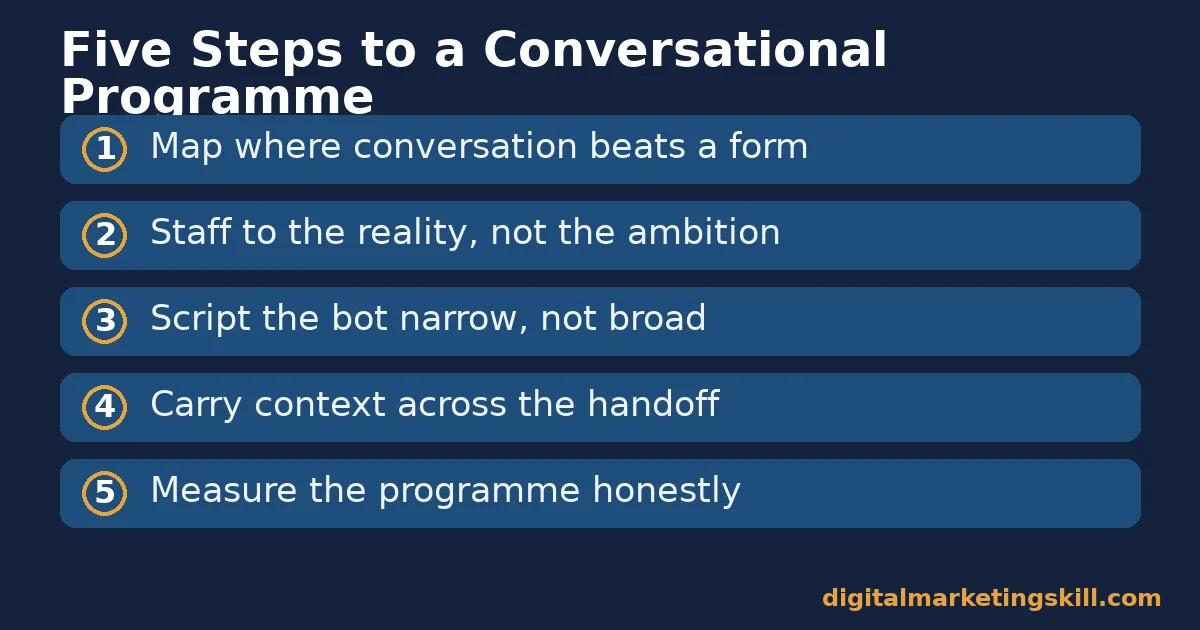
5. Measure the Programme Honestly
Track whether conversational channels convert visitors who would not have filled out a form anyway. Do not just count every chat as a win. A channel that cannibalises form conversions, without adding net new ones, is not succeeding, even if the transcript count looks impressive.
Common Conversational Marketing Mistakes
Launching an Unstaffed Chat Widget
The most common mistake is turning on a chat widget without committing staff hours to answer it. A question that sits unanswered for hours sets an expectation of immediacy, then breaks it. That damages trust more than a simple contact form ever would.
Conversational Amnesia
The second mistake is a tool that forgets everything between sessions. A returning visitor who already told the bot their budget and timeline should never be asked the same two questions again. Every repeat question costs trust, especially given how many consumers now expect consistent, joined-up service. Fixing this is rarely a technology problem. Most platforms already support carrying a visitor’s prior answers forward. The gap is usually a process one: nobody assigned the task of checking whether the handoff actually passes that data along.
Putting Chat Everywhere at Once
The third mistake is launching conversational marketing sitewide on day one. Start on the two or three pages where visitors are genuinely deciding. Prove it works there. Then expand. A widget on every page, including a blog archive, mostly adds noise. It also spreads a small team thin across low-intent pages, which is exactly the staffing trap the earlier illustrative scenario describes.
How to Measure Conversational Marketing
Three numbers matter more than raw chat volume. Net-new conversion rate is the share of conversations that convert a visitor who would not have filled out a form, isolated with an A/B test or a holdout page without chat. First-response time is how long a real question waits before a human or bot responds. Track the actual distribution, not just the average, since a few very slow replies can hide inside a good-looking mean. Escalation quality is the satisfaction score given specifically to conversations that moved from bot or chat to a human. It tells you whether your handoff carries context or starts over.
Review these three together monthly. A rising conversation volume with a flat net-new conversion rate usually means the channel is cannibalising form leads, not creating new ones. There is a fourth, softer signal worth tracking too: repeat-question rate, or how often a human agent has to ask something the bot or chat already collected. When that number is high, it points straight back to a broken handoff, even when the other three metrics look fine.
The One Decision Rule Worth Following
Put conversation only where a visitor is already stuck or deciding. Measure it against a form, not against nothing. Here is an illustrative, invented example. Picture a business adding chat to its pricing page only. If net-new conversions rise 15% over a holdout period with no chat, that is a real win worth keeping. If chat volume is high but net-new conversions barely move, the channel is just relabelling conversions that would have happened anyway. The budget is better spent staffing fewer, higher-intent pages well.
A second illustrative scenario makes the same point from the staffing side. Picture a team that adds live chat across the entire site instead of just the pricing page. Volume triples. But most of the new conversations are simple questions a help page already answered. Meanwhile, the team’s higher-intent pricing-page conversations now wait longer for a reply, because agents are stretched thin. Expanding coverage without expanding staff usually makes the highest-value conversations worse, even while the total conversation count looks like a win on a dashboard.
A Real Case: Deflection That Actually Worked
A beauty and wellness company using Zendesk’s AI-assisted conversational tools resolved 44% of incoming customer requests through automation, cut average resolution time by 87%, and lifted customer satisfaction to 92%, according to Zendesk. The company targeted its highest-volume, most repetitive requests first, rather than trying to automate every type of conversation at once. That is the same narrow-scope principle behind the decision rule above.
The lesson generalises beyond customer service. Domino’s Pizza built its ordering chatbot around one job only: placing and tracking an order inside a chat window. It did not try to also handle loyalty, feedback, and support in the same thread. Both cases point the same way. A conversational channel that does one job completely outperforms one that tries to do several jobs at once.
Frequently Asked Questions About Conversational Marketing
What is conversational marketing in simple terms?
It is using real-time, two-way dialogue, through live chat, a chatbot, or a messaging app, to answer questions and move a visitor toward a decision, instead of making them wait for an email reply to a form.
Is conversational marketing the same as chatbot marketing?
No. Chatbot marketing is one channel inside conversational marketing. Conversational marketing also includes staffed live chat and messaging-app conversations run by a human.
Does conversational marketing replace traditional lead forms?
Not entirely. It replaces forms on the pages where a visitor is actively deciding and has a specific question. Simpler pages, like a newsletter signup, often still convert fine with a plain form.
What is the biggest risk of conversational marketing?
An unstaffed or forgetful tool. A chat widget nobody answers, or a bot that forgets what a returning visitor already said, damages trust faster than simply not offering chat.
How do you measure conversational marketing without overcounting chats?
Isolate net-new conversions with an A/B test or a holdout page, rather than counting every chat conversation as a win. A high chat volume with flat net-new conversions means the channel is relabelling conversions, not creating them. Run the comparison for at least a few weeks, since early results on a brand-new channel are often noisy either way.
Should a small business start with live chat or a chatbot?
Start with whichever you can realistically staff or script narrowly. A bot answering a fixed list of questions on one page is cheaper to launch reliably than live chat you cannot cover during business hours.
Does personalisation really change conversational marketing results?
It can. A large majority of consumers expect a personalised, context-aware interaction. Carrying context across a conversation, what a visitor already asked or viewed, is one of the simplest ways to meet that expectation without new technology.
What size business should consider conversational marketing?
Any size, scaled to what it can staff. A solo business can run a single scripted bot on one landing page. A larger team can staff live chat during business hours and script a bot for the rest. The principle, narrow scope first, applies at every size.
Can conversational marketing work on social media, not just a website?
Yes, but treat it as an earlier stage of the funnel. A direct message answers a quick question and moves the conversation somewhere built for a decision, like your site or a messaging app, rather than trying to close a sale entirely inside the social platform’s own chat window.
How long should a business wait before expanding conversational marketing to more pages?
Long enough to see whether net-new conversion rate, not just conversation volume, actually moved on the first page you tried. A few weeks of real traffic is usually enough to tell the difference between a genuine lift and noise.
Where to Go From Here
Conversational marketing works best as one well-staffed or well-scripted piece of a wider strategy. It sits alongside marketing automation and structured lead generation, not as a replacement for either.
If you want structured, hands-on training in how these pieces fit together, the Master Diploma in Digital & AI Marketing at Digital Marketing Skill Institute is built around four AI-powered tracks. Together they cover ten execution-first courses, including AI-Powered Lead Generation and Email Automation and AI-Powered Social Media Management and Advertising, with a Full Stack option for completing all four. Every track includes unlimited one-on-one coaching and mentoring, plus a U.S. Project Internship with a verified U.S. Work Reference Letter. The program is dual US and UK accredited, recognised in more than 100 countries, and fully online. You can study and apply it anywhere in your country.
See the full Master Diploma program, read outcomes on the reviews page, or browse more guides on the blog. Wherever you live, you can apply here to get started, or learn more at digitalmarketingskill.com.
Every figure in this guide was checked against its original source before publication. Figures marked as illustrative are invented examples, not real results.
