
Retargeting ads are online ads shown to people who already visited your website or app but left without converting. A tracking pixel adds each visitor to a list. Ad platforms then show that list your retargeting ads as they browse elsewhere. Done well, retargeting ads recover lost interest instead of chasing cold strangers.
Key Takeaways
- Most visitors leave before buying. Baymard Institute’s analysis of 50 separate studies puts the average online cart abandonment rate at 70.22%. So most retargeting audiences start large by default.
- Cookie-based retargeting is not going away soon. Google confirmed it is keeping third-party cookies available in Chrome by default, rather than removing them as once planned. Pixel-based retargeting ads still work for now.
- Retargeting ads run on list membership, not guesswork. Google’s own remarketing documentation describes showing ads to past visitors “as they browse sites and apps” across more than 2 million websites and apps in its network.
- Frequency, not just reach, decides whether retargeting ads help or annoy. A list with no cap on how often the same person sees an ad turns a reminder into a nuisance.
- Not every abandoned visit has the same cause. Price doubts, a confusing checkout and simple distraction all produce the same “left without buying” signal, but they need different retargeting ads in response.
In this guide
- What Most Retargeting Ads Guides Get Wrong
- How Retargeting Ads Actually Work
- Three Retargeting Approaches, Three Different Jobs
- How to Run Each Type of Retargeting Ads Well
- How to Measure Whether Retargeting Ads Are Actually Working
- The One Rule: Match the Offer to the Reason They Left
- A Real Case: How Google’s Own Remarketing System Is Built
- Frequently Asked Questions About Retargeting Ads
- Where to Learn Retargeting Ads and the Rest of Digital Marketing Properly
What Most Retargeting Ads Guides Get Wrong
Most articles describe retargeting ads as one tactic. Put a pixel on your site, build a list, show ads. That is the mechanism. It skips the part that decides whether retargeting ads help a business or waste its budget. That part is matching the right message to the right kind of abandoned visit.
A few ground rules first. The cart abandonment figure below is a cross-study average that Baymard Institute compiles from 50 separate studies. Treat it as a broad industry snapshot, not a number that applies exactly to any one store.
The cookie policy note reflects Google’s own stated plans at the time of writing. Ad platforms change these policies, so confirm the current status before building a strategy that depends on it.
This distinction between tactic and strategy matters. Retargeting is one of the few ad formats where doing nothing beats doing it badly. A cold-audience ad that underperforms simply wastes money on strangers who were never likely to buy. A retargeting ad that underperforms actively damages how a warm, interested audience feels about your brand. You keep showing up in front of people who already know who you are.
How Retargeting Ads Actually Work
Retargeting ads run on three parts working together: a tracking pixel, an audience list, and an ad auction.
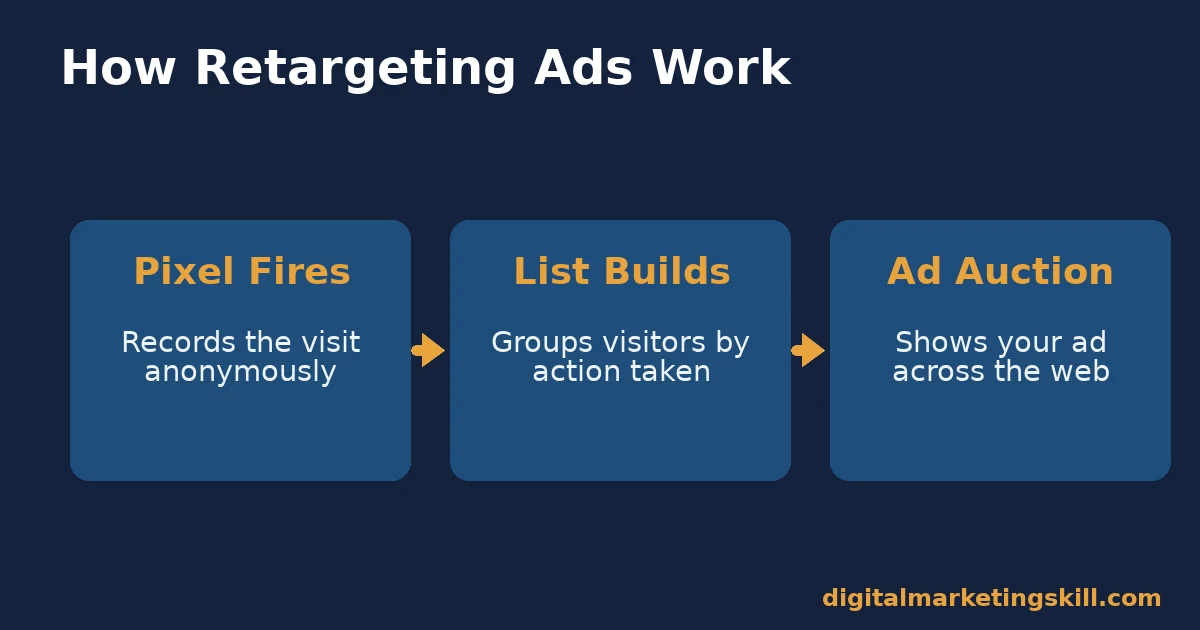
The pixel is a small piece of code placed on your website. When a visitor loads a page, the pixel fires. The ad platform records that visit, usually against an anonymous browser identifier rather than a name.
Over time, this builds an audience list of people who did something specific. Maybe they viewed a product page, or started checkout without finishing.
Most platforms let you build separate lists for separate actions. A visitor who only viewed your homepage can sit in a different list from one who added an item to a cart. That matters once you message each group differently.
The list then feeds an ad auction, the same mechanism behind any pay-per-click advertising campaign. When someone on your list later visits a site or app that shows ads from that network, your retargeting ad competes to be shown to them. It works the same way a cold-audience ad would. The difference is that the platform already knows this person has shown real interest.
Google’s own remarketing documentation describes this as showing ads “to your past visitors as they browse sites and apps” across a network of more than 2 million sites and apps. That scale is why a single retargeting list can follow a visitor across much of the web.
Cookie policy matters so much to retargeting specifically because of how that pixel works. Google had planned to remove third-party cookies from Chrome, which would have broken a large share of cross-site retargeting ads. It later confirmed it is keeping third-party cookies available by default instead.
That keeps today’s retargeting setups working. But it is a policy position, not a permanent guarantee, so recheck it before you build a strategy that assumes nothing will change.
List size alone is a weak measure of retargeting health. A list built from every single site visitor is mostly noise, including people who bounced off the homepage in two seconds.
A smaller list is different: people who viewed a specific product, added something to a cart, or spent real time on a page. That smaller list is far more valuable per member, even though the headline number looks smaller on a dashboard.
Three Retargeting Approaches, Three Different Jobs
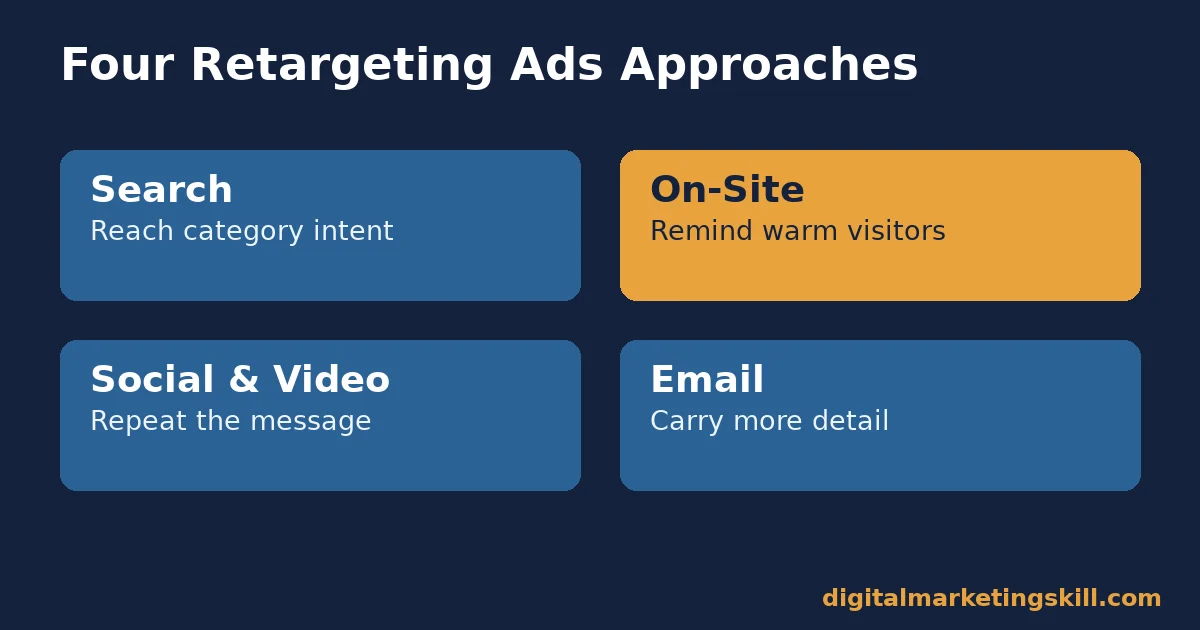
Not all retargeting ads should carry the same message. Four common approaches suit four different situations, based on how much the visitor already showed you about what they want.
Search Retargeting: Built For Intent Signals
Search retargeting shows ads to people based on search terms related to what you sell, rather than a visit to your own site. It works best when you want to reach people who have shown interest in your category but have not found you yet. The message needs to introduce you, not just remind them.
On-Site Visitor Retargeting: Built For Warm Leads
This is the classic form of retargeting ads: people who visited your website, viewed specific pages, or started checkout. These visitors already know who you are. The message can be direct, referencing the exact product or page they looked at rather than a generic offer.
Social and Video Retargeting: Built For Repetition
Platforms such as social feeds and video sites let an ad appear multiple times in a short period. That suits reminding rather than persuading. This approach works best for reinforcing a message someone has already half-decided on, rather than introducing something new.
Email Retargeting: Built For Context
Email retargeting uses a past interaction, such as an abandoned cart or an opened-but-unclicked email, to trigger a follow-up message. It arrives in an inbox rather than mixed into a feed. That means it can carry more detail than a display ad, such as the exact item left behind and a direct link back to it.
A Factor That Cuts Across All Four Approaches
Budget allocation sits underneath whichever approach you pick. Retargeting audiences are smaller than cold audiences, so spend tends to run out fast on a narrow list. A popular product page might only generate a few hundred weekly visitors to retarget, which limits how much a platform can spend efficiently before frequency climbs too high.
Pair a tightly defined retargeting list with a modest, capped budget. Move the remaining spend to broader prospecting, rather than force-feeding the same small list more impressions than it can usefully absorb.
How to Run Each Type of Retargeting Ads Well
Each approach needs a different message and a different trigger. Mismatching them is the most common reason retargeting ads underperform.
Search Retargeting: Lead With Category Relevance
Since these viewers have not visited your site, open with what you offer and why it fits their search, not a reminder of a visit that never happened. Treat the first ad like a first introduction, because for this audience, it is one. Strong creative matters even more here than for warm retargeting; our guide to Facebook ad setup covers the choices that shape first-impression ads on that platform specifically.
On-Site Retargeting: Lead With the Exact Item They Viewed
Show the specific product, service or page the visitor looked at, not a generic catalogue ad. Dynamic ad formats pull in the exact item a visitor viewed. They consistently outperform static, one-size-fits-all retargeting creative, because the ad matches something the visitor already chose to look at.
The same specificity matters on the page the ad sends them to. Our guide on landing page optimisation covers how to keep that promise once a visitor clicks through.
Social and Video Retargeting: Lead With a Frequency Cap
Set a hard limit on how many times the same person sees the ad in a given period. Many advertisers use somewhere between three and six times a week, depending on the platform and your audience size. Without a cap, repetition turns into the exact “stalking” feeling that makes people distrust a brand instead of returning to it.
Email Retargeting: Lead With the Specific Item and a Clear Next Step
Name the exact product or service left behind, show it again, and give one clear next step, whether that is finishing checkout or booking a call. A vague “we miss you” email wastes the one advantage email retargeting has over a display ad: room to be specific.
How to Measure Whether Retargeting Ads Are Actually Working
Retargeting can look successful on vanity metrics while actually losing money. Track these instead.
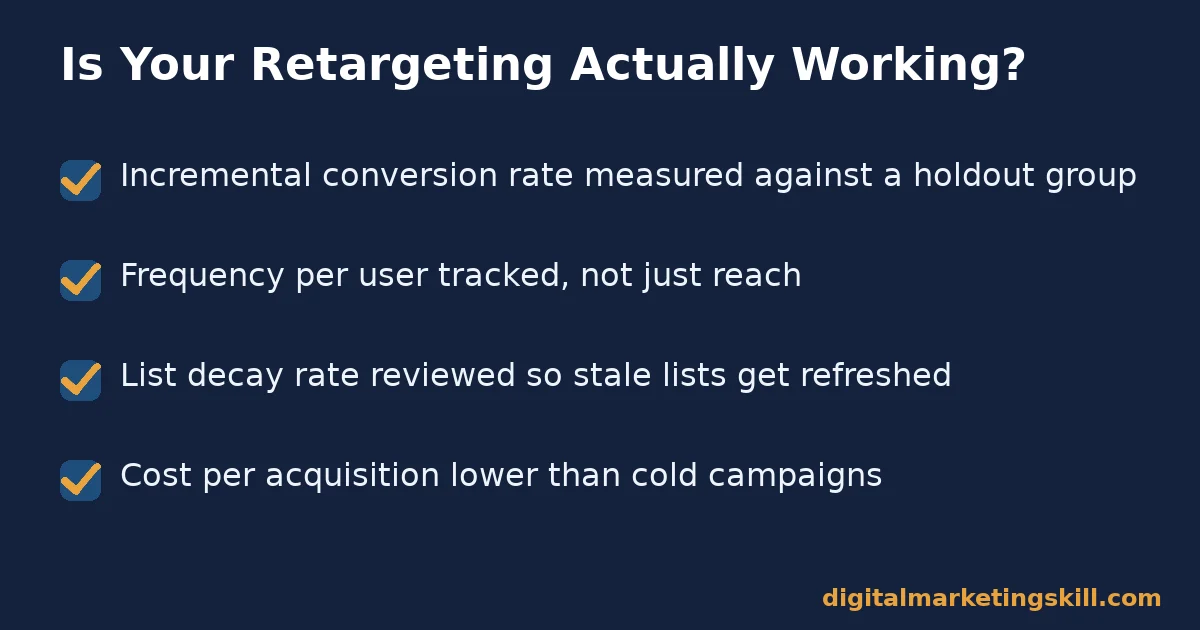
- Incremental conversion rate. Compare conversions from retargeted visitors against a holdout group who were not shown the ads. Without a holdout, you cannot tell how many of those buyers would have returned anyway.
- Frequency per user. How many times, on average, each person on your list saw the ad. Rising frequency with flat conversions is a sign you are paying to annoy the same people, not to convert new ones.
- List decay rate. How quickly people drop off your retargeting list without converting. A fast-decaying list means your follow-up window is too short, or your offer is not addressing the real reason they left.
- Cost per acquisition versus cold campaigns. Retargeting should cost less per conversion than reaching a cold audience, since the list already contains warmer prospects. If it does not, the targeting or creative needs attention.
How to Read These Numbers Together
A low cost per acquisition with rising frequency is often a false positive. You may simply be capturing sales that would have happened anyway, at a discount you did not need to offer. Pair cost metrics with the incremental conversion rate before declaring retargeting ads a success. Our guide on conversion rate optimisation covers how to read these numbers across a full funnel, not just the retargeting stage.
Looking at the whole funnel matters for another reason too. It stops a retargeting win from hiding a bigger leak earlier in the journey. A slow page or an unclear offer can turn visitors away before they ever reach your list.
The One Rule: Match the Offer to the Reason They Left
If there is a single decision rule for retargeting ads, it is this: find out why the visitor left before you decide what to show them again. The same generic ad cannot fix three different problems.
As an illustrative, invented example: someone who abandoned checkout at the shipping cost step needs a different message than someone who abandoned on a product page after comparing options. The first might respond to a free-shipping threshold. The second needs reassurance or a comparison, not a discount.
Showing the same price-cut ad to both wastes budget. It wastes budget on the first group, and it trains the second group to wait for a markdown every time.
Finding the reason does not require guesswork. A few checks surface the real reasons quickly. Try a short on-site survey triggered at checkout exit, a look at where in the funnel people drop off, and a review of support tickets about pricing or shipping. Build your retargeting ads around those reasons, rather than a single generic discount aimed at everyone.
This example is illustrative. It shows how the reasoning works, not a claim that these are the only two reasons people abandon a purchase. Your own funnel data will surface different patterns depending on what you sell, who buys it, and how long a typical decision takes.
A Real Case: How Google’s Own Remarketing System Is Built
Rather than a single company story, the clearest documented case of retargeting ads at scale is the system itself. Google’s own support documentation explains how this works. Its remarketing lists, now folded into what it calls “your data” segments, let advertisers “show ads to your past visitors as they browse sites and apps.” That network spans more than 2 million websites and apps, plus YouTube and other Google products.
That scale is exactly why list hygiene and frequency limits matter so much in practice. Imagine a list built from every single site visitor, shown an identical ad an unlimited number of times across two million destinations. That is the fastest way to turn retargeting ads from a useful tool into an intrusive, repetitive ad experience that damages a brand rather than helping it.
The lesson scales down to any business running retargeting ads, regardless of budget. The infrastructure that makes retargeting possible is identical whether a campaign spends a small daily budget or a large one. Either way, it reaches the same person across millions of destinations.
What differs is discipline: how tightly the list is defined, how low the frequency cap is set, and how quickly underperforming segments get removed rather than left running on autopilot.
A business running five small, well-defined retargeting lists with sensible caps will usually outperform one giant list on autopilot. That holds even at the same total spend. Every impression in the smaller setup reaches someone the message actually fits.
Frequently Asked Questions About Retargeting Ads
What is the difference between retargeting and remarketing?
The terms are often used interchangeably, though some marketers draw a line. Retargeting usually refers to paid ads shown to past website visitors, while remarketing more often describes re-engaging past customers through email. In practice, most platforms, including Google, now use the terms loosely across both. Whichever word a platform uses, the underlying mechanism stays the same: a list built from past interactions.
Do retargeting ads still work with privacy changes?
Cookie-based retargeting ads still work in most major browsers, since Google has kept third-party cookies available in Chrome rather than removing them as once planned. Privacy rules and platform policies change, though, so check the current status of cookie support before relying on it long-term.
How long should someone stay on a retargeting list?
It depends on your typical sales cycle. A list membership window that matches how long people usually take to decide works better than a fixed default. A long consideration purchase needs a longer window than an impulse buy, and a list left open indefinitely just accumulates people who were never going to return.
Are retargeting ads annoying to customers?
They can be, if frequency is not capped. Research on cart abandonment shows people leave for many reasons, including simply not being ready yet. A retargeting ad that respects a sensible frequency limit reads as a helpful reminder, while an uncapped one reads as surveillance.
Can small businesses afford retargeting ads?
Yes. Retargeting ads typically target a smaller, warmer audience than cold campaigns, so budgets can be modest. Most major ad platforms let you start with a small daily budget and scale up once you see which message and list combination performs.
What is a good frequency cap for retargeting ads?
There is no universal number, but many advertisers start around three to six impressions per person per week and adjust from there based on how the incremental conversion rate responds. If conversions flatten while frequency keeps climbing, the cap is set too high.
Should every abandoned visitor get a discount?
No. A discount only makes sense when price is the actual reason someone left, and for many visitors it is not. Offering a markdown to someone who abandoned for an unrelated reason, such as needing to compare options elsewhere first, just trains them to expect a discount on every future visit.
How are retargeting ads different from a cold prospecting campaign?
A cold campaign reaches people who have never interacted with your brand, so it has to earn attention from nothing. Retargeting ads reach people who already took some action, such as a visit or a cart add, so the message can reference that action directly instead of starting a conversation from scratch.
Where to Learn Retargeting Ads and the Rest of Digital Marketing Properly
Retargeting is one skill inside a much larger toolkit. The Master Diploma in Digital & AI Marketing at Digital Marketing Skill Institute is built around four AI-powered tracks: AI-Powered Social Media Management and Advertising, AI-Powered Lead Generation and Email Automation, AI-Powered Google Specialist, and AI-Powered WordPress and SEO Specialist. Together they total ten courses, with a Full Stack option for completing all four.
The programme includes unlimited one-on-one coaching and mentoring, and a U.S. Project Internship with a verified U.S. Work Reference Letter. You practise running and measuring real retargeting ads and other campaigns, not just reading about frequency caps and list hygiene in theory.
That hands-on practice matters here. Retargeting mistakes are easy to make and expensive to leave running unnoticed. A frequency cap set too high, or a list left stale for months, can quietly burn through an ad budget long before anyone checks the numbers closely.
The programme is dual US and UK accredited, recognised in more than 100 countries, and delivered 100% online, so you can study from anywhere in your country. There are no income or job guarantees attached to any of this; see the Institute’s earnings disclaimer for the full context behind any student outcome you read elsewhere.
For the full course breakdown, visit the Master Diploma programme page, browse more guides on the blog, or go straight to the application page when you are ready to build retargeting ads and campaigns that convert, wherever in your country you are working from.
Every figure in this guide was checked against its original source before publication. Figures marked as illustrative are invented examples, not real results.
