
A digital marketing strategist plans and oversees a company’s online marketing. They decide which channels, campaigns and messages will meet a business goal, then direct the specialists who execute each part. The role sits above execution and below the C-suite, turning research and data into a plan other marketers can run.
Key Takeaways
- The closest US government job category pays well above average. The Bureau of Labor Statistics reports a median annual wage of $165,780 for marketing managers, the closest official category to this role. Pay varies by employer and experience.
- Demand is growing, but unevenly. The BLS projects 7% growth for marketing managers through the next decade. The narrower advertising and promotions manager category is expected to shrink by 4%.
- Freelancing is a real path, not a fallback. Upwork’s Freelance Forward research found 47% of US freelancers, around 30 million people, provide skilled knowledge services. Marketing is one of them, alongside IT and consulting, not just gig work.
- The job is strategic, not just technical. A digital marketing strategist spends more time on research, planning and coordination than on hands-on execution. One channel rarely occupies most of their week.
- Google judges content the same way strategists should judge their own plans. Its guidance on helpful content asks whether a reader will “leave feeling they’ve learned enough,” a useful bar for any strategy document too.
In this guide
- What Most “Digital Marketing Strategist” Guides Skip
- What a Digital Marketing Strategist Actually Does
- Three Places Digital Marketing Strategists Work
- How to Break Into Each Path
- The Skills That Actually Matter
- The One Rule: Specialize First, Generalize Second
- A Real Case: How the US Government Classifies This Job
- Frequently Asked Questions About Digital Marketing Strategists
- Where to Build the Skills Behind This Career
What Most “Digital Marketing Strategist” Guides Skip
Most guides to this role list tasks: run an audit, build a strategy, manage a team. That is accurate. But it skips the part that actually separates a strategist from a channel specialist. That part is deciding what not to do with a limited budget and a limited team.
A few ground rules first. The wage figures below come from the US Bureau of Labor Statistics, under the closest official job categories. “Digital marketing strategist” is not tracked as its own line item, so treat these as a US-specific guide, not a global number. The freelancing figures come from Upwork’s own research into its user base, a large sample but not a random one.
This distinction between task list and real skill matters, because the title gets used loosely. Some employers post “digital marketing strategist” for a senior specialist role. It is really one channel with slightly more authority, not true strategy. The version this guide describes is the broader one: someone who plans across channels and directs other people’s execution of them.
What a Digital Marketing Strategist Actually Does
The job runs on four stages that repeat in a loop, not a straight line.
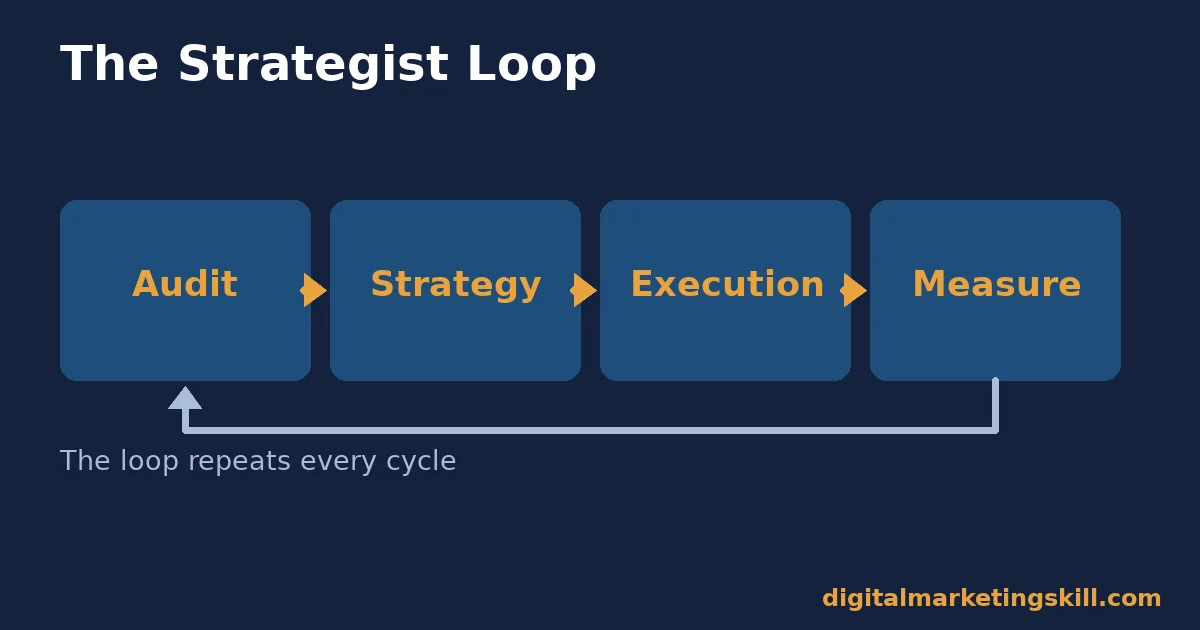
It starts with an audit. A strategist reviews what a business is already doing online, and what its competitors are doing. They find the gap between the two. This stage is research, not creativity. Skipping it is the most common reason a strategy fails before it starts.
Next comes the strategy itself: which channels to use, what each one needs to achieve, and how much budget and time each gets. A good strategy names trade-offs openly. A weak one tries to do everything at once and ends up doing nothing well.
Execution follows, but a strategist rarely does this part alone. They brief content writers, SEO specialists, paid media managers and social media teams. Then they check that each piece of work still matches the original plan. Strategy and coordination overlap most right here.
Finally, measurement closes the loop. A strategist reviews what worked, and reports it honestly even when results are mixed. That feeds back into the next audit. Without this step, a strategy is a one-time plan instead of a system that improves.
A Factor That Shapes Every Stage
Budget size changes how much of this loop one person can actually run. A strategist with a small budget and a tiny team often ends up doing some execution themselves, blurring the line between strategist and specialist.
A strategist with a larger budget and a full team of specialists can stay closer to pure planning and coordination. Neither version is wrong; they are different jobs that happen to share a title.
Ask about this directly in an interview. A question as simple as “what does my typical week look like” will usually reveal which version of the role you are actually being hired for.
Three Places Digital Marketing Strategists Work
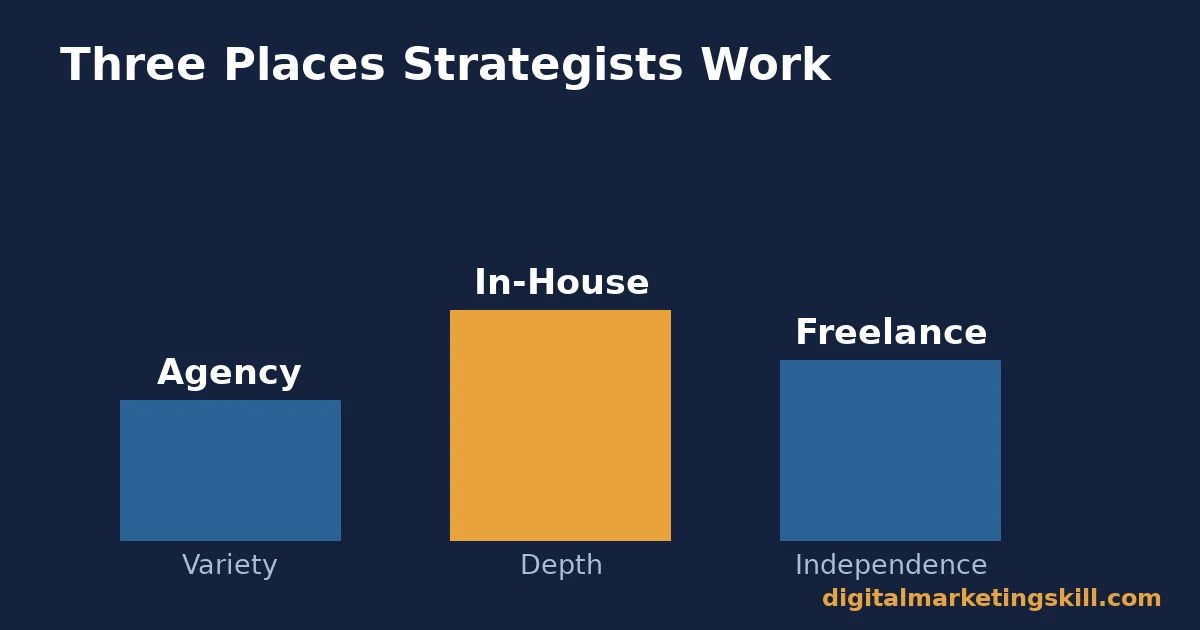
The job looks different depending on where you do it. Three settings cover most of the field. Each trades variety for depth in a different way.
Agency Strategist: Built For Variety
An agency strategist works across several client accounts at once, often in different industries. This builds broad experience fast, since you see many strategies succeed and fail in a short time. The trade-off is less depth in any one business, and a harder balance between multiple client deadlines. Agency turnover also tends to be higher than in-house turnover, so expect faster career movement in both directions, up and out.
In-House Strategist: Built For Depth
An in-house strategist works for a single company, often reporting to a marketing director or CMO. This path builds deep knowledge of one brand, audience and product line, at the cost of broad exposure.
In-house roles are also the ones closest to the BLS marketing manager category and its reported wage figures. Once you are in that position, our guide on how to negotiate your salary as a digital marketing professional is worth reading before your first review.
Freelance Strategist: Built For Independence
A freelance or consultant strategist serves several clients directly, without an agency between them. Upwork’s research found skilled marketing freelancers are a substantial share of the US freelance workforce, not a small niche.
This path offers the most control over client selection and schedule. It also carries the most responsibility for finding the next contract. There is no recruiter or sales team doing that work for you, which is the part most new freelance strategists underestimate before they start.
How to Break Into Each Path
Each path rewards a different first move, built on the same underlying skills.
Agency Strategist: Lead With a Varied Portfolio
Agencies hire for range. Build case studies across more than one industry if you can, even small ones. That shows you can adapt a strategy to a new business quickly.
Agency interviews often test this directly, asking how you would approach a business you have never seen before. Practise that exact exercise before an interview: pick an unfamiliar company, spend thirty minutes researching it, and sketch a one-page strategy outline. It is close to what you will actually be asked to do.
In-House Strategist: Lead With Depth in One Industry
In-house hiring teams want someone who already understands their world. A portfolio showing sustained work in, or deep research into, their specific industry carries more weight than broad but shallow experience. A strong digital marketing cover letter that names that industry knowledge directly, rather than reusing a generic template, also helps at this stage. Show how a strategy you ran changed over time, not just a single campaign snapshot.
Freelance Strategist: Lead With a Specific, Named Outcome
Freelance clients buy outcomes, not job titles. Lead with a specific, named result from past work, such as a defined increase in qualified leads or organic traffic. A general claim of “strategic experience” convinces no one.
A narrow, provable track record builds trust faster than a broad but vague one. Our guide on how to get digital marketing clients as a beginner covers outreach approaches that work well for this kind of proof-first pitch.
The Skills That Actually Matter
Technical skill in one channel is not enough on its own. These four areas separate strategists who get hired from those who stay stuck as specialists.
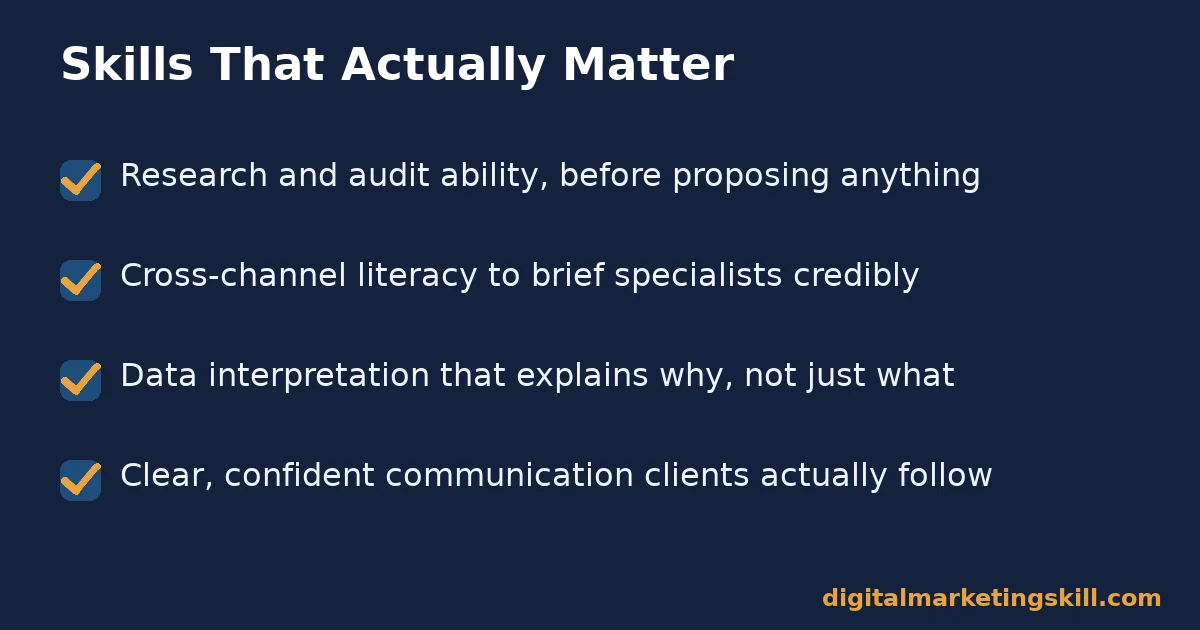
- Research and audit ability. Reading a competitor’s strategy from the outside, and honestly assessing your own client’s weak points, before proposing anything.
- Cross-channel literacy. Enough working knowledge of SEO, paid media, email, content and social to brief a specialist credibly, even without hands-on expertise in every one. Our guides on becoming an SEO expert and how to become a social media manager cover two of the channels a strategist is most often expected to brief.
- Data interpretation. Reading a dashboard is easy. Explaining what changed and why, in plain language a client can act on, is the actual skill.
- Clear, confident communication. A strategy only works if a client or internal team actually follows it. That depends on being understood, not just being right.
Proving These Skills Without a Job Title Yet
You do not need a strategist job title to build proof of these four skills. Run a real audit on a small business you know, even for free, and write it up properly.
Track the data from one of your own channels for three months. Explain the trend in plain language, as if a client were reading it. These small projects become real portfolio pieces, not hypothetical ones.
A free audit for a local business, documented properly with before-and-after numbers, often carries more weight in an interview than a certificate alone. It proves one thing a certificate cannot: that you can do the work, not just describe it.
How These Skills Work Together
No single skill on this list substitutes for the others. Strong data interpretation without clear communication produces a report nobody acts on. Strong communication without research produces a confident but wrong strategy. Hiring managers test for the combination, not any one skill in isolation.
This is also why junior hires sometimes struggle to move into strategist roles quickly. A junior specialist can be excellent at one skill from this list, usually research or a single channel’s data, without yet having practised the others under real pressure. The gap closes with time and deliberate practice, not just more years in a specialist seat.
The One Rule: Specialize First, Generalize Second
If there is a single decision rule for this career path, it is this: become genuinely good at one channel before trying to oversee all of them. A strategist who has never run a real SEO campaign or a real paid media budget is guessing at what specialists can realistically deliver.
As an illustrative, invented example: someone who spent two years running email marketing campaigns, then moved into a strategist role, will set more realistic timelines and budgets for an email specialist. Someone who only read about email marketing, but never ran a campaign themselves, will not. The credibility and the realism both come from the same place: direct experience.
This rule also explains why the fastest route to a strategist title is not always the best route to the actual job. Skipping the specialist stage can get someone a strategist job title sooner, but it leaves them unable to judge whether a specialist’s timeline or budget request is realistic. That gap shows up quickly once real campaigns are running.
A Real Case: How the US Government Classifies This Job
There is no official “digital marketing strategist” occupation code anywhere in the US Bureau of Labor Statistics system. The closest match is “advertising, promotions, and marketing managers,” a combined category the BLS tracks as two related roles. Marketing managers, the larger of the two at over 420,000 jobs, are projected to grow. Advertising and promotions managers, a smaller and more execution-focused category, are projected to shrink.
That split is itself a real-world data point about the industry. As a documented, government-tracked case, it shows a wider shift away from narrow, campaign-execution roles and toward broader, strategic ones. That is exactly the direction this role itself represents.
A government classification system updates slowly. Treat this as a lagging confirmation of a trend, not a leading indicator of where the field is headed next.
By the time an occupation split shows up this clearly in official statistics, the shift has usually already been visible in job postings and hiring patterns for several years. Anyone deciding whether to specialise or generalise today is better served by watching current job postings directly, rather than waiting for government data to confirm a trend they could already see.
Frequently Asked Questions About Digital Marketing Strategists
What is the difference between a digital marketer and a digital marketing strategist?
A digital marketer typically executes one or more channels directly, such as running ads or writing content. A digital marketing strategist plans the overall approach and coordinates the specialists who execute it, spending more time on research and direction than on hands-on production.
Do I need a degree to become a digital marketing strategist?
A bachelor’s degree in marketing, communications or a related field is the typical entry point the Bureau of Labor Statistics reports for marketing management roles. A strong portfolio and demonstrated results can substitute for formal education at many employers, especially smaller ones and agencies.
How long does it take to become a digital marketing strategist?
Most people spend two to four years working as a specialist in one or more channels before moving into a strategist role, since the job depends on having run real campaigns, not just studied them. Moving faster than that is possible, but it makes the credibility problem harder to solve.
Is digital marketing strategy a good career path?
The Bureau of Labor Statistics projects 7% growth for marketing managers over the next decade, faster than average for all US occupations. This is a US-specific figure, though, and growth varies by industry and region elsewhere.
Can you be a freelance digital marketing strategist?
Yes. Upwork’s research into the US freelance workforce found skilled marketing services are one of the largest categories of freelance work, alongside programming, IT and business consulting. Freelancing is an established path, not an unusual one.
What tools does a digital marketing strategist need to know?
Analytics platforms such as Google Analytics, a project management tool for briefing specialists, and familiarity with the reporting dashboards of whichever channels your strategy relies on, such as a search console or an ad platform’s own reporting. The specific tools matter less than being able to read and explain what the numbers mean.
Tools also change often. A strategist who learns the underlying logic of a dashboard, rather than memorising one interface, adapts faster when a platform redesigns its reporting or a client switches tools entirely.
Does a digital marketing strategist need to know how to code?
No. Coding is not a required skill for this role. A working understanding of how a website and its content management system function is useful for briefing technical specialists credibly.
Writing code yourself is not part of the job. Knowing enough to ask a developer the right question, and to understand their answer, is a very different skill from writing the code yourself. That is the one that actually matters here.
What does a typical week look like for a digital marketing strategist?
It usually mixes client or leadership meetings, reviewing campaign data from the previous week, briefing or checking in with specialists, and blocks of planning time for the next phase of a strategy. The exact mix shifts depending on whether a new strategy is being built or an existing one is being executed.
Is a digital marketing strategist the same as a brand strategist?
No, though the two roles overlap. A brand strategist focuses on identity, positioning and messaging consistency across every channel, including offline ones. A digital marketing strategist focuses specifically on the online channels that deliver and measure results. Some smaller companies combine both responsibilities into one role.
Can a digital marketing strategist work across multiple countries or time zones?
Yes, and many do. Most of the channels involved, such as paid search, social media and email, run on platforms that work the same way regardless of location.
The main adjustments are around local regulations, language and cultural context for messaging, rather than the underlying strategy process itself. The audit, strategy, execution and measurement loop described earlier in this guide works the same way whichever market you are planning for.
Where to Build the Skills Behind This Career
Becoming a strong digital marketing strategist starts with becoming genuinely skilled in individual channels first. The Master Diploma in Digital & AI Marketing at Digital Marketing Skill Institute is built around four AI-powered tracks: AI-Powered Social Media Management and Advertising, AI-Powered Lead Generation and Email Automation, AI-Powered Google Specialist, and AI-Powered WordPress and SEO Specialist.
Together they total ten courses, with a Full Stack option for completing all four, which builds exactly the cross-channel literacy a strategist role depends on.
The programme includes unlimited one-on-one coaching and mentoring, and a U.S. Project Internship with a verified U.S. Work Reference Letter, so you graduate with real campaign experience behind your strategy work, not just theory. That real experience is exactly what the specialize-first rule in this guide describes, built in before you ever need to lead a strategy of your own.
The programme is dual US and UK accredited, recognised in more than 100 countries, and delivered 100% online, so you can study from anywhere in your country. There are no income or job guarantees attached to any of this; see the Institute’s earnings disclaimer for the full context behind any student outcome you read elsewhere.
For the full course breakdown, visit the Master Diploma programme page, browse more guides on the blog, or go straight to the application page when you are ready to start building the specialist experience every strategist needs, wherever in your country you are based.
Every figure in this guide was checked against its original source before publication. Figures marked as illustrative are invented examples, not real results.
