
B2B lead generation fails for a boring reason more often than an exciting one. Follow-up is slow, forms ask for too much, and outreach is timed to the seller’s convenience, not the buyer’s. This guide covers how B2B lead generation actually works, what separates inbound from outbound tactics, and how to measure whether your pipeline is healthy, not just busy.
Key Takeaways
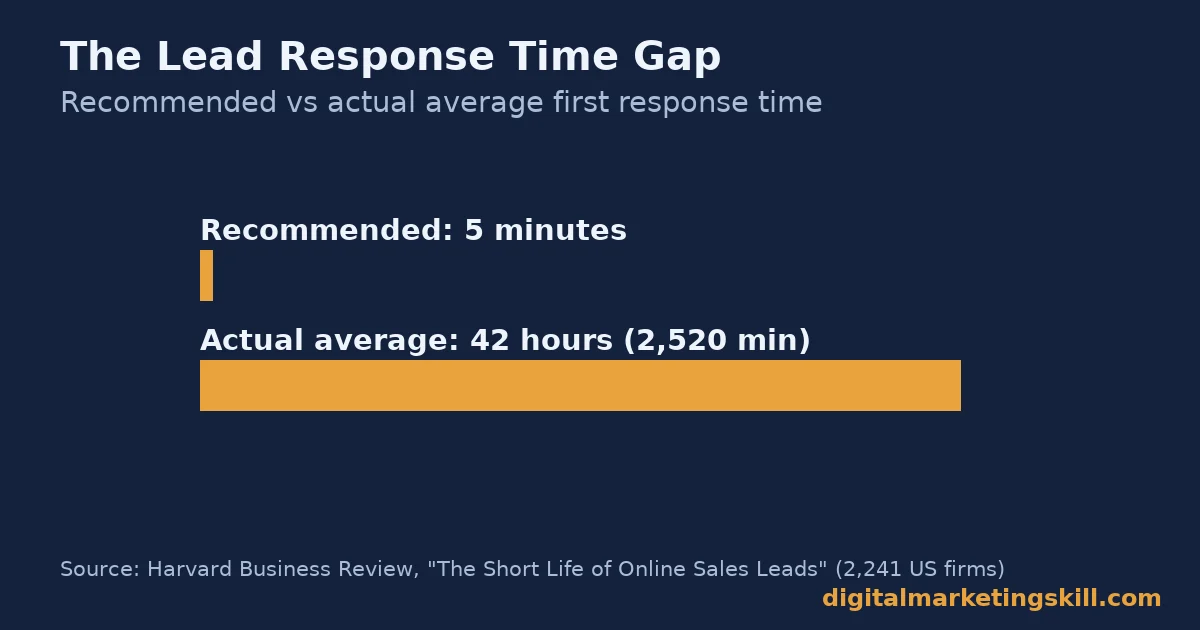
- Companies that contact a lead within 5 minutes convert far more often than those that wait 30 minutes. Yet the average US company takes 42 hours to respond (Harvard Business Review study of 2,241 firms).
- LinkedIn’s own benchmark data shows Lead Gen Forms convert at roughly 13%, compared to about 4.7% for standard landing pages.
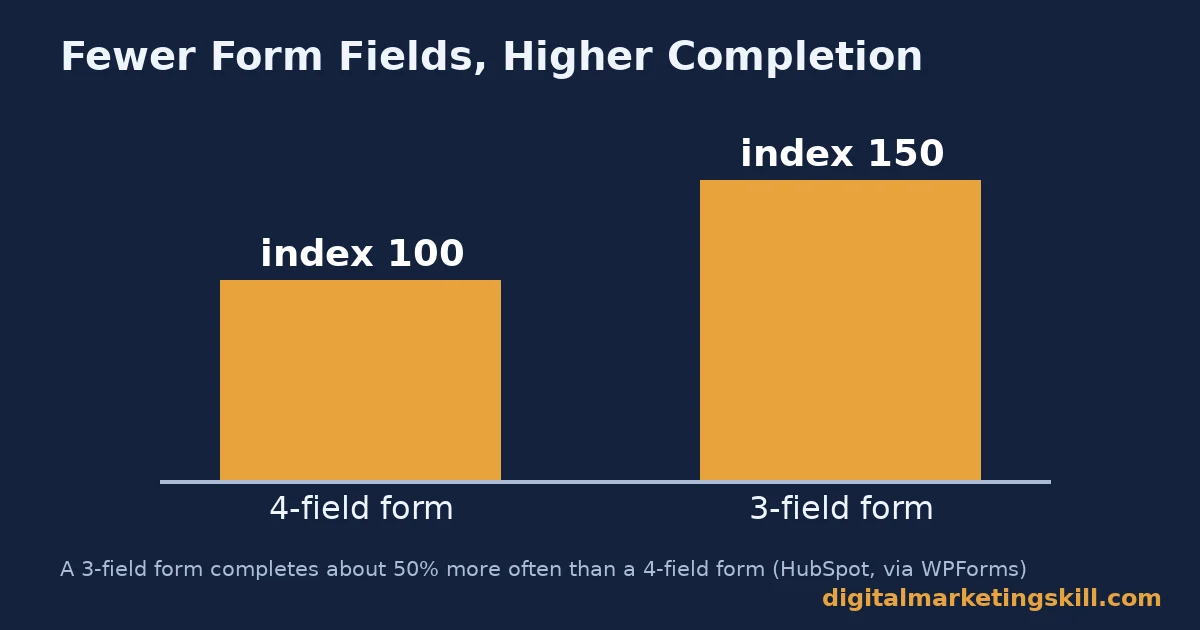
- Cutting a form from 4 fields to 3 brings a 50% improvement in form completion, according to HubSpot’s landing page research.
- It takes an average of 8 touches across calls, email and social to land a first meeting with a new B2B prospect. Top performers do it in 5 (RAIN Group, surveying 488 buyers and 489 sellers).
- 87% of marketers say account-based marketing delivers a higher ROI than their other marketing strategies (ITSMA research).
In this guide
- What Most B2B Lead Generation Guides Skip
- How B2B Lead Generation Actually Works
- What Differs By B2B Lead Generation Approach
- How To Get More From Each B2B Lead Generation Approach
- Measuring Whether B2B Lead Generation Is Working
- The One Decision Rule Worth Highlighting
- What Doing This Right Looks Like
- Frequently Asked Questions About B2B Lead Generation
- Turn Slow Leads Into A Fast, Measured Pipeline
What Most B2B Lead Generation Guides Skip
Most guides list channels: LinkedIn, email, webinars, content, ads. They skip the sequencing question. Which lead gets a call today? Which one gets an email next week? This guide answers that, not just the channel list.
Ground rules: every figure below names its source and sample. That lets you judge how far to trust it. A benchmark from one study is a useful comparison point, not a guarantee for your market. B2B lead generation also varies a lot by deal size. A $500 tool and a $500,000 contract do not follow the same buying pattern, even though both are technically B2B. Treat every number here as a starting estimate, something to compare your own results against, not a target you assume you will hit automatically.
How B2B Lead Generation Actually Works
B2B lead generation is the process of identifying and attracting potential business customers. Then you capture enough information to start a sales conversation. It sits between marketing and sales, and it fails most often at that handoff, not inside either team alone.
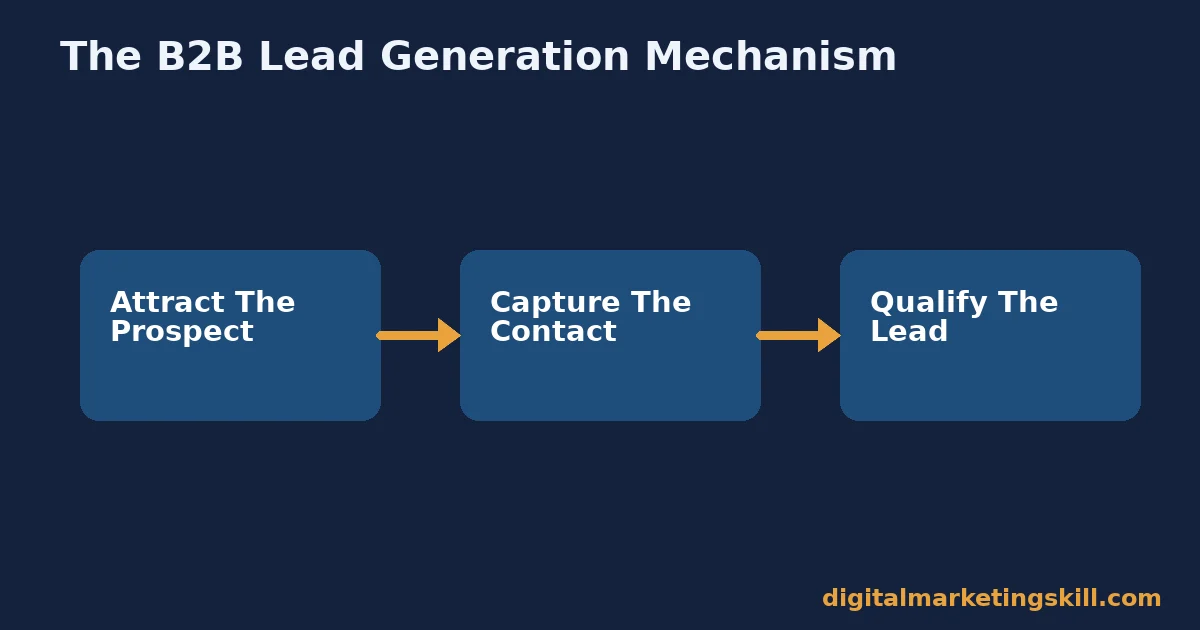
The mechanism has three stages. First, attract: content, ads, events and outreach bring a prospect into contact with your brand. Second, capture: a form, a reply, or a booked call turns that contact into a record you can act on. Third, qualify: you decide whether this lead matches your buyer profile closely enough to pursue now, later, or not at all.
Each stage can fail independently. Great attraction with a weak capture mechanism just produces visitors who leave without a trace. Great capture with no qualification step floods your sales team with contacts who were never going to buy. The stages work as a chain, and a chain is only as strong as its weakest link.
Speed matters more at the capture-to-qualify step than almost anywhere else in the funnel. Leads contacted within 5 minutes of filling out a form convert far more often than leads contacted after 30 minutes. That finding comes from the Harvard Business Review study “The Short Life of Online Sales Leads”. The researchers audited 2,241 US firms and more than 100,000 web-generated leads.
The same research found the average US company takes 42 hours to respond. Most of the lost leads in that 42-hour window are not lost to a better competitor. They are lost to nobody, because the prospect moved on before anyone replied.
That gap is the single easiest fix in this whole guide, because it rarely needs new budget. It needs a process change: a notification that reaches a real person the moment a lead arrives, and a team agreement that someone checks it within business hours, every day, not just when things are quiet.
Qualification keeps the pipeline honest. Every lead that enters the funnel without a real chance of closing wastes a sales rep’s time. It also makes your conversion numbers look worse than your actual targeting really is. A smaller list of well-matched leads consistently outperforms a larger list of loosely matched ones.
Write your qualification criteria down before you launch a campaign, not after the leads start arriving. A simple checklist works: company size, a budget signal, and a real problem your product solves. That checklist keeps the decision consistent across every rep and every week, instead of changing based on whoever happens to be reviewing leads that day.
What Differs By B2B Lead Generation Approach
Inbound Lead Generation: Built For Scale
Inbound lead generation pulls prospects toward you through content, SEO and search engine optimization, so the prospect arrives already searching for an answer. The advantage is scale. One well-ranked guide can generate leads for years with no per-lead cost. The trade-off is time, since inbound results compound slowly, and a new site can wait months before organic traffic becomes meaningful. Treat inbound as an investment with a long payback period, not a campaign you judge after two weeks. Judging it too early is how teams abandon a channel right before it would have started paying off.
Gated content, webinars and free tools are the typical capture mechanisms. A documented content marketing plan is what keeps a steady stream of these offers coming, instead of one-off pieces published whenever someone has time.
The prospect trades contact information for something genuinely useful, so the offer has to be worth that trade. A thin PDF nobody would pay attention to converts poorly, no matter how well the landing page is designed. Think about what you would actually give your own email address for, then build that. If you would not trade your own inbox for it, your prospect probably will not either.
Outbound Lead Generation: Built For Speed
Outbound lead generation reaches out directly, through cold email, LinkedIn outreach or calls, to prospects who have not yet raised their hand. The advantage is speed and control. You decide who gets contacted and when, instead of waiting for them to search. The trade-off is that most recipients did not ask for the message, so the opening has to earn attention fast.
LinkedIn blends both approaches. Paid Lead Gen Forms sit inside an outbound-style ad, but they convert closer to an inbound rate, because the form auto-fills from the viewer’s profile. LinkedIn’s own benchmark data, reported by B2B Ads, puts Lead Gen Form conversion at roughly 13%, against about 4.7% for a standard landing page. Removing friction, not just adding budget, is what closes that gap.
Persistence matters more than any single clever line. It takes an average of 8 touches across calls, email and social media to land a first meeting with a new prospect. That figure comes from RAIN Group’s Center for Sales Research, which surveyed 488 B2B buyers and 489 sellers. Top-performing sellers do it in about 5 touches. That is not because their opening line is better. It is because their targeting and timing are sharper from the first touch onward.
How To Get More From Each B2B Lead Generation Approach
Inbound: Lead With Offer Quality, Not Form Length
Before optimizing anything else, make sure the offer earns the trade. A calculator, template or short assessment that solves one specific problem usually outperforms a long whitepaper nobody has time to read. Match the offer’s depth to the stage of the buyer’s journey, not to how impressive it looks internally.
Once the offer is right, the form is the next lever. Cutting a form from 4 fields to 3 produces a 50% improvement in completion, based on HubSpot’s analysis of landing pages, reported by WPForms’ research roundup. Ask only for what you need to qualify and follow up. You can collect the rest after the first conversation.
Every field beyond the essentials is a small tax on your conversion rate. Name, work email and company are usually enough to start. A job title, phone number or company size can wait until the lead replies to your first message. Once they reply, you already have the context to ask one or two more questions naturally, instead of forcing every field into the first touch.
Outbound: Lead With Timing, Not Just Targeting
Good targeting picks the right company. Good timing picks the right moment inside that company’s own buying process, and the two are not the same skill. 6sense’s research on buyer timing, a survey of 934 B2B buyers, found a clear pattern. Vendors who made contact later in the buyer’s journey, around 70% of the way through, won more often than vendors who reached out earlier, around 60 to 64% through.
The researchers are careful to call this a correlation, not proof that later contact causes the win. But it lines up with a simple explanation: reaching out before a buyer is ready to engage reads as pushy, not helpful.
Account-based marketing applies this same logic to a short list of named accounts instead of a broad outbound list. 87% of marketers report that ABM delivers higher ROI than their other marketing strategies, according to ITSMA’s benchmark research, reported by Motion.
The depth of research per account is what makes that return possible. A short list treated with real attention beats a long list treated generically. Resist the urge to expand the list the moment results look promising. The depth is the strategy, and a bigger list without more research time just dilutes it back into generic outbound.
Measuring Whether B2B Lead Generation Is Working
Track these KPIs together, because any one of them alone can be misleading:
- Lead-to-opportunity rate: the share of captured leads that become real sales opportunities. A high lead volume with a low rate here usually points to a qualification or offer problem, not a volume problem.
- Response time: how long between a lead arriving and a human responding. Given the 5-minute research above, this single number can explain a conversion gap that looks, on the surface, like a messaging or targeting problem.
- Cost per qualified lead: total spend on a channel divided by the leads that actually passed qualification, not every form fill. This keeps channels honest when one produces cheap, low-quality volume and another produces fewer, better leads. Pair this metric with a wider set of lead generation tips, so cost control does not become the only thing you optimize for.
- Touches to meeting: how many outreach attempts it takes to book a first meeting, compared against the 8-touch industry average above. A number far above that average suggests a targeting or messaging problem worth isolating before adding more volume.
Worked example (illustrative, invented numbers): a team runs two campaigns with the same budget. Campaign A generates 200 leads at $20 each, but only 4 become opportunities. Campaign B generates 60 leads at $65 each, and 9 become opportunities.
By raw lead count, Campaign A looks better. By cost per qualified lead and conversion to opportunity, Campaign B is the clear winner. That is the number that should decide next quarter’s budget, not the one that looks biggest on a dashboard. A raw lead count flatters whichever channel is cheapest to fill a form on, which is rarely the channel actually filling the pipeline.
The One Decision Rule Worth Highlighting
If you fix one thing, fix this: respond to every new lead within 5 minutes during business hours. Even a short acknowledgment while you prepare a fuller reply counts. Speed is one of the few levers in B2B lead generation that is almost entirely under your control. Budget, market conditions and competitor behavior are not. The research above shows speed is also one of the highest-leverage levers you have.
Illustrative example (invented numbers, not a real campaign): a team that responds to leads within 5 minutes converts 1 in 8 into an opportunity. The same team, when leads sat for over an hour during a busy week, converted closer to 1 in 20. Nothing else about the leads changed. Only the response time did.
What Doing This Right Looks Like
Students who run real B2B campaigns during coaching routinely discover the same pattern. The lead source matters less than they expected, and the response process matters more. A list of leads sitting unanswered in an inbox for two days performs worse than a smaller, slower-growing list that gets a reply within minutes, no matter how good the original targeting was.
The students who see faster traction build a simple routine before they scale spend. They write a clear definition of a qualified lead, a same-day response standard, and one dashboard that tracks cost per qualified lead instead of cost per raw lead. None of this requires expensive software to start. A shared spreadsheet and a team agreement on response time covers the first few months, and the dashboard can get more sophisticated once the habit is proven. Results vary by effort, market and offer; see the earnings disclaimer for context on any income-related claims.
Frequently Asked Questions About B2B Lead Generation
What is B2B lead generation?
B2B lead generation is the process of identifying potential business customers, attracting their attention, and capturing enough contact information to start a sales conversation with them.
What is the difference between inbound and outbound B2B lead generation?
Inbound lead generation attracts prospects through content, SEO and offers they find on their own. Outbound lead generation reaches out directly through email, calls or LinkedIn messages to prospects who have not yet engaged with your brand.
How fast should you respond to a new B2B lead?
Within 5 minutes during business hours, based on research showing a sharp drop in qualification odds the longer a response is delayed. Even a short acknowledgment while you prepare a full reply keeps the lead warm.
What makes a B2B lead “qualified”?
A qualified lead matches your ideal buyer profile on criteria you define in advance, such as company size, budget authority and a real need for what you offer. Qualification exists to protect sales time, not to make your lead count look smaller.
Is account-based marketing better than broad B2B lead generation?
Better for specific goals, not universally better. ABM works best with a short list of high-value accounts where deep research pays off. Broad lead generation works better when your market has many similar-sized buyers, and no single account justifies that depth of research.
How many touches does B2B lead generation usually take?
An average of 8 touches across calls, email and social to land a first meeting. Top performers often do it in about 5, with sharper targeting and timing rather than more volume.
Do shorter lead capture forms really convert better?
Generally yes. Cutting a form from 4 fields to 3 produced a 50% improvement in completion in the research cited above. Ask only for what you need to start a conversation, and collect additional details later.
Why do some B2B leads never convert, no matter how good the follow-up is?
Because not every lead was a real match in the first place. A weak qualification step lets unqualified contacts into the funnel, where no amount of fast, polite follow-up turns them into a buyer, since the underlying need or budget was never really there.
Should marketing or sales own B2B lead generation?
Both, with a clear handoff point defined in advance. Marketing usually owns attraction and initial capture. Sales usually owns qualification and the conversation that follows. Problems appear when nobody has agreed exactly where one team’s job ends and the other’s begins.
What is the biggest mistake teams make with B2B lead generation?
Measuring raw lead volume instead of qualified leads or opportunities. A channel that produces hundreds of cheap, unqualified leads looks impressive on a dashboard, but it wastes sales time and makes a genuinely effective, lower-volume channel look worse by comparison.
Turn Slow Leads Into A Fast, Measured Pipeline
Pick one lead source this month. Set a 5-minute response standard for it. Track cost per qualified lead instead of cost per raw lead, and compare the result to your current process before you decide whether to scale it. Write down what you expect before you see the results, so next month’s review has a clear baseline instead of a vague memory of what you hoped would happen.
If you want structured practice building and measuring real B2B lead generation campaigns, the Master Diploma in Digital & AI Marketing runs four AI-powered tracks built from ten execution-first courses, including AI-Powered Lead Generation and Email Automation, with a Full Stack option to complete all four.
Every track includes unlimited 1-on-1 coaching and mentoring, plus a U.S. Project Internship with a verified U.S. Work Reference Letter. The diploma is dual US and UK accredited and recognised in more than 100 countries, 100% online. You can study and apply it anywhere in your country.
Explore the full program and apply here. Browse more guides on the Digital Marketing Skill Institute blog, or start wherever you are at digitalmarketingskill.com. Student outcomes are shared on the reviews page for a closer look. Learn more at digitalmarketingskill.com.
Every figure in this guide was checked against its original source before publication. Figures marked as illustrative are invented examples, not real results.
