
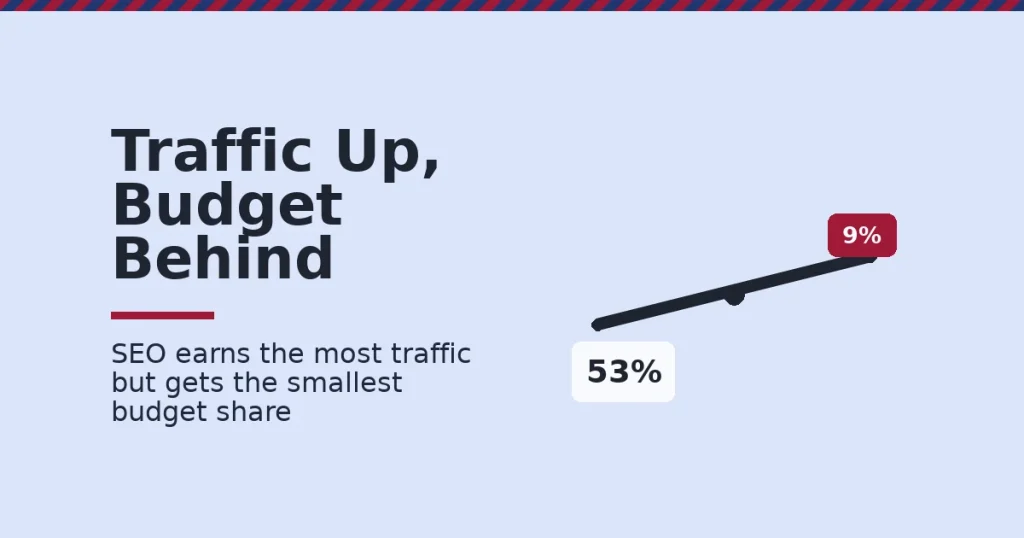
SEO in digital marketing earns more traffic than any paid channel. Yet most companies still fund it last. BrightEdge’s channel-share research found organic search drives 53% of trackable website traffic, more than paid search and organic social combined. This guide covers where SEO in digital marketing fits in a channel mix. It covers how much budget it deserves, and how to measure what it returns.
Key Takeaways
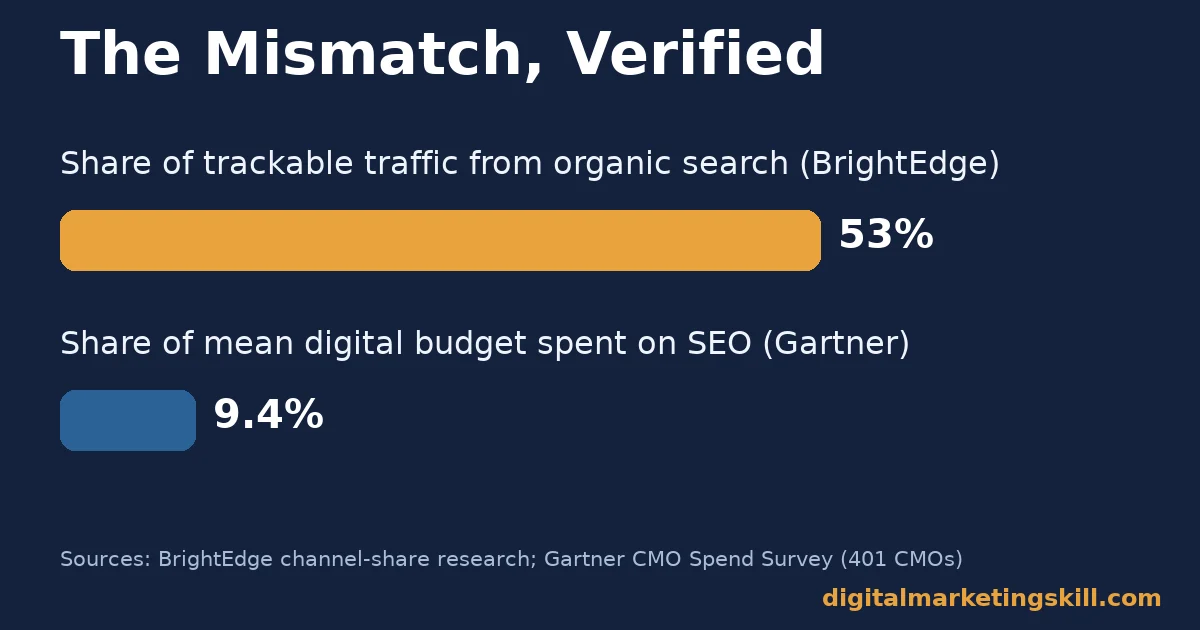
- Organic search out-traffics every paid channel. BrightEdge’s research puts organic search at 53% of trackable traffic, against 15% for paid search and 5% for organic social.
- Budget has not caught up with that traffic share. Gartner’s CMO Spend Survey of 401 CMOs found SEO receives just 9.4% of mean digital budget. Paid search ads get 16%. Social ads get 15.7%.
- Recommended SEO budgets run far higher than actual ones. Multiple marketing budget guides recommend 15% to 30% of a digital budget for SEO, well above the single-digit share most companies actually spend.
- SEO compounds; paid ads do not. One founder’s published $500-per-channel test found SEO content kept driving traffic for 12 months after spend stopped. Paid traffic stopped completely the moment the ad budget ran out.
- SEO needs patience, not just budget. Even well-funded SEO in digital marketing plans typically take months to show results, which is why it is usually paired with a faster channel early on.
In this guide
- The Real Question About SEO in Digital Marketing
- How SEO in Digital Marketing Actually Earns Its Budget
- SEO in Digital Marketing Pays Off Differently by Business Stage
- Three Budgeting Mistakes That Waste SEO Spend
- How to Budget for SEO at Each Stage
- How to Measure SEO’s Contribution Inside a Channel Mix
- The One Decision Rule: Fund SEO Like a Compounding Asset, Not a Campaign
- A Real Case: A Founder’s $500-Per-Channel Test
- Frequently Asked Questions About SEO in Digital Marketing
- Learn to Allocate a Real Marketing Budget, Not Just Run Channels
The Real Question About SEO in Digital Marketing
Most articles explain what SEO is. Fewer explain how much of it a business actually needs. Fewer still say how it should sit alongside paid search, social and email in a real budget. That is the harder, more useful question.
This guide skips the SEO fundamentals. That means crawling, indexing and keyword research. Our guide on search engine optimization covers those basics in depth. Instead, this guide answers the allocation question. How does SEO in digital marketing earn its keep? What share of budget does it deserve at different business stages? How do you measure its real contribution?
Ground rules first. BrightEdge’s traffic-share figures and Gartner’s budget-share figures come from two different studies, with different scopes. So treat them as two separate snapshots, not one unified data set. The founder case study later in this guide is one person’s self-reported result. It comes from a single SaaS product, not a controlled experiment. Treat the worked example as illustrative, not a guarantee.
How SEO in Digital Marketing Actually Earns Its Budget
SEO in digital marketing works differently from paid channels. Understanding that difference explains why it is often underfunded relative to what it delivers.
Paid channels rent attention. Google Ads and Meta Ads buy placement for as long as you keep paying. Stop the spend, and the traffic stops too. This is simple to budget for, because cost and output move together in the same period.
SEO builds an asset. A ranked page keeps earning visits long after the work that built it is finished. That is the core difference. That is why BrightEdge’s data shows organic search outperforming paid search by more than three times. Far less budget goes toward it, even so.
So the mismatch is not that SEO underperforms. Its payoff arrives later. Its cost is harder to tie to a single month’s results. Finance teams naturally favor budgets they can measure fast, in the same period they spend them. That bias usually explains the gap between its 53% traffic share and its 9.4% budget share, not SEO’s actual return.
Content marketing and email marketing sit on the same side of this divide as SEO. A well-built content creation process and a maintained email list both keep delivering value after the initial work is done, the same compounding pattern SEO follows. Paid search and paid social sit on the other side, renting attention one click at a time.
SEO in Digital Marketing Pays Off Differently by Business Stage
How much to invest in SEO in digital marketing depends heavily on where a business stands today. Two stages call for very different approaches.
Early-Stage Businesses: Built for Patience
A new site has no ranking history. It has few backlinks and little topical authority. SEO here is a long game. Expect months before meaningful organic traffic arrives, even with strong content and technical work.
Because of that delay, early-stage budgets usually need a faster channel too. Paid search or social ads can generate revenue while the organic asset builds. SEO spend here should be treated as a long-term investment, not a short-term acquisition line.
Established Businesses: Built for Compounding
A site with existing rankings and real backlink history earns a different kind of return entirely. New content on an established domain tends to rank faster. The domain’s authority already carries weight with search engines.
At this stage, SEO in digital marketing often becomes the most cost-efficient channel in the mix. Each new page adds to assets that already compound. This is usually where a higher allocation starts to make financial sense: 15% to 30% of digital budget, the range several budget guides recommend.
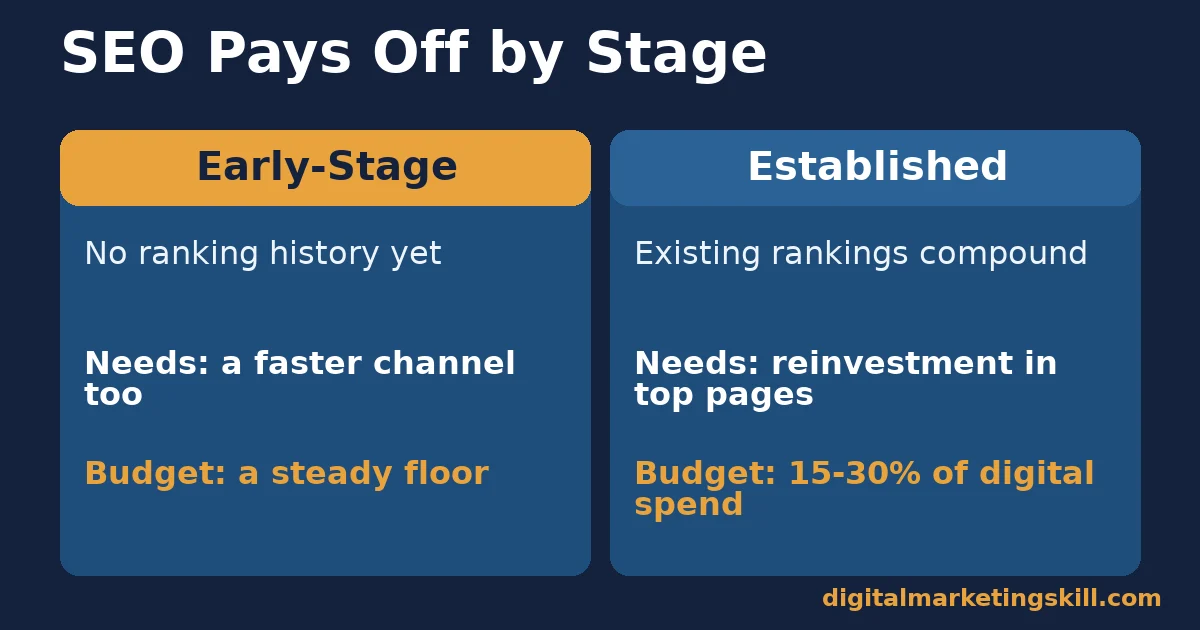
Neither stage is a reason to skip SEO. The early stage simply needs it paired with something faster, while the established stage can lean on it more heavily. Most real budgets shift gradually from one pattern to the other as a site matures.
There is a simple test for knowing which stage you are actually in. Look at your last six months of organic traffic. If it is flat regardless of what you publish, you are likely still early-stage, no matter how long the business has existed. If new content reliably outperforms old content within weeks, you have already crossed into the compounding stage, and your budget should reflect that.
Three Budgeting Mistakes That Waste SEO Spend
Most SEO budgets underperform for one of three reasons, regardless of how much money is involved. Fixing any one of them usually improves returns faster than simply spending more.
Judging SEO on a monthly cycle. Because paid channels show results within days, many teams apply the same monthly scorecard to SEO. That mismatch kills SEO budgets before they have time to compound, since the first few months almost always look weak by a monthly paid-media standard.
Spreading the budget across too many topics at once. A small SEO budget split across twenty unrelated topics rarely builds enough authority on any one of them to rank well. Instead, concentrating spend on a narrower topic cluster usually builds authority faster than spreading thin.
Cutting SEO first during a budget squeeze. Because its results are harder to tie to a single month, SEO is often the first line item cut when budgets tighten. That is backwards: cutting the channel that keeps earning after spend stops, to protect the channel that stops the moment spend does, usually makes a budget squeeze worse over time, not better.
How to Budget for SEO at Each Stage
Knowing the two stages exist is not the same as setting a number. The sections below mirror the stages above, with a practical starting point for each.
Early-Stage: Fund a Floor, Not a Forecast
Set a fixed monthly SEO floor. Even a modest one works better than promising a traffic forecast you cannot yet back up. A consistent floor builds the asset steadily. A set number of optimized pages a month, reported honestly, avoids overpromising short-term results to stakeholders.
Pair that floor with a faster channel sized to cover near-term revenue needs. Our guide to pay-per-click advertising covers how to size a paid search budget that can carry a business while SEO builds. Review the split every quarter rather than setting it once and forgetting it, since the right balance shifts as the first ranked pages start to contribute.
Established: Shift Budget Toward Compounding Pages
Review which existing pages already rank reasonably well but fall short of the top results. Expanding and improving those pages usually returns more traffic per dollar than starting new topics from zero. The domain’s authority already backs them.
Increase SEO’s share of the budget gradually, using the logic Gartner’s data suggests many companies are missing. Traffic share should set the next budget, not the previous budget line. A strong martech stack makes it easier to track which pages deserve that reinvestment.
How to Measure SEO’s Contribution Inside a Channel Mix
SEO in digital marketing needs its own metrics, separate from paid channel metrics. It does not behave the same way month to month.
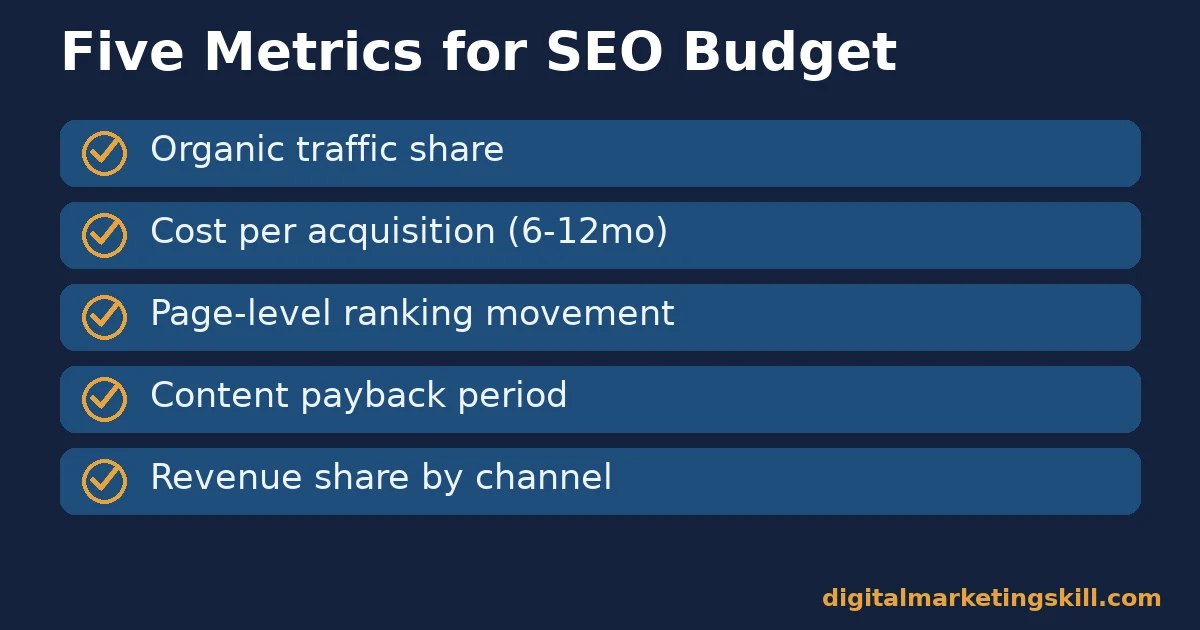
- Organic traffic share. The percentage of total site traffic coming from unpaid search results. Rising share, even with flat total traffic, shows SEO is doing more of the work paid channels used to.
- Cost per acquisition, measured over a longer window. Divide total SEO spend over 6 to 12 months by acquisitions in that same window, not a single month. A short window understates SEO because its payoff is delayed.
- Page-level ranking movement. Track whether your priority pages are climbing toward the first page of results, not just whether total traffic is rising. Rankings are the leading indicator; traffic is the lagging one.
- Content payback period. The number of months before a piece of content’s cumulative traffic value exceeds what it cost to produce. This is the SEO equivalent of a paid channel’s cost-per-click.
- Revenue share from organic, by channel attribution. The share of actual revenue, not just traffic, that organic search contributes. This is the number that ultimately should guide next year’s budget split.
Read these together quarterly, not monthly. SEO’s numbers move slowly by design. Judging it on a single month’s traffic graph almost always leads to cutting a channel right before it starts compounding.
Put these five metrics on the same dashboard as your paid channel numbers, not a separate report nobody opens. When stakeholders see organic traffic share and content payback period next to cost-per-click, the case for SEO’s budget tends to make itself, without needing a separate argument every quarter.
The One Decision Rule: Fund SEO Like a Compounding Asset, Not a Campaign
If you remember one decision rule from this guide, make it this one. Budget SEO in digital marketing the way you would budget a long-term asset. Its payback period is measured in months. Budget a paid campaign the other way, with a payback period measured in days.
Here is an illustrative example, with invented numbers. A business spends $2,000 a month on paid search and $500 a month on SEO content. After a year, the paid channel has generated steady but flat monthly leads, costing roughly the same each month. The SEO content, slower to start, has built up 40 ranking pages that together now generate as many leads as the paid channel, at a fraction of the ongoing cost, because most of that content needs little further spend to keep earning traffic.
The lesson is about the shape of the return, not the total spend. A channel that costs the same every month forever is a different financial bet. A channel that costs more upfront and less later is a different bet entirely.
So when comparing two channels on a spreadsheet, add a column for what happens if spend stops. A paid channel’s number in that column is usually zero. An SEO channel’s number is usually most of its recent traffic, at least for a while. That single column often changes which channel looks like the better bet.
A Real Case: A Founder’s $500-Per-Channel Test
Ilias Ism, founder of the AI presentation tool GenPPT, published a direct comparison of three channels on his own blog. He spent $500 each on Google Ads, Meta Ads, and SEO content for the same product. The results differed sharply by channel type, not just by amount spent.
Google Ads produced one trial signup for the full $500. Meta Ads produced two purchases, a cost of roughly $250 each. The SEO content told a different story. It drew more than 100,000 visitors over the following 12 months and was credited with five-figure revenue, largely driven by one piece of content that resonated unexpectedly well.
The limits matter here. This is one founder’s self-reported result for one SaaS product in one niche, not a controlled study. The author himself notes that a single viral post drove most of the organic traffic. The case does not prove SEO always outperforms paid ads by this exact margin. It illustrates the compounding pattern this guide describes: paid traffic stops the moment spend stops, and organic traffic does not.
What makes the case useful despite its limits is the shape, not the size, of the gap. Even a reader who expects the real-world ratio to be far less dramatic can still take the underlying lesson: a dollar spent on content that keeps working is not the same as a dollar spent on an ad that stops the instant payment does.
Frequently Asked Questions About SEO in Digital Marketing
How much budget should SEO get in digital marketing?
Marketing budget guides commonly recommend 15% to 30% of a digital marketing budget for SEO. Gartner’s CMO Spend Survey found actual spending averages closer to 9.4%. The right number depends heavily on business stage. Newer sites often need a smaller SEO share paired with a faster channel. Established sites can shift more toward SEO.
Is SEO in digital marketing still worth it with AI search tools?
Yes, for now organic search still drives the largest share of trackable traffic of any channel, per BrightEdge’s data. AI-powered search results are changing how some queries get answered. But the underlying content and authority signals SEO builds still matter for visibility, in both traditional and AI-assisted search.
How long does SEO take to show results in a digital marketing plan?
Most SEO work takes several months to show meaningful traffic. That is why this guide recommends pairing it with a faster channel, like paid search, early on. Patience is part of the strategy, not a sign something is wrong.
What is the difference between SEO and paid search in a marketing budget?
Paid search traffic stops the moment you stop paying; SEO traffic can keep arriving long after the content is published. That difference is why SEO deserves a different budgeting approach, closer to a long-term asset than a monthly campaign line.
Should small businesses invest in SEO in digital marketing?
Yes, but with a modest, consistent floor rather than a large upfront spend. A small business without ranking history should expect a longer runway before SEO drives meaningful revenue. It should not be the only channel funded in the first several months.
How do you measure SEO’s contribution alongside other digital marketing channels?
Track organic traffic share, cost per acquisition over a 6-to-12-month window, page-level ranking movement, content payback period, and revenue share by channel attribution. Review these quarterly rather than monthly, since SEO’s numbers move slowly by design.
Why does SEO get cut first when marketing budgets shrink?
Because its results are harder to tie to a single month, SEO often looks like the easiest channel to pause. In practice, that usually hurts most, because it removes the one channel that keeps earning traffic after spend stops, while leaving the channel that stops the moment spend does.
Can content marketing and email marketing follow the same budgeting logic as SEO?
Yes. Both compound in a similar way: a strong content library and an engaged email list both keep delivering value well after the work that built them is finished, unlike a paid ad that stops the moment spend does.
Learn to Allocate a Real Marketing Budget, Not Just Run Channels
Understanding where SEO in digital marketing fits inside a real budget is a strategic skill, not just a technical one. It means learning to read channel data, forecast payback periods, and make the call on where the next dollar goes.
The Master Diploma in Digital & AI Marketing at Digital Marketing Skill Institute is built from ten execution-first courses across four AI-powered tracks, including AI-Powered WordPress and SEO Specialist and AI-Powered Google Specialist, with a Full Stack option for completing all four. Every track includes unlimited 1-on-1 coaching and mentoring and a U.S. Project Internship with a verified U.S. Work Reference Letter.
The program is dual US and UK accredited, recognised in more than 100 countries, and 100% online, so you can study channel strategy and SEO from anywhere in your country. Browse more guides on the Digital Marketing Skill Institute blog, read student reviews, and when you are ready, apply for the Master Diploma or start from the Digital Marketing Skill Institute homepage.
Every figure in this guide was checked against its original source before publication. Figures marked as illustrative are invented examples, not real results.
![9 Amazing Digital Marketing Skills to Make Money Online [With Proof]](https://digitalmarketingskill.com/wp-content/uploads/2019/07/9-Amazing-Digital-Marketing-Skills-to-Make-Money-Online-With-Proof-17.png)






