Most online stores lose far more buyers at checkout than they convert. That is why effective e-commerce marketing strategies matter more than traffic alone. The right mix of trust signals, retention tools and paid tactics turns browsers into repeat buyers. It does this without relying on guesswork or discounting.
Key Takeaways
- The average documented cart abandonment rate across 50 studies is 70.22% (Baymard Institute). Recovery tactics matter as much as acquisition.
- Online retail now accounts for roughly a fifth of global retail sales. Mobile devices generate around 59-60% of that e-commerce revenue, per industry tracking of Statista’s e-commerce data.
- Email marketing returns about 45:1 for retail and e-commerce brands (Litmus). List-building is one of the highest-leverage e-commerce marketing strategies available.
- Retargeted display ads convert roughly 10 times more clicks than standard display ads. They reach people who already showed intent.
- Repeat customers can be well under a quarter of a store’s customer base yet close to half of its revenue (Gorgias). Loyalty work often beats new-customer spend.
In this guide
- Why Traffic Alone Doesn’t Grow an Online Store
- How E-commerce Marketing Actually Moves a Sale
- What Differs Across the Core E-commerce Marketing Strategies
- How to Lead With Each Group of E-commerce Marketing Strategies
- How to Measure Whether It’s Working
- The One Decision Rule Worth Following
- Common Mistakes That Waste E-commerce Marketing Strategies Budget
- A Real Case for E-commerce Marketing Strategies: What a Loyalty Programme Changed
- Frequently Asked Questions About E-commerce Marketing Strategies
- Where to Go From Here
Why Traffic Alone Doesn’t Grow an Online Store
Most store owners treat e-commerce marketing strategies as a traffic problem. More visitors should mean more sales. That assumption breaks down at checkout.
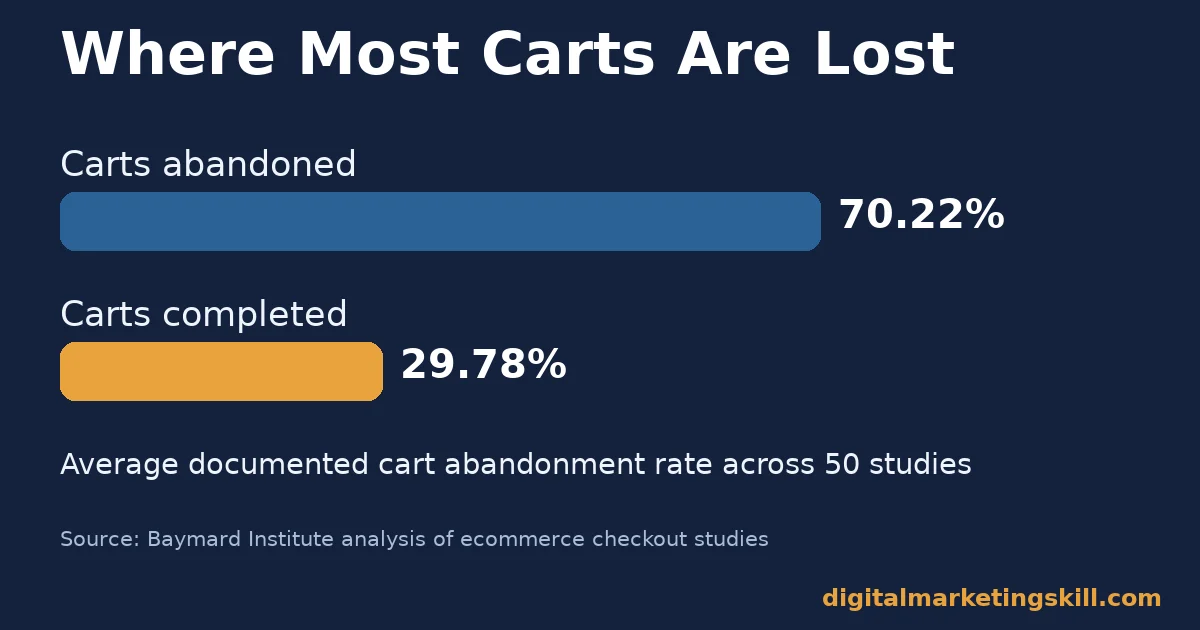
The Baymard Institute’s analysis of 50 separate studies puts average cart abandonment at 70.22%. That figure has held in the high-60s to low-70s range for more than a decade. In practice, seven of every ten shoppers who start checkout leave without buying. That trend holds whether a store is optimising for desktop or for mobile conversion rate specifically.
This guide treats that gap as the starting point. It groups e-commerce marketing strategies into three buckets: trust-building, retention and paid acquisition. You’ll see what differs when you lead with one over another, how to measure the result, and when a single tactic is enough.
One ground rule first: a figure describing a US or UK retailer is labelled as such. Conversion and loyalty benchmarks vary sharply by market and by product category.
How E-commerce Marketing Actually Moves a Sale
E-commerce marketing is the set of methods used to attract visitors to an online store, convince them to buy, and bring them back. It works through three linked stages.
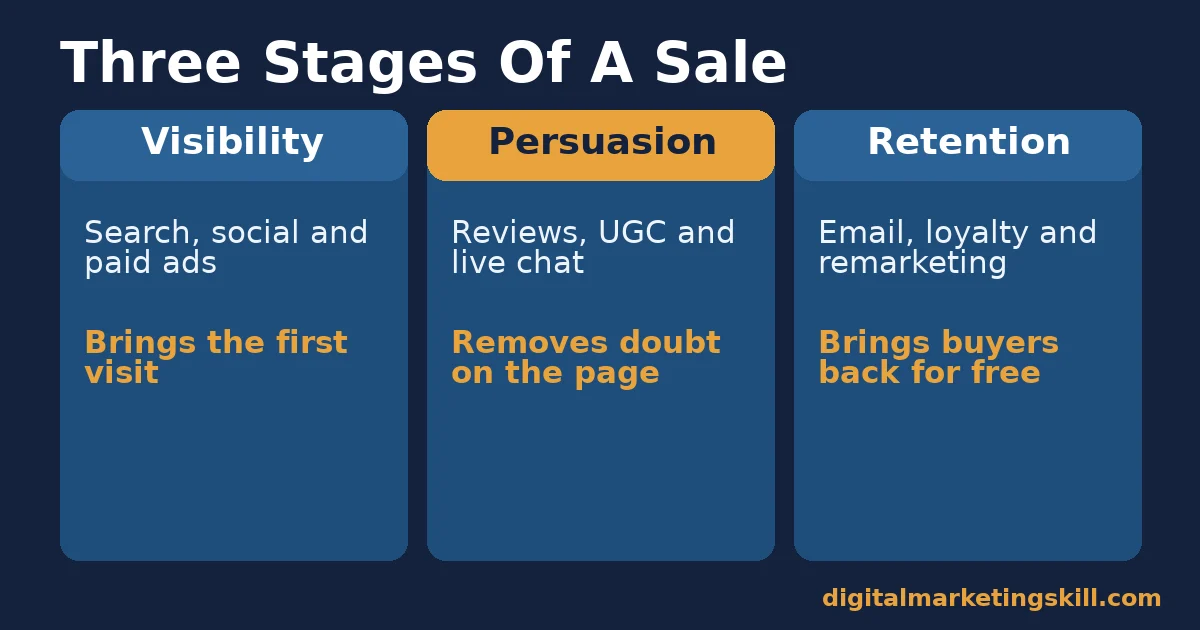
The first stage is visibility: search, social and paid ads that bring a first visit. Persuasion comes next: reviews, demonstrations and offers that remove doubt at the product page. Retention follows last: email, loyalty and remarketing that bring a buyer back without a new acquisition cost.
Most of the e-commerce marketing strategies covered in this guide map onto one of these three stages. Grouping them this way, instead of listing fifteen equal options, makes it easier to decide what to do first.
Each of the e-commerce marketing strategies below sits in one of those stages. A store that only invests in visibility keeps paying to refill a leaking bucket. A store that only invests in retention has nothing to retain.
The mechanism that matters is sequencing. Build enough trust signals before you scale paid spend. Build a retention habit before you lean on discounts to bring people back.
Skipping the sequence is the most common reason a store’s e-commerce marketing strategies underperform. A paid campaign sending visitors to a page with no reviews wastes most of its budget on people who arrive, hesitate and leave. The fix is rarely a bigger ad budget. It is usually a smaller fix made earlier in the sequence.
What Differs Across the Core E-commerce Marketing Strategies
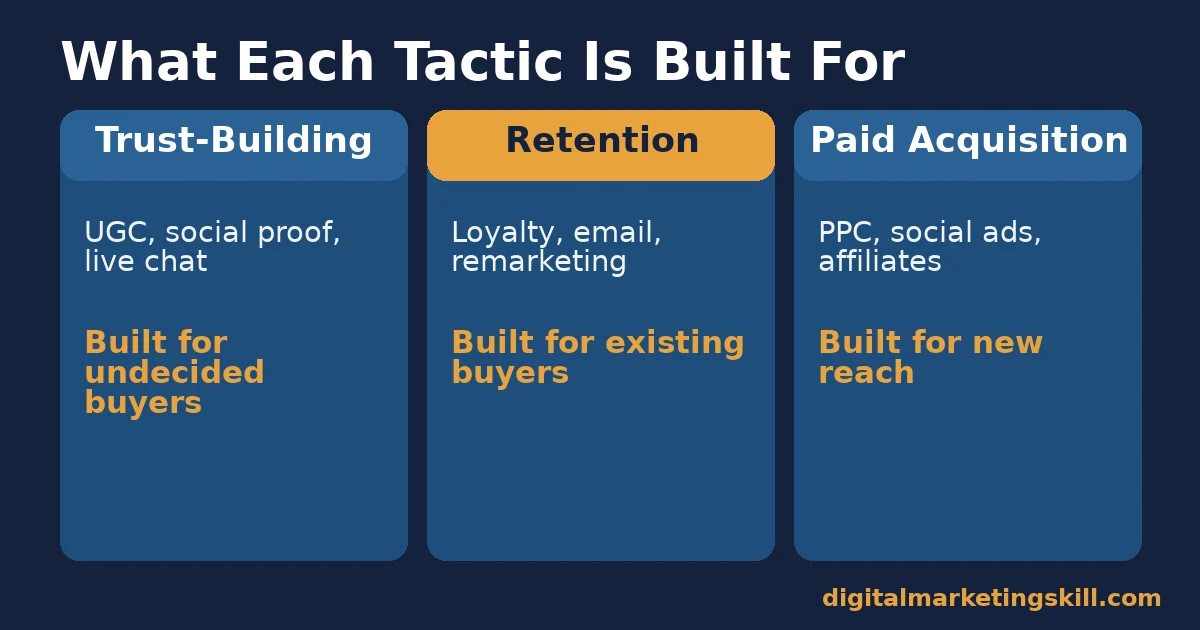
Trust-Building Tactics: Built for Undecided Buyers
User-generated content, social proof and live chat all work on the same undecided buyer. That is someone who has reached a product page but isn’t ready to pay.
User-generated content includes customer photos, videos and reviews rather than brand-produced imagery. Surveys on UGC performance consistently find that most shoppers rate it more trustworthy than brand-made content. Social proof is the umbrella term for ratings, testimonials and “X people bought this” counters. Live chat adds a real-time answer to the one question stopping a purchase.
None of these tactics add new visitors. They raise the share of existing visitors who convert. A product page with twenty reviews and three customer photos will usually outperform an identical page with none, even when both receive the same number of visits from the same ad campaign.
Retention Tactics: Built for Existing Buyers
Loyalty programs, email marketing and remarketing all target people who already know the brand. Gorgias’ analysis of merchant data found that repeat customers made up a minority of total customers yet generated close to half of revenue. That is why a loyalty program’s job is to shorten the gap between a first and second purchase, not just reward it after the fact.
Email marketing extends that relationship on a channel the retailer owns outright. Retail and e-commerce brands see an average documented return of 45:1, according to Litmus’s ROI of Email Marketing research. That figure is worth tracking alongside whatever you already learn from Google Analytics.
Remarketing, also called retargeting, closes the loop for visitors who left without buying. It converts clicks at roughly 10 times the rate of standard display ads, according to a compiled analysis of retargeting ad performance.
Paid Acquisition: Built for New Reach
Pay-per-click advertising, social media advertising and affiliate marketing extend reach beyond a store’s existing audience. PPC and social ads are charged per click or impression. You can switch either off instantly, which makes them useful for testing a new product or market before committing to content or SEO.
Affiliate marketing shifts the cost structure to commission-only. You pay affiliates, such as bloggers, creators or other stores, a share of each sale they generate. The acquisition cost then tracks revenue instead of ad spend. This makes affiliate marketing lower-risk for a store with a tight cash budget, because you only pay out once a sale has already happened, rather than paying upfront for impressions that may not convert.
How to Lead With Each Group of E-commerce Marketing Strategies
Leading With Trust Signals First
Before increasing ad spend, audit the product pages that get the most traffic. Add at least three genuine customer photos or videos per top product. Surface the star rating and review count above the fold. Give support a live chat widget during your busiest hours.
Run a UGC contest, or simply ask recent buyers for a photo in the post-purchase email. Feature the best submissions back on the product page.
This order matters, because sending more paid traffic to an unconvincing page just raises the cost of the same abandonment problem. Fixing trust signals first is usually the cheapest of all the e-commerce marketing strategies in this guide, since it reuses content your own customers already created for free.
Leading With a Retention Habit
Launch a simple points-based loyalty programme before a complex tiered one. The goal in month one is participation, not sophistication. Pair it with a welcome series and an abandoned-cart email automation strategy. Cart-recovery emails address the single biggest leak in the funnel: the 70.22% of shoppers who start checkout and stop.
Segment your list by purchase history. A first-time buyer and a five-time buyer should never receive the same message. Set up a retargeting campaign aimed only at cart-abandoners for the first two weeks, then broaden it to general site visitors.
Leading With a Small Paid Test
If the goal is reaching a new audience rather than converting an existing one, start differently. Run PPC and social ads with a fixed weekly budget and a single, specific product rather than the whole catalogue. The same discipline applies to the broader social media marketing challenges most stores eventually hit.
Write ad copy around one clear benefit and one call to action. Let the campaign run long enough to collect at least 100 clicks before judging it.
Affiliate programmes take longer to produce volume, so pair them with a clear commission structure and ready-made creative assets. Don’t expect affiliates to build their own. A short brief, a few ready images and two or three sample captions make it far easier for a new affiliate to start promoting your store in their first week.
How to Measure Whether It’s Working
Four metrics cover most of what the tactics above are meant to move.
- Conversion rate: the share of visitors who complete a purchase. It isolates whether trust-building tactics, such as reviews, UGC and live chat, are doing their job on the page.
- Cart abandonment rate: the share of started checkouts that don’t finish. Compare your own rate against the 70.22% documented average (Baymard) to judge whether your checkout is better or worse than typical.
- Repeat purchase rate: the share of customers who buy a second time within a set window. This is the clearest read on whether loyalty and email are building real retention, not just one-off discounts.
- Customer acquisition cost versus average order value: what you spend to win a customer, set against what that customer spends per order. If acquisition cost rises faster than order value, paid acquisition is outrunning the retention work needed to make it profitable.
Track the Trend, Not a Single Day
Pull each number from the same analytics or e-commerce platform dashboard every time you review it. Track the trend over several weeks rather than reacting to a single day. A single bad day rarely means a tactic has failed. A single good day rarely means it has succeeded either; one unusually large order or one viral social post can distort a single day’s numbers without changing the underlying trend.
Keep a simple running log of these four metrics, updated at the same interval each time, such as weekly. That log becomes the evidence you need to decide whether a tactic earns more budget or gets dropped, instead of relying on a gut feeling about what “seems to be working.”
The One Decision Rule Worth Following
If your cart abandonment rate is at or above the 70% documented average, fix checkout and recovery emails before adding any new acquisition channel. Adding PPC, social ads or affiliates on top of a leaking checkout simply increases the number of people who abandon. Each new channel then costs more per lost sale, not less.
Illustrative, invented numbers: a store spends $1,000 a month on ads. It converts 2% of visitors and loses 75% of carts at checkout. That store is losing three of every four carts before a sale closes. Cutting abandonment to 60%, without spending another ad dollar, would raise completed sales by roughly 60% from the same traffic.
The same rule applies in reverse. A store with a cart abandonment rate already below 60%, strong reviews on every top product, and a working loyalty programme has less to gain from more checkout tweaks. For that store, a new paid channel or an affiliate programme is the more productive next step, because the trust and retention groundwork is already in place.
Common Mistakes That Waste E-commerce Marketing Strategies Budget
Running Too Many Tactics at Once
The first mistake is running every tactic at once. A store that launches a loyalty programme, a UGC contest and three paid channels in the same week cannot tell which change moved a single metric. Add one tactic, measure it for two to four weeks, then add the next.
The second mistake sits close behind it: measuring the wrong metric for the tactic. Trust-building tactics should move conversion rate, not traffic. Retention tactics should move repeat purchase rate, not one-off sales spikes. Judging a loyalty programme by this week’s revenue, instead of next quarter’s repeat rate, leads owners to cancel programmes that were only just starting to work.
Skipping the Checkout Fix
The third mistake is skipping the checkout fix. Many stores add a loyalty programme or a referral scheme to boost revenue, while checkout still loses 70% of carts at the finish line. A faster checkout, clearer shipping costs and more payment options usually return more than a new acquisition channel, and they cost far less to build.
The fourth mistake is copying a competitor’s tactic without their audience. A high-ticket furniture store and a low-cost snack brand do not share a buying cycle. A tactic built for one rarely transfers cleanly to the other without real changes to offer, price point and messaging. Before copying any tactic, ask whether your own average order value, purchase frequency and margin can support it.
The fifth mistake is treating every one of these e-commerce marketing strategies as permanent once it launches. Audiences change, platforms change their algorithms, and a tactic that worked well a few months ago can quietly stop working. Review each active tactic on the same schedule you review the four metrics above, and retire anything that no longer earns its budget.
A Real Case for E-commerce Marketing Strategies: What a Loyalty Programme Changed
Pacifica Beauty, a cosmetics retailer, reported a 47% improvement in repeat purchase rate after launching a structured loyalty and rewards programme. Customer spend rose by 46%. Roughly 35% of revenue then came from loyalty members, according to a case study published by loyalty-platform provider LoyaltyLion.
The limits matter here. This is a single brand in one category, beauty. The figures are self-reported by the brand to its own software vendor. The case study does not disclose the exact time period measured, and it does not control for other marketing changes running at the same time. Treat it as a plausible outcome for a similar retention effort, not a guaranteed result for any other store.
Frequently Asked Questions About E-commerce Marketing Strategies
Which e-commerce marketing strategy should a new store try first?
Start with trust signals on your highest-traffic product pages: reviews, UGC and live chat. Do this before spending on paid ads, because sending traffic to an unconvincing page wastes acquisition spend.
How much should a small store spend on PPC or social ads?
Begin with a fixed, modest weekly budget on a single product. Let the campaign collect at least 100 clicks before judging performance, rather than spreading a small budget across many products at once.
Do loyalty programmes work for small catalogues?
Yes. A simple points-based programme with two or three reward tiers is easier for a small catalogue to run than a complex one. The Pacifica Beauty case above shows meaningful gains from a comparatively simple structure.
Is email marketing still effective for e-commerce?
Yes. Litmus reports that retail and e-commerce brands see an average return of roughly 45:1 on email marketing. That return is driven largely by segmented, behaviour-based messages rather than one-off blasts.
What’s the difference between remarketing and affiliate marketing?
Remarketing targets people who already visited your store but didn’t buy, using ads that follow them elsewhere online. Affiliate marketing pays a third party a commission to bring new visitors who have never seen your store before.
How do I know if my cart abandonment rate is a problem?
Compare it against the 70.22% documented average from the Baymard Institute’s analysis of 50 studies. A rate meaningfully above that points to checkout friction worth testing directly: unexpected costs, forced account creation or limited payment options.
Which e-commerce platform should I use for marketing tools?
Shopify, BigCommerce, Wix and WooCommerce each include built-in marketing tools, such as email, discounts and basic analytics. The better question is which platform fits your technical resources and catalogue size. Most of the tactics in this guide run on any of them.
Does e-commerce marketing cost more than it returns?
Not when it is sequenced well. Trust-building tactics are often the cheapest to run and the first to pay back, because they convert visitors you have already paid to acquire, rather than requiring new spend.
How long should I test a new e-commerce marketing tactic before judging it?
Give trust-building tactics two to four weeks, since conversion rate reacts quickly to page changes. Give retention tactics, such as loyalty programmes, at least one full purchase cycle for your product, often two to three months, because repeat purchase rate needs real time to show up.
Can a very small store run all fifteen e-commerce marketing strategies at once?
No. Running every tactic at once makes it impossible to tell which one is working. A small team gets better results from doing three or four tactics well, in the sequence this guide recommends, than from doing fifteen tactics poorly.
Where to Go From Here
Pick one trust tactic and one retention tactic from this guide. Implement both this month. Measure conversion rate and repeat purchase rate before adding a third. Most stores improve faster by fixing the leaks they already have than by adding new acquisition channels on top of them.
If you want structured, mentor-led training in applying e-commerce marketing strategies alongside the rest of digital marketing, the Digital Marketing Skill Institute’s Master Diploma in Digital & AI Marketing covers this inside its AI-Powered Lead Generation and Email Automation track. That is one of four AI-powered tracks built from ten courses in total, with a Full Stack option for learners who want all four.
The programme includes unlimited one-on-one coaching and mentoring, a U.S. Project Internship with a verified U.S. Work Reference Letter, and dual US and UK accreditation recognised in more than 100 countries. It is delivered 100% online, so you can study anywhere in your country.
Explore the full curriculum on the Master Diploma page, browse more guides on the blog, or go straight to the application page to get started.
You can also read real outcomes on the reviews page; our earnings disclaimer applies to any income figures mentioned there. Learn more at digitalmarketingskill.com, or start your application from the homepage wherever you live.
Every figure in this guide was checked against its original source before publication. Figures marked as illustrative are invented examples, not real results.