
Web marketing means promoting a product, service or brand online. It uses search, social, email and paid ads. A business reaches the right audience. It tracks every result. It can change course in days, not months. Small teams and global brands both use it the same way.
Key Takeaways
- 6.12 billion people now use the internet. That is 73.8% of the world’s population (DataReportal). Nearly every buyer is online.
- Mobile devices send 51.6% of global web traffic. 96.2% of users go online from a phone at least sometimes (DataReportal). A plan that ignores mobile is already behind.
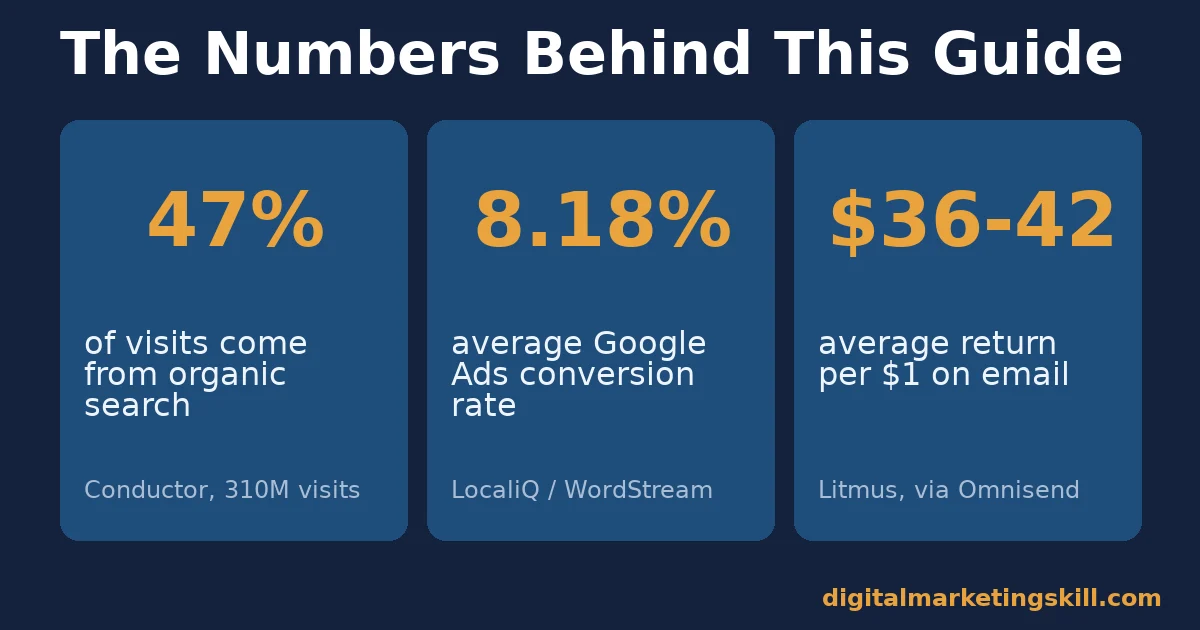
- A study of 310 million visits by the SEO platform Conductor found organic search drove 47% of all visits. No other single channel came close.
- Benchmark data puts average email ROI at $36 to $42 per $1 spent (Litmus data, via Omnisend’s report). Email is one of the cheapest channels to run.
- Average search-ad conversion rates sit near 8% across industries, per aggregated advertiser data from the agency network LocaliQ/WordStream. Cost and payback still vary a lot by business type.
In this guide
- Why Most Web Marketing Plans Stall
- How Web Marketing Actually Works
- Which Web Marketing Channel Fits Your Business
- How To Lead With Each Channel
- Measuring Web Marketing Results
- The One Decision Rule For Picking Your First Channel
- A Real Web Marketing Case, And Its Limits
- Frequently Asked Questions About Web Marketing
- Where To Learn Web Marketing Properly
Why Most Web Marketing Plans Stall
Most guides just list channels. SEO, PPC, social, email. Then they stop. The hard part isn’t knowing these channels exist. It’s picking which one gets your first dollar and your first hour. Then you need a way to tell, within 90 days, if that bet is working.
In practice, most small businesses skip this decision entirely. They copy whatever a competitor is doing, or they try all four channels at once with a thin budget spread too wide to work. As a result, nothing gets enough attention to prove itself one way or the other.
Meanwhile, if a single channel never gets enough budget or time to show a real signal, you can’t actually tell whether it failed or whether you simply gave up on it too early. A narrower first bet, measured properly, beats a scattered one almost every time.
Two ground rules help here. First, every number below is an informed guess, not a fact about your business. Your results will differ by industry and market. Second, channel performance is a snapshot. It is not a permanent ranking. Ad costs and search difficulty shift as competitors react. Because of this, treat every figure here as a starting point to test, not a guarantee.
How Web Marketing Actually Works
Every web marketing channel runs on three steps. First, a business shows up where its audience already looks. That could be a search result, a social feed or an inbox. Second, a person takes a small, trackable action: a click, a form filled in, or a reply. Third, the business uses that data to decide what to do next.
SEO and content marketing earn visibility over time. PPC and social ads buy it right away. Email works differently. Once someone opts in, you can reach them again for free.
A Cross-Channel Example
For example, imagine a local bakery. It could write a blog post about wedding-cake pricing (SEO), run a search ad for “wedding cake near me” (PPC), post daily photos of finished cakes (social) or email past customers before a holiday (email). Each move uses the same three-step loop. Only the entry point and the cost of that first visibility change.
Notice, too, that these four moves aren’t mutually exclusive. A person might see the social post first, search for the bakery’s name a week later, land on the blog post about pricing, and finally book after an email reminder about a seasonal discount. From the bakery owner’s side, that single customer touched every channel on the list.
From the customer’s side, it simply felt like one brand showing up consistently wherever they happened to be looking.
Google’s own SEO Starter Guide puts it simply: useful content “will likely influence your website’s presence in search results more than any of the other suggestions in this guide.” That is true across every web marketing channel, not just search. Ultimately, the offer behind the click is what a visitor actually judges, no matter which channel sent them there.
Most buyers also don’t convert on their first visit. Consequently, judging any single channel in isolation can be misleading.
Which Web Marketing Channel Fits Your Business
Each major channel does a different job. Picking the wrong one first is the most common mistake in small-business web marketing. Below, each channel gets two sections: what it’s naturally built for, and the one move that leads to a stronger result inside it. Together, they should make the tradeoffs easier to see at a glance.
Search Engine Optimization: Built For Compounding Organic Reach
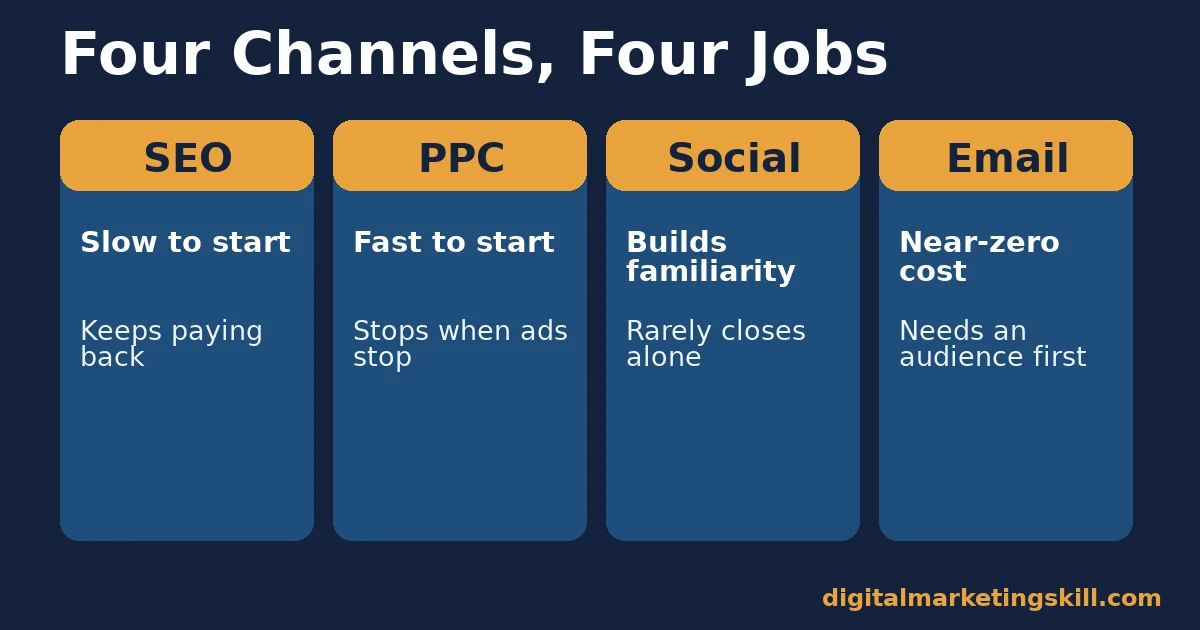
SEO keeps paying you back long after the work is done. A page that ranks for a buyer’s search term earns visits for months. You don’t pay for each visit. That is why organic search still drives roughly 47% of all site visits in large traffic studies.
Strong content marketing gives SEO something worth ranking. The tradeoff is speed. New content often takes weeks or months to rank. SEO rewards patience more than any other channel.
Pay-Per-Click Advertising: Built For Immediate, Measurable Demand
Pay-per-click advertising is built for speed. A campaign can go live and send visitors within hours. Every click, cost and result is tracked in real time. Average conversion rates sit near 8% across industries on search ad networks, though this swings a lot by sector. PPC rewards a business that already knows its offer converts and wants volume fast.
Social Media Marketing: Built For Relationship and Discovery
Social media marketing is built for discovery, not direct response. A brand gets found by people who weren’t searching for it yet. It can answer questions in public, where other prospects see the exchange. This channel rarely drives an immediate sale as well as search or email does. Over time, though, it builds the familiarity that makes a later ad or search result convert.
Email Marketing: Built For Owned, Repeatable Revenue
Email marketing is built to be owned. No algorithm change or auction price hike can take your list away. Once someone opts in, reaching them again costs almost nothing. That is the main reason benchmark email ROI runs far higher than most paid channels. The comparison isn’t perfectly fair, though. Email only works on people who already chose to hear from you.
How To Lead With Each Channel
Knowing what a channel is built for is half the job. The other half is the one move that makes it actually perform.
Search Engine Optimization: Lead With Topic Clusters and Technical Health
Don’t target one keyword per page. Instead, group the related questions a buyer asks into a cluster. Link those pages to one “pillar” page on the same topic.
Pair that with basic technical health too. Your site needs to load fast, work well on mobile and let Google crawl it without errors. Specifically, mobile matters more than most businesses assume: 96.2% of internet users now go online from a phone at least sometimes, and 51.6% of all web traffic is mobile, per DataReportal. So, a slow or broken mobile page quietly costs half your potential audience before they ever read a word.
Google’s own guidance treats fast, crawlable pages as a baseline, not a ranking boost on its own.
Pay-Per-Click Advertising: Lead With Tight Keyword-to-Landing-Page Match
The single biggest lever in PPC is matching the ad’s exact promise to the exact content on the landing page. Google’s own Ads Help documentation notes that ad rank and cost are partly driven by expected relevance. A mismatched landing page is the most common reason a campaign gets clicks but few sales, no matter the budget.
Social Media Marketing: Lead With Response Speed and Native Formats
Treat every comment and message as part of the campaign, not an afterthought. Build content in each platform’s native format. Short video. Carousels. Live sessions. Don’t just repost the same static image everywhere. Platforms consistently favour accounts that keep people on-platform longer.
Email Marketing: Lead With Segmentation and Send Cadence
Split your list by behaviour and by target audience. New subscribers, past buyers and inactive readers all need different emails. Don’t send one email to everyone. Set a cadence your subscribers can expect and keep it. Segmentation is the single detail that separates list owners who hit the top end of published ROI benchmarks from those who don’t.
Measuring Web Marketing Results
Four numbers tell you most of what you need to know.
Organic traffic share is the percentage of visits from unpaid search results. It shows if your SEO work is compounding.
Conversion rate is the percentage of visitors who complete your goal action, such as a purchase or a form. It shows if your traffic actually matches your offer.
Cost per click (CPC) is what you pay, on average, each time someone clicks a paid ad. It shows if a channel is getting more or less expensive over time.
Return on investment (ROI) is revenue divided by what you spent. It is the one number that lets you compare an SEO hour against an ad dollar on the same scale.
For example, if your conversion rate drops from 3% to 1.5% in the same month your traffic doubled, that’s not failure. Instead, it usually means new traffic is less targeted than your old traffic, and the fix is the audience, not the whole campaign.
Track these numbers monthly, not daily. Daily web marketing data is noisy. One good or bad day rarely means much on its own. Overall, a steady trend across three months tells you far more than any single week.
Why First Touch and Last Touch Disagree
Remember too that most buyers don’t convert on their first visit. Typically, someone finds a brand through search or social, leaves, sees a retargeting ad a few days later, and finally converts after an email reminder. Because of this, the channel that gets credit for the “last click” in your analytics often isn’t the one that did the most work to earn the sale.
So, weigh first-touch and last-touch data together rather than trusting either one alone, and don’t cut a channel’s budget just because it rarely closes the final sale itself.
The One Decision Rule For Picking Your First Channel
Suppose you can fund only one web marketing channel this quarter. Match the choice to how fast you need revenue, and how much content or cash you have to spend testing it.
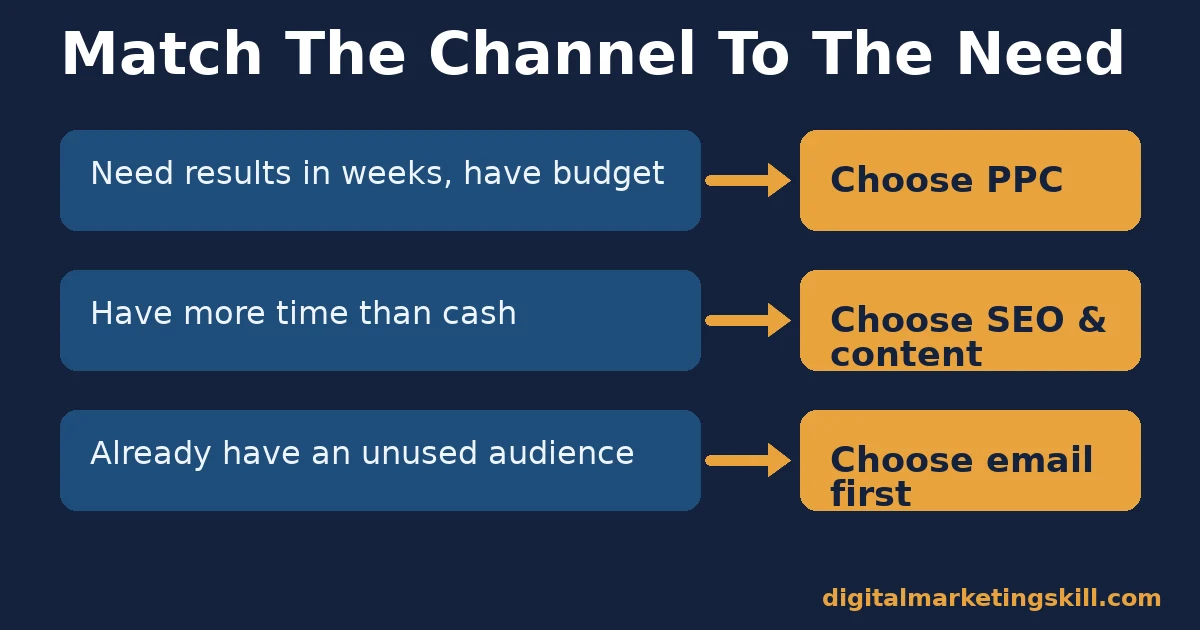
Choose PPC if you need measurable results within weeks and have a budget for testing. Choose SEO and content if you need a durable asset over six to twelve months and have more time than cash.
Or lead with email if you already have an audience sitting unused, such as past customers or old leads. Otherwise, you risk spreading a small budget across four channels and learning nothing clearly from any of them.
Illustrative, invented numbers: picture a business with a $1,000 monthly budget and no existing list. PPC would likely give the faster first signal, with clicks and conversions inside days. SEO might take three to six months to show meaningful organic traffic.
Even so, the SEO investment could out-earn the ad spend after a year, once the ranking is established. Meanwhile, a business that already owns a 2,000-person email list could skip paid spend entirely and still see its first sale within a week, simply by emailing that list a clear offer.
Add A Second Channel Once The First One Works
Afterward, once the first channel is clearly working, add a second one that supports it rather than competes with it for attention. For example, a business that proved PPC works can usually add SEO next, using the keywords that already convert in ads as a guide for which content to write first.
Similarly, a business already getting steady email replies can often add social media next, since it already knows what messaging resonates with its exact audience.
A Real Web Marketing Case, And Its Limits
Olajire Jacob is a graduate of the Digital Marketing Skill Institute. He built email marketing flows as a service for clients across the US, UK and Canada. He charged around $500 per setup. That single channel grew his freelance services to roughly $5,000 a month, as published on the Institute’s reviews page.
The limits matter here. This is one named, published result. It is not a typical outcome or a guarantee. Client acquisition, pricing and market conditions all affect what any one person achieves. Therefore, read it alongside the Institute’s earnings disclaimer, not as a promise of similar income.
Still, the case is useful as a pattern, not just a number. Notice that Jacob didn’t try to run every channel at once. Instead, he picked one owned channel, email flows, and went deep on it until it paid for itself. Then he scaled the same service to more clients rather than adding new, unrelated channels. That sequencing — depth before breadth — shows up in most web marketing results worth reading about.
In other words, the channel itself wasn’t the whole story. Specifically, the repeatable process behind it mattered just as much: a clear niche offer, a fixed price, and a narrow set of clients he understood well. Any of the four channels covered in this guide can support that same pattern, provided you resist the urge to add a new channel before the first one is actually working.
Frequently Asked Questions About Web Marketing
What is the difference between web marketing and digital marketing?
Web marketing is the part of digital marketing that happens through the internet. Think search, social, email and web ads. Digital marketing is broader. It also covers offline-adjacent channels like SMS and in-app messages. In short, every web marketing tactic is digital marketing, but not every digital marketing tactic happens on the web.
Which web marketing channel gives the fastest results?
Pay-per-click advertising usually wins here. The ad runs as soon as it’s approved, so clicks and conversions show up within days. Organic channels like SEO usually need weeks or months to build visibility. However, PPC results stop the moment you stop paying, while SEO keeps working after the initial effort.
Do I need a large budget to start web marketing?
No. Email marketing to an existing list and organic content both carry a near-zero media cost. The real investment is your time, not ad spend. Paid channels can also start small, with test budgets, before you scale what works. Even a few dollars a day on a search ad is usually enough to learn whether an offer converts.
How long before web marketing shows results?
Paid channels can show results within days. Search engine optimization more often takes a few months to build real organic traffic. Email results depend on list size, and show up as soon as your first campaign sends. Generally speaking, the faster a channel can show results, the shorter that result tends to last once spending stops.
Is social media marketing the same as web marketing?
No. Social media marketing is one channel inside web marketing. It isn’t a replacement for the whole plan. Most effective web marketing combines social with at least one other channel, such as search or email. For instance, a post that drives someone to search for your brand name is social and SEO working together.
How do I know if my web marketing is working?
Track organic traffic share, conversion rate, cost per click and ROI every month. If conversion rate stays flat while traffic grows, the offer or landing page usually needs attention first, not the channel. Likewise, if cost per click keeps rising while conversions stay flat, that channel may be getting more competitive and deserves a second look.
Can a small business compete with larger companies in web marketing?
Yes. Web marketing channels rank and price mostly on relevance and quality signals, not budget size alone. A smaller business with a sharper offer and better-matched content can outrank a bigger competitor in its own niche. Indeed, a tightly targeted local or niche campaign often beats a broad, generic one, even against a much bigger ad budget.
Where To Learn Web Marketing Properly
Given everything above, the practical question isn’t “which channel is best,” but “which one fits where you are right now, and how will you learn the one move that makes it actually work.” That is exactly the gap most generic advice leaves open, and exactly where structured, hands-on training earns its place over another list of tips.
Reading about web marketing gives you the vocabulary. Running real campaigns is what builds the judgment to pick the right channel and fix what isn’t working. The Digital Marketing Skill Institute’s Master Diploma in Digital & AI Marketing is built around that kind of practice. It has four AI-powered tracks: AI-Powered Social Media Management and Advertising, AI-Powered Lead Generation and Email Automation, AI-Powered Google Specialist, and AI-Powered WordPress and SEO Specialist. Together they total ten courses, with a Full Stack option for completing all four tracks.
Every track includes unlimited 1-on-1 coaching and mentoring, a U.S. Project Internship with a verified U.S. Work Reference Letter, and dual US and UK accreditation recognised in more than 100 countries. It is 100% online, so you can study from anywhere in your country.
Start Wherever You Are
Explore the Master Diploma program, browse more guides on the digital marketing blog, or go straight to the application page. Whatever your starting point, the team at digitalmarketingskill.com is there to help you turn web marketing from a buzzword into a repeatable skill, wherever you live. Start today at digitalmarketingskill.com.
Every figure in this guide was checked against its original source before publication. Figures marked as illustrative are invented examples, not real results.
