
Small business marketing strategies fail less often from a bad tactic than from a mismatched budget. A strategy built for a company spending 8% of revenue rarely works for one spending under $1,000 a year. This guide sorts strategies by budget stage, with the data behind each choice and a way to measure results.
Key Takeaways
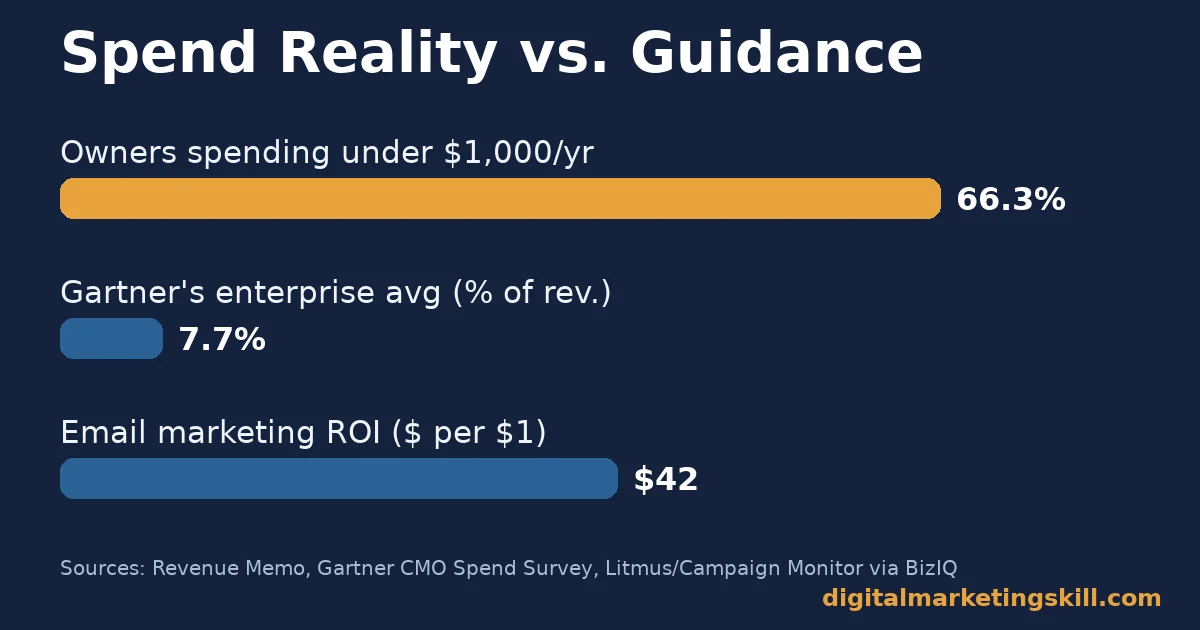
- 66.3% of small business owners spend less than $1,000 a year on marketing, well below what most guidance recommends.
- Gartner’s CMO Spend Survey puts average marketing spend at 7.7% of revenue, though that figure covers established enterprise organizations, not small businesses specifically.
- Email marketing returns $42 for every $1 spent, the highest return of any channel tracked by Litmus and Campaign Monitor.
- 82% of small businesses say referrals are their main source of new business, according to Constant Contact research.
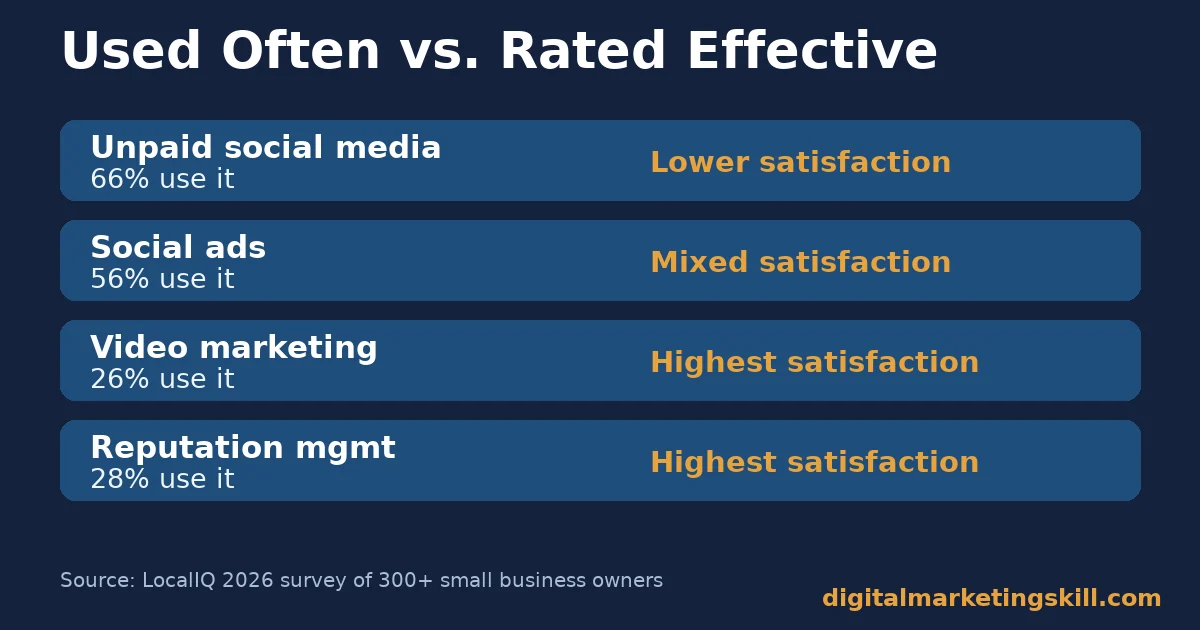
- Video marketing and reputation management led small business satisfaction scores in a LocalIQ survey, despite lower adoption than social media.
In this guide
- Why Most Small Business Marketing Strategy Lists Fail
- How Your Budget Stage Changes Which Strategy Works
- Small Business Marketing Strategies By Budget Stage
- How to Execute Small Business Marketing Strategies At Each Stage
- Which Channels Small Businesses Actually Rate as Effective
- Common Mistakes That Undermine Small Business Marketing Strategies
- The One Decision Rule For Picking a Small Business Marketing Strategy
- How to Measure Whether a Small Business Marketing Strategy Is Working
- Tools That Support Small Business Marketing Strategies at Each Stage
- A Real Case: What Students Learn About Picking the Right First Strategy
- Putting Small Business Marketing Strategies Together
- Frequently Asked Questions About Small Business Marketing Strategies
- Build These Skills With Structured, Guided Practice
Why Most Small Business Marketing Strategy Lists Fail
A list of twenty tactics looks thorough. In practice, it overwhelms. Most small businesses cannot run twenty strategies at once, so a long list just delays the three or four that would actually move revenue.
The real constraint is rarely creativity. It is budget and time. A strategy that works well at $10,000 a month often fails completely at $200 a month. The idea is not wrong. It simply never gets enough resources to work. That single mismatch explains more failed small business marketing strategies than any flaw in the tactics themselves.
Many of these failures trace back to the same root causes covered in our guide to common digital marketing mistakes, so it helps to rule those out first.
A ground rule before the framework: the spending figures below come from named surveys, some self-reported by business owners. Treat them as a planning range, not a guarantee of what your business will spend or earn.
How Your Budget Stage Changes Which Strategy Works
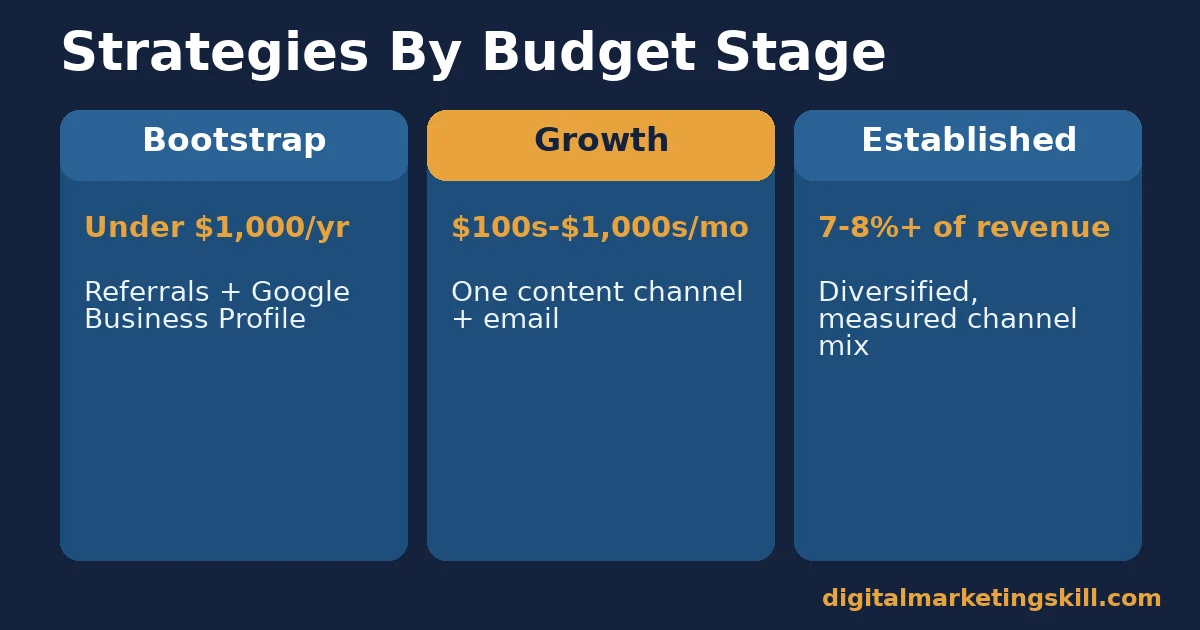
Marketing strategy is not one-size-fits-all advice. It is a set of decisions that change as a business moves through three rough budget stages: bootstrap, growth, and established. Each stage can realistically execute a different mix of strategies well.
66.3% of small business owners spend less than $1,000 a year on marketing. That is squarely a bootstrap budget, and most popular marketing advice is not written for it.
Gartner’s enterprise-focused 7.7%-of-revenue average assumes a business already generating meaningful revenue. That describes the growth and established stages far better than the bootstrap stage. The U.S. Small Business Administration’s own marketing guidance skips a fixed percentage entirely. It instead tells owners to compare marketing cost against the revenue it generates, which is exactly the measurement habit this guide builds toward.
Small Business Marketing Strategies By Budget Stage
Here is how the useful strategy set shifts as budget grows. Use the stage that matches your actual monthly spend, not your ambitions.
Bootstrap: Built For Zero-Cost Trust
At under $1,000 a year, paid channels rarely get enough budget to learn. The highest-leverage strategies are the ones that cost time, not money: referrals, a complete Google Business Profile, and consistent posting on one social platform you can actually sustain.
Growth: Built For Compounding Content
Once a business can commit a few hundred to a few thousand dollars a month, content marketing and email marketing start to compound. Each blog post or email keeps working after it is published, unlike a paid ad that stops the moment spending stops. Our guide to content marketing for startups covers how to build that habit from scratch.
Established: Built For a Diversified Channel Mix
At 7% to 8% of revenue or more, a business can run paid search, paid social, content, and email at the same time, each measured separately. The job shifts from picking one strategy to allocating budget across several that already work.
How to Execute Small Business Marketing Strategies At Each Stage
Knowing the stage is not the same as executing it well. Here is what to actually do at each one, mirrored against the stages above.
Bootstrap: Lead With a Referral Ask
Ask every satisfied customer for a referral within a week of a good result, while the experience is fresh. 82% of small businesses already say referrals are their main source of new business, according to research cited by Demandsage. Yet few businesses ask for one systematically.
Pair that with a fully completed Google Business Profile and a clear sense of who your target audience actually is, since local search is often the first place a referred prospect checks.
Growth: Lead With One Content Channel, Not Five
Pick one content format, such as a blog or a short newsletter, and publish it consistently before adding a second. Litmus and Campaign Monitor data, reported by BizIQ, puts email marketing’s return at $42 for every $1 spent. That is the highest of any tracked channel, and it makes a simple email list one of the best places to start compounding.
Our step-by-step email marketing guide covers how to build that first list.
Established: Lead With Measurement, Then Scale What Works
Before adding a new channel, confirm the current mix is actually measured separately. A LocalIQ survey of over 300 small business owners found video marketing and reputation management led satisfaction scores, even though adoption of each sat well below more commonly used channels like social media. Measure before assuming the popular channel is the effective one.
Why Budget Stage Matters More Than Industry
Two businesses in the same industry can sit at completely different budget stages. Two businesses in unrelated industries can sit at the same one.
A local bakery spending $500 a month has more in common, strategically, with a solo consultant spending $500 a month than with a bakery chain spending $30,000 a month. Industry shapes which specific tactics make sense. Budget stage shapes which categories of tactic are even viable.
Which Channels Small Businesses Actually Rate as Effective
Usage and effectiveness are not the same thing. The LocalIQ survey found unpaid social media used by 66% of small businesses, social ads by 56%, and SEO and email each by 53%. Yet video marketing and reputation management, used by only 26% and 28% respectively, led the pack on owner-reported satisfaction.
That gap matters for small business marketing strategies on a tight budget. Chasing the most popular channel is not the same as chasing the most effective one. Website chat and online business listings posted the highest dissatisfaction scores in the same survey, at 19% and 18%, so popularity alone is a poor guide to where to spend next.
Common Mistakes That Undermine Small Business Marketing Strategies
Most underperforming campaigns share one of four habits. Check your own plan against each before adding a new tactic.
Copying a Strategy Built For a Bigger Budget
A strategy designed for 7.7% of a large company’s revenue rarely survives a transplant to a $50-a-month budget. Scale the ambition of a strategy to the budget stage it actually fits, not the stage you hope to reach next year.
Skipping Measurement to Save Time
A simple intake question, “how did you hear about us,” costs nothing and answers the question every other metric depends on. Skipping it means every later decision about small business marketing strategies is a guess.
Chasing Every Channel at Once
Running five channels at 20% effort each usually loses to one channel at full effort. Consolidate before expanding, especially below the growth-stage budget line.
Ignoring the Gap Between Popular and Effective
The most-used channel in survey data is not always the best-rated one. Revisit the channel effectiveness data above before assuming the popular choice is the right one for your business.
Starting a Strategy Without an Exit Plan
Before launching anything, decide in advance what result would make you stop and try something else. Without that line drawn ahead of time, a weak strategy often keeps running on momentum alone, well past the point where the numbers already answered the question.
The One Decision Rule For Picking a Small Business Marketing Strategy
Pick the one strategy your current budget stage can fully fund and measure, run it for one full quarter, then add a second. A thin budget spread across five strategies usually produces weaker results than a full budget behind one.
Here is an illustrative example, with invented numbers. A bootstrap-stage service business spends $0 on ads and instead asks every customer for a referral and keeps its Google Business Profile current. After one quarter, 40% of new customers arrive through referrals or local search, without spending a cent on paid channels.
A Worked Example: Two Budget Stages, Two Different Strategies
Here is a second illustrative comparison, with invented numbers, showing why one playbook cannot serve every stage. A bootstrap-stage bakery and a growth-stage software company both consider adding paid social ads.
For the bakery, spending under $1,000 a year, a $50 ad test barely reaches enough people to produce a signal. The referral and Google Business Profile strategy above remains the better use of that time.
For the software company, spending $3,000 a month, the same paid social budget can run long enough to learn which audience converts. That makes it a reasonable addition alongside its existing content strategy. Same tactic, two very different verdicts.
How to Measure Whether a Small Business Marketing Strategy Is Working
Four numbers show whether a strategy is paying off, regardless of budget stage. Track them monthly so a trend is visible.
- Customer source: where new customers say they heard about you. A simple intake question captures most of this for free.
- Cost per customer: total spend on a channel divided by customers it produced. This is the number that actually compares channels fairly.
- Repeat rate: the share of customers who buy again. Referral and word-of-mouth customers often show a higher repeat rate than paid channels.
- Review volume: new reviews earned per month. It is a leading indicator for both reputation management and local search visibility.
Review these four numbers together. A low cost per customer paired with a low repeat rate often means a channel is winning one-off bargain hunters, not loyal customers. The SBA’s own guidance frames this as comparing marketing cost against the revenue it generates, which is the same discipline at a slightly bigger scale.
Tools That Support Small Business Marketing Strategies at Each Stage
A tool never replaces a strategy. It just makes execution faster once the strategy is chosen. At the bootstrap stage, a free spreadsheet to log referral sources and a Google Business Profile login are usually enough. No paid software is required yet.
At the growth stage, a simple email platform and a basic content calendar tool start to pay for themselves. Pick one of each, not three, so the habit stays easy to maintain. At the established stage, a shared analytics dashboard that pulls cost per customer across every channel becomes worth the setup time, since manual tracking breaks down once several channels run at once.
Across all three stages, resist the urge to buy a tool before the underlying habit exists. A scheduling tool does not fix an inconsistent posting habit, and an analytics dashboard does not fix a missing intake question. Fix the habit first. Add the tool once the habit is already working, so the tool amplifies something real instead of papering over a gap.
A Real Case: What Students Learn About Picking the Right First Strategy
Published reviews on the Institute’s reviews page consistently describe the same early lesson: students who pick one strategy and execute it fully outperform those who spread effort thin across many. Digital Marketing Skill Institute, at digitalmarketingskill.com, structures its training around that exact sequencing, rather than a long tactic list, because a focused strategy is easier to measure and easier to improve.
No specific income figures are claimed here, since marketing skill alone does not guarantee a result for every business. The consistent pattern across reviews is sequencing and measurement discipline, not a shortcut.
Putting Small Business Marketing Strategies Together
Start with the budget stage, not the tactic. Figure out honestly whether a business is bootstrap, growth, or established this month, not where it hopes to be by year end.
From there, pick one strategy that fits the stage. Fund it fully. Measure it with the four numbers above. Only then add a second strategy.
This sequence feels slower than launching five tactics at once. In practice, it is faster, because a single well-funded, well-measured strategy produces a usable answer within one quarter. Five half-funded strategies usually produce five weak, inconclusive signals instead, and nobody learns anything worth repeating.
Frequently Asked Questions About Small Business Marketing Strategies
What is the best marketing strategy for a brand-new small business?
A systematic referral ask, paired with a complete Google Business Profile. Both cost time rather than money, which fits a bootstrap budget, and 82% of small businesses already report referrals as their main source of new business.
How much should a small business spend on marketing?
There is no single right number. Gartner’s CMO Spend Survey puts average spend at 7.7% of revenue for established companies, while the Small Business Administration’s own guidance skips a fixed percentage and instead tells owners to compare marketing cost against the revenue it generates. Many small businesses spend far less than either benchmark in practice, which should shape which strategies are realistic.
Is social media still worth it for small businesses?
Often, but it is the most used channel, not necessarily the most effective one. Survey data shows channels like video and reputation management scoring higher on owner-reported satisfaction despite lower adoption.
Should a small business run multiple marketing strategies at once?
Not before one is fully funded and measured. A thin budget spread across many strategies usually underperforms a full budget behind one, especially at the bootstrap stage.
What marketing strategy has the highest return for small businesses?
Email marketing is reported to return $42 for every $1 spent, the highest of any tracked channel. It requires an existing list, so it fits best once a business has moved past the bootstrap stage.
How long should a small business test a new marketing strategy before judging it?
At least one full quarter. Referral-based and content-based strategies compound slowly, so short test windows often underestimate their real effect.
Do small business marketing strategies need to change as revenue grows?
Yes. A strategy sized for a bootstrap budget usually needs more channels and more measurement once a business reaches the growth or established stage, even if the original strategy keeps working.
What is the single most common reason small business marketing strategies fail?
A mismatch between the strategy’s required budget and the budget actually available. Many failed campaigns were sound ideas that simply never had enough resources to reach the volume needed to work.
Can two small businesses in the same industry need completely different marketing strategies?
Yes, if they sit at different budget stages. A new local shop and an established chain in the same category rarely benefit from the same strategy, even though they sell similar products.
Is it ever worth hiring help for small business marketing strategies?
Often, once a business reaches the growth or established stage and has more channels than one person can measure well. Below that point, the time spent learning one strategy directly usually beats the cost of outsourcing it.
Build These Skills With Structured, Guided Practice
Choosing and sequencing small business marketing strategies is a skill built on real campaigns, not a checklist read once. The Master Diploma in Digital & AI Marketing from Digital Marketing Skill Institute includes an AI-Powered Lead Generation and Email Automation track, inside four AI-powered tracks totalling ten courses, with a Full Stack option for completing all four.
Every track includes unlimited 1-on-1 coaching and mentoring, a U.S. Project Internship with a verified U.S. Work Reference Letter, and dual US and UK accreditation recognised in more than 100 countries. The program runs 100% online, so you can build this skill from anywhere in your country.
Explore the Master Diploma program structure, browse more guides on the Digital Marketing Skill Institute blog, or read real outcomes on the reviews page. When you are ready, apply for the Master Diploma, or start from the Digital Marketing Skill Institute homepage.
Every figure in this guide was checked against its original source before publication. Figures marked as illustrative are invented examples, not real results.
![9 Amazing Digital Marketing Skills to Make Money Online [With Proof]](https://digitalmarketingskill.com/wp-content/uploads/2019/07/9-Amazing-Digital-Marketing-Skills-to-Make-Money-Online-With-Proof-17.png)






