

Most people who deal with job rejection blame their resume or bad luck. But the bigger shift happened inside the hiring funnel itself. Applications per hire have more than tripled in five years, while interview callbacks have fallen by half. This guide shows why rejection lands so often, and what to do about each kind.
Key Takeaways
- Rejection is mostly funnel math, not a verdict on you. Ashby’s analysis of more than 100 million applications found applications per hire have more than tripled in five years. Candidates are roughly half as likely to land an interview as they were five years ago.
- Your network beats your volume. Referred candidates get hired at around 30%, against about 7% for everyone else. Referrals make up only a sliver of all applications, per SHRM’s analysis of hiring-source data.
- Reframing a rejection helps fast, but the effect fades. In a field study of 180 job seekers, writing briefly about a rejection with self-kindness cut negative feelings right away. The lift faded within a week.
- How you cope changes what happens next. Researchers tracked 668 adults after job loss. People who reframed their situation positively grew more resilient a month later. Those who distracted themselves grew more anxious and depressed.
- A long search is common, not a personal failing. In the US, 27.1% of unemployed workers have been searching for 27 weeks or longer, per the Bureau of Labor Statistics. That is a US-only figure, but it shows how normal a long search is.
In this guide
- The Real Gap: Rejection Math Changed, Most Advice Didn’t
- Why You Get Rejected: Mechanism, Not Judgment
- Three Kinds of Job Rejection Need Three Different Responses
- How to Respond to Each Kind of Rejection
- Measure Your Job Search Like a Funnel
- The One Decision Rule: Fix the Resume or Fix the Interview
- What Handling Job Rejection Well Looks Like
- Frequently Asked Questions About How to Deal With Job Rejection
- Turn This Into Your Next Move
The Real Gap: Rejection Math Changed, Most Advice Didn’t
Most articles on how to deal with job rejection focus only on feelings. Stay positive. Be resilient. Don’t give up. That advice isn’t wrong, but it skips the part that explains why rejection feels so relentless right now.
The hiring funnel got far more crowded. A few ground rules before the detail: the funnel figures below are a snapshot from one widely used recruiting platform, not a universal law. Ratios like these shift as the job market shifts.
The psychology studies further down use samples of a few hundred to a few thousand people each. Treat the direction of each finding as solid. Treat the exact numbers as specific to that study, not a guarantee for your own search.
And a long search is more common than it feels. In the US, the Bureau of Labor Statistics reports that 27.1% of unemployed workers have searched for 27 weeks or longer. That’s a US-only number, but duration alone says little about your odds.
Why You Get Rejected: Mechanism, Not Judgment
A rejection email rarely means someone read your resume and decided you weren’t good enough. More often, it means your application never reached a human at all. Tracking systems filter and rank resumes before anyone on the hiring team opens them, because the volume makes manual review impossible.
These systems usually rank applicants against the exact wording in the job posting, not against some abstract idea of talent. A resume that describes the same skill with different words than the posting can rank lower than a weaker candidate who happened to match the phrasing. That is a matching problem, not a measure of your ability.
Recruiters then work from a shortlist the system produces, often reviewing only the top handful out of hundreds. A hiring manager may never see most applications at all, simply because the queue is too long to open by hand.
The Volume Behind Every Rejection
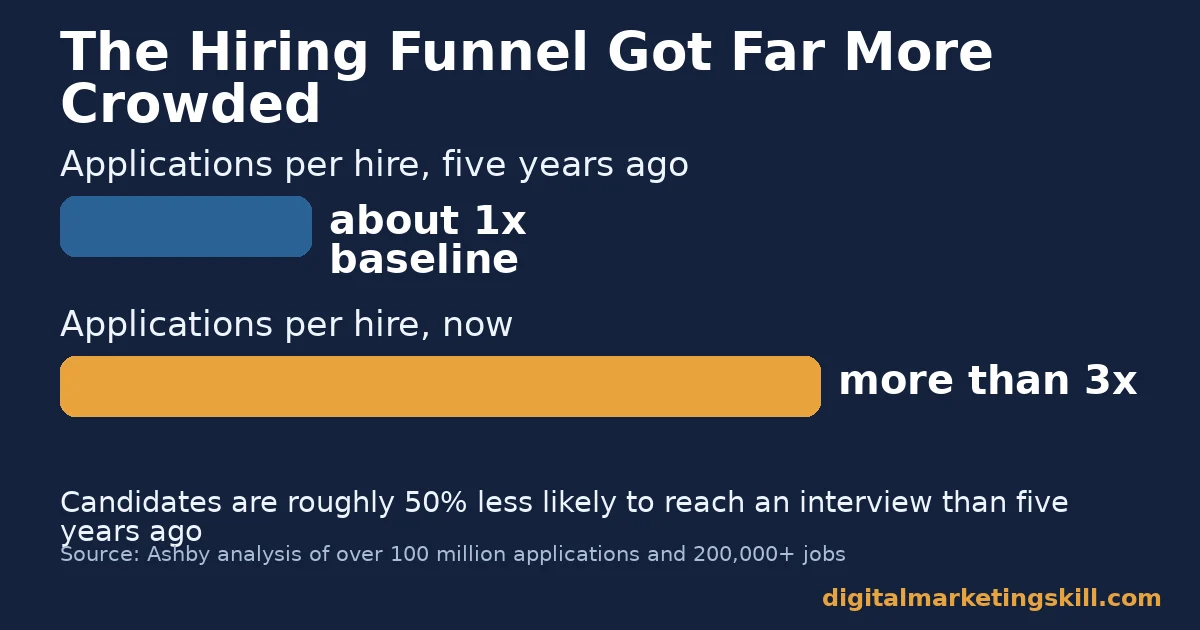
That’s also why everyone has to deal with job rejection on a scale most advice ignores. Ashby’s analysis of more than 100 million applications covered over 200,000 jobs across five years. Applications per hire more than tripled. Some roles now draw over 300 applications for every hire.
Candidates are roughly 50% less likely to be invited to an interview than they were five years earlier. Yet offer rates for people who do reach an interview have actually improved. The two facts together point to one mechanism.
The bottleneck sits earlier in the funnel than most advice assumes. Once you’re in front of a person, your odds are better than ever. Getting in front of that person is the hard part, and it has nothing to do with your character.
Three Kinds of Job Rejection Need Three Different Responses
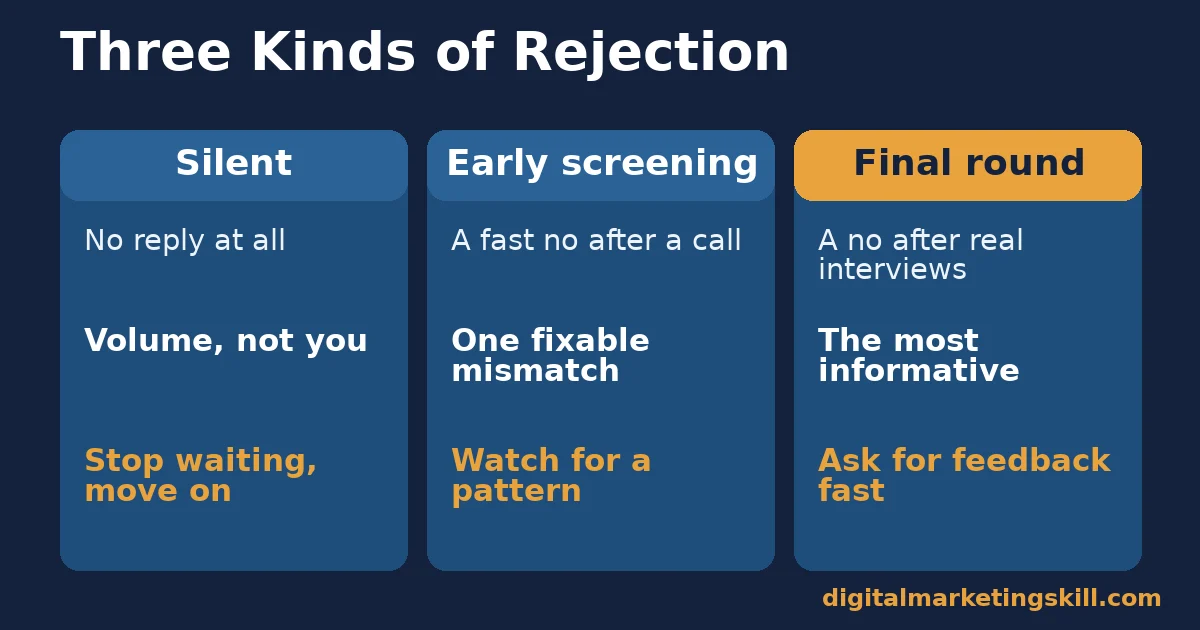
Not every “no” is the same event, even though each one stings in the moment. Learning to deal with job rejection well starts with splitting your rejections into three groups, instead of treating a silent application like a thoughtful final-round decline.
Silent Rejection: Built for Volume, Not for You
This is the application that never got a reply, automated or otherwise. It’s the most common kind of job rejection by far, and the least personal. Application volume has more than tripled industry-wide, so most employers simply cannot answer everyone.
If you deal with job rejection mostly through silence, know that it tells you nothing about your qualifications. It mainly tells you that your application sat in a queue of hundreds and didn’t surface near the top, whether from keyword matching, timing, or a role filled internally before the posting closed.
Early Screening Rejection: A Fast No About Fit
This rejection arrives after a recruiter call or a short phone screen, usually within days. Someone did look at your application and spoke with you, unlike with silent rejection. But the decision still rested on a handful of qualifying questions, not a full evaluation.
Early screening rejections often come down to one fixable mismatch: a salary range, a location requirement, a tool you haven’t used, or a start date that didn’t line up. They carry more signal than silence, but still less than you’d think.
Final-Round Rejection: The Closest No, and the Most Useful
This rejection comes after one or more real interviews, maybe even a final round with a hiring manager. It’s the hardest to receive emotionally, because you invested real time and pictured yourself in the role already.
It’s also, mechanically, the most informative rejection you’ll get. A real person compared you against other finalists on criteria that mattered to them. The reasons behind that decision, if you can get them, are specific enough to act on.
How to Respond to Each Kind of Rejection
The sections below mirror the three kinds of rejection above and show how to deal with job rejection of each type. Match your response to the kind of “no” you actually received, instead of reacting the same way to all three.
Silent Rejection: Stop Waiting, Reallocate Your Time
Set a deadline, such as two weeks. After that, treat a silent application as closed and stop checking for a reply. Waiting on silence costs you time you could spend on applications more likely to convert.
Put that time into your network instead of more cold applications. Referred candidates get hired at around 30%, against about 7% for everyone else, per SHRM’s analysis of hiring-source data. A short message to a former colleague usually outperforms another round of blind applications.
If you want ideas for building that network in the first place, our guide on finding a digital marketing mentor covers how to approach people without feeling like you’re imposing.
Early Screening Rejection: Mine It for One Resume Fix
Before you move on, write down the specific reason given, even a vague one like “we need more experience with X.” Watch for a pattern over three or four early rejections. A repeated gap is worth fixing directly.
Don’t rewrite your whole resume after one data point. Wait until you see the same signal twice, then make one targeted change. Our guide on building a stronger digital marketing resume covers exactly what to adjust once you know what’s missing.
Final-Round Rejection: Ask for Feedback While You’re Still Memorable
Reply within a day or two, while the interview team still remembers your conversation. A short, direct note works better than a long one:
Subject: Thank you, and a quick question
Hi [Name],
Thank you for letting me know, and for the time your team spent with me. I’m disappointed, but I valued learning more about [Company].
If you have a moment, I’d welcome any feedback on where I fell short compared to the person you chose.
Either way, thank you again, and I’d be glad to stay in touch for future openings.
Best,
[Your name]
Many hiring teams won’t give detailed feedback, for legal or time reasons. But enough will respond that it’s worth the two minutes it takes to send. If you do get feedback, look for a pattern across more than one final round before you change anything major.
Measure Your Job Search Like a Funnel
A job search feels chaotic partly because most people track only one number: how many applications they’ve sent. A funnel view shows where your search is actually breaking down, the same way a sales team tracks a pipeline instead of just counting calls.
Three Numbers Worth Tracking Each Week
- Response rate. The share of applications that get any reply within three weeks, positive or negative. A very low rate points to your resume or your targeting, not your interview skills.
- Interview-to-offer ratio. Of every interview you land, how many lead to a later round or an offer. A low ratio here, despite a decent response rate, points to the interview itself.
- Follow-up reply rate. The share of your feedback requests and thank-you notes that get a response. It tells you how much real signal you’re likely to collect from future rejections.
Reading the Three Numbers Together
If your response rate is low but your few interviews tend to go well, the problem sits early: your resume, your targeting, or both. If you land plenty of first interviews but rarely move to round two, the problem has shifted to your interview itself.
Track both numbers for a month before making a big change. A few rough weeks can look like a trend when they’re really just noise.
Here’s an illustrative example, with invented numbers, showing how the two metrics diverge. One job seeker applies to 30 roles a month and gets replies from 9 of them, a 30% response rate that looks healthy. But only 1 of those 9 interviews leads to a second round, an 11% interview-to-offer ratio. The data points clearly toward interview preparation, not the resume, as the next fix.
The One Decision Rule: Fix the Resume or Fix the Interview
Here is the single most useful rule in this guide for anyone trying to deal with job rejection at scale. If you aren’t getting interviews, fix your resume and targeting. If you’re getting interviews but not offers, fix your interview preparation instead. Don’t work on both at once, or you won’t know which change actually moved the number.
Here’s an illustrative example, with invented numbers. Someone sends 40 applications in a month and gets 2 interviews and 0 offers. That ratio looks bad, but two data points tell you almost nothing yet. The honest first move is to keep the funnel moving until there’s enough data to read.
What Handling Job Rejection Well Looks Like
Olajire Jacob’s story appears on Digital Marketing Skill Institute’s student reviews page. He didn’t land steady income right away. Early on, he priced email marketing setup work for clients at around $500 per project, and plenty of pitches went nowhere before any of them landed.
Rather than treating each unanswered pitch as a verdict on his skills, he kept refining his offer and outreach. He eventually scaled his services to roughly $5,000 a month in revenue.
The limits of this case matter. It’s one published story, in freelance client work rather than traditional employment, so see the Institute’s earnings disclaimer for that context.
What it shows is the pattern this guide to how you deal with job rejection keeps pointing to. People who treated early “no” responses as information, not a final judgment, kept moving instead of stalling. The same pattern applies whether the “no” comes from a client or a hiring manager.
Frequently Asked Questions About How to Deal With Job Rejection
What should I do right after a job rejection?
Give yourself a short window, even just that evening, to feel disappointed. A field study of 180 job seekers found that briefly writing about the rejection with self-kindness reduced negative feelings right afterward. The effect faded within a week, so treat it as a way through the first day, not a long-term fix.
Is it normal to deal with job rejection many times before getting hired?
Yes. Applications per hire have more than tripled over five years, so multiple rejections before an offer is the typical experience now. It isn’t a sign that something is wrong with your approach specifically.
Should I ask every employer for feedback after a rejection?
Ask after final-round rejections, since a real person evaluated you directly and is likely to have something specific to share. Skip it after silent or very early rejections, since there’s often no individual decision-maker to respond.
How do I stay motivated during a long job search?
Track a few funnel metrics, such as response rate and interview-to-offer ratio, instead of only counting rejections. Watching the numbers move gives you something concrete to hold onto. Leaning on your network also helps directly, since referred candidates are hired at roughly four times the rate of other applicants.
Does a positive mindset actually help you deal with job rejection?
The honest answer is mixed. A study tracking 668 adults after job loss found that reframing a setback positively was linked to greater resilience a month later, while distracting from it was linked to more anxiety.
But a widely discussed replication of earlier growth-mindset research found changed beliefs about ability didn’t significantly change real-world resilience to failure. Other researchers dispute that analysis, so treat mindset work as one helpful input, not a guaranteed fix.
What’s the single biggest mistake people make when they deal with job rejection?
Responding to every kind the same way. Chasing feedback after a silent application wastes time a final-round rejection would actually reward. Skipping feedback after a final round throws away the most useful information in your whole search.
How many applications should I expect to send before getting an offer?
There’s no fixed number, because it depends on your field, location, and how targeted your applications are. What the funnel data does show is that hundreds of applications per hire is now typical industry-wide, so judging your search against an old, smaller number will only discourage you unfairly.
Turn This Into Your Next Move
Learning to deal with job rejection well is frustrating mainly because it’s common, not because it’s a verdict on your ability. The people who keep moving are the ones separating the kind of “no” they got, asking for feedback where it’s likely to exist, and leaning on people rather than only job boards.
Our guide on using LinkedIn to get a job is a good next read if your network-building needs more structure.
If a skills gap is part of why you deal with job rejection often, Digital Marketing Skill Institute’s Master Diploma in Digital & AI Marketing builds practical, in-demand ability. It runs through four AI-powered tracks covering ten courses total: social media management and advertising, lead generation and email automation, Google specialisation, and WordPress and SEO, with a Full Stack option covering all four.
Every track includes unlimited one-on-one mentoring, plus a U.S. Project Internship with a verified Work Reference Letter. You graduate with real project experience, not just a certificate. The program is dual US and UK accredited, recognised in 100+ countries, entirely online, so you can build the skill set anywhere in your country.
Explore the program and apply at digitalmarketingskill.com/apply/, browse more career guides on the blog, or start at digitalmarketingskill.com to see what’s covered, wherever you live right now.
Every figure in this guide was checked against its original source before publication. Figures marked as illustrative are invented examples, not real results.
