

A digital marketing mentor is an experienced practitioner who gives you direct, personal feedback on your real work. That is different from generic advice you could find in any article. Finding one shortens your learning curve. This guide shows where to look, what to ask for, and how to spot a mentor who will actually help.
Key Takeaways
- Mentors are promoted roughly six times more often than non-participants. Mentees are promoted roughly five times more often. That is according to a long-running Sun Microsystems mentoring study.
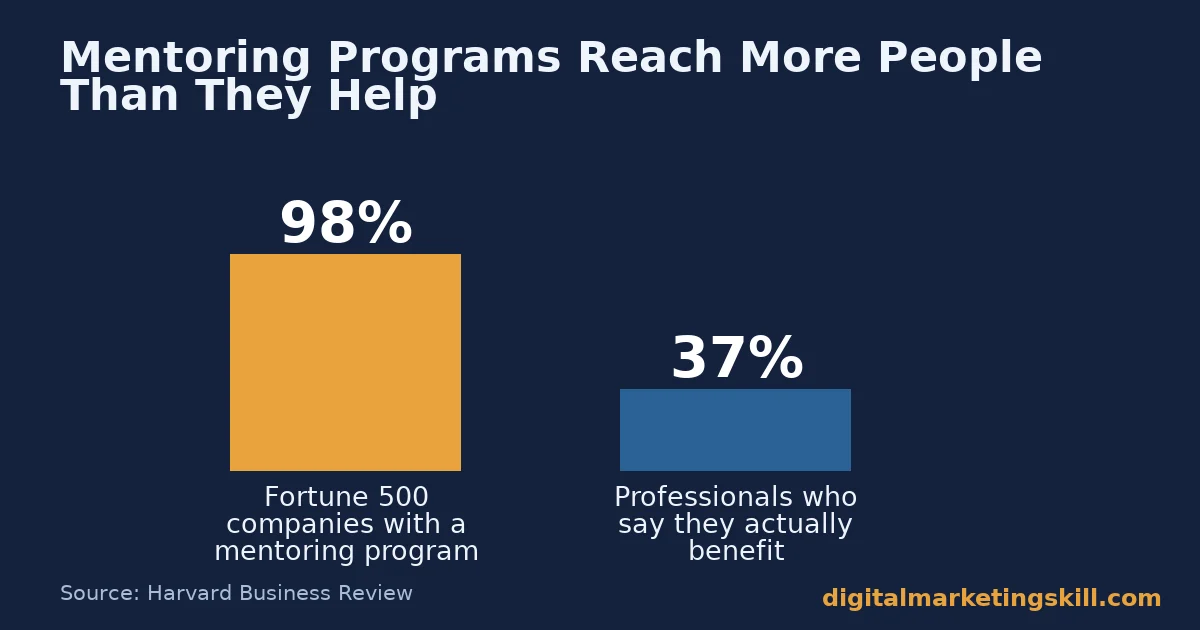
- 98% of Fortune 500 companies run a formal mentoring program. Yet only 37% of professionals say they actually benefit from one, according to Harvard Business Review’s reporting on workplace mentoring.
- Market research and marketing specialist roles are projected to grow 7% over the coming decade, well above average, per the U.S. Bureau of Labor Statistics.
- A manager alone drives at least 70% of the variance in how engaged their team feels, Gallup’s workplace research shows. A mentor should add to that relationship, not replace it.
- Only 14% of mentoring relationships start with a formal, explicit request. Most grow out of an ordinary working relationship. A small, specific ask usually beats a big, vague one.
In this guide
- The Digital Marketing Mentor Gap
- What A Digital Marketing Mentor Actually Does
- Three Places To Find A Digital Marketing Mentor
- How To Lead With Each Mentor Type
- How To Measure Whether Mentorship Is Working
- The One Rule For Choosing A Digital Marketing Mentor
- A Real Mentorship Outcome
- Frequently Asked Questions About Finding A Digital Marketing Mentor
- Your Next Step
The Digital Marketing Mentor Gap
Most people know a digital marketing mentor would help their career. Few actually have one. That gap is not about effort or talent. It is about access. It is worth naming plainly before you start searching.
Digital marketing moves fast. Search algorithms update. Ad platforms change their rules. New AI tools reshape entire workflows within a single quarter. Meanwhile, roles in this broader field are projected to grow 7% over the coming decade, well above the average occupation, according to the U.S. Bureau of Labor Statistics. As competition for these roles grows, a mentor who already works in the field becomes more valuable, not less.
Ground Rules Before You Start Searching
A mentor is not a magic shortcut. This guide is an informed starting point, not a guaranteed outcome. Results depend on the mentor’s time, your preparation, and how specific your ask is. Treat every number below as a snapshot of how mentoring tends to work, not a promise of your own outcome. The cost of skipping a mentor is rarely dramatic. It shows up quietly, as weeks spent solving a problem someone else could have flagged in five minutes.
With that framing in place, this guide covers what a mentor actually does, where to find one, how to choose between the realistic options, and how to know whether the relationship is working.
There is also a quieter reason the gap persists. Most people wait for a formal invitation that rarely comes. Only 14% of mentoring relationships begin with someone formally asking another person to be their mentor. Most grow naturally out of a shared project or a recurring conversation instead.
Waiting for someone to offer to mentor you is therefore usually the slowest path available. A small, specific request, asked early, replaces most of that waiting, and it costs you almost nothing if the answer turns out to be no.
What A Digital Marketing Mentor Actually Does
A digital marketing mentor is not the same as a coach, a consultant, or an instructor, even though the roles overlap. Think of a coach as someone paid to hit one outcome with you. A consultant solves a defined problem, then leaves. Meanwhile, an instructor teaches a curriculum to many people at once.
A mentor is different. They are further along in their career, and they voluntarily share judgment, not just information. Because they have already made the mistakes you are about to make, they can tell you which ones actually matter.
Four Ways A Mentor Actually Helps
In practice, that shows up in four ways. First, they shortcut your trial and error. They flag a bad decision before you make it, not after. Second, they give feedback on your actual work: your campaign, your resume, your pitch. That beats generic best practice.
Third, they hold you accountable to goals you set together, because motivation naturally dips between milestones. A manager still drives most of your day-to-day engagement at work, Gallup’s research suggests, accounting for at least 70% of that variance, so a mentor’s accountability works alongside your manager, not instead of one. Fourth, a mentor opens doors you cannot open yourself, through an introduction or a recommendation that carries their reputation.
None of this needs a formal title or a paid arrangement. If you have not yet started a digital marketing career, a mentor can help you avoid the most common first-year mistakes before they cost you time.
The Effect On Pay, Not Just Confidence
The effect also shows up in compensation, not just confidence. In the same Sun Microsystems research cited above, 25% of mentees saw a salary grade change, compared with just 5% of people without a mentor. Mentors themselves did even better: 28% saw a salary grade change over the same period.
Correlation is not the same as proof that mentoring alone caused the difference, since motivated people may seek out mentors in the first place. Even so, the gap is large enough to weigh seriously when you decide how much effort to put into finding a digital marketing mentor of your own. Treat it as one more piece of supporting evidence, alongside the promotion figures above, rather than a guarantee tied to your specific situation.
Three Places To Find A Digital Marketing Mentor
There is no single best place to find a digital marketing mentor. The right option depends on how much time you have, how specific your question is, and how much structure you want. None of the three paths below is universally better. They solve different problems. Match the option to the question you have right now, rather than picking whichever one sounds most impressive.
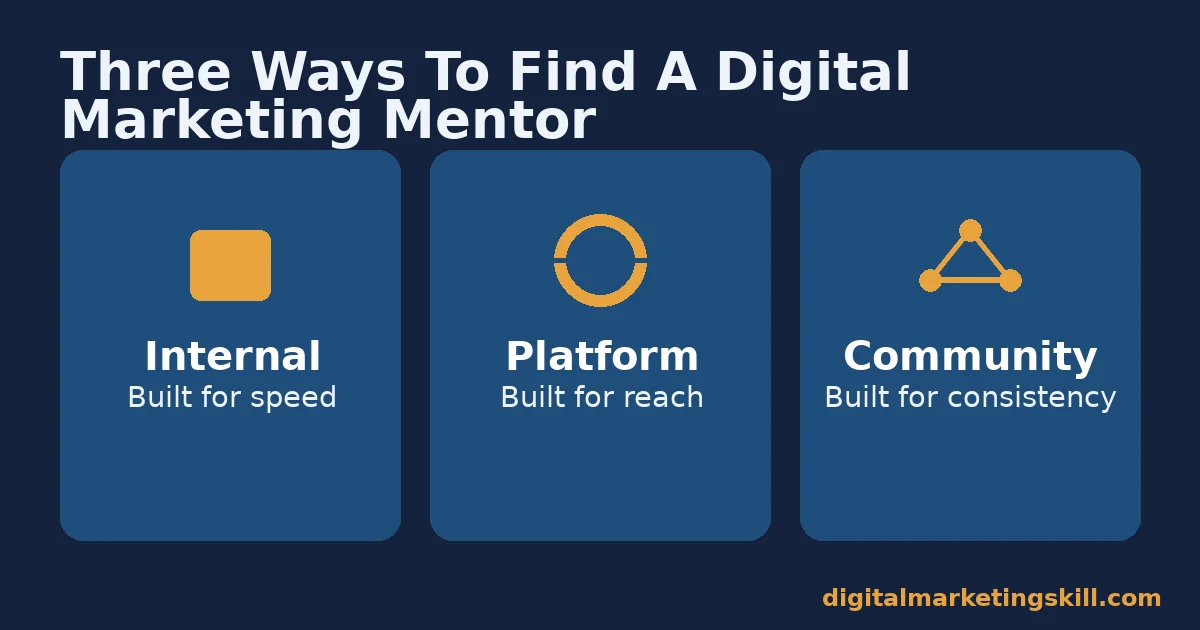
Here are the three realistic paths, and what each one is built for. Most people who successfully find a digital marketing mentor end up combining two of these three paths rather than relying on just one, so do not feel you have to pick a single lane and stay in it forever.
Internal Mentors: Built For Speed
An internal mentor is a colleague or manager inside your current workplace. They already understand your context, your tools, and your constraints. You do not need to explain background before asking your question.
This option is fastest when you need an answer today, on a problem specific to your company’s stack or process. It is weakest when you want an outside perspective, since an internal mentor shares many of your blind spots by default.
Platform Mentors: Built For Reach
A platform mentor is someone you find through a dedicated mentoring marketplace or a professional network such as LinkedIn. Free mentoring marketplaces connect mentees with tens of thousands of volunteer mentors worldwide. That is useful when you need a specific skill you cannot find close to home, such as a senior SEO specialist’s review of a technical audit.
On a network like LinkedIn, start by following people who already do the job you want. Engage with their posts before asking for their time. Platform mentoring is weakest when you want an ongoing relationship, since most sessions are one-off conversations, not standing arrangements.
Community Mentors: Built For Consistency
A community mentor emerges from an ongoing group: a course cohort, an alumni network, or an industry forum such as a Reddit community. You interact regularly over weeks or months. Trust develops naturally, rather than being forced into a single scheduled call.
This path works best when you are not in a hurry and want a mentor who understands how you have grown over time. It works least well if you need a fast answer to an urgent problem, since community relationships take time to reach real candor.
How To Lead With Each Mentor Type
Knowing the three types is only half the job. How you approach each one decides whether you get a real answer or a polite brush-off. The most common reason a mentoring request gets ignored is not a bad fit. It is a vague ask that leaves the other person unsure what you want. Here is what to lead with for each option, in the same order as above.
Internal Mentors: Lead With A Specific Ask
Do not open with “can you mentor me.” That question is vague, and vague requests get vague replies. Instead, lead with something specific: “I’m stuck on how to structure this campaign brief, could I get fifteen minutes of feedback?” A specific ask is easy to say yes to. It also sets up the next conversation if it goes well.
Platform Mentors: Lead With A Tight Brief
Platform mentors see many requests and have limited time per session. Arrive with your materials ready. Share your resume, campaign, or portfolio in advance. State the one decision you need help with. Let the mentor spend the full session on substance, not on gathering context. The tighter your brief, the more useful the session.
Community Mentors: Lead With Consistency
You cannot rush a community relationship into existence. Lead with regular, genuine participation instead. Show up, ask thoughtful questions, and help other members when you can. After a few months, the person whose answers you find most useful is usually the right person to ask directly. This same consistency helps if you are weighing a digital marketing career change and want honest input before you commit.
How To Measure Whether Mentorship Is Working
A mentoring relationship can feel pleasant without actually moving your career forward. The benefit is often intangible, so it helps to track a few concrete signals instead of relying on a vague sense of progress.
Session Cadence
This is how often you and your mentor actually talk, measured in sessions per month. A relationship with zero sessions in two months has effectively ended, even if nobody has said so. Aim for at least one real conversation a month to keep momentum.
Goal Completion Rate
Agree on two or three specific goals at the start, for example to land one freelance client or pass a technical SEO interview. Goal completion rate is the share of those goals you actually hit after a set period, such as three months. A low rate is a sign to revisit the goals or the relationship itself. It may also mean you need to close a specific skill gap before the goal is realistic.
Feedback-To-Action Ratio
This measures how much feedback you actually act on, compared with feedback you hear and ignore. A healthy ratio is high: most of what your mentor tells you should show up in your next piece of work. A low ratio usually means the feedback was not specific enough to act on, or you did not follow through.
Network Growth
Count the new, relevant contacts you make through your mentor’s introductions over a set window, such as six months. A good mentor connects you to other people who can help, not just answers your questions directly. This number should rise steadily, not stay flat.
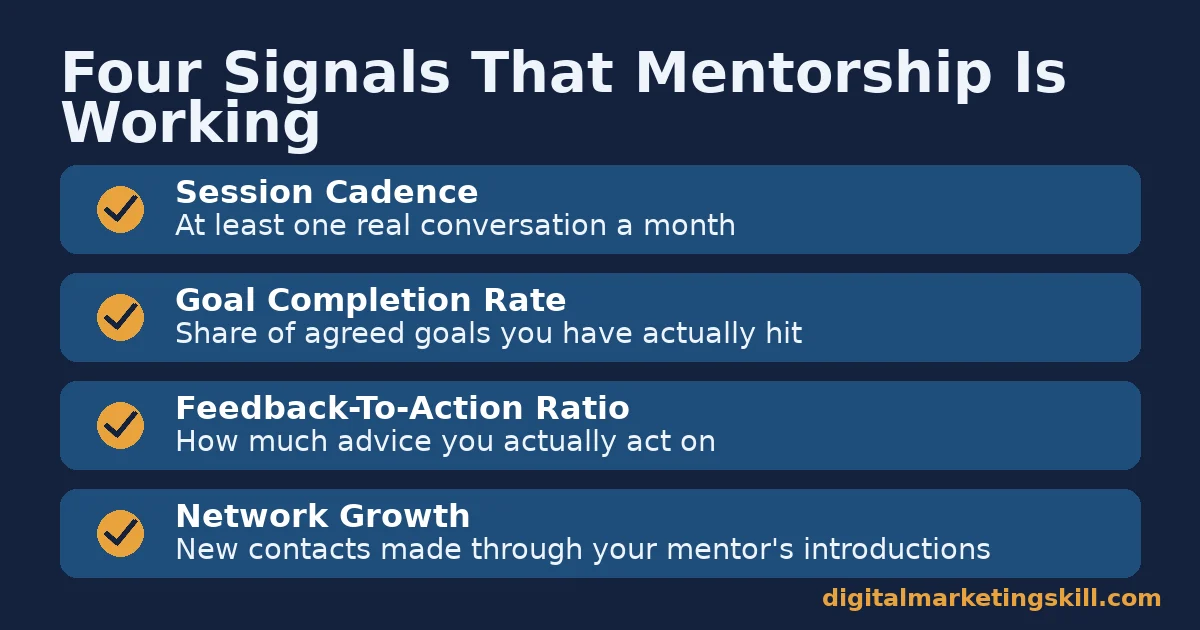
Track these four signals for a single quarter. You will get an honest, number-based answer: continue the relationship as it is, change what you are asking for, or look for a different mentor. None of this needs a formal review process. A notebook and ten minutes a month is enough.
The One Rule For Choosing A Digital Marketing Mentor
If you remember only one rule from this guide, make it this one: choose the mentor whose current skill gap matches your current goal, not the mentor with the most impressive title.
A worked example makes this concrete. Picture two candidates. The first is a marketing director with fifteen years of experience, but no hands-on SEO work in the last five years. The second is a mid-level SEO specialist who ranks pages for competitive keywords every week. If your goal is to land your first SEO role, the second mentor usually serves you better. They are solving the exact problem you need solved right now.
Title and seniority matter less than you might expect. What matters is whether the person you are asking has recently and repeatedly done the specific thing you are trying to learn. Apply this rule every time your goal changes, because the right digital marketing mentor for landing a first role is often not the right one for negotiating your next promotion.
A Real Mentorship Outcome
Chinelo E., a student at Digital Marketing Skill Institute, described hitting a wall while managing a $7,000 monthly ad budget for a U.S. client. In her own words, published on the Institute’s reviews page: “I almost quit when I got stuck, but my mentor jumped on a call and cleared it in 15 minutes.”
That one call did not teach her an entirely new skill. It unblocked a specific, stuck decision, which is usually what mentoring is best at. For context, only about half of U.S. workers report being extremely or very satisfied with their job overall, according to a national Pew Research Center survey. A single conversation that removes a specific blocker is a meaningful win against that baseline. Individual results vary and are not guaranteed, in line with the Institute’s earnings disclaimer. Treat this as one real example, not a typical outcome.
Frequently Asked Questions About Finding A Digital Marketing Mentor
These are the questions people ask most often once they decide to look for a digital marketing mentor, based on the practical, common sticking points covered above.
Can I find a digital marketing mentor for free?
Yes. Free mentoring marketplaces connect you with thousands of volunteer mentors at no cost. Many experienced marketers will also give you a free fifteen-minute call if you ask a specific, well-prepared question.
How many mentors should I have at once?
Most people do well with one or two active mentors, not many. A single relationship that goes deep on your current goal is usually more useful than several shallow ones. It is still reasonable to ask different mentors about different specialties, such as one for SEO and one for career strategy.
How long does a typical mentoring relationship last?
It varies widely, from a single useful call to a multi-year relationship. What matters more than duration is whether the relationship still produces real feedback and real progress. A relationship that has gone quiet for months has effectively ended, no matter how long it formally lasted.
What if nobody will mentor me?
Lower the ask. Instead of requesting an ongoing mentorship, request one small favor: a fifteen-minute review of one document or one decision. Most professionals will say yes to a small, bounded request, even when they would decline a bigger, open-ended one. A good small interaction is how most mentoring relationships actually begin.
Should I pay for a digital marketing mentor?
You do not need to pay to get started. Free options like internal colleagues, community groups, and mentoring marketplaces cover most needs. Paid coaching can make sense once you have a specific, recurring need and have already tested the relationship. It is not a requirement for useful mentoring.
What can I offer a mentor in return?
Mentoring works best as a two-way exchange, not a one-way favor. Offer your time on a task they need help with. Share a resource relevant to their work. Or simply follow through on their advice and tell them how it went. Most mentors find that update rewarding in itself.
What is the difference between a mentor and a sponsor?
A mentor gives you advice, feedback, and encouragement directly. A sponsor goes further: they use their own influence to advocate for you when you are not in the room, for example recommending you for a project or a promotion. Far fewer people have an active sponsor than have had a mentor. If someone already acts like a sponsor for you, protect that relationship deliberately.
Can a digital marketing mentor work with me remotely?
Yes, and most mentoring now happens this way. A video call, a shared document, and a messaging app cover almost everything a mentoring relationship needs. Distance is rarely the real obstacle. What matters more is whether you both show up prepared and follow through between conversations.
Your Next Step
Finding the right digital marketing mentor matters, and for many people it is the single highest-leverage step in an entire career plan. Structured guidance built into your learning path can get you there faster, because the mentoring is not an afterthought, it is part of the design. The Master Diploma in Digital & AI Marketing from Digital Marketing Skill Institute is built around four AI-powered tracks, drawn from ten execution-first courses: AI-Powered Social Media Management and Advertising, AI-Powered Lead Generation and Email Automation, AI-Powered Google Specialist, and AI-Powered WordPress and SEO Specialist. A Full Stack option covers all four tracks at once, for anyone who wants the complete picture rather than a single specialty.
What The Program Includes
Every track includes unlimited one-on-one coaching and mentoring. You are never stuck waiting weeks for feedback on real work. You also complete a U.S. Project Internship with a verified U.S. Work Reference Letter. That gives you a mentor-reviewed project to show employers, the same kind of proof that strengthens any digital marketing internship application, not just a certificate. The program is dual US and UK accredited and recognised in more than 100 countries. It runs 100% online, so you can study from anywhere in your country.
Review the full track breakdown and current details on the Master Diploma program page. Read real outcomes on the reviews page, or browse more guides on the digital marketing blog. When you are ready, apply here to start building that kind of mentored, hands-on experience, wherever you live.
Every figure in this guide was checked against its original source before publication. Figures marked as illustrative are invented examples, not real results.
