
Search intent is the goal behind a search, or what a person actually wants when they type a query into a search engine. It tells you whether they want to learn something, find a website, compare options or buy. As a result, it decides which kind of page has a real chance of ranking for that search.
Key Takeaways
- It is the reason behind a query, not just the words in it.
- Marketers usually sort intent into four types: informational, navigational, commercial and transactional.
- The search results page is your best clue. The pages that already rank show what Google thinks people want.
- Ahrefs breaks intent into three parts: content type, content format and content angle.
- Many queries mix more than one intent, so one page often has to serve several needs.
What Is Search Intent?
Every search starts with a need. Someone types “how to clean white trainers” because they want steps. Another person types “Nike” because they want the brand’s website. A third types “buy running shoes size 9” because they are ready to pay. The words differ, but so does the goal behind them.
Ahrefs puts it simply: “Search intent is the reason behind a search query.” It also calls intent “one of the most important ranking factors.” In other words, a page can be well written and still fail if it answers the wrong question.
This idea is not new. An early study of web search sorted queries into three groups: informational, navigational and transactional. Later research tested that model against real search logs and found it held up. Today, most SEO tools add a fourth group, commercial, for people who are still comparing.
How Search Intent Works
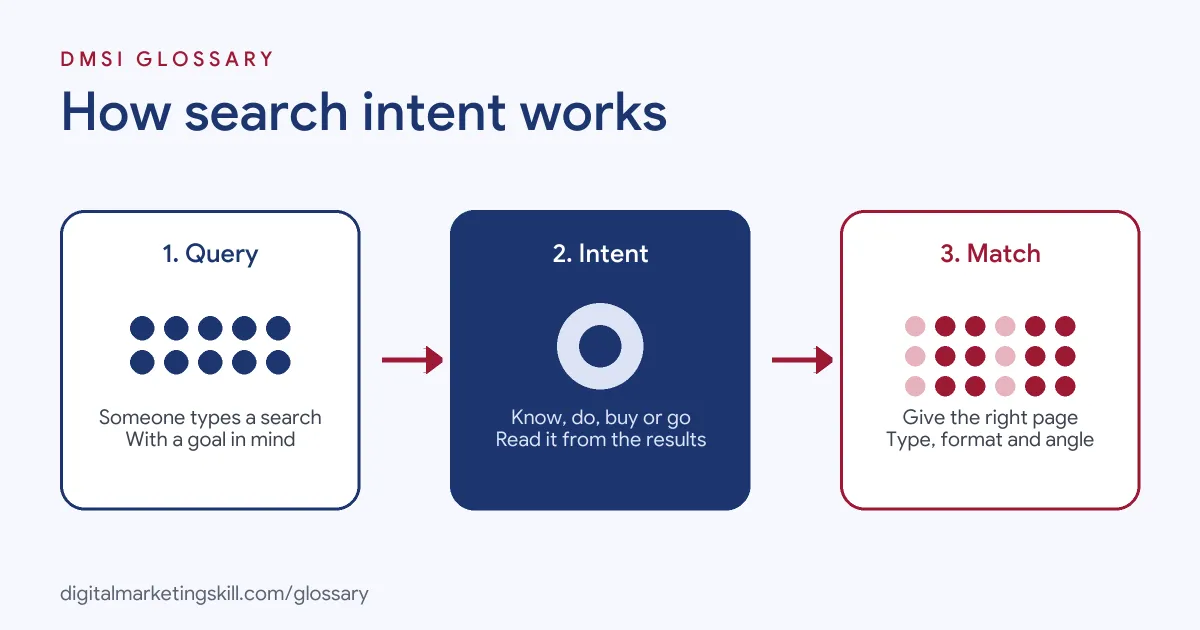
Search engines try to show the most useful result for each query. So they study which pages people click, read and stay on. Over time, a clear pattern forms for most searches. Your job is to spot that pattern and then build the page that fits it.
Think of it like a shop assistant. If a customer asks where the shoes are, you point the way. You do not hand them a leaflet about the history of shoes. Search works the same way. The engine wants to send each person to the page that solves their problem fastest. So the closer your page fits that need, the more often it gets the click and keeps the reader.
The Four Types of Search Intent
Here is how the four common types break down:
- Informational: The person wants an answer or an explanation, such as “what is a lead magnet”.
- Navigational: They want one specific website or page, such as “YouTube” or “Gmail login”.
- Commercial: They are comparing products or services before they decide, such as “best email marketing software”.
- Transactional: They are ready to act, often by buying or signing up, such as “buy noise cancelling headphones”.
The Three Cs
Knowing the type is only the start. Ahrefs suggests you also check three details on the results page. First, look at the content type, such as a blog post, product page or video. Next, check the content format, such as a how-to guide, a list or a comparison. Finally, note the content angle, which is the hook that makes top pages stand out, such as “for beginners” or “under five minutes”.
Mixed Intent
Some searches carry more than one goal. Ahrefs gives the example of “best air fryer”, which is informational, commercial and transactional at once. In that case, the top pages usually blend advice, comparisons and links to buy. So your page needs to cover all three needs, rather than just one.
Search Intent Examples
Here are three ways intent changes the page you should build:
- Local bakery: A bakery wants to rank for “birthday cake ideas”. The top results are list posts with photos, not shop pages. So the bakery writes a picture-led list of ideas, then links to its order page.
- Software company: Ahrefs found its own backlink checker page ranked poorly. The reason was simple. Searchers expected a free tool, and the page did not offer one. Once it added a free version, the page matched what searchers wanted.
- Online course provider: A school targets “what does an SEO specialist do”. This is informational, so it publishes a clear guide. Then it adds a short link to its course for readers who want the next step.
In each case, the business looked at the results first. Only then did it decide what to publish.
Search Intent Types Compared
Use this table as a quick guide when you plan a page:
| Intent type | What the searcher wants | Typical query | Page that usually ranks |
|---|---|---|---|
| Informational | To learn or get an answer | “how to start a blog” | Guide, tutorial or video |
| Navigational | To reach one site or page | “Canva login” | The brand’s own page |
| Commercial | To compare before deciding | “best website builder” | List post, review or comparison |
| Transactional | To buy or sign up now | “buy yoga mat online” | Product, category or pricing page |
In short, the type of query tells you the type of page. However, always confirm it by checking the live results.
How to Match Search Intent
Follow these steps each time you plan a new page:
- Type your target keyword into Google in a private browser window.
- Look at the top results. Note the page type, format and angle that most of them share.
- Decide which intent type the query has. If the results mix types, note that too.
- Ask what a searcher needs to leave satisfied. For example, do they need steps, prices, photos or a tool?
- Plan a page that fits the pattern. Then add something extra, such as clearer steps or a better example.
- After you publish, check Google Search Console. If people see the page but rarely click, your title may not match their goal.
Ahrefs also suggests a simple test: watch how often rankings change. Stable results usually mean the intent is clear. By contrast, results that move a lot suggest Google is still unsure what people want.
Best Practices for Search Intent
A few habits help you match intent more often:
- Write for people first. Google asks whether a reader will “leave feeling like they’ve had a satisfying experience.” That question is a good test of any page.
- Answer the main question early. Put the core answer near the top, then add detail below.
- Match the format, not the words. If the top pages are lists, a long essay will struggle, even with the right keyword.
- Map intent to the buyer journey. Use guides for early questions and product pages for ready buyers.
- Review old pages. Intent can shift over time, so check your key pages against the results now and then.
Common Mistakes to Avoid
Beginners often make the same errors. First, they push a sales page for an informational query. Second, they guess the intent instead of checking the results. Third, they copy the top page so closely that it adds nothing new. Finally, they target one keyword per page, even when several close variations share the same intent. Each of these mistakes is easy to fix once you check the results page first.
Where You’ll Use Search Intent at Work
Intent comes up in almost every SEO and content role. For example, current remote job listings ask candidates to:
- “Conduct in-depth keyword research with a focus on search intent, content gaps, and competitive opportunities” (SEO Content Strategist).
- “Develop content aligned with search intent, buyer journey stages, and conversion goals” (Inbound Marketer).
- “Ensure content aligns with relevant search intent” (Content Writer).
So if you want to work as an SEO Specialist, Content Writer or Website Manager, employers will expect you to read the results page and plan content around it. They will also want proof, such as a page you planned that now ranks.
Learn It in the WordPress and SEO Track
You can learn to research and match search intent in the AI-Powered WordPress and SEO Specialist track. There, you build a WordPress site or store and rank it with an SEO content plan, so you finish with real work you can show an employer. You also work on a U.S. Project Internship from day one, with unlimited 1-on-1 mentoring.
Want to go deeper? Read our guide to building a keyword strategy, or start with the basics of search engine optimisation.
Frequently Asked Questions
What is search intent in simple terms?
It is the reason someone searches. For example, they may want to learn something, find a site, compare options or buy.
What are the four types of search intent?
The four common types are informational, navigational, commercial and transactional. Some queries mix two or more of them.
How do I find the search intent of a keyword?
Search for it on Google and study the top results. Their page type, format and angle show you what searchers want.
Why does search intent matter for SEO?
Google aims to show the most useful result for each query. So if your page does not match the intent, it will struggle to rank, however good it is.
Can one page target more than one intent?
Yes, when the results show mixed intent. For instance, a “best” list can explain, compare and link to buy, all on one page.
Sources: Ahrefs: What Is Search Intent?; Google Search Central: Creating helpful, reliable, people-first content; Wikipedia: Web query; remote job listings on Himalayas.