
A long-tail keyword is a specific search query that only a small number of people type each month. It usually describes a clear, narrow need, such as “waterproof hiking boots for wide feet” rather than just “boots”. Each long-tail keyword brings fewer visitors, but together they add up, and they are often easier to rank for.
Key Takeaways
- A query counts as long-tail because of its low search volume, not simply because it has many words.
- Ahrefs reports that keywords with fewer than 10 searches a month make up almost 93% of its US keyword database.
- Long-tail searches tend to be less competitive, so newer sites have a better chance to rank.
- They often show a clearer need, which makes it easier to write the right page.
- Many long-tail searches can be covered by one strong page on the wider topic.
What Is a Long-Tail Keyword?
Ahrefs defines long-tail keywords as “search queries that get a small number of searches per month.” In other words, the test is how often people search for it, not how long it is. A short query can be long-tail if few people use it. Likewise, a long query can be popular.
The name comes from a wider idea. According to Wikipedia, the writer Chris Anderson popularised “the long tail” in Wired magazine. The idea is that many niche items, each with small demand, can add up to a large share of the total. Search works the same way. A few broad terms get huge volume, while millions of specific searches each get only a handful.
Here is a simple example. “Running shoes” is a broad, popular term. By contrast, “best running shoes for flat feet on trails” gets far fewer searches. However, the person typing it knows exactly what they want. So if your page answers that need, they are more likely to stay, trust you and act.
How a Long-Tail Keyword Works
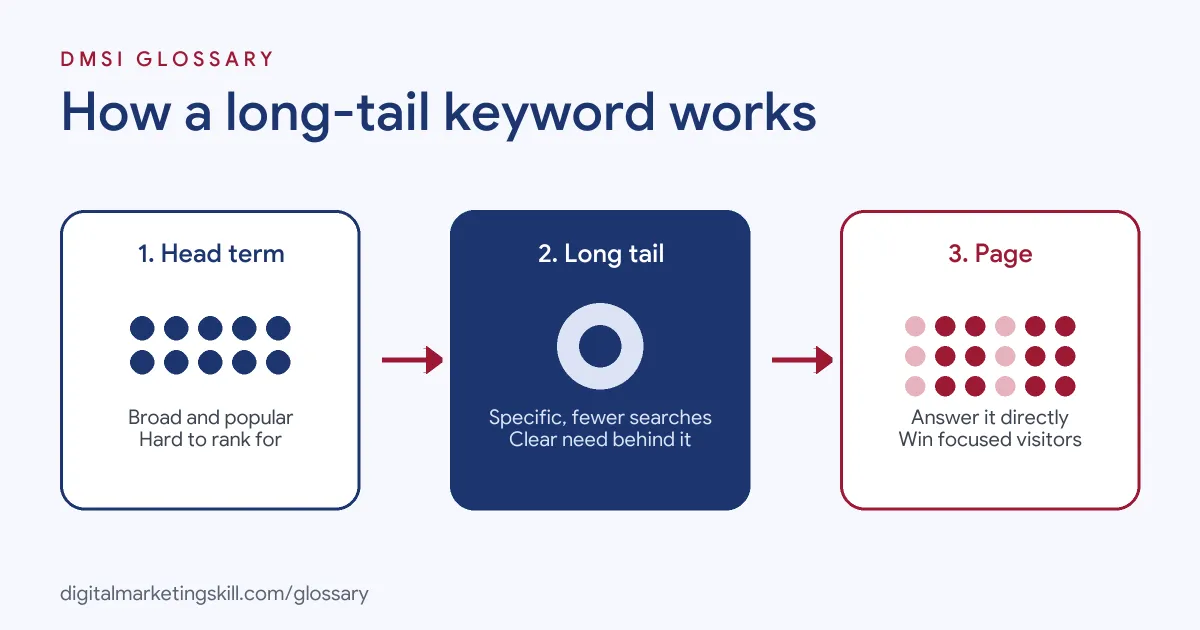
Think of search demand as a curve. At the head are a few popular terms that big brands fight over. Along the tail sit thousands of narrow searches. Each long-tail keyword is small. However, a site that covers many of them can win a large amount of focused traffic.
Types of Long-Tail Keywords
Ahrefs splits long-tail searches into a few types:
- Supporting long-tail: A less popular way to search for a bigger topic. For example, “best healthy treats for dogs” sits under the more popular “healthy dog treats”. One page can usually cover both.
- Topical long-tail: The most popular way to search for a narrow topic, such as “fly bites on dogs ears”. This deserves its own page.
- Conversational long-tail: Questions people type into AI tools. Ahrefs says over 95% of these show no measurable search volume.
Why They Are Often Easier to Rank For
Ahrefs is careful here. It says the answer “depends”, because some long-tail searches are just as hard as short ones. Still, many have low difficulty scores, so newer sites have a chance. They are also easier to answer well. As Ahrefs puts it, “The more general the search query, the more detail you’ll have to include when addressing it.”
The numbers show why the tail matters. Ahrefs counts just under 18,000 US keywords with more than 100,000 searches a month. By contrast, it finds around 2.3 billion US keywords with fewer than 10 searches a month. It also notes that roughly 15% of daily Google searches are brand new. So no keyword list can ever capture every search. That is why good pages aim to answer a need fully, rather than chase one exact phrase.
Long-Tail Keyword Examples
Here are three ways businesses use them:
- Online pet shop: Instead of chasing “dog food”, a shop writes a guide on “grain-free dog food for small breeds with allergies”. The audience is smaller, but it matches the shop’s products closely.
- Local plumber: A plumber publishes a page on “how to fix a dripping mixer tap”. As a result, homeowners in the area find the page, and some call for help.
- Software company: A project tool writes about “how to plan a website launch with a small team”. This long-tail keyword reaches people with a real problem the tool solves.
In each case, the business chose a precise need over a big, vague term. That trade often brings better visitors.
Long-Tail vs Short-Tail Keywords
Here is how the two compare:
| Feature | Short-tail (head) keyword | Long-tail keyword |
|---|---|---|
| Search volume | High | Low |
| Competition | Usually high | Often lower |
| Searcher’s need | Broad or unclear | Specific and clear |
| Example | “coffee machine” | “quiet coffee machine for a small office” |
| Best page | A broad guide or category page | A focused answer or section |
In short, head terms bring reach, while long-tail terms bring focus. Most sites need a mix of both.
How to Find and Use Long-Tail Keywords
These steps draw on the methods Ahrefs suggests:
- Start with a broad topic that matters to your business.
- Use a keyword tool and filter for low search volume and low difficulty.
- Check the questions people ask, for example on forums, Reddit, Quora and YouTube.
- Look at the words your competitors rank for, then spot the gaps.
- Open Google Search Console. Then filter your queries for question words such as “how”, “why” and “what”.
- Group searches that share the same need, so one page can cover them.
- Write a clear page that answers the need fully, then link to it from related pages.
Before you write, search each long-tail keyword yourself. The results will show what kind of page Google prefers, which tells you the search intent.
Best Practices
A few habits help you get the most from the long tail:
- Write for people first. Google asks whether readers will leave feeling they have “learned enough about a topic to help achieve their goal.” That is the bar.
- Use natural wording. Answer the question clearly, rather than forcing an awkward phrase into every paragraph.
- Cover related questions. One thorough page can rank for many close variations.
- Link pages together. Similarly, connect narrow pages to your broader guides, so readers and search engines see the full topic.
- Track impressions, not just clicks. Search Console shows which long-tail queries already find your pages.
Common Mistakes to Avoid
Beginners often stumble in a few places. First, they judge a query by its length rather than its volume. Second, they build a separate thin page for every tiny variation. Third, they ignore searches with “zero” volume in tools, even though real people use them. Finally, they target phrases that have nothing to do with what they sell. Each of these mistakes wastes effort that could go into one strong, useful page.
Where You’ll Use Long-Tail Keywords at Work
Long-tail research is part of everyday keyword work in SEO and content roles. For example, an SEO Specialist uses it to find quick wins for a new site. A content writer uses it to plan articles that answer real questions. Meanwhile, a Website Manager uses it to decide which pages to add or improve. In practice, you often share this work as a simple sheet that lists each search, its volume and the page that should answer it.
So if you aim to become an SEO Specialist, WordPress Developer or Website Manager, employers will expect you to research keywords, group them and turn them into a content plan. They will also want proof, such as pages you planned that now bring in traffic.
Learn It in the WordPress and SEO Track
You can learn to find and use the long tail in the AI-Powered WordPress and SEO Specialist track. There, you build a WordPress site or store and rank it with an SEO content plan, so you have real work to show. You also work on a U.S. Project Internship from day one, with unlimited 1-on-1 mentoring.
Want to go deeper? Read about the importance of keyword research, or learn how to build a full keyword strategy.
Frequently Asked Questions
What is a long-tail keyword in simple terms?
It is a specific search that few people make each month. For example, “vegan birthday cake delivery in Leeds” rather than “cake”.
Does a long-tail keyword have to be long?
No. Ahrefs says the test is search volume, not word count. Even so, most long-tail searches do have several words.
Why should I target long-tail keywords?
They are often less competitive and show a clearer need. As a result, they can bring visitors who are more likely to act.
How do I find long-tail keywords?
Use a keyword tool with a low-volume filter, check questions on forums, study competitors and review your queries in Google Search Console.
Should every long-tail keyword get its own page?
Not always. If several searches share the same need, one strong page can cover them. Give a page of its own only to a distinct topic.
Sources: Ahrefs: Long-Tail Keywords; Wikipedia: Long tail; Google Search Central: Creating helpful, reliable, people-first content.