
The importance of keyword research shows up in one blunt number: Ahrefs studied about 14 billion pages and found 96.55% get zero traffic from Google. Most of that content targets a topic nobody searches for, in words nobody actually types, which is exactly what keyword research is meant to prevent.
Key Takeaways
- Most content never gets found. Ahrefs’ study of about 14 billion pages found 96.55% get zero organic traffic from Google. 55% have no referring domains at all.
- Search itself is changing. SparkToro found 68% of US Google searches now end without a click, a sharp rise from a couple of years earlier, as AI Overviews answer more questions directly.
- Almost all search demand is long-tail. Ahrefs’ own keyword database shows 93% of US keywords get fewer than 10 searches a month. That is out of 2.3 billion keywords tracked.
- Page length tracks with ranking, not causes it. Backlinko’s analysis of 11.8 million Google results found the average top-10 page runs about 1,447 words, a correlation rather than a ranking factor.
- Intent beats word count. Google’s own helpful-content guidance asks whether a reader will “leave feeling they’ve learned enough,” which is a test keyword research exists to help you pass.
In this guide
- What Keyword Research Checklists Usually Skip
- Why Keyword Research Changes What Gets Found
- Short-Tail and Long-Tail Keywords Need Different Research
- How to Research Each Keyword Type
- Five Mistakes That Undercut the Importance of Keyword Research
- How to Measure the Importance of Keyword Research in Practice
- The Most Useful Rule: Match the Keyword to What You Can Realistically Win
- A Four-Week Plan to Put Keyword Research Into Practice
- A Real Case: Why Ahrefs Studied 14 Billion Pages
- Frequently Asked Questions About the Importance of Keyword Research
- Start With the Questions Your Audience Already Asks
What Keyword Research Checklists Usually Skip
Most keyword research advice is a tool tutorial: open this software, type a seed word, export a list. That is a mechanical step. It is not the reason the importance of keyword research gets repeated by every SEO writer.
The real reason is the Ahrefs number above. Writing without checking demand first means most of that effort reaches no one, no matter how polished the final paragraph turns out to be.
This guide explains why that happens. It covers how search intent splits by keyword type, and what to check before you write the next sentence.
Why Keyword Research Changes What Gets Found
A search engine matches a query to pages that answer it well, not to pages that simply exist. Keyword research is how a writer finds the exact words real people type. That beats guessing at a topic from the inside of your own head, where every phrase sounds reasonable because it is the one you would use.
This is the mechanism behind the importance of keyword research. A search engine cannot reward a page for matching demand it never checked existed.
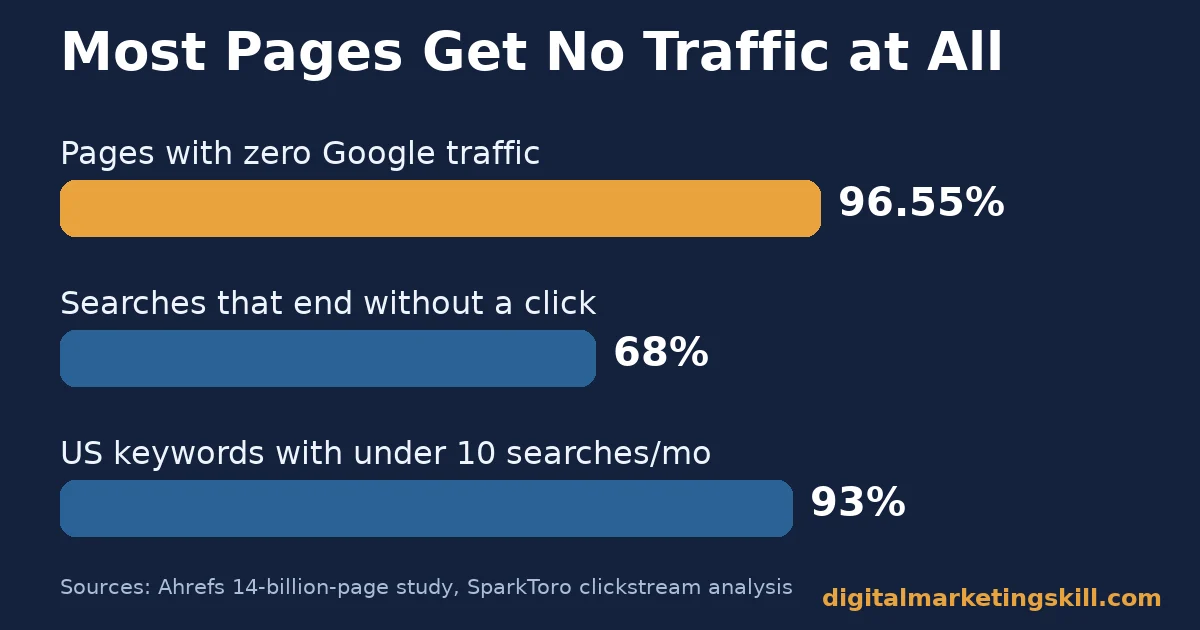
SparkToro’s analysis of Similarweb clickstream data found 68% of US Google searches now end without a click, a sharp rise from a couple of years earlier. AI-generated answer boxes appear on more than 20% of searches, and cut click-through by close to 60% when they do.
That shift raises the importance of keyword research rather than lowering it. When fewer searches send a click at all, ranking for the wrong phrase wastes effort that was already scarce. The same is true of a phrase too broad to ever win.
Search Intent Is the Real Target
Two pages can target the same word and serve completely different intents. “Running shoes” might want a buying guide, a specific product list or a sizing chart. Google’s results page usually signals which one it rewards right now.
Google’s own guidance on helpful content asks whether a reader will “leave feeling they’ve learned enough” to reach their goal. That is the test every page needs to pass. Keyword research narrows the guess about what that goal actually is, before you write a single paragraph.
Short-Tail and Long-Tail Keywords Need Different Research
Not every keyword behaves the same way. Short phrases differ from long phrases. They pull in different kinds of searcher, with very different odds of ever ranking at all. Understanding this split is where the importance of keyword research becomes a practical decision, not just a theory.
Treating every keyword the same is the most common mistake in keyword research. A ten-minute check of which type a phrase belongs to changes how much writing time it deserves, and whether it belongs on this month’s content calendar at all.
Short-Tail Keywords: High Volume, High Competition
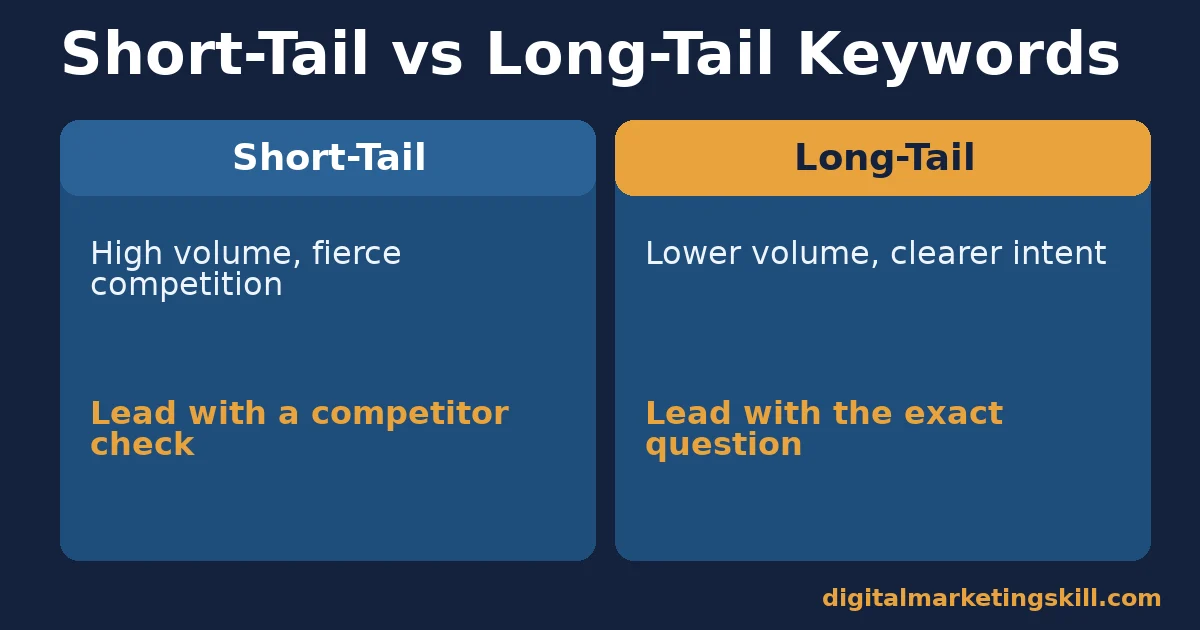
Short-tail keywords are one or two broad words, like “shoes” or “SEO.” They carry real search volume. Ahrefs’ own database shows just under 18,000 US keywords get more than 100,000 searches a month, against 2.3 billion keywords with fewer than 10 searches. Competition for that small top tier is fierce.
A new or smaller site competing head-on for a short-tail term is usually competing against pages with years of backlinks already in place. Brand trust adds to the gap. The odds are long before the writing even starts.
Long-Tail Keywords: Lower Volume, Clearer Intent
Long-tail keywords are longer, more specific phrases, like “best running shoes for flat feet marathon training.” Ahrefs found keywords with fewer than 10 monthly searches make up almost 93% of its entire US keyword database.
Each individual long-tail phrase brings few visitors. Collectively, they are where almost all real search demand actually lives. The intent behind them is usually much clearer than a short, ambiguous term, too.
How to Research Each Keyword Type
Short-tail and long-tail keywords call for a different first move, not just a different word count in the title. The research itself is quick either way; the judgment about what to do with the results is where most of the value sits. Together, these two steps turn raw search demand into a page actually built to capture it.
Short-Tail: Lead With a Realistic Competitor Check
Before chasing a short-tail term, look honestly at who already ranks for it. If the top results are all large, well-linked sites, that term is a long-term goal. It is not a quick win worth this month’s writing time. This is the importance of keyword research in practice. A quick competitor check saves weeks spent chasing a phrase you were never going to win soon.
Use a short-tail term as a category label or a navigation page, not the keyword a brand-new post is staked on. Let long-tail content earn the traffic. The short-tail authority builds slowly behind it, page by page, over the months that follow.
Long-Tail: Lead With the Exact Question
Write the long-tail phrase as the question a real person would type or ask aloud, then answer that exact question in the first few sentences. The closer the content matches the phrasing, the easier it is for both readers and search engines to confirm a match. This is the importance of keyword research showing up directly in the words on the page, not just in a planning spreadsheet.
Cluster related long-tail phrases around one page rather than writing a separate thin page for each. A single thorough page usually wins here. It answers five related questions, and outperforms five short pages that each answer only one. Our guide on setting a content marketing budget also touches on this trade-off, when weighing where to spend writing time.
Five Mistakes That Undercut the Importance of Keyword Research
Keyword research fails for a short list of repeatable reasons. Check your last few posts against each one of these, before you write the next page.
- Picking a keyword with no real demand. A phrase that sounds right but nobody searches for sends effort nowhere, however well you write the page.
- Ignoring what the results page already shows. If every top result is a product page and you wrote a blog post, the intent mismatch alone can keep a good page from ranking. No amount of thorough writing fixes that mismatch on its own.
- Chasing volume over relevance. A high-volume term that barely fits your business brings visitors who leave immediately. That signals a poor match back to the search engine, and can quietly drag down pages that were ranking fine before.
- Writing one page per tiny variation. Near-duplicate pages split authority instead of combining it into one page strong enough to rank for the whole cluster of related phrases.
- Never revisiting the research. Search demand shifts. A phrase worth targeting a while back may be worth less now. A page built around it can quietly go stale without anyone noticing, until traffic has already dropped.
Most of these mistakes share one root cause. Teams treat keyword research as a box to tick once, rather than a habit that keeps content aimed at demand that still exists.
How to Measure the Importance of Keyword Research in Practice
Keyword research is only useful if it changes what actually ranks and gets clicked. Track it with the same rigor as any other part of content strategy. Do not treat it as a one-time step before writing that you never check again.
Five Metrics That Show Keyword Research Is Paying Off
- Search impressions. Search Console shows how often a page appears in results for a given query. Rising impressions on the target phrase show the match is working.
- Average position. The typical ranking spot for that query. A slow climb toward the first page is the clearest sign research chose a realistic target.
- Click-through rate. Clicks divided by impressions for that query. A low rate despite a decent position often points to a weak title or meta description, not a bad keyword choice.
- Query count per page. The number of distinct queries a page already ranks for. A strong page should pick up related long-tail variations over time without new posts. That is a sign the original keyword research covered a genuine cluster of demand.
- Time to first ranking. How long a new page takes to appear anywhere in results for its target phrase. A realistic long-tail target usually shows up faster than an ambitious short-tail one, often within weeks rather than months.
How to Read These Together
Read impressions and position together first. Rising impressions with a stuck position suggest the topic is right. The page itself needs strengthening, not a different keyword entirely. That is usually a writing problem, not a research problem.
If impressions never rise at all, the keyword research step is the likely problem, not the page. Go back to demand data before rewriting content that aimed at the wrong target from the start. No amount of rewriting fixes a page built around a phrase nobody searches for.
The Most Useful Rule: Match the Keyword to What You Can Realistically Win
If you remember one decision rule from this guide, make it this one. Before writing, check whether a brand-new page could plausibly outrank the current top results for that exact phrase. Give it a reasonable time frame, not an optimistic one. If the honest answer is no, the importance of keyword research is telling you to pick a different, winnable phrase instead.
Here is an illustrative example, with invented numbers. A new outdoor gear blog wants to rank for “hiking boots,” a short-tail term with huge competition. Instead, it targets twenty long-tail phrases like “best hiking boots for wide feet on rocky trails,” each with modest volume on its own, but together covering a real slice of search demand that the big competitors never bothered writing for directly.
Within a few months, those twenty pages together bring in more total search traffic than one unranked attempt at the short-tail term ever would. Each one was a fight the new site could actually win, which is the whole point of matching effort to a realistic target.
A Four-Week Plan to Put Keyword Research Into Practice
This plan fits around existing content work rather than replacing it. It takes about an hour a week, using tools most teams already have access to. No new subscription or dedicated analyst is required to run it.
- Week one: list real questions. Collect the actual questions that customers, support tickets or comments raise, in their own exact words.
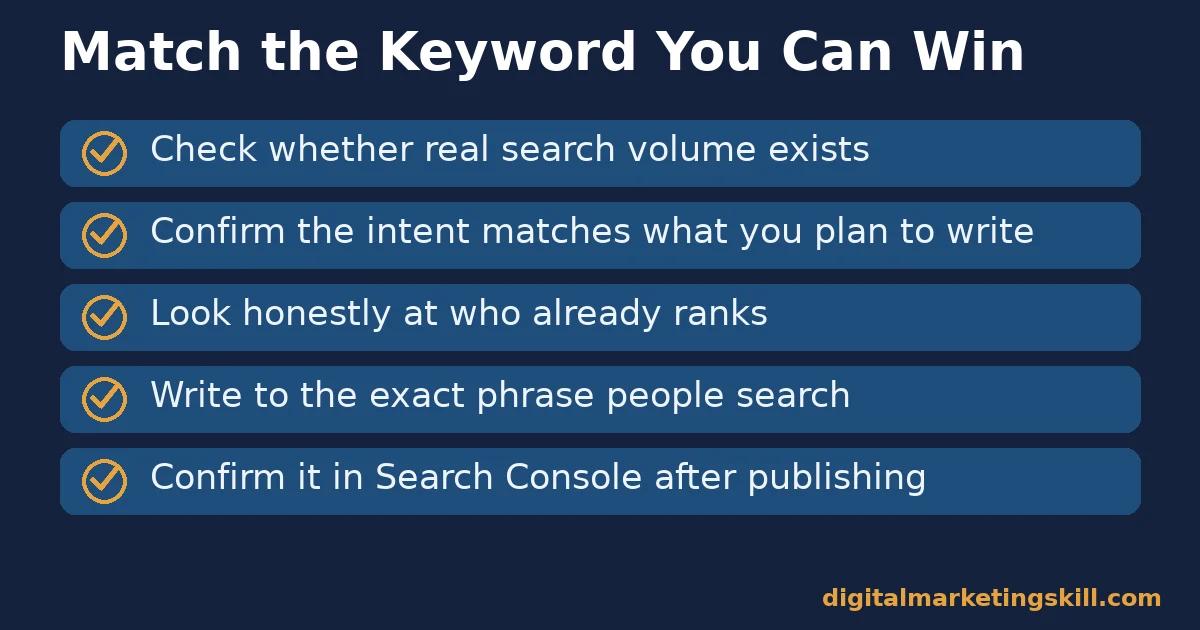
- Week two: check demand and competition. For each question, check whether anyone searches for it and who already ranks for it.
- Week three: write to the exact phrase. Answer the question using language close to how it was actually asked, in the opening sentences.
- Week four: check Search Console. Confirm the new page is picking up impressions for the intended phrase, and adjust if it is not.
Repeating this cycle, one batch of real questions at a time, keeps keyword research tied to actual demand instead of guesswork. Most teams see their first new ranking within one or two cycles once the habit sticks, and the gap between effort and result closes noticeably from there, long before the twentieth page is finished.
A Real Case: Why Ahrefs Studied 14 Billion Pages
Ahrefs built its search traffic study, a useful companion to our guide on basic SEO tips for beginners, because so many of its own users kept asking why their content was not ranking. Rather than guess, the company’s researchers pulled data across roughly 14 billion pages in its index to find a real answer, instead of repeating the usual advice unchanged.
According to Ahrefs’ published study, 96.55% of all pages indexed get zero traffic from Google, and 55% of pages have no referring domains pointing to them at all. The study is drawn from Ahrefs’ own crawl data, so it reflects pages its crawler has found, not literally every page that exists online.
The finding behind the finding is simple: most of that traffic-less content was never aimed at a real, winnable search demand in the first place. That is the exact gap keyword research closes, one checked phrase at a time.
Treat the Ahrefs number as a floor, not a target. A page that clears the demand-and-competition check described in this guide starts with better odds than the vast majority of pages that skip it entirely.
That gap is the clearest practical demonstration of the importance of keyword research available anywhere. One dataset, 14 billion pages, and a single habit separating the pages that get found from the pages that do not.
Frequently Asked Questions About the Importance of Keyword Research
What is the importance of keyword research in SEO?
Keyword research shows whether real people search for a topic before you spend time writing about it. Without it, Ahrefs’ data suggests most content ends up among the 96.55% of pages that get no Google traffic at all.
It is the step that connects writing effort to actual search demand, rather than a guess about what readers want, and it costs little more than the time it takes to check.
How do I know if a keyword is worth targeting?
Check that real search volume exists, that the intent behind the phrase matches what you plan to publish, and that the current top results are realistic to outrank within a reasonable time. If any one of those three checks fails, the keyword is probably the wrong one for right now, even if it looks attractive on paper.
Are long-tail keywords better than short-tail keywords?
Not universally better, but usually more realistic for a smaller or newer site. Long-tail phrases carry less competition and clearer intent, even though each one brings fewer visitors on its own. Short-tail terms still matter for brand and category pages, just rarely as the target of a brand-new post.
How many keywords should one page target?
One primary phrase, plus a small cluster of closely related long-tail variations the same page can naturally answer. Spreading one page across unrelated phrases usually weakens all of them, because no single phrase gets the depth of coverage a search engine expects to reward with a top ranking. This is where the importance of keyword research turns into a simple editorial rule: one clear topic per page.
Does keyword research still matter with AI Overviews taking more clicks?
Yes, arguably more. SparkToro’s data shows a shrinking share of searches send any click at all, so aiming at a realistic, well-matched keyword matters more when fewer total clicks are available to win. Wasting the ones that remain on the wrong phrase costs more now than it used to.
How often should keyword research be updated?
Revisit it whenever a page’s traffic stalls or search behaviour around a topic visibly shifts. Search demand is not fixed, and a phrase worth targeting before may fade over time. A quarterly check against Search Console data catches most of these shifts before they cost much traffic.
What tools are used for keyword research?
Search Console shows what already brings impressions to your own site. Third-party keyword databases from providers like Ahrefs or Semrush estimate demand and competition for phrases you have not targeted yet. Between the two, you can see both where you already stand and where the next realistic opportunity sits.
Start With the Questions Your Audience Already Asks
The importance of keyword research comes down to one habit: check real demand before you write, not after. Collect the actual questions your audience asks, confirm people search for them, then write directly to that phrasing.
For the technical side of putting a page together once the keyword is chosen, our guide on how to optimise a blog post for search engines covers titles, headings and structure.
If you want guided practice turning keyword research into ranking content, Digital Marketing Skill Institute teaches it hands-on inside the Master Diploma in Digital & AI Marketing. The programme is built around four AI-powered tracks totalling ten courses, including AI-Powered WordPress and SEO Specialist, with a Full Stack option for learners who want all four tracks.
It comes with unlimited 1-on-1 coaching and mentoring and a U.S. Project Internship with a verified U.S. Work Reference Letter. The diploma is dual US and UK accredited, recognised in more than 100 countries, and fully online, so you can study from anywhere in your country.
Browse more guides on the Digital Marketing Skill Institute blog, and when you are ready, apply for the Master Diploma or start from the Digital Marketing Skill Institute homepage. The first step is simply checking whether your next post idea has any real demand behind it.
Every figure in this guide was checked against its original source before publication. Figures marked as illustrative are invented examples, not real results.
![9 Amazing Digital Marketing Skills to Make Money Online [With Proof]](https://digitalmarketingskill.com/wp-content/uploads/2019/07/9-Amazing-Digital-Marketing-Skills-to-Make-Money-Online-With-Proof-17.png)






