
Prompt engineering is the practice of writing and refining instructions for an AI model so that it gives accurate, useful answers in the format you need. It involves choosing the right words, context, examples and structure, then testing and improving the prompt. It matters because the same AI tool can give a weak answer or an excellent one, depending on how you ask.
Key Takeaways
- OpenAI defines it as “the process of writing effective instructions for a model.”
- Clear instructions, relevant context and a few examples are the core techniques.
- Google recommends that you “always include few-shot examples” in your prompts.
- AI output is non-deterministic, so the same prompt can give different answers. That’s why testing matters.
- Anthropic advises you to define what success looks like before you start refining a prompt.
What Is Prompt Engineering?
A prompt is the text you give an AI model, such as a question, a task or a set of instructions. The skill lies in writing prompts that get the result you want, reliably. OpenAI’s guide describes the aim as getting the model to consistently produce output that meets your needs.
Google uses the term prompt design and describes it as “the process of creating prompts, or natural language requests, that elicit accurate” responses. Either way, the idea is the same. You treat a prompt like a brief for a new colleague, and you improve it until the output is right.
These tools run on a large language model, which predicts text based on patterns it has learned. So the clearer your instructions and context, the better its predictions tend to be.
How Prompt Engineering Works
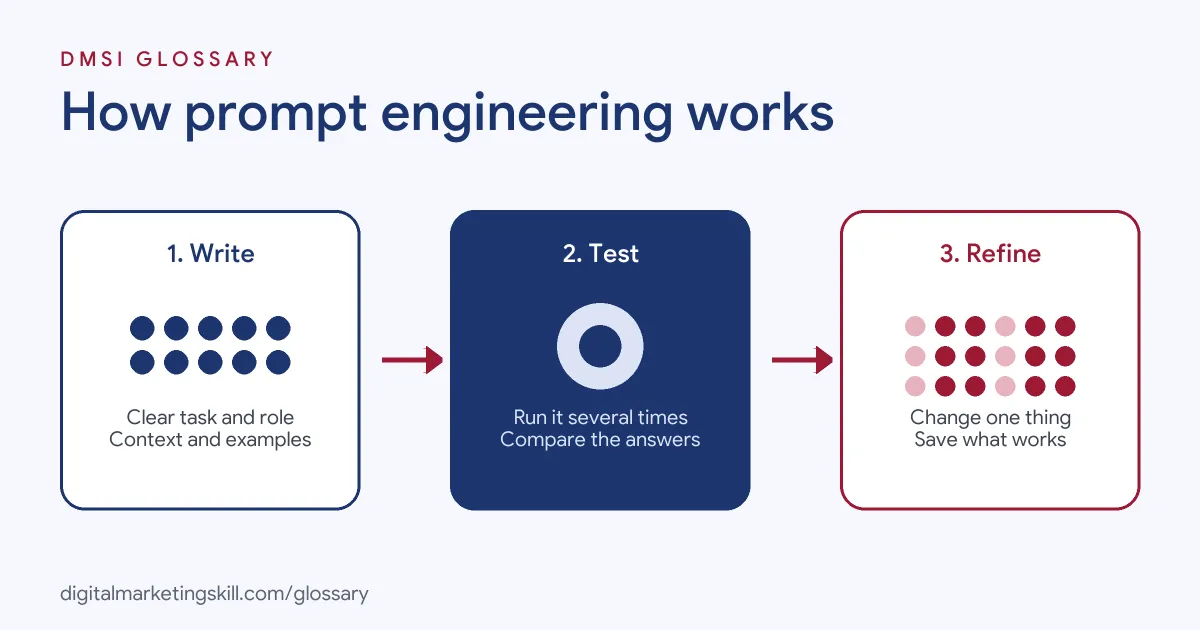
The process is a loop. First, you write a prompt with a clear task and context. Next, you run it and review the output. Then you adjust the wording, examples or format, and test again until the results are consistent.
Clear Instructions and Context
OpenAI notes that models “benefit from precise instructions that explicitly provide the logic and data required” for a task. It also suggests you include “additional context information the model can use to generate a response.” For a marketer, that context might be the brand voice, the audience, the product details and the goal of the content.
Examples: Zero-Shot and Few-Shot
Google explains that a prompt with no examples is called zero-shot, while one with examples is few-shot. Examples show the model the pattern to follow, so they help with format, phrasing and scope. Google goes further and states: “We recommend to always include few-shot examples in your prompts.”
Format, Constraints and Steps
You can also tell the model how to shape its answer. Google says “you can give instructions that specify the format of the response,” such as a table or a bulleted list. You can add constraints, such as a word limit. For complex jobs, Google suggests “breaking things down into simpler components,” then handling each part in turn.
Testing and Iteration
Because “the content generated from a model is non-deterministic,” in OpenAI’s words, one good answer does not prove a prompt works. Therefore, OpenAI recommends building tests that “measure prompt behavior” over time. Similarly, Google notes that prompt design “can sometimes require a few iterations” before you get consistent results.
Prompt Engineering Examples for Marketers
Here are three before-and-after examples:
- Social captions: “Write an Instagram caption” becomes “You are a social media manager for a vegan bakery. Write three Instagram captions under 150 characters for our new lemon cake. Use a warm, playful tone and end with a question.”
- Email subject lines: A marketer adds three past subject lines that performed well as examples. As a result, the new suggestions match the brand’s style.
- Content briefs: An SEO specialist asks for an outline first, then for each section separately. This breaks a large task into simpler steps.
In each case, the improved prompt gives the model a role, context, examples or a clear format. That is what turns a generic answer into a useful one.
Prompt Engineering Techniques Compared
The main techniques appear across the major AI providers’ guides. Here is a quick comparison:
| Technique | What you do | When it helps |
|---|---|---|
| Clear instructions | State the task, audience and goal precisely | Every prompt |
| Context | Add background such as product facts or a reference document | When answers feel generic |
| Few-shot examples | Show one or more examples of the output you want | When format or tone matters |
| Role prompting | Give the model a role, such as “copy editor” | When you need a particular viewpoint |
| Structure and tags | Separate instructions, examples and data clearly | Long or complex prompts |
| Prompt chaining | Split a big task into a series of smaller prompts | Multi-step work such as research then writing |
Anthropic’s guidance lists these too, from “clarity and examples to XML structuring, role prompting, thinking, and prompt chaining.”
How to Write a Good Prompt Step by Step
Anthropic suggests you start with three things: clear success criteria, a way to test against them, and a first draft prompt. Building on that, follow these steps:
- Decide what a good answer looks like, including length, tone and format.
- Give the model a role and the audience you are writing for.
- Add the context it needs, such as product details or brand guidelines.
- State the task in plain, specific words.
- Include one to three examples of the style you want.
- Specify the output format, such as a table, a list or a word limit.
- Run the prompt several times and compare the answers.
- Refine one element at a time, then save the version that works.
Over time, you can build a shared library of tested prompts for your team.
Best Practices for Prompting
A few habits lead to better results:
- Say what to do, not only what to avoid. A clear target gives the model something specific to aim for.
- Check every fact. AI tools can produce confident mistakes, so verify names, numbers and claims.
- Protect sensitive data. Do not paste private customer details into tools your company has not approved.
- Know when prompting is not the answer. Anthropic notes that you can sometimes improve speed and cost “more easily by choosing a different model.”
- Keep versions. When a prompt works, save it with notes on what it is for.
Common Mistakes to Avoid
Beginners often write one vague line and accept the first answer. Instead, treat the first output as a draft. Another common mistake is cramming several tasks into one prompt, which leads to muddled results. Some people also skip examples, even though they are one of the most reliable ways to control style. Finally, many judge a prompt on a single run. Since outputs vary, test it a few times before you rely on it.
Another trap is copying long prompt templates without understanding them. A shorter prompt that you can explain and test is usually easier to improve, and easier for your colleagues to reuse.
Where You’ll Use Prompt Engineering at Work
Prompting now appears in job listings for both technical and creative roles. For example, recent remote listings ask for:
- Strong, “practical prompt engineering skills in educational or professional contexts” (AI Specialist).
- Training a design team “through hands-on workshops, prompt engineering sessions, and collaborative workflows” (Generative AI Content and YouTube Advertising Specialist).
- “Familiarity with LLM APIs, prompt engineering, and AI orchestration frameworks” (AI Implementation and Automation Engineer).
In marketing, the skill is usually practical. Social Media Managers, Email Marketing Specialists and SEO Specialists use prompts to draft, research and analyse faster, while still checking quality. A portfolio piece that shows your prompt, the output and your edits is a simple way to prove this skill.
Learn It in the Full Stack Programme
AI fundamentals, including strategy and planning with AI tools, are part of every DMSI track. To apply prompting across every channel, choose the Full Stack (all four tracks) programme. It covers all ten courses, with one portfolio project from each track. You also join a U.S. Project Internship from day one and get unlimited 1-on-1 mentoring.
Want ready-made ideas? See our guide on how to write ChatGPT prompts.
Frequently Asked Questions
What is prompt engineering in simple terms?
It is the skill of writing instructions for an AI tool so it gives you useful, accurate answers. You add context, examples and a clear format, then test and improve the prompt.
Do I need to code to learn prompting?
No. Most marketers write prompts in plain English inside chat tools. Coding only matters if you want to connect AI models to other software.
What is a few-shot prompt?
It is a prompt that includes examples of the output you want. A prompt with no examples is called zero-shot.
Why does the same prompt give different answers?
AI output is non-deterministic, so it can vary each time. That is why you should run important prompts several times and check the results.
Is prompt engineering a job on its own?
Some technical roles focus on it, but in marketing it is usually one skill within a wider role, such as content, social media or SEO.
Sources: OpenAI: Prompt engineering guide; Google AI for Developers: Prompt design strategies; Anthropic: Prompt engineering overview; remote job listings on Himalayas.