
Keyword difficulty is a score that estimates how hard it would be for a page to rank on the first page of Google for a particular search term. SEO tools usually show it from 0 to 100, where a higher number means stronger competition. It matters because it helps you spend your time on keywords you can realistically win, instead of chasing terms that big sites already own.
Key Takeaways
- Keyword difficulty is an estimate made by SEO tools, not a number that Google publishes.
- Most tools score it from 0 to 100, based mainly on the links and authority of the pages already ranking.
- Each tool calculates it differently, so a score in one tool will not match another.
- A low score does not guarantee a ranking, and a high score does not rule one out.
- Always check the search results yourself, because content quality and search intent matter too.
What Is Keyword Difficulty?
Think of keyword difficulty as a quick read on the competition. Before you write a page, you want to know who you are up against. If the top ten results are huge, well-linked websites, you will need a lot of work to beat them. If they are small sites with few links, you have a better chance.
Ahrefs describes the metric as one that “estimates how hard it would be to rank on the first page of Google for a given keyword.” Similarly, Semrush says its score “measures the SEO effort it would take for your content to rank organically” in the top ten.
In other words, the score helps you sort a long list of ideas. It does not replace judgement. Instead, it tells you where to look first. If you are new to this, our guide to keyword research explains where the list comes from.
How Keyword Difficulty Works
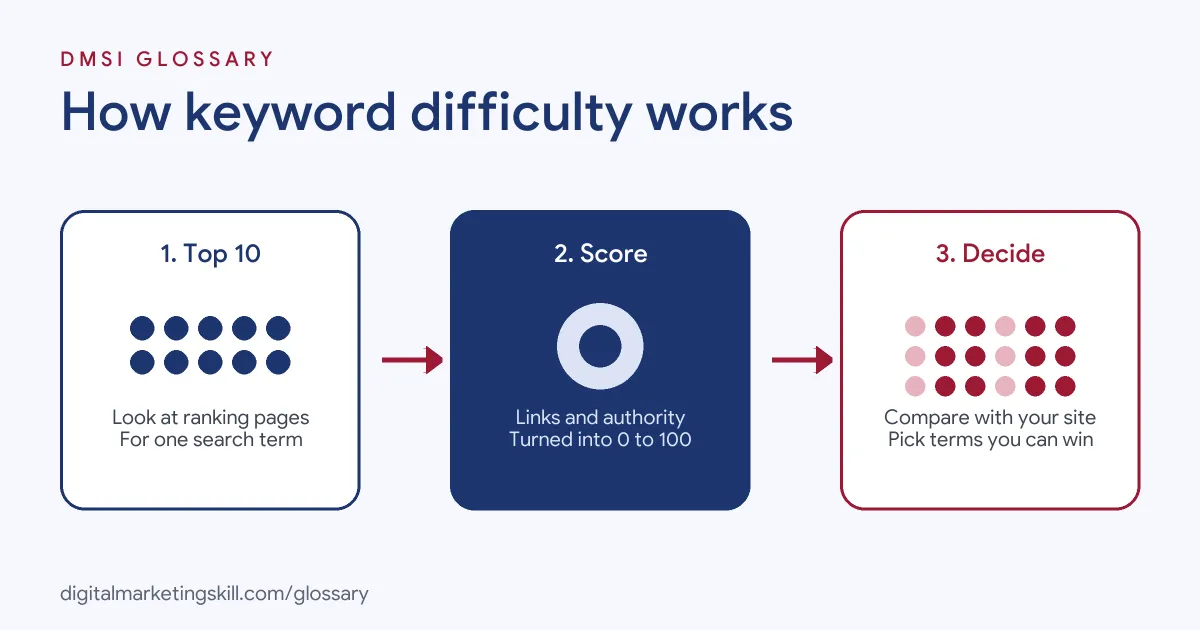
Every tool follows the same basic idea. First, it looks at the pages that rank for a keyword. Next, it measures how strong those pages are. Finally, it turns that strength into a single score.
What the Tools Measure
Ahrefs keeps its method simple. It takes the top ten ranking pages and counts the websites that link to each one. As Ahrefs puts it, “the more links the top-ranking pages for your keyword have, the higher its KD score.”
Semrush, by contrast, blends several inputs. These include the median number of referring domains to the ranking pages, the ratio of followed to nofollow links, the median authority score of the ranking domains, and features of the results page itself.
Reading the Score
Ahrefs gives some useful anchor points. At a score of 0 to 5, the top pages have barely any backlinks. A score near 50 means they have a couple of hundred. At 90 and above, they have thousands.
Semrush uses named bands instead. For example, 0 to 14 is “very easy”, 30 to 49 is “possible”, and 85 to 100 is “very hard”. In its words, “the higher the percentage, the more difficult Semrush predicts it would be to rank.”
Why Scores Differ
Since each tool uses its own data and formula, the same keyword can look easy in one tool and harder in another. So pick one tool and use it consistently. Compare keywords within that tool, rather than across tools.
Your Own Site Matters Too
A standard score describes the competition, not you. Ahrefs calls its KD the baseline for an average site and treats “Personal Keyword Difficulty”, which looks at your own site, as a separate idea. Even without that feature, you can do a rough version yourself. Simply compare the links pointing to your site with the links pointing to the pages at the top.
Keyword Difficulty Examples
Here are three situations where the score changes your plan:
- New blog: A new cookery site wants to rank for “vegan recipes”. The score is very high, so it targets “vegan lunch box ideas for work” instead. That long-tail keyword has fewer searches but a much lower score.
- Local business: A florist checks “flower delivery” and finds national brands at the top. However, “flower delivery in Bath” scores low, and the results show small local shops.
- Established site: A large software blog already has thousands of links. As a result, it can go after harder terms, because its own authority is closer to the top results.
In each case, the score is a starting point. The final choice depends on your site and on what the searcher wants.
Keyword Difficulty vs Google Ads Competition
Beginners often mix these two up, because both describe “competition”. They measure very different things:
| Metric | Where you see it | What it measures |
|---|---|---|
| Keyword difficulty | SEO tools such as Semrush and Ahrefs | How hard it is to rank in the free, organic results |
| Competition | Google Keyword Planner | How many advertisers showed ads for the keyword, shown as low, medium or high |
| Top of page bid | Google Keyword Planner | What advertisers have paid to appear at the top of the paid results |
In short, Keyword Planner’s competition column tells you about paid ads. For organic rankings, you need keyword difficulty from an SEO tool.
How to Use Keyword Difficulty
Follow these steps to turn the score into a content plan:
- Build a keyword list. Gather ideas from your tool, your customers and the search results.
- Add the score for each one. Use the same tool for every keyword.
- Check your own strength. Look at how many sites link to you, and compare that with the pages at the top.
- Open the search results. Look at what kind of pages rank, and whether they answer the search well.
- Match the intent. Make sure you can create the type of page people want, such as a guide, a tool or a product page.
- Prioritise. Start with keywords that have a fair score, clear intent and real value to your business.
- Plan links for harder terms. If a keyword is worth it but scores high, plan how you will earn links to that page.
Best Practices
- Use it to sort, not to decide. Ahrefs itself concludes that no metric can accurately predict whether you will rank.
- Look for weak top results. Ahrefs notes that a high score “doesn’t tell you if those pages actually satisfy the user.” So a better page can still win.
- Respect search intent. Ahrefs found that one of its own pages only climbed once it was rebuilt to match what the top results offered.
- Write for people first. Google advises content “created primarily for people, and not to manipulate search engine rankings.”
- Balance difficulty with value. An easy keyword nobody needs is not worth much.
Common Mistakes to Avoid
New SEO writers often trip up in the same places. First, they chase the biggest terms on a new site and get no traffic for months. Second, they treat a low score as a promise and skip the work on quality. Third, they compare scores from two different tools. Finally, they ignore intent and write a blog post where Google clearly prefers product pages.
Where You’ll Use Keyword Difficulty at Work
Job listings rarely name the score itself. However, they ask for the keyword research it belongs to and the tools that report it. For example, recent remote listings ask candidates to:
- “Conduct keyword research, entity mapping, and intent analysis to prioritize content” (SEO/AEO Manager).
- “Own keyword research, search intent analysis, competitive research, and content/search opportunity identification.” (Growth Engineer, SEO, SEM and AI Search)
- Show “proficiency with Google Search Console, GA4, and SEO tools such as Semrush or Ahrefs” (Senior SEO Specialist).
So if you want to work as an SEO Specialist, WordPress Developer or Website Manager, you will use keyword difficulty to choose which pages to build first.
Learn It in the WordPress and SEO Track
You can learn to judge competition like this in the AI-Powered WordPress and SEO Specialist track. There, you build a WordPress site or store and rank it with an SEO content plan. You also join a U.S. Project Internship from day one, with unlimited 1-on-1 mentoring.
For a practical checklist, read our guide to effective SEO keywords, which covers the checks to run before you choose one.
Frequently Asked Questions
What is a good keyword difficulty score?
It depends on your site. A new site should usually start with low scores, while a site with many links can aim higher. In Semrush, 0 to 29 is labelled easy or very easy.
Does Google use keyword difficulty?
No. It is an estimate made by SEO tools. Google ranks pages on its own signals and does not publish a difficulty score.
Why does keyword difficulty differ between tools?
Each tool uses its own link data and formula. For example, Ahrefs counts linking websites, while Semrush blends several factors.
Can I rank for a keyword with high difficulty?
Yes, but it takes more work. You will usually need a stronger page than the current results and links from other sites.
Is keyword difficulty the same as search volume?
No. Search volume shows how many people search for a term. Difficulty shows how hard it is to rank for it.
Sources: Semrush Knowledge Base: Keyword Difficulty; Ahrefs: Keyword difficulty; Google Ads Help: Keyword Planner metrics; Google Search Central: Creating helpful, people-first content; remote job listings on Himalayas.