
Effective SEO keywords are specific, searched phrases that match what a buyer actually wants. They are not the broad, “vanity” term a business owner assumes everyone types. Picking them means trading reach for intent: longer phrases, lower volume, and far higher odds of ranking and converting.
Key Takeaways
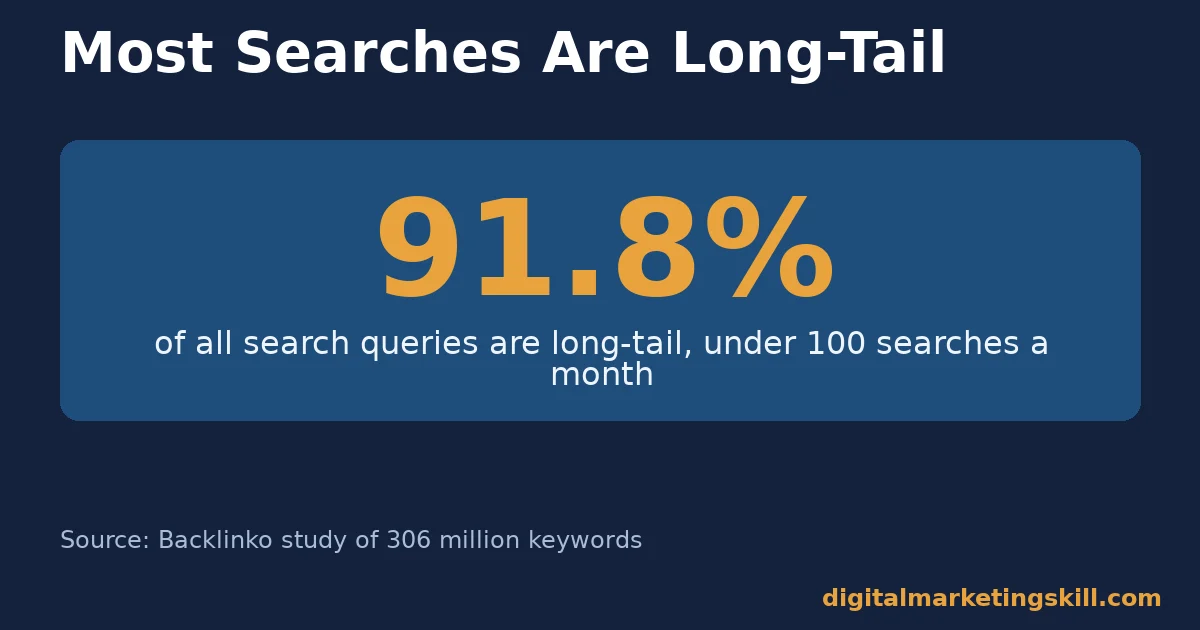
- Most searches are long and specific. Backlinko’s analysis of 306 million keywords found 91.8% of all search queries are long-tail, each getting fewer than 100 searches a month.
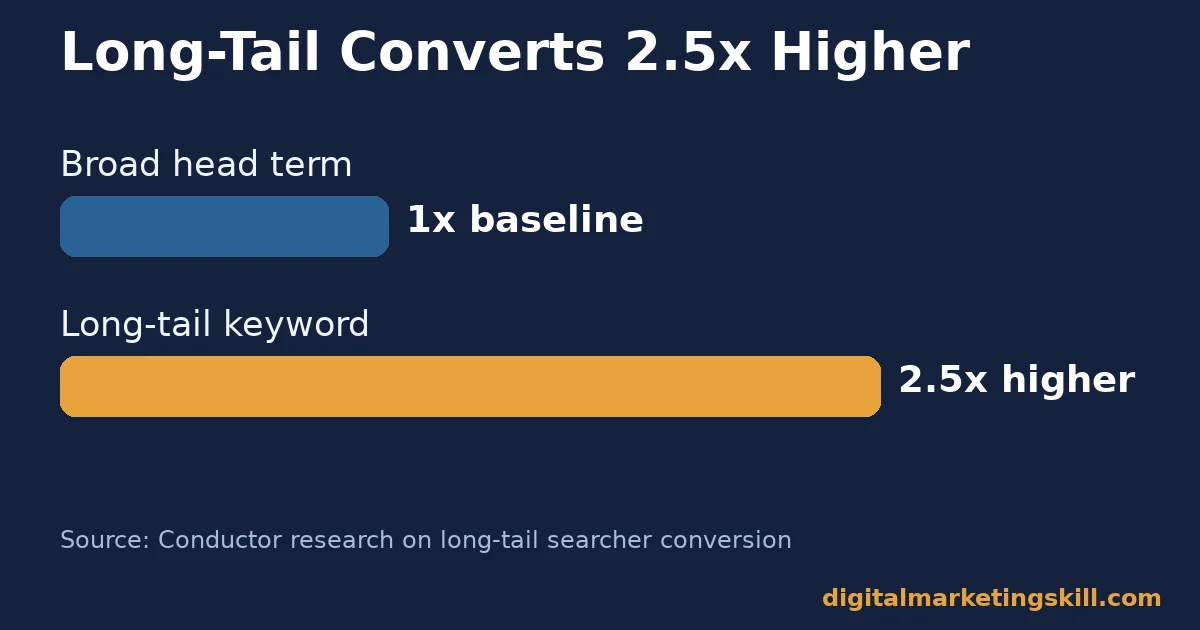
- Broad keywords convert worse. Conductor found that long-tail searchers convert at a rate more than 2.5 times higher than visitors who searched on broad head terms.
- Popularity means competition. The same Backlinko study found keyword difficulty rises by roughly 1.63 points every time search volume doubles.
- Many marketers skip this step. Orbit Media’s survey of 1,042 content marketers found nearly 23% never research keywords before writing.
- Relevance beats volume. Google’s own guidance rewards content that matches what a specific searcher needs, not content built around the biggest number in a keyword tool.
In this guide
- Why Vanity Keywords Still Win the Argument
- How Search Intent Shapes an Effective SEO Keyword
- Seven Checks for Choosing Effective SEO Keywords
- Three Mistakes That Undo Good Keyword Research
- How to Apply These Checks to a Real Decision
- How to Measure Whether Your Effective SEO Keywords Are Working
- Why This Choice Matters for Budget, Not Just Ranking
- The One Rule: Choose Intent Over Volume
- A Real Case: What 306 Million Effective SEO Keywords Showed
- Frequently Asked Questions About Effective SEO Keywords
- Start With One Page and One Honest Keyword Check
Why Vanity Keywords Still Win the Argument
Choosing effective SEO keywords sounds simple. Then the actual choice sits in front of you, and the broad, obvious term always looks more appealing. It has the biggest search volume. It has the most prestige. And it makes the easiest story to tell a boss or a client.
That instinct is usually wrong. This guide explains why, using named, verified studies rather than guesswork. It also sets out a repeatable way to judge any keyword before you build content around it. Treat every figure below as one study’s finding, not a universal rule. Search behaviour varies by industry and changes over time.
How Search Intent Shapes an Effective SEO Keyword
A keyword is not just a string of words. It represents a real person with a specific goal, at a specific moment. Effective SEO keywords are the ones that match that goal precisely.
Why Most Searches Are Longer Than You Think
Backlinko’s study of 306 million keywords found that 91.8% of all search queries are long-tail. Each one gets fewer than 100 searches a month. A single broad term like “shoes” represents a tiny fraction of how people actually search. Most real searches look more like “waterproof hiking shoes for wide feet.”
This is the core argument for effective SEO keywords over vanity ones. The broad term feels like the obvious target, because it is the word people say out loud. The long-tail phrase is what people actually type when they are close to a decision.
Why the Broad, “Vanity” Keyword Underperforms
A broad keyword like “jewellery” looks attractive because of its size. It rarely converts well, though. Conductor’s research found that long-tail searchers convert at a rate more than 2.5 times higher than visitors on broad head terms. A specific search signals a buyer much closer to a decision.
Broad terms are also harder to win. Backlinko’s analysis found keyword difficulty rises by about 1.63 points every time search volume doubles. The biggest, most tempting keyword is usually also the most competitive one on the page. In practice, a business chasing “jewellery” competes with every large, well-funded retailer in the category. A business chasing “handmade silver stacking rings” competes with a far smaller, more winnable field.
Despite this, many marketers skip the research step that would catch this mistake. Orbit Media’s survey of 1,042 content marketers found nearly 23% never research keywords before writing. Close to a quarter of published content gets built on guesswork instead of evidence.
Seven Checks for Choosing Effective SEO Keywords
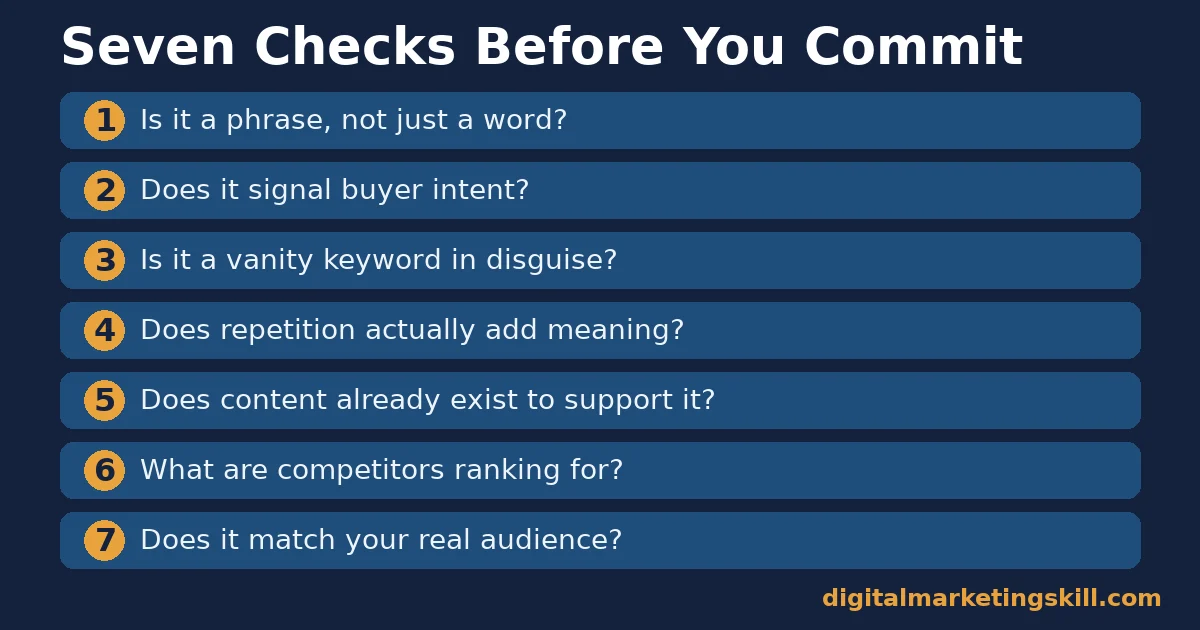
Run every keyword candidate through these seven checks before building a page around it.
1. Is It a Phrase, Not Just a Word?
A single root word like “dog” or “food” rarely describes what a page actually offers. A phrase like “buy dog food online” tells Google and the searcher exactly what to expect. It also faces far less competition than the single word alone.
2. Does It Signal Buyer Intent?
Some searches are pure research. Others come from someone ready to act. A tool such as Google Keyword Planner or another keyword research tool can show estimated cost-per-click figures. These often hint at how commercial a phrase is, since advertisers pay more for keywords that reliably lead to a sale.
3. Is It a Vanity Keyword in Disguise?
If ranking for a term would feel good to say out loud, but would not obviously bring the right visitor, it is probably a vanity keyword. Favour the specific term a real customer would type. “Women’s waterproof hiking boots” beats the broad category name alone, almost every time.
4. Does Repetition Actually Add Meaning?
Targeting similar phrases on different pages is fine, as long as each phrase reflects genuinely different content. “Dog food reviews” and “dog food comparison” can each support their own page. It becomes a problem only when a page is stuffed with near-duplicate phrases that do not map to distinct, useful content.
5. Does Content Already Exist to Support It?
A keyword should guide content, not the other way around. If you do not actually have a comparison page, do not target comparison keywords. Mismatched intent frustrates visitors. It also teaches Google that your page does not deliver what it promised. This is where effective SEO keywords connect to a wider content marketing strategy, since the keyword list should shape what you write next, not the reverse.
6. What Are Competitors Already Ranking For?
Checking which terms similar pages already rank for shows realistic opportunities and gaps. A tool like SEMrush or Ubersuggest can surface a competitor’s top organic keywords. That is often faster than researching from a blank page.
7. Does It Match What Your Actual Audience Searches?
The final check is simple. Would your real customer type this exact phrase? Google Trends and a keyword tool’s monthly volume figures can confirm or correct that assumption before you commit a page to it. Google’s own guidance on helpful content frames this the same way: content should help a reader “achieve their goal,” which starts with targeting the phrase that reader actually searched.
Three Mistakes That Undo Good Keyword Research
Even after running the seven checks, a few habits quietly undo good keyword choices. Watch for these while you apply the checklist above.
Optimising a Page for Only One Keyword
A page can rank for one target keyword and several related phrases at once, as long as they genuinely fit the content. Therefore, treating a page as if it can only ever rank for its single primary keyword leaves real traffic on the table.
Ignoring Whether Volume Is Rising or Falling
A keyword’s current search volume is a snapshot, not a forecast. A term with modest but growing volume is often a better long-term bet than a term with higher but shrinking volume, because the second one is already losing relevance.
Treating Keyword Research as a One-Time Task
Search behaviour shifts as products, seasons and audiences change. A keyword list built once and never revisited slowly drifts out of step with what people actually search, so a periodic review matters as much as the original research.
How to Apply These Checks to a Real Decision
Here is how the seven checks work together on an actual keyword decision, from start to finish.
A Worked Example: Online Jewellery Store
Picture a jewellery store deciding between “jewellery” and “gold jewellery” or “silver necklace.” The broad term scores poorly on checks two, three and six. It rarely signals buyer intent, and it is a classic vanity keyword. Worse, it faces every large, well-established competitor in the category.
The narrower phrases score far better. They pass checks one, two and three by being specific, commercial, and free of vanity appeal. They are also realistic to win against smaller, more relevant competition. The broad term still has a place in the strategy. It just should not be the page’s primary target.
A Second Example: A Local Service Business
A plumber choosing between “plumber” and “emergency plumber for burst pipes” faces the same pattern. The broad term brings volume, but much of it comes from people researching a career, not hiring help. The specific phrase brings fewer visitors, but nearly all of them are already looking to book a job.
Notice what changed between the two examples. The jewellery store needed a more descriptive product term. The plumber needed a term that captured urgency and a specific problem. Effective SEO keywords rarely follow one formula; they follow whatever actually separates a browser from a buyer in that particular market.
A Third Example: An Informational Blog
Not every page sells something directly, and the same checks still apply. A blog comparing “best running shoes” to “best running shoes for overpronation and flat feet” still benefits from the narrower phrase. The broad version competes against every major shoe retailer’s category page. The specific version competes against a much smaller set of genuinely comparable articles, and it answers a question a search engine can match with more confidence.
How to Measure Whether Your Effective SEO Keywords Are Working
Track these figures for each page built around a chosen keyword.
- Average position. Where the page ranks for its target keyword over time, not a single snapshot.
- Click-through rate. Clicks divided by impressions in Search Console. A weak rate at a good position suggests the title or description, not the keyword, is the problem.
- Conversion rate by landing keyword. Whether visitors arriving from that specific keyword actually take the action the page is built for.
- Keyword difficulty versus your site’s authority. Whether the term you chose is realistic for a site your size, not just the one with the biggest volume.
- Content-to-keyword match. Whether the page genuinely delivers what the keyword promises, checked by rereading it as a first-time visitor would.
Read these together. Strong position with weak clicks points to the title, not the keyword choice. Strong clicks with weak conversions often means the keyword’s intent does not match what the page actually offers. Review all five figures monthly, so a slow drift goes noticed early, not three months later.
A page can also look healthy on every metric and still be built on the wrong keyword for the business. If the keyword ranks well, gets clicked, and converts, but the resulting customers are the wrong fit, the page needs a different target entirely, not just a better version of the same one.
Why This Choice Matters for Budget, Not Just Ranking
Effective SEO keywords matter beyond organic rankings, because the same research feeds paid search decisions too. A broad, vanity keyword in a pay-per-click campaign often costs more per click and converts worse, which compounds the mistake with real advertising spend rather than just wasted writing time.
Teams that research keywords once for SEO and reuse the same list for paid campaigns save real effort. The buyer-intent check and the vanity-keyword check matter just as much when money is being spent per click as when a page is competing for free organic traffic.
The One Rule: Choose Intent Over Volume
When two keyword options compete for the same page, pick the one with clearer buyer intent. Do this even if it has a smaller search volume. A smaller, well-matched audience converts better than a larger, mismatched one.
Illustrative, invented numbers: suppose a page could target “shoes,” with 50,000 monthly searches and a 1% conversion rate. Or it could target “waterproof trail running shoes for flat feet,” with 200 monthly searches and an 8% conversion rate. The narrow keyword would produce roughly 16 conversions a month. The broad keyword would produce roughly 5, from a far larger amount of traffic and competition.
A Real Case: What 306 Million Effective SEO Keywords Showed
Backlinko’s study analysed 306 million keywords, using data from DataForSEO and Ahrefs. It found that long-tail terms, those earning fewer than 100 searches a month, made up 91.8% of all search queries. That held true even though they represent a much smaller share of total search volume.
The lesson is not that broad keywords are worthless. Some business goals genuinely need them. It shows that a strategy built entirely around a handful of broad, high-volume terms chases a small, hyper-competitive slice of search behaviour. Meanwhile, it ignores the long-tail majority of how people actually search.
Frequently Asked Questions About Effective SEO Keywords
What makes a keyword “effective” rather than just popular?
An effective keyword matches real buyer intent and realistic competition for your site, not just a large search volume. A smaller, specific phrase that converts well beats a broad term that brings visitors who never take action.
Are long-tail keywords always better than short, broad keywords?
Not always, but research consistently favours them for conversion. Broad terms still matter for brand awareness and top-of-funnel visibility. Long-tail phrases typically convert far better and face less competition.
How do I know if a keyword signals buyer intent?
Check its estimated cost-per-click in a keyword planning tool. Advertisers tend to pay more for terms that reliably lead to a purchase. Phrases that include words like “buy,” “best,” or a specific product variant also tend to signal stronger intent.
Is it bad to target similar keywords on different pages?
Not if each phrase reflects genuinely different content, such as a reviews page and a comparison page. It becomes a problem only when near-duplicate phrases get stuffed onto a single page without distinct, matching content.
How many keywords should I research before choosing one?
Generate a broad list first, often 20 to 100 candidates, including competitor terms, before narrowing down. A wide starting list makes it easier to spot the specific, high-intent options you would otherwise miss.
What tools can help with keyword research besides Google’s own?
Tools such as SEMrush, Ubersuggest, and Moz’s Keyword Explorer each offer volume, competition and related-term data. Compare a few before settling on one, since coverage and accuracy vary by tool and market.
Do effective SEO keywords differ between countries or languages?
Yes. The same product or service is often searched for with different words, spellings and phrasing in different markets, so a keyword list built for one country rarely transfers directly to another. Research each market’s actual search behaviour separately, rather than translating one keyword list word for word.
Should I target the exact same keyword on my homepage and a blog post?
No. Competing pages on the same site for the same keyword usually split ranking signals instead of combining them. Give each page its own effective SEO keyword, closely related but distinct, so every page has a clear job to do.
Start With One Page and One Honest Keyword Check
Take your most important page. Run its current keyword through the seven checks above. If it fails more than two or three, choosing effective SEO keywords for that page likely means trading some search volume for a phrase that actually matches your real customer.
If you want structured, hands-on training in finding and using effective SEO keywords, look at the Master Diploma in Digital & AI Marketing at the Digital Marketing Skill Institute. It includes an AI-Powered WordPress and SEO Specialist track, one of four AI-powered tracks across a ten-course program, with a Full Stack option covering all four.
It comes with unlimited 1-on-1 coaching and mentoring, a U.S. Project Internship with a verified U.S. Work Reference Letter, and dual US and UK accreditation recognised in more than 100 countries, 100% online. You can learn and apply real keyword research from anywhere in your country.
Explore the Master Diploma program, browse more guides on the digital marketing blog, read real outcomes on the reviews page, or go straight to the application page when you are ready. Learn more at Digital Marketing Skill Institute, wherever you live, and start choosing effective SEO keywords your real customers actually search for. Our guide to SEO tips for beginners covers the rest of the on-page and technical basics once your keyword is set. Visit digitalmarketingskill.com to get started.
Every figure in this guide was checked against its original source before publication. Figures marked as illustrative are invented examples, not real results.
![9 Amazing Digital Marketing Skills to Make Money Online [With Proof]](https://digitalmarketingskill.com/wp-content/uploads/2019/07/9-Amazing-Digital-Marketing-Skills-to-Make-Money-Online-With-Proof-17.png)






