
A sales qualified lead (SQL) is a lead that your sales team has checked and accepted as a real potential customer, ready for a direct sales conversation. It usually comes after marketing has qualified the lead first. It matters because it tells salespeople where to spend their time, and it gives both teams a shared way to measure which leads turn into revenue.
Key Takeaways
- An SQL is a lead that sales, not marketing, has qualified as a potential customer.
- It normally follows the marketing qualified lead (MQL) stage and comes before an opportunity or deal.
- Many sales teams check budget, authority, need and timeline, known as BANT.
- Strong signals include free trial sign-ups, booked calls and repeat visits to pricing pages.
- Salesforce cites a Gartner figure that just 21% of MQLs convert to SQLs.
What Is a Sales Qualified Lead?
HubSpot defines an SQL as “a contact or company that your sales team has qualified as a potential customer.” Salesforce describes it as a lead that has “expressed enough interest in your brand that they’re ready to move into your sales process.”
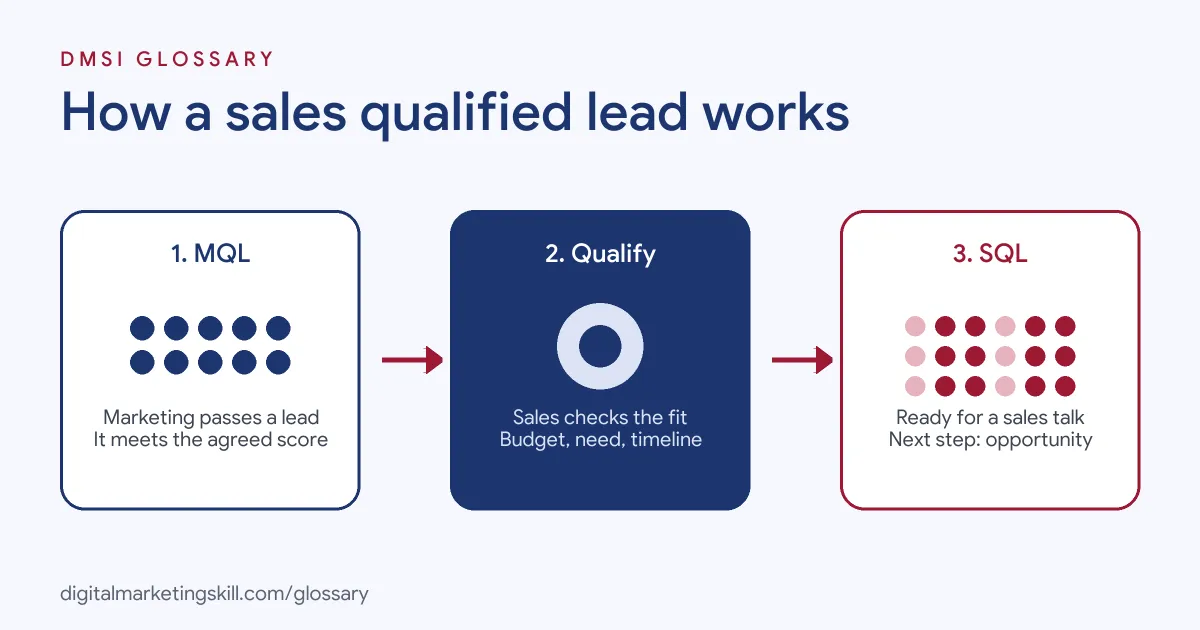
So the key difference is who decides and why. Marketing passes a lead on because it fits and is engaged. Sales then talks to that lead, or reviews it, and decides whether it could really buy.
For example, a software firm’s marketing team hands over a lead who downloaded two guides and visited the pricing page. A salesperson calls and learns the lead manages a team of 20, has budget set aside and wants a tool within the next quarter. At that point, the salesperson marks the lead as an SQL.
How a Sales Qualified Lead Works
An SQL comes out of three steps. First, marketing passes an MQL to sales. Next, sales checks whether the lead fits and is ready. Finally, if it passes, the lead becomes an SQL and moves towards a deal.
The Handoff From Marketing
Adobe explains that once a prospect reaches the target lead score, CRM automation can send it to sales “via an email notification or task.” This keeps the handoff quick, so warm leads don’t go cold while they wait.
Qualifying With BANT
Salesforce sets out the four BANT questions:
- Budget: “Does the prospect have the financial resources to afford your offering?”
- Authority: “Who at the company makes buying decisions?”
- Need: “Does the prospect have a problem your product or service can solve?”
- Timeline: “What is the timeframe for the prospect’s purchasing decision?”
Not every team uses BANT exactly. Salesforce notes that you can pick elements from several qualification methods. Still, most checks cover the same ground. Salesforce also suggests tracking the answers in your CRM, so the next person who speaks to the lead doesn’t ask the same questions again.
Lead Status in the CRM
HubSpot tracks progress within the SQL stage using a Lead Status property. Its default options include New, Open, In Progress, Attempted to Contact, Connected, Open Deal, Unqualified and Bad Timing. As a result, managers can see which SQLs have been contacted and which are stuck.
Sales Qualified Lead Examples
Here are three examples of when a lead might become an SQL:
- Software trial: A lead starts a free trial, invites two colleagues and asks about team pricing. A salesperson confirms the budget and marks it as an SQL.
- Agency services: A business owner books a discovery call. On the call, they explain a clear problem, a monthly budget and a start date. That is enough to qualify.
- Training course: A lead downloads a course guide, then books a call with an adviser. Because they confirm they can start soon and meet the entry needs, the adviser records them as an SQL.
In each case, a real conversation or a high-intent action confirms readiness. A single download, on the other hand, rarely does. Salesforce adds that deeper signals include frequent visits to pricing or detailed product pages, use of tools such as cost calculators, and specific questions about what you offer.
MQL vs SQL vs Opportunity
Here is how the SQL fits between the stages around it:
| Stage | Who decides | Typical signal |
|---|---|---|
| Marketing qualified lead | Marketing | Good fit plus engagement, such as pricing page visits |
| Sales qualified lead | Sales | Confirmed budget, need and timeline |
| Opportunity | Sales | A deal is open in the CRM |
HubSpot defines an opportunity as a contact or company “associated with a deal,” and a customer as one with “at least one closed deal.” So the SQL is the point where a lead turns into active sales work. For more on the stage before it, see our entry on the marketing qualified lead.
How to Qualify a Sales Qualified Lead
Use these steps to set up a fair, repeatable process:
- Agree the definition. Marketing and sales write down what makes a lead an SQL.
- Define your ideal customer. Salesforce suggests a clear buyer profile, so reps know who fits.
- Prepare questions. Write open-ended questions for budget, authority, need and timeline.
- Follow up fast. Contact new MQLs quickly, while their interest is high.
- Record the outcome. Update the lifecycle stage and lead status in your CRM after each call.
- Send back the rest. Return leads that aren’t ready to marketing for more nurturing, with a reason.
- Review monthly. Check how many SQLs became deals, then refine the criteria.
How to Measure Sales Qualified Leads
A count of SQLs tells you little on its own. Instead, track a few rates together:
- MQL to SQL rate: the share of marketing leads that sales accepts. For example, 40 SQLs from 200 MQLs is 20%.
- SQL to opportunity rate: the share of SQLs that lead to an open deal.
- SQL to customer rate: the share that ends up buying, which shows the real quality of each source.
- Time in stage: how long leads stay as SQLs. HubSpot records the date each record enters and leaves a stage, so you can report on it.
Then compare these rates by campaign or channel. If one source sends many SQLs that never become deals, the problem is probably the qualifying criteria, not the salespeople.
Best Practices for Sales Qualified Leads
- Listen more than you pitch. Salesforce recommends active listening, so you learn the real need.
- Weight high-intent actions. Adobe lists free trial sign-ups and booked discovery calls as signs of an SQL.
- Look for buy-in. Adobe notes that ready buyers have the information to decide, the budget and executive support.
- Share feedback. Tell marketing which leads converted, so they can improve their scoring.
- Track the rates. Measure MQL-to-SQL and SQL-to-deal conversion over time.
Common Mistakes to Avoid
Several errors weaken the SQL stage. First, sales marks leads as SQLs before speaking to them, just to fill a target. Second, teams skip the budget or authority questions and chase people who can’t buy. Third, rejected leads disappear instead of going back to marketing. Finally, marketing and sales use different definitions, so reports never agree.
Where You’ll Use Sales Qualified Leads at Work
SQL targets are common in sales development and lead generation roles. For example, remote job listings include:
- “Achieve and surpass assigned monthly sales quotas and Sales Qualified Lead (SQL) targets” (Business Development Representative).
- “Define clear lead qualification criteria (MQL/SQL) and ensure reporting consistency and transparency” (Mid/Senior Sales Executive).
So as a Lead Generation Specialist or Marketing Automation Specialist, you will help define SQL criteria, automate the handoff and report how many leads reach this stage.
Learn It in the Lead Generation Track
You can learn how leads move from first sign-up to a sales qualified lead in the AI-Powered Lead Generation and Email Automation track. There, you build a lead magnet and an automated email sequence that converts, which warms leads before sales calls. You also work on a U.S. Project Internship from day one, with unlimited 1-on-1 mentoring.
Ready to close more of them? Read our guide to lead conversion strategies.
Frequently Asked Questions
What is a sales qualified lead in simple terms?
It is a lead that sales has checked and agreed could become a customer. It is ready for a direct sales conversation, such as a demo or proposal.
What is the difference between an MQL and an SQL?
Marketing qualifies an MQL based on fit and engagement. Sales then qualifies an SQL by confirming need, budget and timing.
What does BANT stand for?
Budget, authority, need and timeline. Sales teams use these four questions to judge whether a lead is ready to buy.
What happens after a lead becomes an SQL?
Sales usually opens a deal, which makes it an opportunity. If the deal closes, the lead becomes a customer.
What if a lead is not sales ready?
Send it back to marketing with a reason, such as bad timing. Marketing can then keep nurturing it until it is ready.
Sources: HubSpot Knowledge Base: Use lifecycle stages; Salesforce: MQL vs SQL; Salesforce: What is BANT?; Adobe: MQL vs SQL; remote job listings on Himalayas.