
Lead qualification (BANT) is the process of checking whether a lead is a good fit to buy, often by asking about their budget, authority, need and timeline. It helps sales and marketing teams spend time on people who are likely to become customers. As a result, you close more deals with less wasted effort. It also stops good leads from slipping through the cracks.
Key Takeaways
- Lead qualification sorts leads into those worth pursuing now and those that need more time.
- BANT stands for Budget, Authority, Need and Timeline.
- Other frameworks, such as CHAMP and MEDDIC, suit different types of sales.
- Marketing usually qualifies interest first, and sales then checks if the lead is ready to buy.
- Good qualification is a helpful conversation, not a checklist you read out.
What Is Lead Qualification (BANT)?
Not every person who fills in a form is ready to buy. For example, some are students doing research. Others are a perfect match but need a few months. So lead qualification is how you tell them apart.
HubSpot defines it as “the process of determining whether a lead or prospect is a fit for a product or service.” In the same way, Salesforce says it “helps you determine whether a prospective customer is a good fit for your product(s).”
BANT is the best-known way to do it. HubSpot calls BANT “a method for qualifying prospects at the start of the sales cycle.” Each letter stands for one question you need answered:
- Budget: Can the lead afford your product or service?
- Authority: Is this person the decision-maker, or do they need sign-off?
- Need: Do they have a real problem that you can solve?
- Timeline: When do they plan to decide or start?
Think of an estate agent. Before booking viewings, the agent asks if you have a mortgage offer, who else must agree, what kind of home you need and when you want to move. Likewise, BANT asks the same kind of questions before a sales team invests hours in a deal.
Why It Matters
Sales time is limited. Without qualification, all your lead generation work turns into a long list of names. As a result, reps chase leads that never had a chance of buying. Meanwhile, strong leads wait too long and go cold. In addition, clear rules help marketing and sales agree on what a “good lead” means. Therefore, qualification makes both teams more efficient and easier to measure.
How Lead Qualification Works
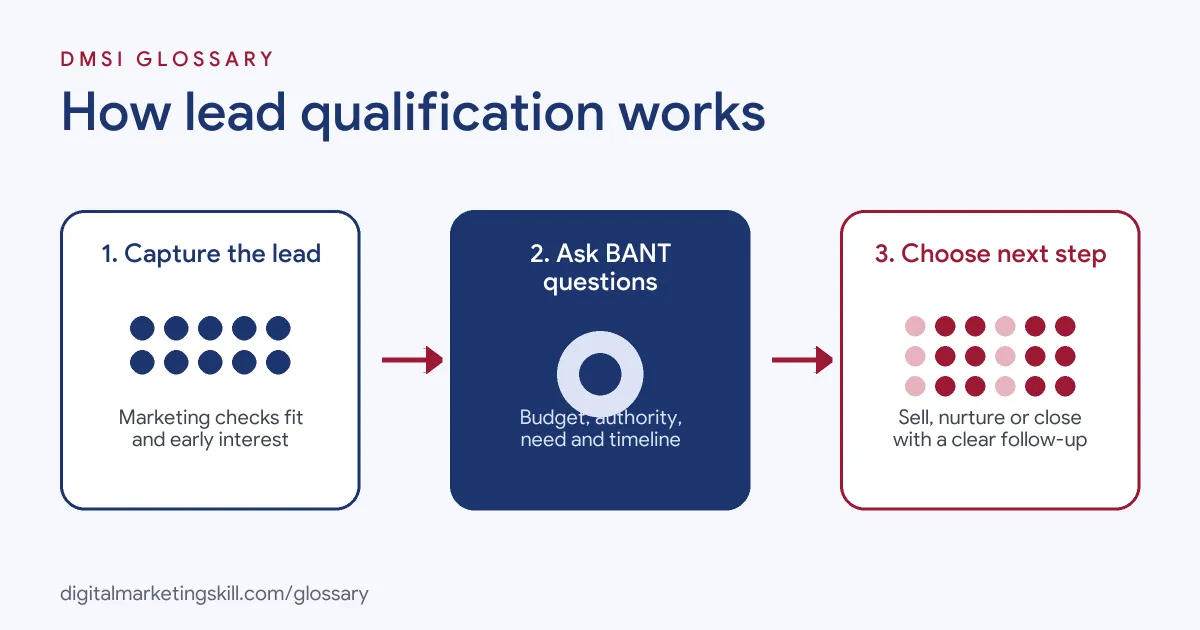
Lead qualification usually happens in stages. First, marketing captures a lead and checks basic fit. Next, the lead shows enough interest to be passed to sales. Then a sales rep confirms budget, authority, need and timeline in a conversation.
Stage 1: Marketing qualification
At this stage, marketing looks at fit and interest. For example, does the lead match your buyer persona? Have they opened emails, visited pricing pages or downloaded a guide? Many teams use lead scoring to add up these signals. When a lead passes a set score, it becomes a marketing qualified lead.
Stage 2: Sales qualification
Next, a sales rep reaches out. This is where BANT is most useful. The rep asks open questions and listens. For instance, “What made you look for a solution now?” can reveal both need and timeline. Once the rep confirms the lead is ready, it becomes a sales qualified lead.
Stage 3: Decide the next step
Finally, the team acts on the result. A qualified lead moves into the sales pipeline. By contrast, a lead with a need but no budget yet goes back to lead nurturing. A lead with no need at all is closed politely. So every lead gets a clear next step.
Other qualification frameworks
BANT is not the only option. HubSpot describes BANT as a common, simple choice for early qualification. However, other frameworks fit other sales:
- CHAMP starts with the lead’s challenges, then looks at authority, money and priority.
- MEDDIC suits complex, high-value deals with many people involved.
- GPCTBA/C&I goes deeper into goals, plans and the cost of doing nothing.
Signs of a qualified lead
So how do you know when a lead is ready? In general, a qualified lead shows clear signs on all four BANT points. For example, they mention a set budget or a price range. Also, they name the people who will sign off. In addition, they describe a problem in their own words. Finally, they give a rough date for a decision.
A lead does not need perfect answers on every point. Instead, look for enough signals to justify a proper sales conversation. For instance, a lead with a strong need and a near deadline may still be worth a call, even if budget is not fixed yet. On the other hand, a lead with no need is unlikely to buy, however large its budget.
Where BANT fits in the funnel
BANT sits near the middle of the sales funnel. Above it, marketing attracts and captures leads. Below it, sales runs demos, sends proposals and closes deals. So BANT works as a gate between the two. Because of that, it is worth agreeing on how strict the gate should be.
Examples of Lead Qualification
- A software company. A manager books a demo. During the call, the rep learns the team has budget, but the director must approve. So the rep invites the director to a second call before sending a proposal.
- A marketing agency. A small business asks for a quote. It has a clear need but wants to wait until after its busy season. As a result, the agency adds the lead to a nurture email series and sets a reminder to call back.
- A training provider. A website chatbot asks visitors a few short questions about goals and start dates. Then it sends ready leads straight to an adviser and offers helpful guides to the rest.
BANT vs CHAMP vs MEDDIC
| Framework | Starts with | Best for |
|---|---|---|
| BANT | Budget | Simple, early-stage qualification |
| CHAMP | The lead’s challenges | Sales that lead with problems |
| MEDDIC | Metrics and the economic buyer | Complex, high-value business deals |
How to Qualify Leads with BANT
- Agree your criteria. Sit down with sales and marketing. Then write down what a qualified lead looks like for your business.
- Prepare open questions. For each BANT letter, write one or two friendly questions. For example, “Who else will be involved in this choice?”
- Research first. Check the lead’s company, role and past activity before you call.
- Listen more than you talk. Let the lead explain their problem. Often they answer several BANT questions at once.
- Record the answers. Log each answer in your CRM so the next person has context.
- Decide the next step. Move the lead forward, nurture it or close it. After that, set a clear follow-up date.
- Review results. Every month, check which qualified leads became customers. Then adjust your criteria.
Best Practices for Lead Qualification
- Lead with need. Start with the problem, not the budget. People open up when they feel heard.
- Keep it a conversation. Ask questions naturally, rather than reading the four letters as a script.
- Define terms together. Make sure sales and marketing agree on what each stage means.
- Use data and talk. Combine scoring signals with what you learn on calls.
- Respect the lead’s time. Follow up quickly and only ask what you need.
- Revisit your rules. Update your criteria as your product, prices and market change.
Common Mistakes to Avoid
- Treating BANT as a script. Firing four blunt questions can feel like an interrogation.
- Dropping leads with no budget. Some can find budget once they see the value. So nurture them instead.
- Talking only to one person. HubSpot notes that “Modern buying decisions involve multiple stakeholders.”
- Not writing answers down. Without notes, the next rep has to ask the same questions again.
- Qualifying too late. If you skip early checks, you may spend weeks on a deal that was never real.
- Ignoring feedback. If sales rejects many leads, marketing needs to know why.
Where You’ll Use Lead Qualification at Work
Lead qualification is part of sales development, lead generation and inside sales roles. For example, real remote job listings ask for:
- “The Lead Qualification Specialist is responsible for researching, screening, and qualifying leads that fit My Amazon Guy’s ideal customer profile.” (Lead Qualification Specialist).
- “Experience in customer service, tele-sales, or lead qualification (required).” (Lead Qualifier).
- “2-5 years of experience in appointment setting, inbound sales, lead qualification, customer service or a similar role.” (Sales Development Representative & Lead Coordinator).
Learn It in the Lead Generation and Email Track
You can learn to score, qualify and nurture leads in the AI-Powered Lead Generation and Email Automation track. Every track includes a U.S. Project Internship from day one, with unlimited 1-on-1 mentoring.
Frequently Asked Questions
What does BANT stand for?
BANT stands for Budget, Authority, Need and Timeline. These are the four things a sales team checks before it invests time in a lead.
Is BANT still useful?
Yes, for many simple sales. However, complex deals with many decision-makers often use deeper frameworks such as MEDDIC.
What is the difference between an MQL and an SQL?
An MQL has shown interest but is not ready for a sales call. By contrast, an SQL has been checked by sales and is ready to talk.
Who does lead qualification?
Marketing often handles the first checks. Then sales development reps or account executives confirm fit in a conversation.
Can AI help with lead qualification?
Yes. For example, chatbots and scoring tools can ask early questions and rank leads. Still, people usually make the final call.
Sources: HubSpot: BANT sales qualification; HubSpot: The ultimate guide to sales qualification; Salesforce: Lead qualification; remote job listings on Himalayas, Himalayas and Himalayas.