
An AI chatbot is a software program that uses artificial intelligence to understand what people type or say and reply in natural language. Unlike a scripted bot, it can handle questions it was never given a fixed answer for. It matters because businesses use chatbots to answer customers, capture leads and book meetings at any hour, without a person on every chat.
Key Takeaways
- Not every chatbot uses AI. Traditional bots follow fixed rules, while AI bots interpret free text and generate replies.
- Most modern AI bots run on natural language processing, generative AI and large language models.
- They can give wrong or invented answers, so you need trusted data sources and regular reviews.
- A good bot knows its limits and hands complex chats to a human.
- In the EU, people must be told when they are talking to an AI system, unless it is obvious.
What Is an AI Chatbot?
IBM defines a chatbot as “a software application that communicates with people through text or voice.” You find them on websites, messaging apps, SMS, WhatsApp and customer service portals. However, IBM also points out that “not every chatbot is an AI chatbot.”
The difference lies in how the bot understands you. A traditional, rule-based bot follows “predefined rules, decision trees or scripted responses.” It works well for predictable questions, such as opening hours. By contrast, an AI chatbot uses natural language processing, generative AI and large language models “to understand user intent, generate more natural responses and adapt to a wider range of conversations.”
In other words, a rule-based bot gives you buttons to press. An AI bot lets you type a question in your own words and still get a useful reply. Tools such as ChatGPT made this style of chat familiar, and many business bots work the same way.
How an AI Chatbot Works
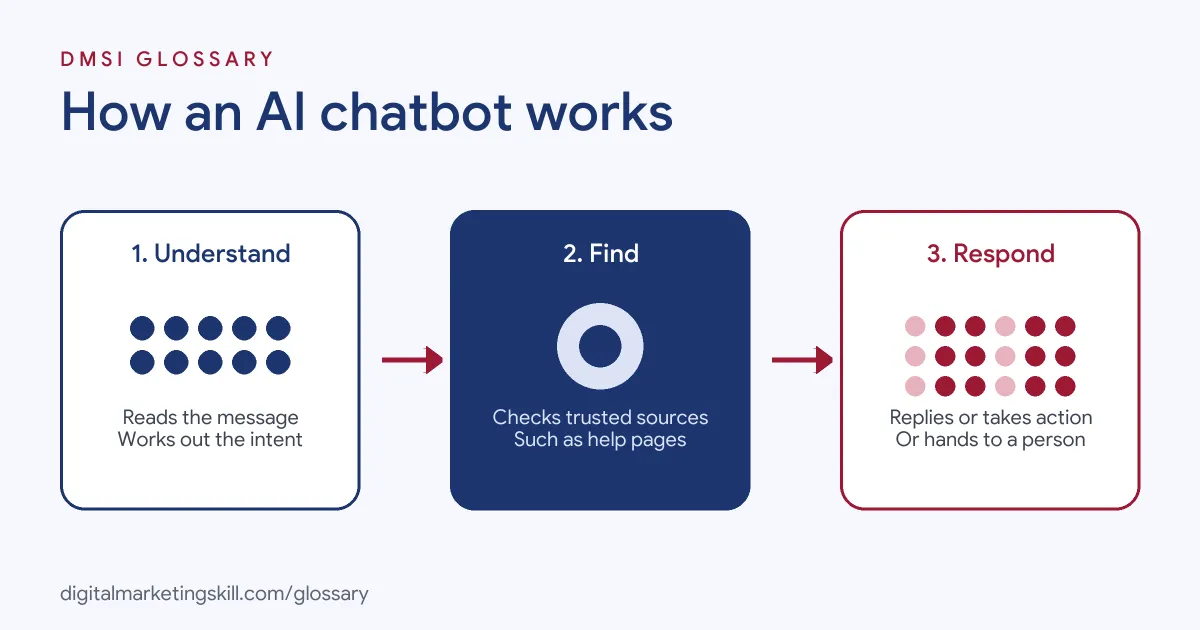
Every conversation follows the same basic loop. First, the bot reads the message and works out what the person wants. Next, it finds the right information. Finally, it writes a reply or takes an action, such as booking a call.
Understanding the Message
The first job is to understand intent. For example, “Can I change my delivery date?” and “I need my parcel later” ask for the same thing. Natural language processing lets the bot see that, even when the words differ.
Finding the Answer
Next, the bot needs facts. A general large language model knows a lot about the world, but it doesn’t know your prices or returns policy. So most business bots connect to a knowledge base, such as help articles, product pages or a CRM.
This step matters for accuracy. IBM warns that AI chatbots “can occasionally generate responses that are inaccurate, incomplete or misleading,” and that this is more likely when a bot “lacks access to reliable information.” That’s why AI hallucination is a real risk you must plan for.
Replying or Handing Over
Finally, the bot replies. It may also act, for instance by creating a lead in your CRM. Microsoft’s Copilot Studio documentation notes that when an agent “can’t resolve a request, it can escalate the conversation to a human representative.” In practice, that handover is what keeps customers happy when the bot reaches its limit.
AI Chatbot Examples
Here are three made-up examples that show common uses:
- Online store (example): A shoe shop adds a bot that answers sizing and delivery questions from its help pages. As a result, fewer customers email the support team.
- Training school (example): A course provider uses a bot to answer questions about course content. Then it offers to book a call with an adviser and sends the lead to the CRM.
- Software company (example): A SaaS firm adds a chatbot that qualifies visitors and passes ready buyers to a calendar, so sales reps only take booked meetings.
In each case, the bot does a narrow job well. It doesn’t try to do everything.
Rule-Based Chatbot vs AI Chatbot
Both types still have a place. Here is how they compare:
| Feature | Rule-based chatbot | AI-powered chatbot |
|---|---|---|
| How it understands | Buttons, keywords and decision trees | Free text, using natural language processing |
| How it replies | Fixed, scripted answers | Generated answers based on its sources |
| Best for | Simple, predictable tasks | Varied questions in the customer’s own words |
| Main risk | Gets stuck outside its script | Can give confident but wrong answers |
In short, rules give you control, while AI gives you flexibility. Many teams combine both, so key steps such as booking stay predictable.
How to Set Up an AI Chatbot
The exact screens depend on your tool, but the process stays much the same:
- Pick one goal. For example, answer pre-sale questions or book demo calls.
- Gather your sources. Collect help articles, FAQs, prices and policies that are current and correct.
- Write clear instructions. Tell the bot its role, its tone and what it must never do, such as promise refunds.
- Plan the handover. Decide when a chat goes to a person, and test that route.
- Tell people it is a bot. Give it a clear label, so nobody thinks they are chatting with a human.
- Test with real questions. Use questions from past emails and chats, including awkward ones.
- Launch and review weekly. Read transcripts, fix wrong answers and update your sources.
Best Practices for an AI Chatbot
- Keep the scope narrow. A bot that does one job well beats one that does ten jobs badly.
- Ground it in your own content. Connect it to trusted pages, so it answers from your facts.
- Be open about AI. The EU AI Act says people who interact with an AI system must be “informed that they are interacting with an AI system,” unless that is obvious.
- Collect leads politely. Ask for an email only when you can offer something useful in return.
- Measure outcomes. Track resolved chats, handovers, leads and booked calls, not just the number of chats.
Common Mistakes to Avoid
Many teams launch a bot and forget it. As a result, its answers go out of date and trust drops. Another mistake is hiding the human option, which leaves frustrated people stuck in a loop. Some teams also feed the bot old documents, so it quotes prices that no longer apply. Finally, a few let the bot make promises on refunds or contracts. Instead, keep those decisions with a person.
How to Measure Your Chatbot
Chat volume alone tells you very little. Instead, track a few numbers that link to business goals:
- Resolution rate: the share of chats the bot finished without a person.
- Handover rate: the share of chats passed to your team. A sudden rise often points to a gap in your sources.
- Leads and meetings: how many chats became a contact or a booked call.
- Wrong answers: how many replies you had to correct during your weekly review.
Review these numbers together. For example, a high resolution rate means little if customers then email to complain.
Where You’ll Use an AI Chatbot at Work
Chatbots appear in marketing, sales and customer service roles. For example, real remote job listings mention:
- “On-site chat, chatbot, voice AI or personalization tools” as a nice-to-have skill (GTM Engineer, Web).
- “Design and maintain routing and SLA flows for our no-SDR motion, including the chatbot-to-calendar handoff” (Rev/Marketing Operations Manager).
- “Testing and evaluating AI chatbots or language models through structured conversations, using assigned goals and prompts” (AI Product Evaluator).
So whether you aim to be a Lead Generation Specialist or a Marketing Automation Specialist, it helps to know how to plan, test and measure a bot. Employers also like proof, such as a bot you set up that captured real leads.
Learn It in the Lead Generation Track
AI fundamentals, including strategy and planning, are part of every DMSI track. You put chatbots to work most in the AI-Powered Lead Generation and Email Automation track, where you study lead generation, email marketing and automation. Your portfolio project is a lead magnet and an automated email sequence that converts. You also get unlimited 1-on-1 mentoring and a U.S. Project Internship from day one.
Want to go deeper? Read our guide to chatbot marketing, and learn how to write ChatGPT prompts that give clear, useful answers.
Frequently Asked Questions
What is an AI chatbot in simple terms?
It is a program that chats with people in natural language and uses AI to understand their questions. As a result, it can answer questions it was never given a fixed reply for.
Is every chatbot an AI chatbot?
No. Rule-based chatbots follow scripts and decision trees. Only bots that use AI, such as natural language processing or large language models, count as AI bots.
Can an AI chatbot give wrong answers?
Yes. It can produce answers that sound right but are wrong. So connect it to trusted sources, review transcripts and give people an easy route to a human.
Do you have to tell people they are talking to a bot?
In the EU, the AI Act requires that people are told they are interacting with an AI system, unless it is obvious. Elsewhere, a clear label is still good practice.
How do marketers use AI chatbots?
Marketers use them to answer pre-sale questions, qualify visitors, capture leads and book calls. They then measure leads and meetings, not just chat volume.
Sources: IBM: What is a chatbot?; Microsoft Learn: Copilot Studio overview; EU AI Act, Article 50: Transparency obligations; remote job listings on Himalayas.