
Domain authority is a score from 1 to 100, created by the SEO software company Moz, that predicts how likely a website is to rank in search results compared with other sites. It is based mainly on the links pointing to a site, so sites with many strong backlinks tend to score higher. It matters because SEO teams use it to compare competitors and judge link opportunities, even though Google itself does not use it.
Key Takeaways
- Domain Authority (DA) is a Moz metric, not a Google metric. Moz says it “is not used by Google to determine search engine rankings.”
- Scores run from 1 to 100. New websites start at 1 and rise as they earn links from other sites.
- The score is relative. A DA of 30 can be strong in one niche and weak in another.
- Other tools have their own versions, such as Ahrefs Domain Rating (DR) and Semrush Authority Score.
- Use it to compare sites and track progress. Don’t treat it as a goal in itself.
What Is Domain Authority?
Think of DA as a forecast, not a rule. Moz looks at a website’s links and asks one question: compared with other sites, how likely is this one to rank? The answer becomes a single number.
Moz describes DA as “a comparative metric to evaluate your website’s search performance.” It also stresses that DA is “not a direct ranking factor.” In other words, raising your score does not move you up in Google by itself. Instead, the things that raise your score, such as earning good links, are the things that tend to help rankings too.
People often use the phrase loosely. Some mean Moz’s score, while others simply mean “how strong a site is in search”. On this page, DA always means the Moz metric.
How Domain Authority Works
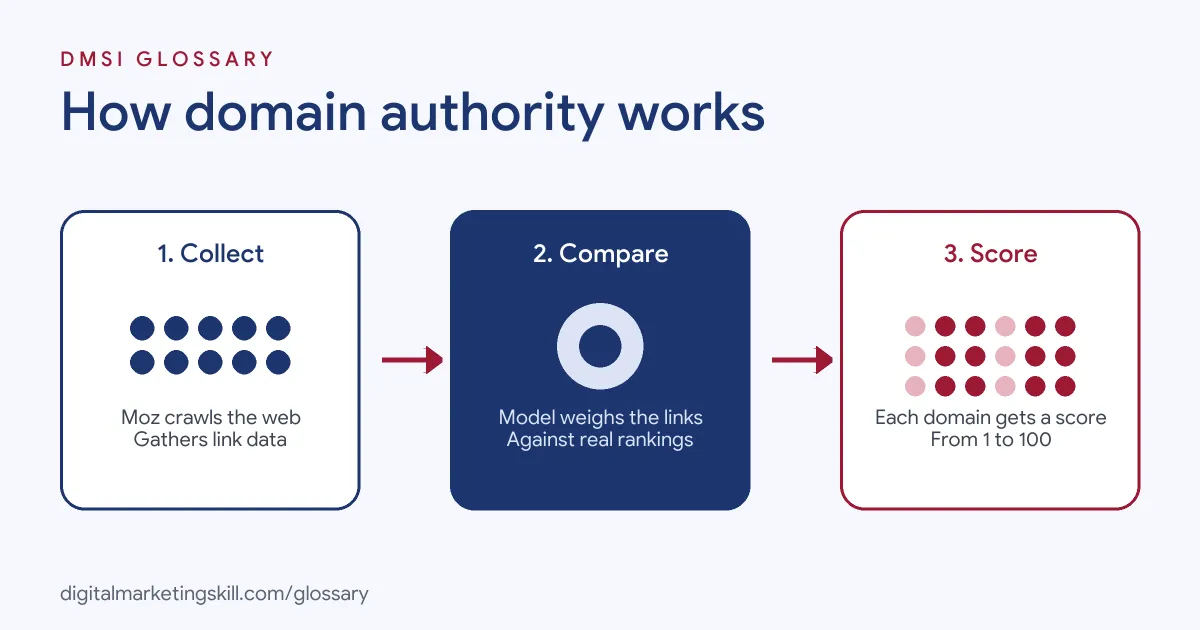
Moz builds the score in three steps. First, it crawls the web and collects link data. Next, a machine learning model weighs that data against how sites actually rank. Finally, it gives each domain a score from 1 to 100.
What Goes Into the Score
Moz says it calculates DA “using a machine learning algorithm that evaluates multiple factors, primarily focusing on backlink data.” The factors include the number of linking root domains and the quality of those links. So ten links from ten different trusted sites usually count for more than ten links from one site.
Why Scores Change
Your score is not fixed. Moz explains that it can rise or fall because of shifts in your backlink profile, changes in competitors’ scores, or updates to the calculation model. As a result, a small drop does not always mean you did something wrong.
Ahrefs describes the same effect for its own score. When top sites gain more links, they can’t go past 100, so “other websites are pushed down the scale.” Your rating can dip even if you lost no links at all.
How Ahrefs Domain Rating Differs
Ahrefs Domain Rating also uses a 100-point scale, but it explains its maths a little differently. A linking site splits its rating equally among all the domains it links to. So, according to Ahrefs, a DR 10 site that links to three domains can help you more than a DR 80 site that links to a million.
Domain Authority Examples
These made-up examples show how SEO teams use the score:
- Competitor check: A new bakery site has a DA of 8. The top three local rivals score between 20 and 25. So the team knows it needs more local links before it can compete for broad terms.
- Link outreach: A link builder has two guest post offers. One site has strong DA and real traffic in the same niche. The other has a high score but no relevant readers. The first is the better choice.
- Progress report: An agency tracks a client’s DA each quarter alongside organic traffic. The score rises as the client earns coverage in trade press, and traffic rises too.
In each case, the score helps with comparison. Still, the real decision rests on relevance and results.
Domain Authority vs Page Authority vs Domain Rating
Several tools offer a similar score, so here is how they compare:
| Metric | Made by | What it measures |
|---|---|---|
| Domain Authority (DA) | Moz | Likelihood of a whole domain ranking, on a 1–100 scale |
| Page Authority (PA) | Moz | Ranking strength of a single page |
| Domain Rating (DR) | Ahrefs | Strength of a site’s backlink profile, on a 100-point scale |
Moz notes that DA and Google’s PageRank are often confused. However, DA is Moz’s own predictive metric, built from Moz’s link index rather than Google’s data.
How to Check and Improve Domain Authority
Follow these steps to check a score and work on it:
- Enter your domain into Moz’s free Link Explorer or Domain Analysis tool. You need a free Moz Community account.
- Write down your score, your linking root domains and your top linked pages.
- Check the same numbers for three to five competitors that rank for your target keywords.
- Find the gap. Look at which sites link to your competitors but not to you.
- Earn links from relevant, trusted sites through useful content, digital PR and genuine partnerships.
- Check again every month or quarter, and compare the trend with your organic traffic.
If you browse a lot of sites, Moz’s free MozBar extension also shows DA directly in your browser.
Best Practices for Domain Authority
- Compare like with like. Moz says there is no universal “good” score. Compare yourself with sites in your own niche and market.
- Pair it with real data. Look at organic traffic, keyword rankings and conversions too. Moz itself warns against relying on DA alone.
- Value relevance over the number. A link from a smaller site in your field can help more than a link from a big site with no connection to you.
- Never buy links to raise a score. Google’s spam policies list “buying or selling links for ranking purposes” as link spam.
- Use one tool consistently. DA, DR and other scores use different data, so don’t mix them in one report.
Common Mistakes to Avoid
Beginners often make the same few errors. First, they believe Google uses DA, so they chase the number instead of rankings. Second, they compare a new local site with global brands and lose heart. Third, they pay for links from high-score sites that have no real readers. Finally, they panic over small drops that come from changes in the model, not from their own site. Treat the score as one signal among many.
Where You’ll Use Domain Authority at Work
Authority metrics come up often in SEO and link building roles. For example, remote job listings ask candidates to:
- Be ready to “manage link-building tactics, and work with agencies and publishers to strengthen domain authority” (Head of SEO).
- Show strong data skills: “you look past vanity metrics to find genuine, contextual link relevance and domain authority” (Link Acquisition Specialist).
- “Get high-quality links and mentions from trusted financial websites, news outlets, and blogs to build our domain authority” (Global SEO Manager).
So if you want to work as an SEO Specialist or Website Manager, employers will expect you to read these scores, explain them to clients and earn links that improve them.
Learn It in the WordPress and SEO Track
You can learn to measure and grow domain authority in the AI-Powered WordPress and SEO Specialist track. There, you build a WordPress site or store and rank it with an SEO content plan. You also work on a U.S. Project Internship from day one, with unlimited 1-on-1 mentoring.
Ready to earn better links? Read our guide to quality backlinks, or see these link building strategies. You can also learn how off-page SEO fits into the bigger picture.
Frequently Asked Questions
What is domain authority in simple terms?
It is a score from 1 to 100, made by Moz, that predicts how well a website can rank compared with others. It is based mainly on the links pointing to the site.
Does Google use domain authority?
No. Moz says DA is its own predictive metric and is not used by Google to rank pages. Even so, the links that raise DA can also help rankings.
What is a good domain authority score?
There is no single good score. Moz says it depends on your niche, so the best test is how you compare with the sites that rank for your keywords.
How long does it take to increase domain authority?
It usually takes months, because it depends on earning links from other sites. New sites start at 1 and grow as they gain trusted links.
What is the difference between DA and DR?
DA is Moz’s score and DR is Ahrefs’ score. Both use link data and a 100-point scale, but they use different link indexes and formulas.
Sources: Moz: Domain Authority; Ahrefs Help Center: What is Domain Rating; Google Search Central: Spam policies; remote job listings on Himalayas.