
A campaign objective is the main result you want an ad campaign to achieve, such as awareness, website traffic, leads or sales. You choose it when you create the campaign, and the platform uses it to decide who sees your ads and what it optimises for. It matters because the wrong objective can get you cheap clicks or views when what you really needed was customers.
Key Takeaways
- The objective is the first choice you make when you build a campaign. It shapes the settings, ad formats and bidding options you see next.
- Meta offers six objectives: Awareness, Traffic, Engagement, Leads, App promotion and Sales.
- Google Ads also asks for an objective, such as Sales, Leads or Website traffic, before you pick a campaign type.
- On Meta, every ad set in a campaign must work with that campaign’s objective.
- Pick the objective that matches the action you will measure, not the cheapest result.
What Is a Campaign Objective?
Meta’s developer documentation says a campaign “should represent a single objective for an advertiser.” In other words, each campaign has one main job. If you want two different results, such as awareness and sales, you usually run two campaigns.
Google Ads explains it in a similar way. It says the objective you select “should align with the main thing that you want to get from your campaign, for example, Sales, Leads or Website traffic.” After that, Google shows you features and settings that suit that goal.
For example, a yoga studio that wants new members should not choose a video views objective. Instead, it should choose Leads or Sales, so the platform looks for people who are likely to sign up.
How a Campaign Objective Works
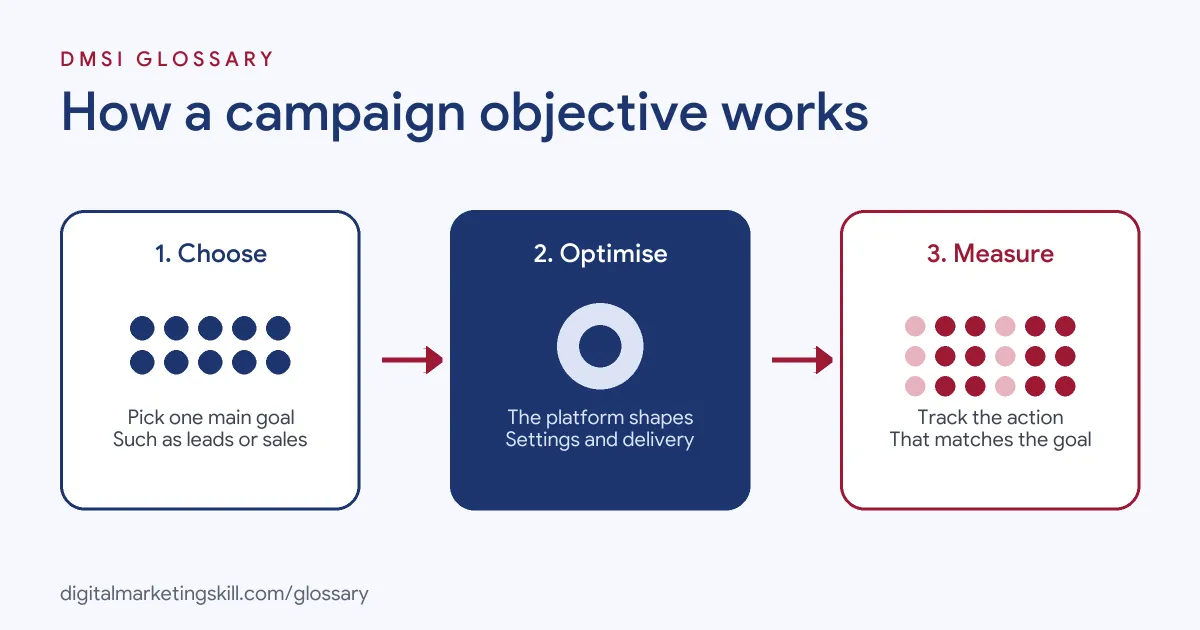
When you pick an objective, you are telling the platform what success looks like. The system then uses that signal at every step. It shapes the options you can choose, the people it shows your ads to and the result it tries to get more of.
It Guides Your Settings
Google says choosing an objective “eases your decision-making” by guiding you to the features designed for that goal. LinkedIn says something similar: “Each objective offers ad formats and bidding strategies that align with the goals of that objective.” So the objective you pick changes what appears on the next screens.
It Guides Delivery
The objective also affects who sees your ads. LinkedIn states that ads “are optimized for delivery to people most likely to take the action you want based on the objective you select.” For instance, a traffic objective looks for people who tend to click, while a sales objective looks for people who tend to buy.
It Sets the Rules for the Campaign
On Meta, the objective applies to everything below it. Meta’s documentation states: “Each campaign has an objective that must be valid across the ad sets within that campaign.” As a result, all ad sets and ads in the campaign have to fit the same goal.
Campaign Objective Examples
Here are three made-up examples of matching the objective to the business goal:
- New café: The owner wants local people to know it exists. So the café runs an Awareness campaign with short videos to people nearby.
- Online course: A training provider wants enquiries. It chooses Leads, with an instant form that asks for a name and email.
- Online shop: A clothing brand wants purchases. It picks Sales and makes sure its pixel tracks each order.
In each case, the objective matches the action the business will measure. That link is what makes the results useful.
Campaign Objectives on Meta, Google, TikTok and LinkedIn
Every major ad platform asks for an objective, but each one handles it slightly differently:
| Platform | Where you set it | Examples |
|---|---|---|
| Meta (Facebook and Instagram) | Campaign level | Awareness, Traffic, Engagement, Leads, App promotion, Sales |
| Google Ads | Campaign level, before you choose a campaign type | Sales, Leads, Website traffic |
| TikTok | Campaign level | App Install, Traffic |
| Ad set level | Chosen as the first step of your ad set settings |
Google also notes that in some campaigns you can add or remove an objective at any time. You can even create a campaign without one. Meanwhile, LinkedIn asks for the objective inside the ad set, rather than at the top level.
Matching a Campaign Objective to the Funnel
A simple way to choose is to think about where your audience sits in the buying journey. People who have never heard of you need a different campaign objective from people who have already visited your pricing page.
- Top of the funnel: Awareness, to reach new people and build recognition.
- Middle of the funnel: Traffic or Engagement, to get people interested and on your site.
- Bottom of the funnel: Leads or Sales, to turn warm audiences into enquiries and customers.
How to Choose a Campaign Objective
Follow these steps to pick the right goal for your campaign:
- Start with the business goal. Write down what the business needs, such as ten new clients a month.
- Find the action that proves it. For instance, a form submission, a booked call or a purchase.
- Match that action to an objective. Purchases fit Sales, sign-ups fit Leads and visits fit Traffic.
- Check your tracking. Make sure the pixel or conversion tag records the action you chose.
- Consider the funnel stage. Use Awareness or Engagement for people who don’t know you yet, and Leads or Sales for warmer audiences.
- Measure the matching result. Judge a Sales campaign on sales, not on clicks.
Best Practices
- Keep one goal per campaign. Mixing goals makes results hard to read.
- Choose the deepest action you can track. If you can track purchases, a Sales objective usually tells the platform more than Traffic does.
- Brief your creative team. An awareness video and a sales ad need different messages.
- Use clear names. Put the objective in the campaign name, such as “UK – Leads – Free Guide”.
- Give it time. Let the system gather results before you switch objectives.
Common Mistakes to Avoid
Beginners often make the same few errors. First, they choose Traffic or Engagement because the results look cheap, then wonder why nobody buys. Second, they pick Sales without a working pixel, so the platform has nothing to learn from. Third, they try to do everything in one campaign. Finally, they judge an awareness campaign on sales and a sales campaign on reach. Each of these comes from not linking the objective to the right measure.
Campaign Objective vs Business Goal vs KPI
These three ideas are linked, but they are not the same:
| Term | What it is | Example |
|---|---|---|
| Business goal | What the company wants overall | Grow online sales |
| Campaign objective | The setting you choose in the ad platform | Sales |
| KPI | The number you track to judge success | Cost per purchase |
In short, the goal sets the direction, the objective tells the platform what to aim for, and the KPI tells you whether it worked. For more on how these settings look on screen, read our entry on Meta Ads Manager.
Where You’ll Use Campaign Objectives at Work
Turning goals into the right campaigns is a core part of paid social work. For example, recent remote job listings ask candidates to:
- “Collaborate with media buyers, designers, and the creative team to turn campaign objectives into compelling video ads” (Video Editor, Ads Campaign Creative).
- “Create and manage Facebook and Meta Ads campaigns based on client objectives” (Media Buyer Specialist).
- “Translate client objectives into clear channel recommendations, audience strategies, campaign structures, budgets, and performance goals” (Media Supervisor).
So if you want to work as a Paid Social Specialist or Social Media Manager, employers will expect you to choose the right objective and explain why.
Learn It in the Social Media Track
You can learn to choose a campaign objective in the AI-Powered Social Media Management and Advertising track. There, you plan, create and run a paid social campaign for a real brand, so you finish with results you can show an employer. You also work on a U.S. Project Internship from day one, with unlimited 1-on-1 mentoring.
Want a wider view of paid social? Read our guide to Facebook advertising.
Frequently Asked Questions
What is a campaign objective in simple terms?
It is the main result you want from an ad campaign, such as awareness, traffic, leads or sales. The platform uses it to decide how to deliver your ads.
What are the Meta campaign objectives?
Meta offers six: Awareness, Traffic, Engagement, Leads, App promotion and Sales.
Can I change a campaign objective later?
It depends on the platform. Google says that in some campaigns you can add or remove an objective at any time. Elsewhere, it is often simpler to build a new campaign.
Which objective is best for a small business?
Choose the one that matches the action you need. Often, that means Leads or Sales, as long as tracking is in place.
Why does my traffic campaign get clicks but no sales?
A traffic objective looks for people likely to click, not to buy. If sales are the goal, switch to a Sales objective and track purchases.
Sources: Meta for Developers: Ad Campaign reference; Google Ads Help: About campaign objectives; TikTok Ads Help: About TikTok Ads Structure; LinkedIn Marketing Solutions Help; remote job listings on Himalayas.