
TikTok ads are paid placements on TikTok that let businesses show videos and other formats to chosen audiences, usually between the organic videos people scroll through. You create and manage them in TikTok Ads Manager, where you set a goal, a budget, an audience and the creative. They matter because they put short, sound-on video in front of people who are actively watching, which suits brands that can tell a story fast.
Key Takeaways
- TikTok Ads Manager uses a three-level structure: campaign, ad group and ad.
- Objectives fall into three groups: awareness, consideration and conversion.
- TikTok’s help centre sets minimum daily budgets of more than $50 at campaign level and more than $20 at ad group level.
- In-Feed Video Ads appear in the For You, Following and Profile feeds, and Spark Ads let you promote organic TikTok posts.
- The TikTok Pixel tracks what people do on your website after they see or click an ad.
What Are TikTok Ads?
TikTok is built around a full-screen feed of short videos. Because of that, ads on the platform usually look and sound like the content around them. That’s the point: the best ones feel native, not like a TV advert squeezed onto a phone.
TikTok’s own glossary describes In-Feed Video Ads as “video ads displayed in the TikTok For You Feed, Following Feed, Profile Feed.” It also describes Spark Ads as “a native ad format that lets you create ads using organic TikTok posts.” So you can either make a dedicated ad or boost a post that’s already working.
TikTok advertising is part of paid social, alongside Meta, LinkedIn and others. Many of the same skills apply, such as choosing objectives, building audiences and testing creative. However, the creative style is different, because TikTok rewards fast, authentic, sound-on video.
How TikTok Ads Work
Every TikTok campaign is built in three layers. First, the campaign sets your objective. Next, the ad group sets the audience, budget, schedule and placements. Finally, the ads hold the videos, text and calls to action that people see.
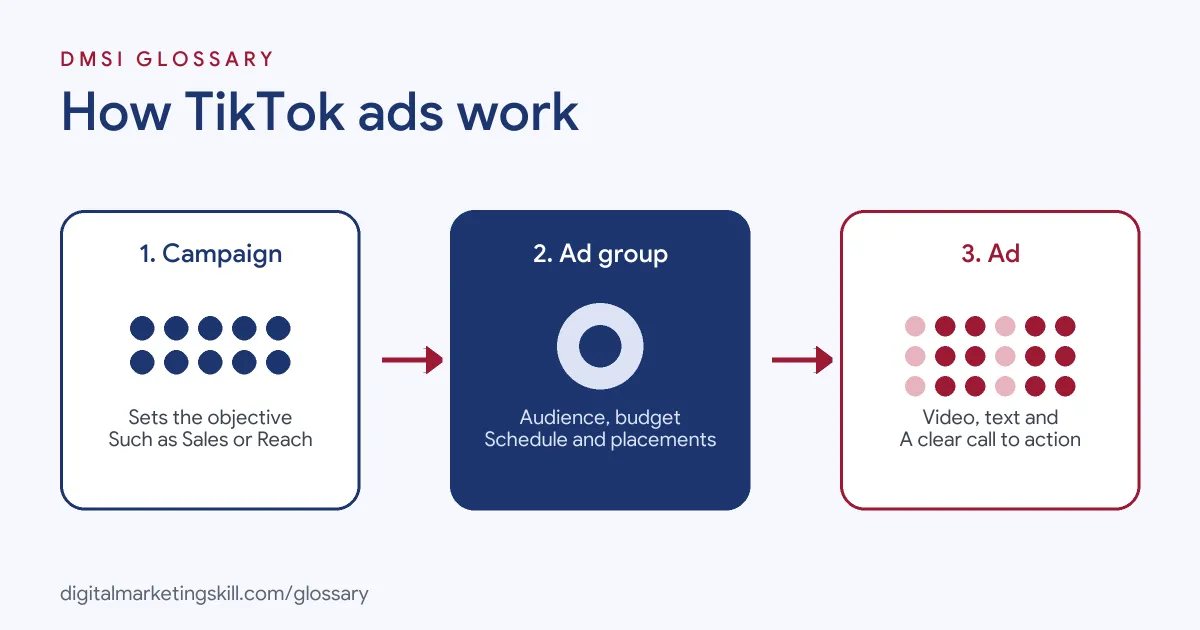
Campaign Structure
TikTok’s glossary defines each layer simply. A campaign “is a specifically designed strategy to achieve desired results.” An ad group “is built up underneath a campaign and contains a set of similar ads.” An ad “is the content that you will ultimately present to your target audience.”
Objectives
Your campaign objective tells TikTok what result to aim for. TikTok groups them like this:
- Awareness: Reach, to “show your ad to the maximum number of people.”
- Consideration: Traffic, Video views and Community interaction, which can bring “more followers, profile visits, page visits or promote your livestream.”
- Conversion: App promotion, Lead generation and Sales, which can “sell products from your TikTok Shop, website, and app.”
Budgets
Next comes money. You can set a daily or lifetime budget. According to TikTok’s help centre, a daily budget “must exceed $50” at campaign level and “must exceed $20” at ad group level. For lifetime budgets at ad group level, the minimum is the number of days multiplied by the minimum daily budget.
Tracking
To measure sales or leads on your site, you need tracking. TikTok’s glossary describes the TikTok Pixel as “an HTML code snippet that gets loaded whenever a user visits a website.” The pixel then reports actions, such as purchases, back to Ads Manager.
TikTok Ads Examples
Here are three made-up examples:
- Example 1, skincare brand: A brand runs a Sales campaign with three creator-style videos. Each shows the product in a real morning routine. As a result, it finds the best-selling video within a week and moves budget to it.
- Example 2, language app: An app runs an App promotion campaign. Its ads show a quick before-and-after of someone ordering food in Spanish.
- Example 3, local gym: A gym uses a Lead generation campaign with an instant form. The video shows a member’s first class, with a free-trial offer.
TikTok Ad Formats and Objectives Compared
This table pairs common goals with the right objective:
| Goal | TikTok objective | What to measure |
|---|---|---|
| Get the brand seen widely | Reach | Reach and cost per thousand impressions |
| Send people to a website | Traffic | Clicks, cost per click and landing page visits |
| Grow followers or watch time | Community interaction or Video views | Follows, profile visits and view rates |
| Collect enquiries | Lead generation | Leads and cost per lead |
| Drive purchases | Sales | Purchases, cost per purchase and return on ad spend |
In short, pick the objective that matches the action you really want. Otherwise, TikTok will optimise for the wrong result.
How to Create TikTok Ads
- Set up Ads Manager. Create a TikTok for Business account and add your payment details.
- Install the TikTok Pixel. Add it to your website, then set up the events you care about, such as purchases or leads.
- Create a campaign. Choose your objective, such as Sales or Lead generation.
- Build an ad group. Set the audience, placements, schedule and budget. Remember the ad group minimum of more than $20 a day.
- Upload your ads. Add two to four videos, a short caption and a clear call to action. Alternatively, use Spark Ads to promote an existing organic post.
- Launch and learn. Let the campaign gather data before you judge it.
- Optimise. Finally, pause weak videos, scale strong ones and test new hooks.
What Makes a Good TikTok Ad
Strong ad creative on TikTok tends to share a few traits. First, it grabs attention in the first second or two. Second, it is filmed vertically and feels like a real person talking, not a polished commercial. Third, it uses sound, captions and on-screen text, so the message works with or without audio. Most importantly, it shows the product solving a problem rather than just describing it.
How to Read Your Results
Start with the number that matches your objective, such as cost per purchase for a Sales campaign. Then look one level down. For example, if purchases are low, check whether people are clicking at all. If clicks are fine but sales are weak, the problem is probably the landing page or offer, not the ad. Similarly, compare videos within the same ad group, so you learn which hooks and formats work best.
Best Practices for TikTok Ads
- Test several videos per ad group. Creative is usually the biggest lever on results.
- Refresh often. Short-form video can tire quickly, so plan new versions regularly.
- Work with creators. Creator-made videos often feel more natural on the platform.
- Match objective to goal. Choose Sales for purchases, not Traffic.
- Check the pixel. Make sure purchase and lead events fire correctly before you scale.
Common Mistakes to Avoid
A common mistake is reusing a polished TV-style advert, which often looks out of place in the feed. Another is choosing Traffic when the real goal is sales. Some advertisers also skip the pixel, so they can’t see which videos drive purchases. Others run one video for weeks without testing new ones. Lastly, many change settings every day, before the campaign has enough data.
Where You’ll Use TikTok Ads at Work
TikTok skills appear across paid social and performance roles. For example, remote job listings mention:
- The need to “Run Meta and TikTok ads: budgets, audiences, creative testing, scaling winners” (Growth Marketing Manager, Paid Media and Klaviyo).
- “LinkedIn Ads, TikTok Ads, YouTube and Programmatic experience” (Paid Media Specialist SR.).
- “Expert-level command of Meta Ads Manager and deep familiarity with TikTok Ads, Pinterest, and emerging social commerce platforms” (Senior Director, Paid Social).
So if you want to work as a Paid Social Specialist, Social Media Manager or Content Creator, expect to plan, launch and report on TikTok campaigns.
Learn It in the Social Media Track
You can learn to run TikTok campaigns in the AI-Powered Social Media Management and Advertising track. It covers content creation, social media marketing and analytics, and social media advertising. You also plan, create and run a paid social campaign for a real brand, with unlimited 1-on-1 mentoring and a U.S. Project Internship from day one.
To go further, read our guide to TikTok for business and our tips on becoming a content creator on TikTok.
Frequently Asked Questions
What are TikTok ads in simple terms?
They are paid videos and other formats that businesses show to chosen audiences on TikTok, managed in TikTok Ads Manager.
How much do TikTok ads cost?
Costs depend on your audience, objective and competition. TikTok sets minimum daily budgets of more than $50 per campaign and more than $20 per ad group.
What objectives can I choose?
TikTok offers Reach, Traffic, Video views, Community interaction, App promotion, Lead generation and Sales, grouped by awareness, consideration and conversion.
What is the difference between In-Feed ads and Spark Ads?
In-Feed ads are video ads in the main feeds. Spark Ads are a native format that lets you promote organic TikTok posts as ads.
Do I need the TikTok Pixel?
If you want to track sales or leads on your website, yes. The pixel sends those actions back to Ads Manager.
Sources: TikTok Ads Help: Ads Manager glossary; TikTok Ads Help: How to choose the right objective; TikTok Ads Help: Budget; remote job listings on Himalayas.