
Reels are short, vertical videos on Instagram and Facebook that you can make with music, effects, text and voiceover, and that play in a full-screen feed. Unlike most posts, they are shown to many people who don’t follow you yet. That makes them one of the main ways for brands and creators to reach new audiences on Meta’s apps without paying for ads.
Key Takeaways
- This is Meta’s short-form video format, found on both Instagram and Facebook.
- Instagram says reels are “designed to help you discover new things, with an emphasis on entertainment.”
- Most videos people see there come from accounts they don’t follow, so a good reel can reach far beyond your followers.
- Instagram lets you upload reels up to three minutes long, and videos of that length can be recommended to non-followers.
- Instagram makes watermarked, low-resolution and reposted reels less visible, so original content matters.
What Are Reels?
Think of a reel as a short video built for discovery. You film or upload clips, then add music, captions, stickers or effects inside the app. Viewers swipe through them one after another in a vertical, full-screen feed.
The key difference is who sees them. A normal feed post goes mainly to your followers. By contrast, Instagram says that in Reels, “the majority of what you see is from accounts you don’t follow.” So the format works more like a recommendation engine than a news feed.
For marketers, that is the main appeal. A small account with one strong video can reach thousands of new people. Still, reach alone is not the goal; you also want viewers to follow, click or buy.
How Reels Work
Every reel goes through the same basic path. First, you create and post the video. Next, Instagram studies signals about the reel and the people who might enjoy it. Finally, it shows the reel to viewers who are likely to watch and engage.
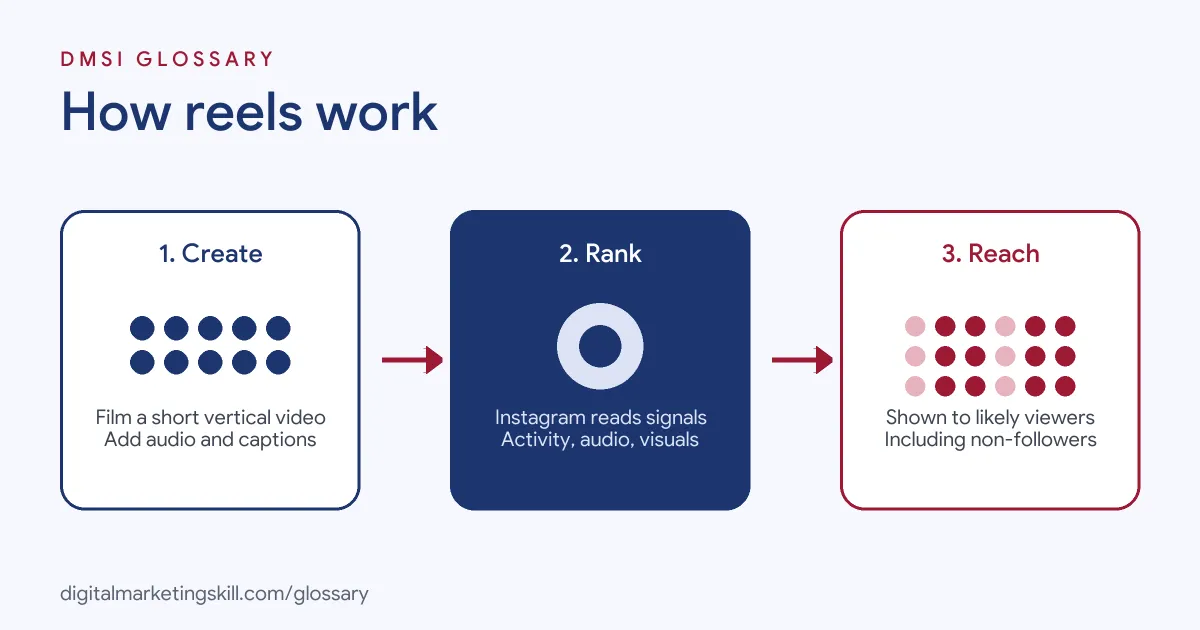
How Instagram Ranks Reels
Instagram lists the signals it uses to rank these videos, in rough order of importance:
- Your activity: which videos you have liked, saved, reshared or commented on.
- Your history with the poster: whether you have interacted with that account before.
- Information about the reel: signals about the content, such as the audio track or the visuals.
- Information about the poster: popularity signals, such as follower count or level of engagement.
In other words, the viewer’s own behaviour matters most. That’s why a reel can do well even from a small account.
Length and Format
Instagram’s head, Adam Mosseri, announced that “you can upload Reels to Instagram up to three minutes long.” Before that, the limit was 90 seconds, because Instagram wanted to focus on short-form video. Instagram’s creators blog adds that videos up to three minutes are eligible to be shown to non-followers in places like the Reels tab and Explore.
Even so, short and sharp still works well for most brands. Longer videos suit tutorials or stories that genuinely need the time. A simple test is to cut your draft in half and ask whether anything important is missing. If not, post the shorter version.
Audio and Remixing
Sound is a big part of the format. According to Instagram, any unique audio mix you make “is attributed to you,” and other users can save and remix it. As a result, a popular original sound can send new viewers back to your account.
Reels Examples
These made-up examples show how brands use the format:
- Café: A coffee shop films a 15-second clip of latte art with a trending sound. It ends with the shop’s location on screen.
- Online course: A training provider posts a 45-second tip on writing better ad headlines. The caption invites viewers to save it for later.
- Clothing brand: A fashion label shows one outfit styled three ways, with quick cuts between each look and a link to the shop in the bio.
In each case, the video gives value in the first few seconds. That hook is what keeps people watching. Notice, too, that each one ends with a clear next step, such as a visit, a save or a click. Without that step, even a popular video may not help the business.
Reels vs Stories vs Feed Posts
Instagram offers several formats, so here is how they compare:
| Format | Main audience | Best for |
|---|---|---|
| Reels | Followers and many non-followers | Reaching new people with entertaining or useful video |
| Stories | Mostly existing followers | Quick updates, polls and behind-the-scenes moments |
| Feed posts | Mostly existing followers | Photos, carousels and lasting brand content |
In short, stories and posts help you keep followers close, while reels help you find new ones. Most brands use all three together.
How to Make Reels That Perform
Follow these steps for your next video:
- Pick one idea per video, such as one tip, one product or one story.
- Write a hook for the first seconds. For example, show the result first, then explain how.
- Film vertically in good light, or upload clean, high-resolution footage.
- Edit in the Instagram app or a video editor, then add captions so people can follow without sound.
- Choose audio that fits the mood, or record your own voiceover.
- Write a short caption with a clear next step, such as “save this” or “visit the link in bio”.
- Post, then check views, watch time, shares and saves in your insights.
If you aren’t sure an idea will land, Instagram offers trial reels. These let you “share your content with people who don’t follow you first.” Then, if the results look good, you can share it with your followers as well.
Best Practices for Reels
- Post original content. Instagram’s creators team advises creators to “post original content consistently.”
- Remove watermarks. Instagram says it makes “low-resolution or watermarked reels” less visible, so don’t repost videos with another app’s logo.
- Don’t recycle old reels. Instagram also limits reach for videos that “have already been posted on Instagram.”
- Hook fast. Viewers swipe quickly, so lead with your best moment.
- Track the right numbers. Shares and saves often say more than likes about whether a reel helped.
Common Mistakes to Avoid
Beginners often make the same errors. First, they cross-post videos from other apps with the watermark still on. Second, they spend the first five seconds on a logo or a slow intro. Third, they forget captions, even though many people watch with the sound off. Finally, they judge success on views alone and ignore whether viewers followed, clicked or bought. Fixing these habits often helps more than posting more often.
Where You’ll Use Reels at Work
Short-form video is a core skill in social media roles. For example, remote job listings ask candidates to:
- “Capture and edit short-form video, Reels, Stories, and other social-first content” (Social Media and Partnerships Coordinator).
- “Write engaging scripts for TikTok, Instagram Reels, YouTube Shorts, and other short-form content formats” (Content Script Creator).
- “Brainstorm engaging content ideas, hooks, storylines and creative angles for short-form videos across TikTok, Instagram Reels and Facebook” (Creative Strategist, Meta Ads Contents).
So if you want to work as a Social Media Manager or Content Creator, employers will expect you to plan, film, edit and report on short videos. A portfolio of real videos with results is strong proof.
Learn It in the Social Media Track
You can learn to plan and create reels in the AI-Powered Social Media Management and Advertising track. It covers content creation with graphics and video, plus social media marketing, analytics and advertising. You also plan, create and run a paid social campaign for a real brand, and you work on a U.S. Project Internship from day one, with unlimited 1-on-1 mentoring.
Want to choose the right format first? Read our Instagram marketing strategy guide, and check these Instagram marketing mistakes that cap your reach. You can also learn how to measure engagement rate.
Frequently Asked Questions
What are reels in simple terms?
They are short vertical videos on Instagram and Facebook, often set to music. They play in a full-screen feed and reach many people who don’t follow you.
How long can Instagram reels be?
Instagram lets you upload reels up to three minutes long. Before that, the limit was 90 seconds.
Why are my reels not getting views?
Common reasons include a slow start, low video quality, watermarks from other apps and reposted content. Instagram says it makes watermarked and reposted videos less visible.
Are reels better than posts?
Not always. Short videos are better for reaching new people, while posts and stories help you stay close to followers. Most brands use a mix.
Can you run ads with reels?
Yes. Brands can use short vertical videos as ads in the Reels feed through Meta’s ad tools. The same rules apply: hook fast, use captions and keep the video native to the format.
Sources: Instagram: Instagram ranking explained; Instagram Creators: Finding success with short video; Social Media Today: Instagram expands video length to three minutes; remote job listings on Himalayas.