
Share of voice (SOV) is the percentage of all the attention in a market that your brand captures compared with competitors, from ads and social posts to search results and press coverage. You work it out by dividing your brand’s figure by the total for the market, then multiplying by 100. It matters because it shows how visible you are next to rivals, which helps you judge whether your marketing is winning attention or falling behind.
Key Takeaways
- SOV compares your brand’s visibility with the whole market, not just with your own past results.
- Brandwatch gives the formula as: SOV = (your brand’s metric ÷ total market metric) × 100.
- You can measure it across social media, organic search, paid ads and PR, using different inputs for each.
- In Google Ads, impression share and the Auction insights report work as a form of paid search SOV.
- Always define the market and the competitors first, or the percentage means very little.
What Is Share of Voice?
Think of SOV as your slice of the conversation. Imagine a room where ten brands are talking. If people hear your brand in 3 out of every 10 mentions, your SOV is 30%.
Brandwatch describes it as “a marketing metric that measures how much of the total conversation, advertising, or visibility” in a market your brand captures “compared to competitors.” In other words, it is a relative measure. A thousand mentions sounds good, but not if a rival gets ten thousand in the same month and the same market.
For example, a running shoe brand might track how often it is mentioned on social media compared with four rival brands. If its share rises after a campaign, the campaign probably helped it stand out. SOV is closely linked to reach and impressions, but it always adds the competitor view.
How Share of Voice Works
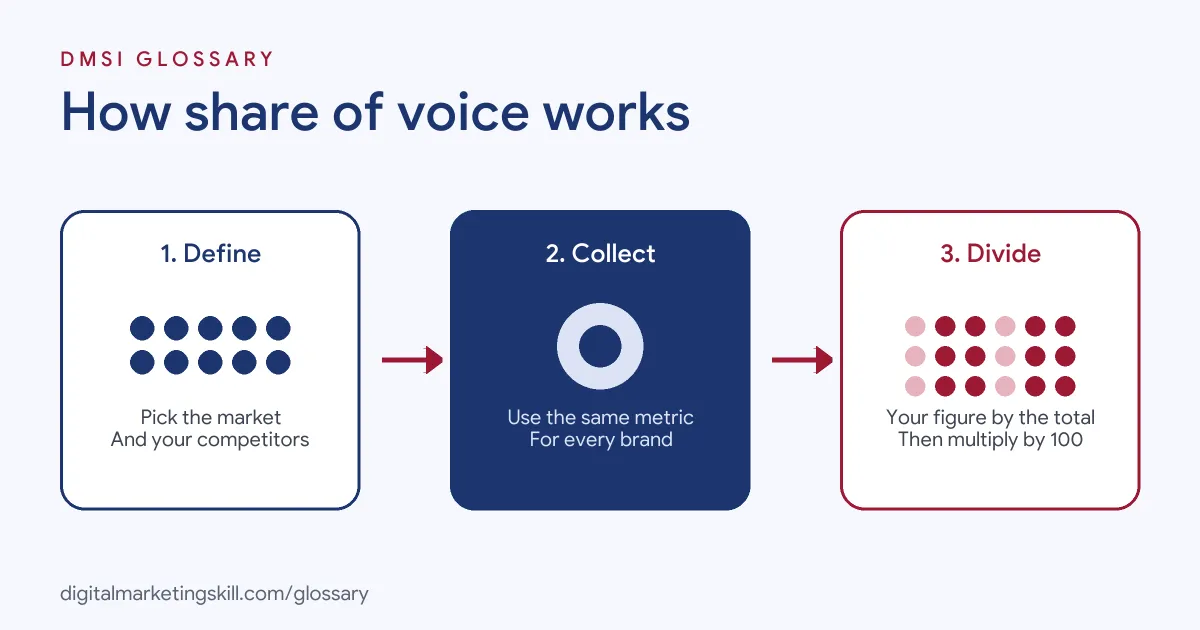
SOV works in three steps. First, you define the market and pick your competitors. Next, you collect the same metric for every brand, such as mentions, impressions or rankings. Finally, you divide your number by the total and multiply by 100.
The Formula
Brandwatch sets it out simply: “SOV = (Your brand’s metric / Total market metric) × 100.” The formula stays the same for each channel, but the inputs change. For social media, the input might be brand mentions. For paid search, it might be ad impressions.
SOV in Paid Search
In Google Ads, the closest built-in measure is impression share. Google defines it as “the percentage of impressions that your ads receive compared to the total number of impressions that your ads could get.” The formula is impressions divided by total eligible impressions. So if your ads could have shown 10,000 times but showed 6,000 times, your impression share is 60%.
Google’s Auction insights report adds the competitor view. It shows other advertisers’ impression share, plus how often their ads appeared with yours (overlap rate) and how often your ad beat theirs (outranking share).
A Worked Paid Search Example
Here is a made-up example. A florist checks Auction insights for its main campaign. Its own impression share is 40%. Rival A shows 65%, and its overlap rate with the florist is 50%, so the two ads appear together in half of the florist’s auctions. However, the florist’s outranking share against Rival A is high, which means the florist usually ranks higher when both ads show. So the florist’s real problem is reach, not ad quality, and a bigger budget at busy times may help most.
Social Media and PR
On social media, teams usually count mentions or engagement for each brand using a listening tool. In PR, they count press coverage. Meanwhile, LinkedIn notes that its Brand Awareness objective is for impression-based campaigns “to drive brand recognition and share of voice among your audience.”
Share of Voice Examples
Here are three made-up examples:
- Social media (example): A coffee chain gets 1,200 mentions in a month, while its four rivals get 4,800 in total. Its SOV is 1,200 ÷ 6,000 × 100, which is 20%.
- Paid search (example): A plumber’s ads show for 45% of eligible searches. Auction insights shows one rival at 70%, so the plumber decides to raise its budget in peak hours.
- PR (example): A software firm appears in 15 of 60 trade press articles on its topic in a quarter, giving it a 25% SOV in the press.
In each case, the number only makes sense next to the competitors in the same market.
Share of Voice by Channel
Here is how the input changes by channel:
| Channel | Typical input | Where to find it |
|---|---|---|
| Social media | Brand mentions or engagement | Social listening tools |
| Paid search | Ad impressions | Google Ads impression share and Auction insights |
| Organic search | Visibility for a set of keywords | SEO rank tracking tools |
| PR | Articles or mentions in the press | Media monitoring tools |
In short, choose one input per channel and keep it the same over time, so your trend is reliable. If you report several channels, show each one separately rather than adding them together.
How to Measure Share of Voice
- Define the market. Decide the topic, product type and region you care about.
- Choose competitors. List the three to five brands your customers compare you with.
- Pick a channel and a metric. For example, choose social mentions or paid search impressions.
- Set a time period. Use the same length each time, such as one month.
- Collect the data. Use a listening tool, Google Ads or a rank tracker to gather each brand’s figure.
- Calculate your share. Divide your figure by the total for all brands, then multiply by 100.
- Track the trend. Compare periods, and note what you changed in between.
It also helps to look beyond volume. For instance, 100 angry mentions are not the same as 100 happy ones, so many teams check sentiment alongside SOV.
Best Practices
- Keep the competitor list fixed. Changing it each month makes trends impossible to read.
- Measure the same way every time. Use the same tool, the same keywords and the same time frame.
- Check sentiment. More mentions only help if most of them are positive or neutral.
- Link it to results. Compare SOV with leads, sales or brand searches.
- Report earned and paid separately. Then everyone knows what came from ads and what was earned.
Common Mistakes to Avoid
A common mistake is quoting an SOV figure without saying which market or competitors it covers. Another is mixing channels, such as adding press mentions to ad impressions, which makes the number meaningless. Some teams also ignore sentiment, so a crisis looks like a success. Others switch tools halfway through the year and lose a fair comparison. Finally, many celebrate a rising share without checking whether sales moved too.
Where You’ll Use SOV at Work
SOV appears in social, PR and content roles. For example, real remote job listings ask candidates to:
- “Track and analyze share of voice (SOV) against competitors and industry benchmarks using comms analytics tools” (Senior Manager, Communications).
- Show “Strong analytical capability across social and content performance, share of voice, distribution, and attribution.” (Senior Social and Content Manager).
- “Own earned media reporting, tracking placements, share of voice, and coverage quality” (Sr. Public Relations Manager).
So if you want to work as a Social Media Manager or Paid Social Specialist, employers will expect you to measure your brand against rivals, not just against itself.
Learn It in the Social Media Track
You can learn to measure and report social performance in the AI-Powered Social Media Management and Advertising track. It covers AI fundamentals, content creation, social media marketing and analytics, and social media advertising. Your portfolio project is a paid social campaign that you plan, create and run for a real brand. You also get unlimited 1-on-1 mentoring and a U.S. Project Internship from day one.
Next, read our guide to brand awareness, which SOV helps you track.
Frequently Asked Questions
What is share of voice in simple terms?
It is your brand’s share of all the attention in your market, shown as a percentage. It compares you with your competitors.
How do you calculate it?
Divide your brand’s figure, such as mentions or impressions, by the total for all brands. Then multiply by 100.
What is a good share of voice?
There is no single target. It depends on your market and rivals, so focus on whether your share is growing over time.
Is impression share the same as SOV?
It is the paid search version. Google defines impression share as the impressions your ads got compared with the total they could get.
Which tools measure SOV?
Social listening tools for social media, Google Ads for paid search, rank trackers for SEO and media monitoring tools for PR.
Sources: Brandwatch: Share of voice; Google Ads Help: Impression share; Google Ads Help: About Auction insights; LinkedIn: How to set the best objective for your ad campaign; remote job listings on Himalayas.