
Link building is the work of getting other websites to link to your pages, so search engines can find your content and see that others trust it. It includes creating content worth linking to, reaching out to relevant sites and earning mentions in the press. It matters because links help Google discover pages and remain a key part of how sites build authority in search.
Key Takeaways
- A backlink is a link from another site to yours. Link building is the process of earning more of the right ones.
- Google says it “primarily finds pages through links from other pages it already crawled.”
- Quality beats quantity. One link from a trusted, relevant site can be worth more than many weak ones.
- Google treats links made mainly to manipulate rankings as link spam, including buying links and excessive link swaps.
- Paid or sponsored links are fine if you mark them with rel=”sponsored” or rel=”nofollow”.
What Is Link Building?
Think of each link as a road into your site. Search engines travel those roads to discover new pages. Meanwhile, people follow them to find useful content. The more good roads lead to you, the easier you are to find.
Google’s own SEO starter guide says other sites linking to you “is something that happens naturally over time.” It adds that you can encourage it by promoting your site. In other words, the best approach is mostly good promotion of content that deserves attention.
This work is a big part of off-page SEO, the work you do outside your own website to improve rankings. It also drives third-party scores such as domain authority, which tools use to compare sites.
How Link Building Works
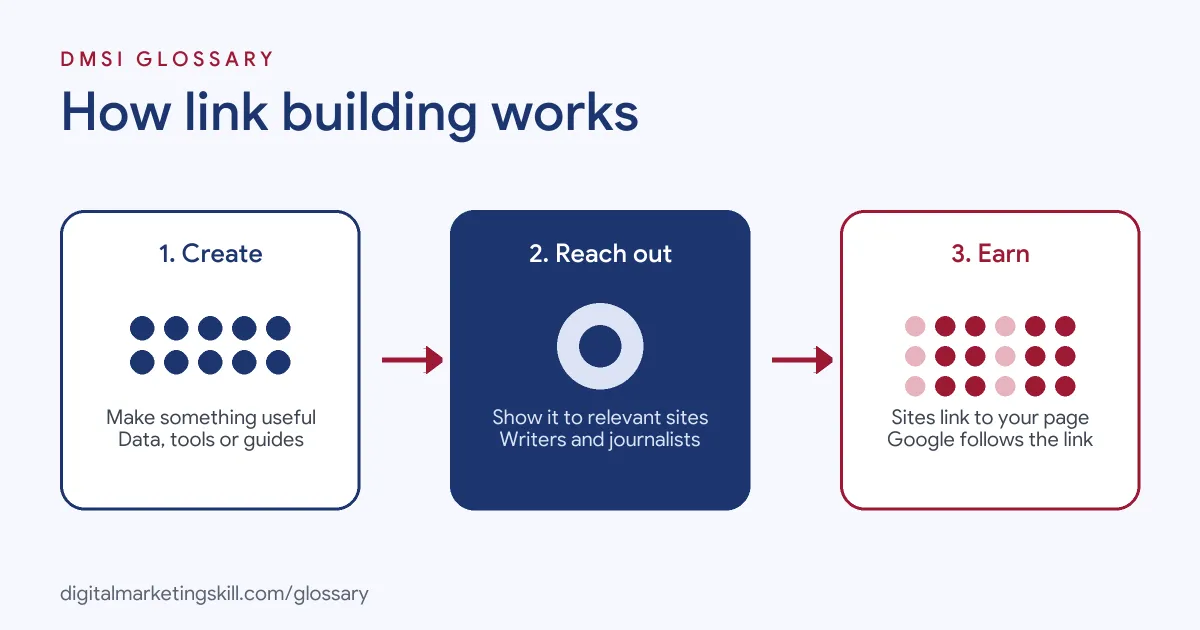
The process usually runs in three steps. First, you create something worth linking to, such as a guide, a tool or original data. Next, you show it to people who run relevant sites. Finally, some of them link to it, and search engines follow those links back to you.
How Google Uses Links
Google explains that some pages are “discovered when Google extracts a link from a known page to a new page.” For example, a category page might link to a new blog post, and Google follows that link. Links from other websites work the same way, so a new page with no links pointing to it is harder to find.
What Makes a Good Link
Not all links count equally. A link from a respected site in your field usually helps more than a link from an unrelated directory. SEO tools reflect this too. For instance, Ahrefs says a link from a site that links to only a few domains can influence its Domain Rating more than a link from a site that links to thousands. Moz makes a similar point, as its scores weigh the number of different linking domains as well as the quality of each link.
Link Attributes
Google asks site owners to label some links. Use rel=”sponsored” for “advertisements or paid placements”. For user-generated content, such as comments and forum posts, Google recommends rel=”ugc”. Use rel=”nofollow” when the others don’t apply and you’d rather Google not associate your site with the linked page. Google notes that nofollow is still an acceptable way to flag paid links, though sponsored is preferred.
Link Building Examples
These made-up examples show common, safe approaches:
- Original data: A recruitment firm surveys 500 local employers and publishes the results. Trade blogs and news sites link to the report as a source.
- Useful tool: A mortgage broker builds a free calculator. Personal finance bloggers link to it because it helps their readers.
- Expert quotes: A nutritionist answers journalist requests. When articles quote her, many include a link to her website.
In each case, the link exists because the content helps someone else’s readers. That’s what makes it last. None of these tactics needs payment, and none of them breaks Google’s rules. They do take time, though, so plan for months of steady effort rather than a quick win.
Safe vs Risky Link Building Tactics
Here is a quick guide to which tactics fit Google’s rules:
| Tactic | Risk level | Why |
|---|---|---|
| Digital PR and original research | Low | Sites link because the content is genuinely useful |
| Outreach to relevant sites | Low | Fine when the site owner chooses freely whether to link |
| Guest posts with keyword-stuffed links | High | Google lists optimised anchor text in guest posts as link spam |
| Buying links that pass ranking credit | High | Google lists this as link spam unless you mark the link as sponsored |
| Low-quality directories and bookmark sites | High | Google names these as examples of link spam |
In short, if a link only exists to move rankings, it is a risk. If it exists to help readers, it is usually safe.
How to Start Link Building
Follow these steps to build links the safe way:
- Check your current backlinks with a tool such as Moz Link Explorer or Google Search Console.
- Look at which sites link to your competitors. These are likely to be relevant to you too.
- Create one strong linkable asset, such as a data study, a free tool or a complete guide.
- Make a list of relevant sites, writers and journalists who cover your topic.
- Send short, personal emails that explain why your content helps their readers.
- Track the links you earn, and note which kind of content attracts the most.
- Repeat with new content. It works best as a steady habit, not a one-off push.
Don’t forget your own site, either. Internal links from your strongest pages help new pages get found faster. For example, when you publish a new guide, link to it from two or three related posts that already get traffic. That way, both readers and search engines reach it sooner.
Best Practices for Link Building
- Focus on relevance. A link from a site your customers actually read is worth more than a random high-score domain.
- Promote widely. Google lists social media, community engagement, advertising and word of mouth as ways to promote a site.
- Mark paid links. Google says buying links for ads or sponsorship is fine if you qualify them with rel=”nofollow” or rel=”sponsored”.
- Vary your anchor text. Natural links use different wording, including your brand name.
- Measure results. Track referral traffic and rankings, not just the number of links.
Common Mistakes to Avoid
Beginners often make the same errors. First, they buy cheap link packages, which Google treats as link spam. Second, they use automated programs to create links, which Google also lists as spam. Third, they swap links with any site that asks. Finally, they chase scores such as DA instead of real traffic and rankings. Slow, steady work on useful content avoids all four problems.
Where You’ll Use Link Building at Work
Earning links is a core skill in many SEO roles. For example, remote job listings mention:
- “Proven ability to acquire high-quality organic backlinks through guest posts, link insertions, etc.” (SEO Specialist).
- “This is a link building-first role.” The same listing asks for “a proven track record of acquiring high-authority backlinks through outreach” (SEO Specialist).
- Candidates with “a deep understanding of SEO best practices, including keyword research, on-page optimization, and link building” (SEO Specialist).
So if you want to work as an SEO Specialist or Website Manager, employers will expect you to plan outreach, earn links and report on what they did for rankings.
Learn It in the WordPress and SEO Track
You can learn link building in the AI-Powered WordPress and SEO Specialist track. There, you build a WordPress site or store and rank it with an SEO content plan. You also work on a U.S. Project Internship from day one, with unlimited 1-on-1 mentoring.
Ready to go deeper? Read our data-backed guide on how to build backlinks, then learn how to prove the value of your work with link building analytics.
Frequently Asked Questions
What is link building in simple terms?
It is the work of getting other websites to link to yours. Those links help search engines find your pages and signal that others value them.
Is link building still important?
Yes. Google still says it primarily finds pages through links. However, quality and relevance matter far more than the number of links.
Is buying backlinks allowed?
Not for rankings. Google treats paid links that pass ranking credit as link spam. Paid links for ads are fine if you mark them as sponsored or nofollow.
How long does link building take to work?
It usually takes months. Links build up slowly, and search engines need time to find and process them.
What is the difference between link building and backlinks?
A backlink is a single link from another site to yours. Link building is the ongoing process of earning those links.
Sources: Google Search Central: Spam policies; Google Search Central: Qualify your outbound links; Google Search Central: SEO Starter Guide; Moz: Domain Authority; Ahrefs Help Center: What is Domain Rating; remote job listings on Himalayas.