
People Also Ask is a Google search feature that shows a box of related questions, each of which expands to reveal a short answer taken from a web page. Google calls it the related questions group and describes it as “a cluster of questions that are related to what the user initially searched for.” It matters because each answer links to a page, so it gives sites another way to appear near the top of results.
Key Takeaways
- People Also Ask (PAA) shows questions related to the original search.
- When someone expands a question, Google says “they’re shown a featured snippet” from a web page.
- Google chooses the questions and answers automatically. You can’t request a place.
- Clear, question-led headings with short, direct answers give pages their best chance.
- The questions are also a free source of content ideas and keyword research.
What Is People Also Ask?
Search for almost any question on Google, and you’ll often see a box titled “People also ask” a little way down the page. It lists a few related questions. Tap one, and it opens to show a short answer, the source page and a link.
Google’s documentation calls this feature the “related questions group, also called People Also Ask.” It describes it as “a cluster of questions that are related to what the user initially searched for.” In other words, it helps people explore a topic beyond their first question.
Each expanded answer works like a small featured snippet. Google’s featured snippets documentation confirms that snippets can “appear in a ‘People Also Ask’ group.” So the same skills that win featured snippets also help with PAA.
For marketers, the box is useful in two ways. First, it’s a place where your page can appear. Second, it shows the real questions people ask around a topic, which is valuable for search intent research.
How People Also Ask Works
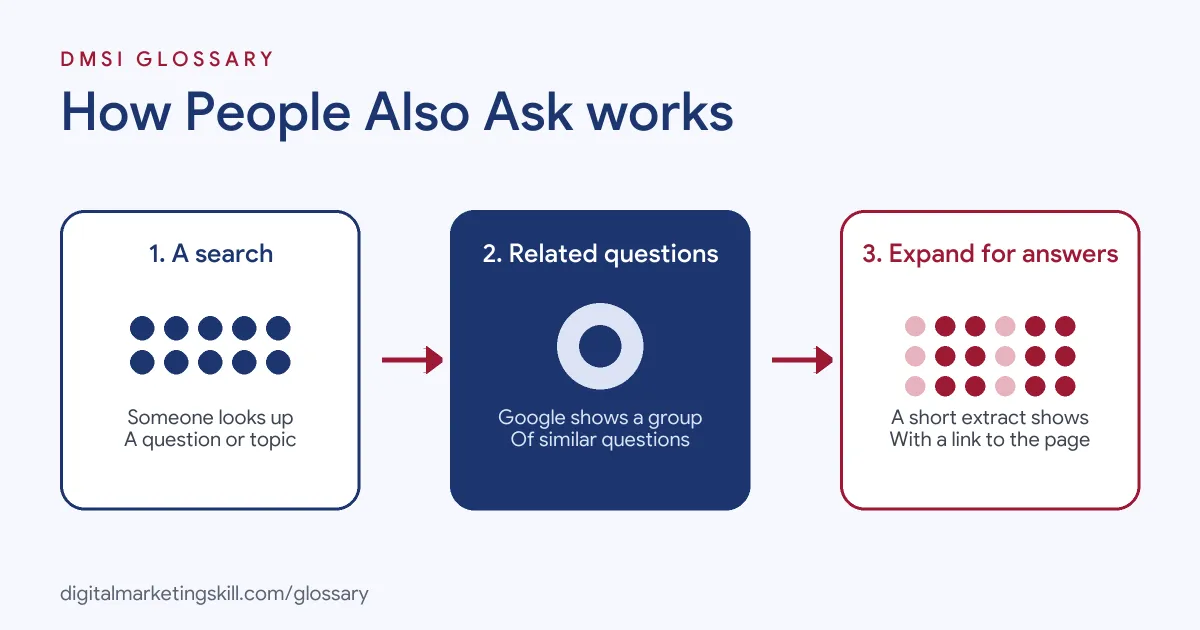
The feature works in three stages. First, someone searches a question or topic. Next, Google shows a group of related questions. Finally, when the person expands a question, Google shows a short answer from a chosen page, with a link to it.
How Answers Are Chosen
Google picks the answers automatically. Its featured snippets documentation says “Google systems determine whether a page would make a good featured snippet” for a search. It also says you can’t mark a page for this. When it asks how to do so, the answer is: “You can’t.”
Quality matters too. Google’s blog explains that “a single featured snippet isn’t right for every question,” and that it may not show one when content seems low quality. So the most reliable answers tend to come from clear, trustworthy pages.
How the Questions Change
The questions aren’t fixed. They depend on the search and often shift as people explore. For example, a search for “email marketing” might show questions about cost, tools and how to start. A search for “email marketing for small business” might show different ones. That’s why it helps to check the box for several related searches, not just one.
Controls for Site Owners
Because PAA answers are snippets, the same controls apply. Google says the nosnippet rule blocks “all snippets (including featured snippets and regular snippets).” You can also exclude parts of a page with data-nosnippet. Most sites, however, want to appear, so they make sure these controls aren’t set by mistake.
Why It Is Worth the Effort
When the box appears, a clear answer can earn a link even when your page doesn’t rank first for the main search, because each expanded answer links to the page behind it. Each question also covers a slightly different need, which gives several sites a chance to appear. Finally, writing these answers usually improves the page for human readers too, because it makes the content easier to scan.
People Also Ask Examples
Here are three made-up examples:
- Accountancy firm: A firm notices “How do I register as self-employed?” in the box. It adds a section with that exact heading and a two-sentence answer. Later, its page appears as the source for that question.
- Pet shop: A shop collects the PAA questions around “puppy food” and turns them into an FAQ on its buying guide.
- Online course provider: A school uses the questions it sees for “learn SEO” to plan five new blog posts.
People Also Ask vs Featured Snippet vs AI Overview
These features sit close together on the results page:
| Feature | What it shows | Where the answer comes from |
|---|---|---|
| People Also Ask | A group of related questions that expand into answers | A short extract from one page per question |
| Featured snippet | One highlighted answer at the top | A short extract from one page |
| AI Overview | An AI-written summary with supporting links | Information drawn from several pages |
In short, PAA is a set of mini snippets for related questions, while an AI summary combines many sources at once.
How to Appear in People Also Ask
- Collect the questions. Search your main topics and note the PAA questions. Then expand a few, because more questions often appear.
- Match them to pages. Decide which page should answer each question, so you don’t create thin duplicate pages.
- Use the question as a heading. Write it in plain words, close to how people ask it.
- Answer straight away. Put a clear one- or two-sentence answer directly under the heading.
- Add detail after. Expand with steps, examples or a short table, so the page is genuinely useful.
- Check snippet settings. Make sure nosnippet or data-nosnippet aren’t blocking your answer.
- Track results. Finally, watch impressions and clicks for those questions in Search Console, and refine answers that don’t appear.
Using PAA for Content Ideas
Even if you never win a place, the box is a useful research tool. The questions show how real people think about a topic. You can use them to plan headings, write FAQ sections and find gaps in your content. For instance, if every search around your product shows a question about returns, your product pages probably need a clear returns section. Many of these questions are also good long-tail keywords.
Best Practices for PAA Answers
- Write for the reader first. A clear answer helps people whether or not Google uses it.
- Keep answers short and complete. One or two sentences should make sense on their own.
- Use the right format. Lists work for steps, tables for comparisons and paragraphs for definitions.
- Group related questions. Answer several on one strong page rather than many thin ones.
- Refresh your answers. Update them when facts, prices or rules change.
Common Mistakes to Avoid
A common mistake is creating a separate page for every question, which spreads your content thin. Another is hiding the answer under a long introduction. Some sites also copy the question but answer a different one. Others stuff FAQ sections with near-identical questions. Lastly, many forget to check the box for related searches, so they miss useful questions.
Where You’ll Use People Also Ask at Work
Job listings usually fold this into “SERP features” work. For example, remote SEO roles ask candidates to:
- “Run content audits, apply intent mapping, and improve CTR and SERP feature capture on your highest-value pages” (SEO Manager).
- Show an “Understanding of technical SEO elements, SERP features, and competitive content analysis” (SEO Content Writer).
- “Conduct content audits, improve SERP feature capture, manage link-building tactics” (Head of SEO).
So if you want to work as an SEO Specialist or Website Manager, you’ll use PAA both as a target and as a research tool.
Learn It in the WordPress and SEO Track
You can practise question-led content in the AI-Powered WordPress and SEO Specialist track. It covers SEO and content marketing, and you build a WordPress site or store and rank it with an SEO content plan. You also get unlimited 1-on-1 mentoring and a U.S. Project Internship from day one.
For more, read our guide to keyword research and our tips on SEO content writing.
Frequently Asked Questions
What is People Also Ask in simple terms?
It is a box in Google results that lists related questions. Each one opens to show a short answer from a web page.
How do I get my page into the box?
You can’t request it. Instead, answer real questions clearly under matching headings, and make sure snippets aren’t blocked.
Is PAA the same as a featured snippet?
They’re closely linked. Google says expanding a related question shows a featured snippet, so each answer works like a small one.
Do I need schema markup for PAA?
No markup can request a place. Clear answers and good page structure matter more.
How can I use PAA for keyword research?
Search your topics, collect the questions in the box and use them to plan headings, FAQs and new articles.
Sources: Google Search Central: Visual elements gallery; Google Search Central: Featured snippets and your website; Google: A reintroduction to featured snippets; remote job listings on Himalayas.