
Ad fatigue is the drop in results that happens when the same people see the same ad too many times. They stop noticing it, scroll past or even get annoyed, so clicks fall and each result costs more. It matters because it quietly drains your budget, often on ads that once worked well.
Key Takeaways
- Ad fatigue sets in when an audience has seen an ad so often that it stops working.
- The usual signs are rising frequency, falling click-through rate and a rising cost per result.
- Meta can flag it in Ads Manager with a “Creative fatigue” or “Creative limited” label.
- Small audiences, big budgets, few placements and too few ads all speed it up.
- The best defence is creative variety, not just swapping one ad for another every few weeks.
What Is Ad Fatigue?
Think about a song you liked on first play. By the twentieth time, you skip it. Ads work the same way. The first few views may catch someone’s eye. After that, each extra view adds less, and at some point it starts to do harm.
You will also hear the term “creative fatigue”. The two mean much the same thing. Creative fatigue puts the focus on the ad itself, while ad fatigue puts it on the audience’s response. Either way, the fix starts with the ads you show.
For example, a café runs one Instagram ad to people within two miles. In the first week, it gets plenty of clicks. By week four, the same few thousand locals have seen it again and again. So clicks dry up, and the cost per visit doubles.
How Ad Fatigue Works
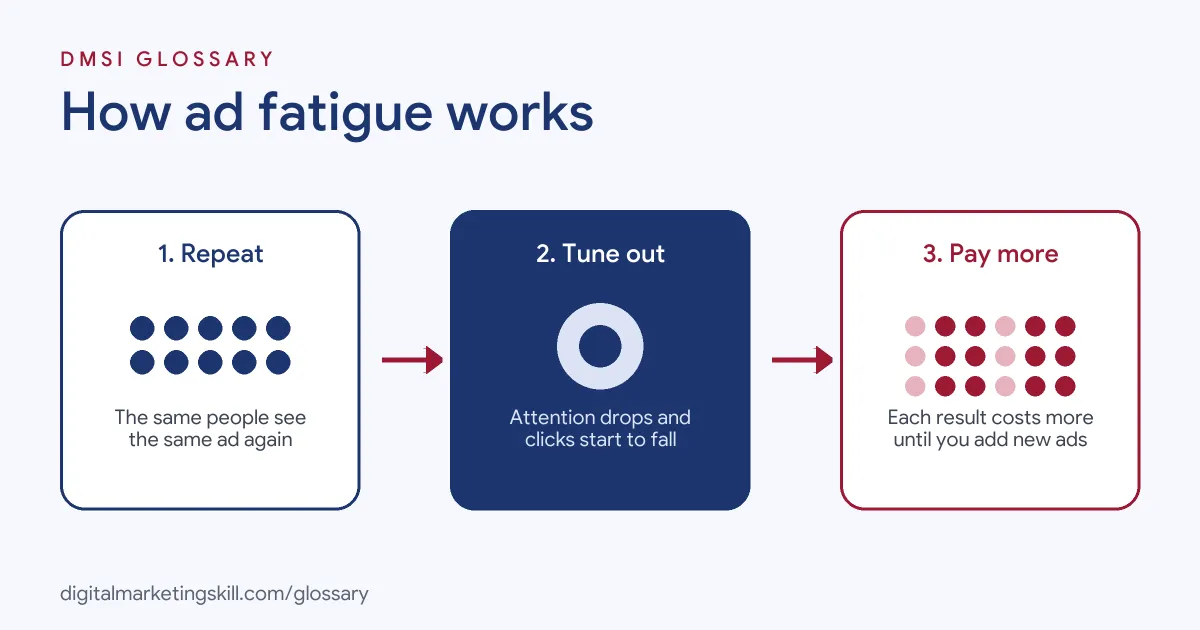
Every audience has a limit. Once your ads have reached most of the people in it, the platform starts showing the same ads to the same people again. As a result, frequency climbs, and response falls.
The Warning Signs
Watch these metrics together, not on their own:
- Frequency: the average number of times each person has seen your ad. A steady rise is the first clue.
- Click-through rate: the share of people who click. It tends to slide as fatigue sets in.
- Cost per result: what you pay for each lead, sale or visit. This is the number that hurts most.
- Negative feedback: hidden ads and critical comments can also rise.
To work out frequency yourself, divide impressions by reach. For example, 30,000 impressions spread across 6,000 people gives a frequency of 5. That means each person saw the ad five times on average, though some saw it far more often and others only once.
How Meta Flags It
Meta sometimes shows a label in the Delivery column of Ads Manager. According to paid social expert Jon Loomer, “Creative fatigue” appears when cost per result is at least twice as high as it has been before. “Creative limited” appears when it is higher than before, but less than double. In other words, Meta warns you when an ad set’s audience has seen your ad too many times and results are slipping.
What Speeds It Up
Loomer lists several causes that often work together. First, a small audience, such as a local area or a short retargeting list. Second, a large budget, which burns through that audience faster. Third, removing placements, so fewer people and fewer ad versions are in play. Finally, running only one ad, or one set of text and images, per ad set.
Ad Fatigue Examples
Here are three made-up examples:
- Retargeting list (example): An online shop shows one discount ad to 3,000 recent visitors with a daily budget of £100. Within ten days, frequency passes 8, and cost per sale has doubled. Adding three new ads with different angles brings costs back down.
- Webinar sign-ups (example): A training firm runs the same video for a month. Click-through rate slips from 1.4% to 0.6%. Then it tests a short testimonial clip and a carousel, and sign-ups recover.
- Local gym (example): A gym targets a three-mile radius and only uses Instagram feed. Because the audience is small and placements are limited, fatigue shows up in the second week.
In each case, the audience did not change. Instead, the ads stayed the same for too long.
Ad Fatigue Tools by Platform
Each major platform gives you a different way to spot or slow fatigue:
| Platform | Tool | What it does |
|---|---|---|
| Meta | Delivery labels and text variations | Flags “Creative fatigue” or “Creative limited”, and lets you add up to five primary text and headline options per ad |
| TikTok | Smart Creative | Mixes assets into many versions, spots tired videos and swaps in new ones |
| Google Ads | Frequency capping | Limits how often your Display or Video ads appear to the same person per day, week or month |
TikTok’s help centre says Smart Creative watches new videos for three to five days, using no more than 10% of the ad group’s budget. It then pauses videos that show signs of fatigue and puts fresh ones in their place.
How to Spot and Fix Ad Fatigue
Use these steps when results start to slip:
- Add frequency to your report. Show frequency, click-through rate and cost per result side by side.
- Compare with your own past. Look at the same ad set over the last few weeks, not against other brands.
- Check the Delivery column. On Meta, look for a fatigue label on the ad set.
- Add new creative. Bring in new angles, formats and hooks, not just a new colour on the old design.
- Widen the audience. If you can, loosen targeting so more new people see the ads.
- Open up placements. More placements give the platform more people and more ways to show your ad.
- Cap frequency where you can. On Google Display and Video campaigns, set a cap that suits your goal.
Best Practices to Prevent Ad Fatigue
Prevention costs less than a rescue. So build these habits in from the start:
- Run several ads per ad set. Loomer argues that many ads working together beat a single “winning ad”.
- Use every text slot. On Meta, you can add up to five primary text and five headline options.
- Mix formats. Rotate images, short videos, carousels and user-generated clips.
- Plan a creative pipeline. Keep new ideas ready before you need them.
- Match budget to audience size. A small list can’t absorb a large daily spend for long.
Common Mistakes to Avoid
First, many advertisers pause a whole campaign when one ad tires, which resets learning. Second, they judge fatigue on frequency alone, even when sales are still strong. Third, they “refresh” by changing tiny details that viewers won’t notice. Finally, they assume every ad must be replaced on a fixed timetable. Loomer notes that with enough variety, some ads can run for months without fatigue.
Where You’ll Use Ad Fatigue at Work
We didn’t find current remote listings that name this term directly. Even so, managing it is part of daily life in paid social roles. As a Paid Social Specialist, you will watch frequency and costs each week and tell the team when ads need replacing. As a Content Creator, you will make the steady stream of new ads that keeps fatigue away. And as a Social Media Manager, you will plan budgets and calendars that leave room for testing. Above all, employers want people who can read the numbers and act before results fall.
It also connects closely to your ad creative, since fresh ideas are the main cure.
Learn It in the Social Media Track
You can learn to spot and fix ad fatigue in the AI-Powered Social Media Management and Advertising track. There, you study content creation for graphics and video, then plan, create and run a paid social campaign for a real brand. You also get unlimited 1-on-1 mentoring and a U.S. Project Internship from day one.
For more ideas on keeping campaigns fresh, read our guide to social media advertising strategy.
Frequently Asked Questions
What is ad fatigue in simple terms?
It is what happens when people see the same ad so often that they stop responding. As a result, clicks fall and costs rise.
What frequency causes ad fatigue?
There is no single number. It depends on your audience size, budget, format and offer. So watch for frequency rising while cost per result also rises.
Is creative fatigue the same as ad fatigue?
Mostly, yes. Both describe falling results from repeated views. Meta uses “creative fatigue” as a label in Ads Manager.
How often should you refresh ads?
There is no fixed rule. Instead, refresh when the data shows fatigue, and keep several varied ads live so each one lasts longer.
Can a frequency cap stop ad fatigue?
It can slow it down. Google Ads lets you cap how often Display and Video ads reach the same person. However, fresh creative is still the main fix.
Sources: Jon Loomer: Creative fatigue on Meta; TikTok Ads Help: About Smart Creative; Google Ads Help: Frequency capping.