toc items: 20
Picking a platform by habit is the most common paid social mistake. A sound social media advertising strategy starts with where your buyers already pay attention, not where competitors spend. This guide shows how to choose, test, and measure that choice with real numbers.
Key Takeaways
- Meta’s family of apps reaches roughly 3.60 billion people a day, the largest base of any ad platform. That is why it is often the default starting point.
- LinkedIn’s advertising audience grew 17.1% in a year to 1.20 billion members, faster growth than most larger platforms.
- TikTok’s ad audience sits near 1.59 billion, but growth has slowed to about 2% a year. Reach alone no longer explains its pull.
- Mobile devices drive about 59% of web traffic. A social media advertising strategy that is not mobile-first optimises for the smaller slice.
- Across roughly 500 FMCG campaigns, media’s share of the sales effect rose to 36% from 15%. Platform choice now carries real weight.
In this guide
- Where Most Social Media Advertising Strategy Advice Falls Short
- How Social Media Advertising Actually Works
- What Differs By Platform
- A Social Media Advertising Strategy By Platform
- Meta Social Media Advertising Strategy: Lead With Precise Targeting
- LinkedIn Social Media Advertising Strategy: Lead With Job Title, Not Demographics
- TikTok Social Media Advertising Strategy: Lead With Native Video, Not Ads
- Mobile Social Media Advertising Strategy: Design For the Small Screen First
- Budget Social Media Advertising Strategy: Start Small, Then Scale What Works
- Creative Testing: Let the Platform Tell You What Works
- Mistakes That Quietly Kill a Social Media Advertising Strategy
- How To Measure a Social Media Advertising Strategy
- The One Decision Rule: Match the Platform to the Buying Stage
- What a Working Social Media Advertising Strategy Looks Like
- Frequently Asked Questions About Social Media Advertising Strategy
- Your Next Step With Social Media Advertising Strategy
Where Most Social Media Advertising Strategy Advice Falls Short
Most guides rank platforms by follower count. That ranking answers the wrong question. The right question is which platform’s audience matches your buyer, your price, and your content format.
A low-cost, visual product and a complex service need different platforms. They need different creative and different budgets too. Treating social media advertising as one channel, instead of several with different jobs, is why so many campaigns underperform.
This is not a settled ranking of platforms. It is an informed comparison built from the audience data each platform reports, which can change as fast as the platforms themselves do. Re-check the numbers that matter to your budget before committing to them for the long term.
This guide, from the team at Digital Marketing Skill Institute, is built from platform-reported audience data, not opinion. Platform numbers shift often. Treat every figure here as a comparison point, not a permanent ranking.
The order matters here too. Picking the right platform costs nothing extra. Building the right creative for it costs a few hours. Scaling budget across more platforms costs ongoing spend and ongoing attention. Spend effort in that order, not in the order that feels most exciting.
How Social Media Advertising Actually Works
A social ad platform sells attention at auction. You bid for a placement. The platform scores your ad on relevance and budget, and the highest effective bid wins the slot. Effective bid is not just money; a more relevant ad can beat a higher bid from a less relevant one.
This is why the same budget performs differently on different platforms. It performs differently again on the same platform over time. Relevance depends on audience fit and creative quality, and both change as a platform’s user base shifts.
Most advertisers control only two levers well: who they target and what they show them. A clear plan for what happens after the click matters just as much. A platform can deliver a cheap, relevant click that still goes nowhere without one.
Think of the auction as a relay race, not a single sprint. Targeting hands off to creative. Creative hands off to the landing page. The landing page hands off to the sale. A campaign can win the fastest leg of that race and still lose, if the baton drops on any other leg.
What Differs By Platform
Three platforms cover most paid social budgets: Meta, LinkedIn, and TikTok. Each has a different audience shape and a different job in a campaign.
Meta: Built For Scale and Precise Targeting
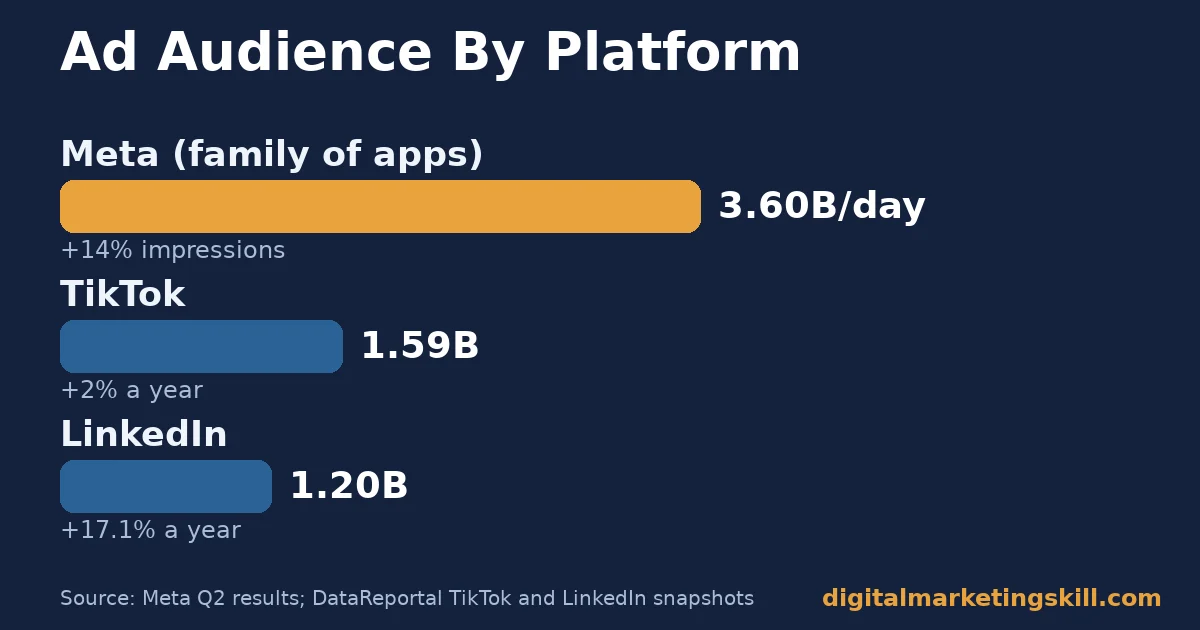
Meta’s family of apps reaches about 3.60 billion people a day, per Meta’s own quarterly results. Ad impressions are up 14% and average price per ad is up 12% year over year. DataReportal’s Facebook snapshot puts ad reach at 2.28 billion, split 43.3% female and 56.7% male. That scale makes Meta the default starting point for most budgets.
LinkedIn: Built For Reaching Decision-Makers
LinkedIn’s ad audience reached 1.20 billion members, per DataReportal’s analysis of the platform’s own ad planning tools, up 17.1% in a year. Its audience skews toward working professionals. That makes it the platform built for B2B offers and higher-priced services, not impulse purchases.
TikTok: Built For Attention, Not Yet Scale
TikTok’s ad audience sits near 1.59 billion, per DataReportal’s platform snapshot, but growth has slowed to about 2% a year. Its strength is not reach. It is attention per impression, because the format rewards native, fast-paced video over polished brand ads.
Choosing Between Them: Start With the Buyer, Not the Platform
Do not ask which platform is best. Ask which platform your specific buyer already uses, and for what. A buyer researching a business tool behaves differently to one scrolling for entertainment between tasks. The platform that matches that behaviour wins, even if it has a smaller total audience than its rivals.
A simple way to check: look at where your current customers already spend time, not where your industry’s largest competitor advertises. A competitor’s platform choice reflects their budget and their buyer, not necessarily yours. Copying it without checking your own audience data is a guess dressed up as a strategy.
A Social Media Advertising Strategy By Platform
Knowing each platform’s shape only helps once you act on it. These moves match the mechanism above to one platform at a time.
Meta Social Media Advertising Strategy: Lead With Precise Targeting
Use Meta’s scale to test multiple audiences cheaply before committing budget. Ad reach skews 56.9% male across the platform family. Check your own audience data before assuming your buyer matches that average.
Pew Research’s social media fact sheet puts Facebook usage by age in the US at 57% among the 65-plus group and 80% among 30 to 49 year olds. Age targeting still needs platform-specific data, not assumptions.
LinkedIn Social Media Advertising Strategy: Lead With Job Title, Not Demographics
LinkedIn’s targeting advantage is professional data: job title, seniority, company size, and industry. Use that instead of age or gender. LinkedIn’s audience is built around work identity, not consumer interest, and it pairs well with organic lead generation on LinkedIn once the paid test proves which message works.
TikTok Social Media Advertising Strategy: Lead With Native Video, Not Ads
Shoot vertical video that looks like the content already on the platform. A polished, static-image-style ad underperforms on TikTok. It reads as an ad, which breaks the native feel that holds attention there.
Mobile Social Media Advertising Strategy: Design For the Small Screen First
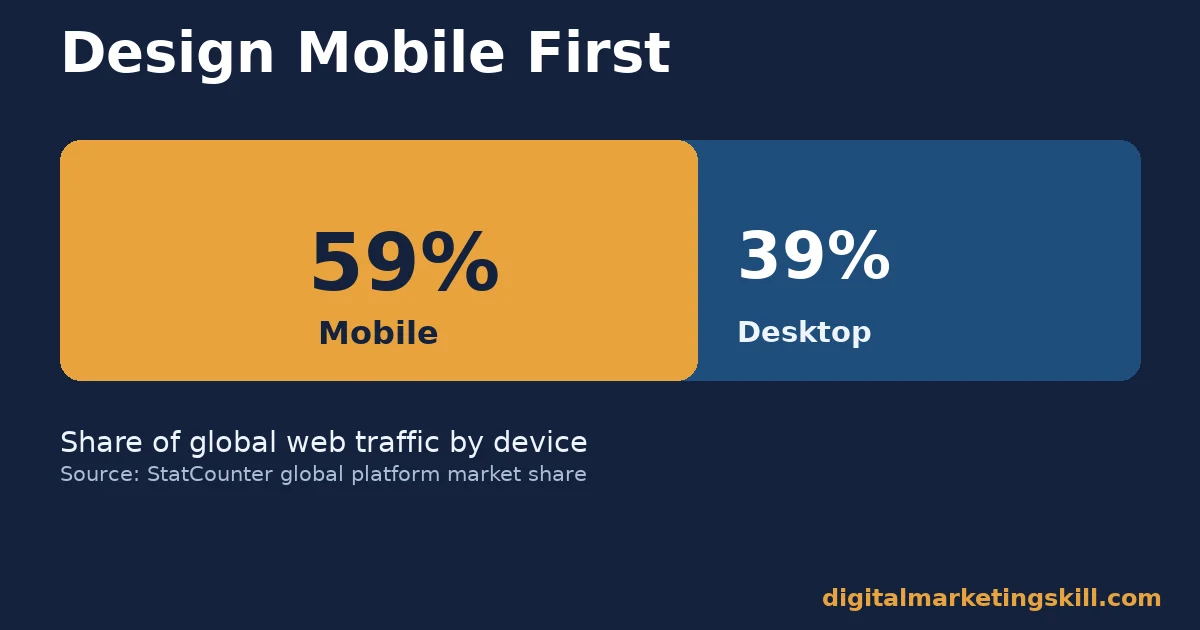
StatCounter’s global platform share data puts mobile at about 59% of web traffic against roughly 39% for desktop. Design the ad and the landing page for a phone screen first. Then check that the desktop version still works, not the other way round. The same logic applies to any page you drive traffic to, including the organic pages you use to increase website traffic alongside paid social.
Budget Social Media Advertising Strategy: Start Small, Then Scale What Works
Do not split a small budget across three platforms on day one. Put it all on one platform first. Give each test enough spend to gather real data before you judge it. Stopping a test after two days rarely tells you anything the platform’s own learning period has not already smoothed over.
A common rule of thumb is to wait until a platform has spent enough to generate at least 50 results, clicks, leads, or sales, before judging its cost per result. Smaller samples swing too much to trust. Once one platform proves itself, move a small slice of budget to a second platform and repeat the test there.
Creative Testing: Let the Platform Tell You What Works
Run at least three creative variants per platform before you judge the platform itself. A weak ad on a strong platform can look like a platform problem when it is really a creative problem, and switching platforms will not fix an ad that was never going to work.
Vary one thing at a time: the headline, the opening frame, or the call to action. Changing everything at once tells you something worked, but not which part did, which leaves you guessing on the next test instead of building on what you learned. Keep the variant that wins, then test a new change against it.
Label every test clearly before you launch it, including the date it started and the one thing you changed. A week later, without that note, it is easy to forget exactly what you were testing and draw the wrong conclusion from the result. A simple spreadsheet row per test is enough; it does not need special software to be useful.
Mistakes That Quietly Kill a Social Media Advertising Strategy
These five mistakes show up across platforms and budgets. Each one caps results no matter how good the targeting is.
- Running the same creative on every platform. A Meta carousel and a TikTok video need different pacing, length, and tone, not one asset resized three ways.
- Ignoring where attention is growing. LinkedIn’s 17.1% yearly growth signals rising reach at a time competitors may still be underpricing it.
- Judging a platform on reach alone. TikTok’s reach growth has slowed, but attention per impression can still outperform a bigger platform.
- Skipping the mobile check. With 59% of traffic on mobile, a desktop-only landing page quietly caps conversion before the ad gets credit or blame.
- Treating platform choice as permanent. Audience shape and pricing shift. A ranking from a year ago is a snapshot, not a rule.
- Judging a test too early. A handful of clicks tells you almost nothing. Wait for enough results before you decide a platform is working or not.
These mistakes compound. A campaign with mismatched creative, a flat budget split, and a desktop-only landing page is not failing at one tactic. It is failing at three at once. Fix them one at a time, starting with creative fit, and measure after each change.
How To Measure a Social Media Advertising Strategy
Four numbers tell you whether a platform choice is working, each defined in one sentence:
- Cost per result: total spend divided by the action you actually want, a click, a lead, or a sale, tracked per platform so one cheap platform cannot hide one expensive one.
- Relevance or quality score: the platform’s own signal of how well your ad matches its audience. It quietly affects how far your budget stretches.
- Return on ad spend: revenue generated divided by spend, the number that decides whether a platform deserves more budget.
- Audience overlap: how much the same people see your ad on more than one platform, which shows whether you reach new buyers or pay twice for the same ones.
Illustrative, invented numbers: imagine splitting a $1,000 monthly budget evenly across three platforms. One platform returns $3 in revenue per $1 spent. Another returns $1.20. Moving $300 from the weaker platform to the stronger one could plausibly add real revenue with no new spend. Treat that as a planning estimate, not a guarantee.
Track these four numbers in one simple sheet, not scattered across each platform’s own dashboard. A side-by-side view is the only way to compare cost per result honestly, since each platform tends to present its own numbers in the most flattering light.
The One Decision Rule: Match the Platform to the Buying Stage
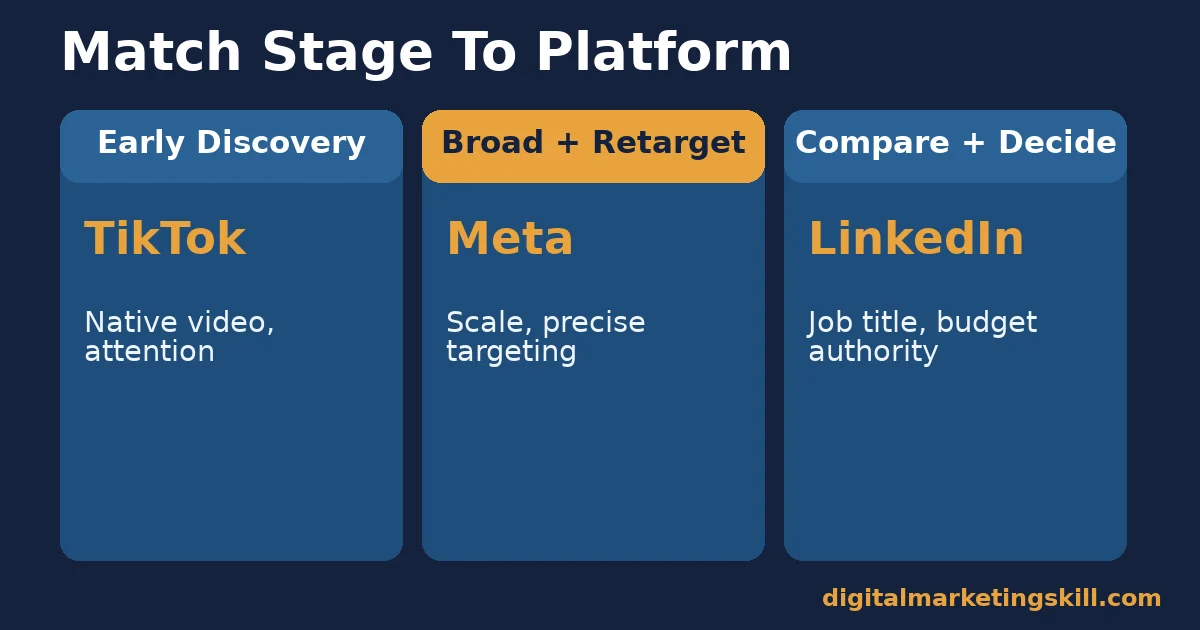
If you only change one thing after reading this, match your first platform to the stage of buying your audience is in. Do not match it to the platform’s total reach. A buyer discovering a problem for the first time responds to different content than one comparing two named options. Showing both groups the same ad wastes the budget spent reaching whichever group it was not built for.
Meta’s scale suits broad discovery and retargeting at every stage, because its tools can narrow a huge audience down to a precise one. LinkedIn suits the comparison and decision stage for B2B buyers, because job title and seniority data reach people with budget authority. TikTok suits early discovery for consumer products, because its format rewards attention over a direct pitch.
This rule outranks a platform’s raw audience size. The biggest audience is wasted on buyers who are not ready for that message yet.
What a Working Social Media Advertising Strategy Looks Like
Across roughly 500 FMCG campaigns spanning TV, digital video, mobile, magazines, and radio, Nielsen found media’s share of the sales effect rose to 36%, up from 15%. The study also found creative was the single most important element in that effect, ahead of the channel it ran on.
The practical read: platform choice matters, but it works alongside the creative shown there, not instead of it. A well-targeted platform with weak creative still underperforms a merely adequate platform with creative built for that specific format. That is also why a solid content marketing foundation makes paid social work harder for the same budget.
The limit on this evidence: the study spans multiple channels, not social platforms alone. Treat the 36% figure as a directional signal about media’s growing weight, not a social-specific benchmark.
The practical version does not need a research team. Keep a simple log of which creative ran on which platform, with the cost per result next to it. After a few months, the pattern of what works where becomes obvious without any special tool.
Honesty matters here too. A result that cannot survive a follow-up question, such as “over what period” or “compared to what,” does more harm than no result at all once someone checks it. Use real figures with real limits stated, or label an illustrative example clearly as invented, as this guide does throughout.
Frequently Asked Questions About Social Media Advertising Strategy
What is the best social media advertising strategy for a small budget?
Start on one platform that matches your buyer’s stage of awareness, not three at once. A small budget split three ways rarely gathers enough data on any one platform to improve.
Which platform has the best social media advertising strategy for B2B?
LinkedIn, because its targeting runs on job title, seniority, and company size rather than consumer interest. That data matches how B2B buying committees actually form.
Should every social media advertising strategy be mobile-first?
Yes. With close to 59% of web traffic on mobile, a desktop-first ad or landing page is optimising for the smaller audience by default.
How often should I review my social media advertising strategy?
Review cost per result and return on ad spend at least monthly. Platform pricing and audience competition shift continuously, not on a fixed yearly cycle. A platform that worked well a few months ago can quietly get more expensive as more advertisers bid for the same audience.
Does a bigger audience always mean a better platform?
No. TikTok’s reach growth has slowed to about 2% a year, yet it can still outperform larger platforms on attention per impression for the right format.
How do I avoid wasting budget across multiple platforms?
Track audience overlap carefully. If the same people see your ad on two platforms, you are often paying twice for one impression instead of reaching new buyers.
What creative works best for social media advertising?
Creative built for the platform’s native format, not one asset resized for every channel. A Nielsen analysis of roughly 500 campaigns found creative was the single most important factor in media effectiveness, ahead of the channel the campaign ran on.
Should I run ads on a platform where my audience overlaps with another?
Only once your top platform is already working well. Overlap is not wasted by default, but it is worth tracking before you add a third platform on top of two that already reach the same people.
How many results do I need before judging a platform?
Aim for at least 50 results, such as clicks, leads, or sales, before you trust the cost per result. Fewer than that, and normal day-to-day variation can make a good platform look bad or a weak one look strong for a week or two.
Should I use the same budget split every month?
No. Move budget toward the platform with the better return on ad spend as the data comes in. A fixed split ignores what the numbers are telling you.
How many creative variants should I test at once?
Three is a reasonable starting number. Fewer gives you too little signal to find a winner. More than five makes each variant too small to judge within a normal budget.
Is organic social media still worth it alongside paid ads?
Yes. Organic content builds the familiarity that makes a paid ad feel recognised rather than unknown, which tends to lower the cost of the paid side over time.
Your Next Step With Social Media Advertising Strategy
Pick one platform that matches your buyer’s stage of awareness. Run a small, honest test for a few weeks before judging it. Measure cost per result and return on ad spend against your own baseline. Then expand to a second platform only once the first one works.
Want a structured path instead of piecing this together alone? The Master Diploma in Digital & AI Marketing at Digital Marketing Skill Institute covers social media advertising and Google specialist skills, alongside lead generation, email automation, and WordPress and SEO. It comes with unlimited 1-on-1 coaching and mentoring, plus real project work inside a US partner company.
The diploma is dual US and UK accredited and recognised in more than 100 countries, delivered 100% online, so you can build these skills anywhere in your country. See full details and apply here, browse more guides on the blog, or read real outcomes on the reviews page first.
Wherever you live, the mechanics stay the same. Match the platform to the buyer. Build creative for that platform. Then measure before you expand.
Every figure in this guide was checked against its original source before publication. Figures marked as illustrative are invented examples, not real results.
![9 Amazing Digital Marketing Skills to Make Money Online [With Proof]](https://digitalmarketingskill.com/wp-content/uploads/2019/07/9-Amazing-Digital-Marketing-Skills-to-Make-Money-Online-With-Proof-17.png)