
A custom audience is a group of people you already know, such as customers, website visitors or app users, that you build inside an ad platform so you can show them ads. You supply the data or the rule, and the platform finds the matching accounts. It matters because these people already know your brand, so they are often the cheapest and quickest people to turn into leads or sales.
Key Takeaways
- You build a custom audience from your own data: a customer list, website or app activity, or engagement with your content.
- Meta requires you to hash customer data with SHA256 before it goes into a customer list.
- TikTok needs at least 1,000 matched users before you can use an audience in an ad group.
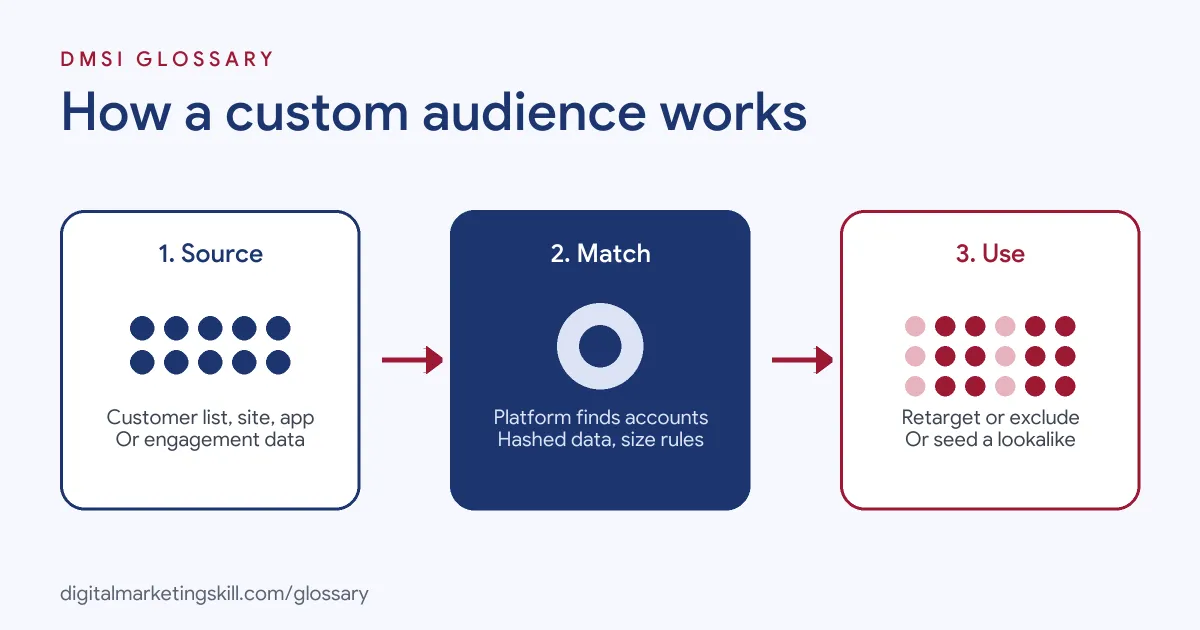
- You can use the same audience three ways: to retarget people, to exclude them, or as the seed for a lookalike.
- Google calls its version Customer Match, and its memberships expire after 540 days.
What Is a Custom Audience?
Most ad targeting is about strangers. You pick an age, a location or an interest, and the platform guesses who fits. This kind of audience works the other way round. You start with people who have already shown up, and you ask the platform to find them again.
For example, an online shop might upload its list of past buyers. Or it might build an audience of everyone who added a product to their basket in the last 30 days but didn’t check out. Then it can show those people a reminder, an offer or a new product.
TikTok puts it simply. It describes custom audiences as a way to “create audiences of known or engaged users”. In other words, these are warm audiences, not cold ones.
How a Custom Audience Works
Every platform follows the same basic pattern. First, you choose a source. Next, the platform matches that source to its own accounts. Finally, it keeps the audience up to date, so you can add it to campaigns as a target or an exclusion.
The Sources You Can Use
Meta’s developer documentation lists several types. These include customer file audiences, website audiences, mobile app audiences, offline audiences and engagement audiences. TikTok offers a similar set, such as customer file, engagement, app activity, website traffic, lead generation and business account audiences.
Website and app audiences rely on tracking. On Meta, that usually means the Meta Pixel or the Conversions API. On TikTok, it means the TikTok Pixel or its own events setup.
How Matching Works
When you upload a customer list, the platform compares it with its own users. Meta’s documentation states, “You must hash data as SHA256; we don’t support other hashing mechanisms.” Hashing turns each email or phone number into a code, so the raw data isn’t sent in plain text.
Not everyone on your list will match. Some people use a different email for their social account, while others don’t have one at all. So a list of 5,000 customers may produce a much smaller audience. Meta’s API also accepts up to 10,000 records per upload request, so large files go up in batches.
Time Windows and Size Rules
Website audiences look back over a set period. Meta’s API lets you choose a retention window of between 1 and 180 days. It also says you can only target an audience once it reaches a certain size. TikTok is more specific: an audience needs 1,000 matched users before you can use it in an ad group.
Custom Audience Examples
- Basket abandoners: A homeware store targets people who added items to their basket in the last 14 days but didn’t buy. It shows them the exact products they left behind.
- Video viewers: A fitness coach builds an engagement audience of people who watched most of a free workout video. Then she offers them a paid programme.
- Customer exclusion: A software company uploads its paying customers and excludes them from sign-up ads. As a result, it stops paying to reach people who have already bought.
Each example uses data the business already owns. That’s what makes this kind of targeting so useful.
Custom Audiences on Meta, TikTok and Google
The idea is the same across platforms, but names and rules differ:
| Platform | Feature name | Key detail |
|---|---|---|
| Meta (Facebook and Instagram) | Custom Audiences | Customer data hashed with SHA256; website audiences look back 1–180 days via the API |
| TikTok | Custom Audiences | At least 1,000 matched users needed to run in an ad group |
| Google Ads | Customer Match | Uses your online and offline data; memberships expire after 540 days |
Google also notes that it won’t use Customer Match lists if you run manual bidding strategies. So check your bidding before you rely on a list there.
How Advantage+ Audience Changes Things
Meta’s Advantage+ audience setting can treat an included custom audience as a suggestion rather than a strict limit. However, Meta’s documentation says custom audience exclusions are not expanded. So if you need to keep certain people out, set them as an exclusion.
How to Create a Custom Audience in Meta Ads Manager
- Open Ads Manager and go to Audiences.
- Select Create audience, then Custom audience.
- Choose a source, such as your website, a customer list, your app or a type of engagement.
- Set the rule. For a website audience, for instance, pick the event and the number of days to look back.
- Name the audience clearly, such as “Website – basket – 14 days”.
- Select Create audience. Then add it to an ad set as a target or an exclusion.
Menu names can change over time, but the steps stay much the same. Before you start, make sure your pixel is firing the right events.
Best Practices for a Custom Audience
- Match the message to the action. Someone who viewed a product needs a different ad from someone who bought it.
- Use short windows for hot audiences. Recent visitors are usually more ready to act than people from months ago.
- Exclude recent buyers. TikTok lists this as a core use, because it cuts wasted spend.
- Refresh customer lists. Meta flags customer file audiences for deletion when no active ad set has used them in over two years. Regular updates keep yours useful.
- Use your best list as a lookalike seed. A list of high-value buyers makes a strong starting point.
Common Mistakes to Avoid
Many beginners make the audience too small, so the ads never deliver. Others forget to exclude people who have already converted. Some upload lists without consent to use the data for advertising, which breaks platform terms. Meta, for example, requires you to accept its Custom Audience Terms. Also, keep an eye on account limits. Meta allows 500 customer file audiences and 10,000 website audiences per ad account, so tidy up old ones. Finally, teams often show the same ad to warm and cold audiences, which wastes the extra context they have.
Where You’ll Use Custom Audiences at Work
Building and testing custom audiences is a daily task in paid social. For example, remote job listings ask for:
- “Hands-on experience building and testing Look-A-Like and Custom audiences, with a clear sense of which source audiences actually scale” (Media Buyer).
- The ability to “Use custom audiences, lookalikes, and interest-based targeting to improve reach and relevance” (Facebook Ads Specialist).
So if you aim to work as a Paid Social Specialist or Social Media Manager, you will need to set up audiences, test them and explain the results.
Learn It in the Social Media Track
You can practise building a custom audience in the AI-Powered Social Media Management and Advertising track. There, you plan, create and run a paid social campaign for a real brand. You also work on a U.S. Project Internship from day one, with unlimited 1-on-1 mentoring.
For more detail, see our guides to Facebook retargeting and Meta Pixel setup. Then learn how to grow beyond warm audiences with a lookalike audience.
Frequently Asked Questions
What is a custom audience in simple terms?
It is a group of people who already know your business, such as customers or site visitors, that you build in an ad platform so you can reach them again.
What is the difference between a custom audience and a lookalike audience?
A custom audience contains people you already know. A lookalike uses that group as a seed to find new people who resemble them.
How big does a custom audience need to be?
It depends on the platform. TikTok needs 1,000 matched users, while Meta says an audience must reach a certain size before you can target it.
Is uploading a customer list safe?
Meta asks you to hash customer data with SHA256 before matching. Even so, you should only upload data you have permission to use for advertising.
Does Google Ads have custom audiences?
Yes, in its own way. Google’s Customer Match lets you upload customer data and reach those people across Search, YouTube, Gmail and more.
Sources: Meta for Developers: Custom Audiences; Meta for Developers: Website Custom Audiences; TikTok Ads Help: Custom Audiences; Google Ads Help: About Customer Match; Meta for Developers: Advantage+ audience; remote job listings on Himalayas.