
Direct response marketing is advertising designed to get people to take a specific action straight away, such as buying, calling or signing up, in a way you can track back to the ad. Every piece carries a clear call to action and a way to measure who responded. It matters because you can see exactly which ads pay for themselves and put more money behind them.
Key Takeaways
- The goal is an immediate, measurable response, not just awareness.
- Every ad needs three parts: a clear offer, a call to action and a way to track the response.
- Tracking can be a unique link, a promo code, a phone number or a conversion tag.
- Most digital ads, from search to email, can work as direct response if you track them.
- It works best alongside brand building, which makes people more likely to respond later.
What Is Direct Response Marketing?
Wikipedia describes it as marketing “designed to generate immediate consumer responses, with each response (and purchase) measurable and attributable to individual advertisements.” In plain terms, you ask people to act now, and you can see which ad made them do it.
The idea is old. Mail-order catalogues, coupons and late-night TV ads with a phone number all used it. Today, the same thinking drives most performance marketing online. A search ad, a lead form on social media or a sales email can all be direct response if they ask for one action and you track the result.
For example, a meal-kit brand might run a video ad with the line “Get 50% off your first box. Use code FRESH50.” Each order that uses the code links back to that ad. As a result, the brand knows how many sales the ad produced and what each one cost.
How Direct Response Marketing Works
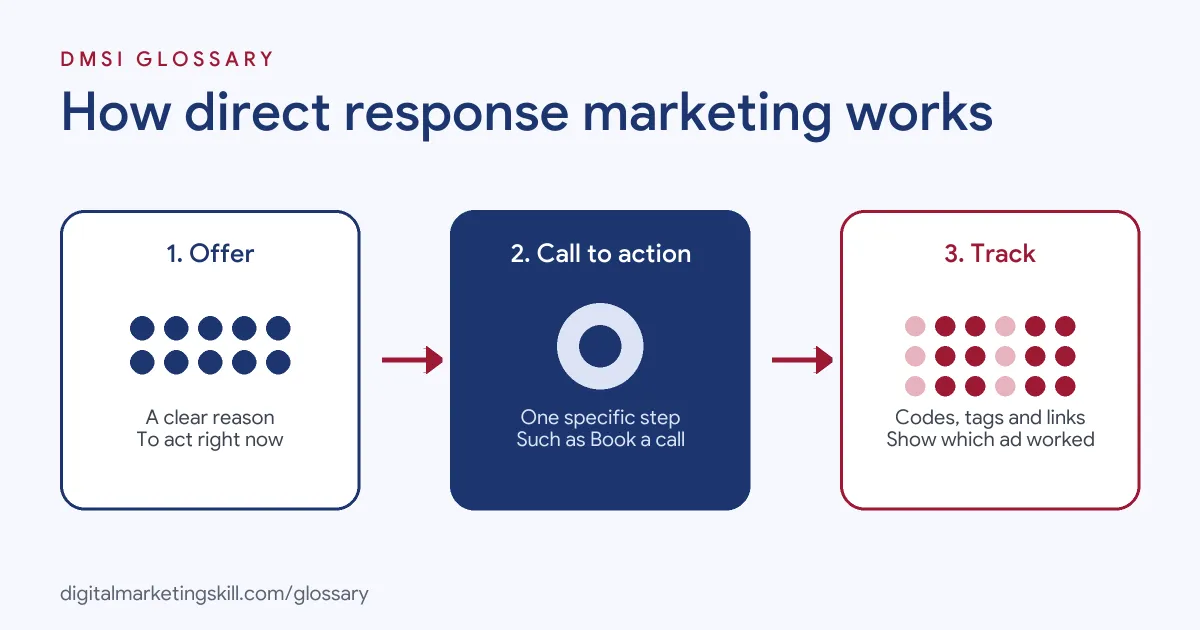
Every campaign rests on three building blocks. First, an offer that gives people a reason to act. Second, a call to action that tells them exactly what to do. Third, a tracking method that records who responded.
The Offer
The offer is what people get for acting. It could be a discount, a free trial, a free guide or a limited bundle. A strong offer is easy to understand in a few seconds and feels worth the effort.
The Call to Action
The call to action, or CTA, names the next step. “Book your free call”, “Download the guide” and “Shop the sale” are all clear CTAs. Vague lines such as “Learn more” often get fewer responses because they don’t promise anything specific.
Tracking in Direct Response Marketing
Tracking is what makes this approach different. On radio, Wikipedia notes, ads often use “a toll-free phone number or a unique Web URL” so results can be counted. Online, you have more options:
- Conversion tracking: In Google Ads, you choose what counts as valuable, “like a purchase, sign-up, or phone call”, and Google records it.
- UTM tags: Google Analytics advises that you “should always use utm_source, utm_medium, and utm_campaign” when you tag a link.
- Promo codes: A unique code per ad or channel shows where each sale came from.
- Offline imports: Google Ads can also import offline conversions, such as sales closed by phone.
Measuring Direct Response Marketing
Once tracking is in place, three simple numbers tell you how an ad is doing:
- Response rate: responses divided by the number of people reached or clicks received.
- Cost per result: what you spent divided by the number of responses.
- Return on ad spend: the revenue from those responses divided by what you spent.
Look at all three together. A cheap lead is no use if it never buys, while a costly one can still be worth it if it turns into a loyal customer.
Direct Response Marketing Examples
Here are three made-up examples across different channels:
- Search ad: A locksmith’s ad reads “Locked Out? Call Now, 30-Min Response”. Google records each call from the ad as a conversion.
- Email: A clothing shop emails “48 hours only: free delivery on everything”. The link carries UTM tags, so sales show up under that email in analytics.
- Social lead ad: A language school offers a free trial lesson through an instant form. Each form submitted is counted against the ad that drove it.
Direct Response Marketing vs Brand Marketing
The two approaches have different jobs. Here is how they compare:
| Feature | Direct response | Brand marketing |
|---|---|---|
| Main goal | An action now, such as a sale or lead | Awareness and long-term preference |
| Call to action | Always clear and specific | Often soft or absent |
| How you measure it | Conversions, cost per result, return on spend | Reach, recall and brand searches |
| Speed of results | Days or weeks | Months or longer |
In practice, you need both. Brand work makes people recognise you. Direct response turns that recognition into sales you can count.
How to Plan a Direct Response Campaign
- Pick one action you want, such as a purchase, a call or a form fill.
- Work out what that action is worth to the business.
- Write an offer that gives people a clear reason to act now.
- Write one strong call to action. Avoid giving people several choices.
- Send traffic to a focused landing page that repeats the offer.
- Set up tracking, such as conversion tags, UTM links or a unique code.
- Launch with two or more versions of the ad or offer.
- Compare cost per result, then move budget to the winners.
A Worked Example
Here is a made-up example with numbers. A business spends £500 on an ad and gets 25 sign-ups for a free trial. That’s £20 per sign-up. If one in five trials becomes a paying customer worth £200, then each £20 sign-up brings in about £40 on average. The ad pays for itself, so the team scales it up and keeps testing new offers.
Best Practices
- Lead with the offer. Make it the first thing people see or hear.
- Use one CTA per ad. One clear step beats three competing ones.
- Match the landing page to the ad. The headline should repeat the promise people clicked on.
- Track everything. If you can’t measure the response, it isn’t direct response.
- Test constantly. Small changes to offers and headlines can shift results.
- Keep claims honest. Urgency must be real, so only use a deadline if it truly ends.
Common Mistakes
Many teams launch ads without tracking, so they can’t tell which ones worked. Others bury the CTA or ask for too many things at once. Some send clicks to a busy home page instead of a focused landing page. Another mistake is judging success on clicks rather than sales or leads. Finally, some brands chase only short-term responses and neglect brand building, so each new customer gets more expensive over time.
Where You’ll Use Direct Response Marketing at Work
Many creative and paid media roles ask for this experience by name. For example, recent remote job listings ask for:
- “2+ years writing direct response video ads for YouTube or Facebook” (Creative Strategist, YouTube Ads).
- “Experience in developing direct response concepts, email marketing, and direct mail” (Copywriter).
- A “Portfolio or reel showing direct-response ads, product-focused edits, and mobile-first social content” (Video Editor).
So whether you aim to be a Digital Marketing Manager, Growth Marketer or Freelance Digital Marketer, expect to write offers, set up tracking and report on cost per result.
Learn It in the Full Stack Track
Direct response runs across every channel, so the best fit is the Full Stack option, which covers all four tracks. You take all ten courses and complete one portfolio project from each track, including a paid social campaign, a Google Ads campaign with conversion tracking and an automated email sequence. You also work on a U.S. Project Internship from day one, with unlimited 1-on-1 mentoring.
Next, read our guides to persuasive email marketing and landing page optimisation. You may also like our glossary entries on copywriting and landing pages.
Frequently Asked Questions
What is direct response marketing in simple terms?
It is advertising that asks people to do one thing now, such as buy or sign up, and tracks who did it so you can measure each ad.
Is direct response the same as performance marketing?
They overlap a lot. Both focus on measurable actions. Performance marketing is the modern, mostly digital version of the same idea.
What makes a good call to action?
It is short, specific and tells people what they get, such as “Get my free guide” rather than “Click here”.
Which channels work for direct response?
Search ads, social ads, email, landing pages, direct mail and even radio or TV can all work, as long as you track the response.
Should a business only use direct response?
Usually not. Brand marketing builds the familiarity that makes people respond. Most businesses get the best results from both.
Sources: Wikipedia: Direct marketing; Google Ads Help: About conversion measurement; Google Analytics Help: URL builders and UTM parameters; remote job listings on Himalayas.