Persuasive email marketing uses a clear promise, concrete proof and one next step to move a reader to open, trust and act. Most marketing emails get read in seconds. Every sentence has to earn the next one.
Key Takeaways
- Personalized subject lines lifted open rates from 35% to 46% in one recent study. Reply rates nearly tripled, from 3% to 7%.
- Open, click and unsubscribe rates differ by list and industry. Compare your own history first, then an outside benchmark.
- The strongest persuasive email marketing pairs one clear promise with one piece of checkable proof. It does not list every feature.
- Scarcity, social proof, authority, liking, reciprocity and consistency are six documented persuasion triggers. Using two well beats stacking all six.
- Cold emails, nurture emails and win-back emails need different proof. The reader’s trust level is different in each case.
In this guide
- The Gap Between A Sent Email And One A Person Reads
- What Makes Persuasive Email Marketing Work
- What Differs By Email Type
- How To Lead With The Right Lever For Each Email Type
- How To Measure Persuasive Email Marketing
- The One Decision Rule For Persuasive Email Marketing
- A Real Case: Proof Beats A Bigger Ask
- Frequently Asked Questions About Persuasive Email Marketing
- Turn Persuasive Email Marketing Into A Full Skill Set
The Gap Between A Sent Email And One A Person Reads
Most inboxes work like a fast triage line. A reader scans the sender name, the subject line and a few words of preview text. Then they decide, in under two seconds, whether to open, skip or delete. Persuasive email marketing closes that gap. It gives the reader a reason to stop scanning.
Set three ground rules first. Persuasion is not manipulation; every claim here has to be true and checkable, or it erodes trust on your next send. Benchmarks below are averages across many senders; your own list’s history is a better baseline. And nothing here guarantees a result, because list quality, offer and timing move the outcome too.
These rules matter more in email than almost anywhere else in marketing, because the same reader opens the same inbox every day. A claim that does not hold up gets noticed fast, and it gets remembered the next time your name shows up in that inbox.
What The Average Inbox Actually Does
One provider’s email marketing benchmarks put the all-industry open rate at 35.63%. Click rate averaged 2.62%, and unsubscribe rate averaged 0.22%. The data covers campaigns sent to lists of 1,000 or more subscribers.
The provider adds a caveat worth repeating. Apple’s Mail Privacy Protection pre-loads images for many readers. That can inflate an open count without a single extra person reading the email. Open rate alone is no longer a safe way to judge a subject line.
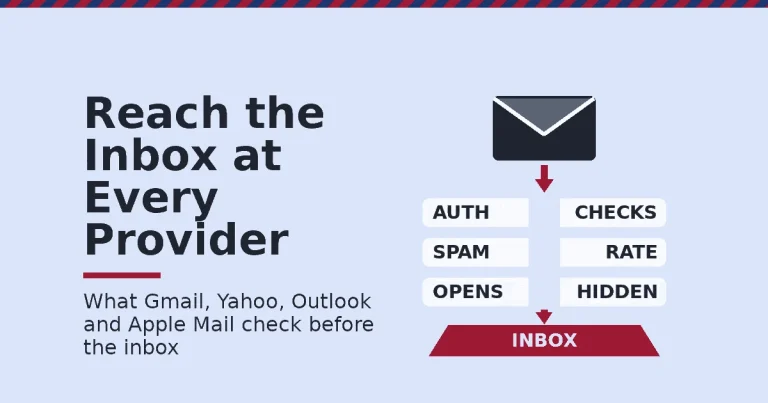
Persuasion also depends on the email reaching the inbox at all. Gmail reports that it blocks more than 99.9% of spam, phishing and malware before a reader sees it. Unauthenticated bulk mail to Gmail addresses fell 75% after it tightened sender rules. A well-written email that lands in spam persuades no one.
US CAN-SPAM rules add a floor under all of this. They require a working opt-out, honoured within 10 business days, and a subject line that is not deceptive. That floor applies no matter how persuasive the copy is.
These two layers, deliverability and copy, get confused when results disappoint. A low open rate can mean a weak subject line. Or it can mean the email never reached the inbox at all. Check authentication and sender reputation before rewriting a subject line a third time.
What Makes Persuasive Email Marketing Work
Psychologist Robert Cialdini catalogued six triggers that make a request easier to agree to, summarised on resources like Vero’s weapons-of-persuasion guide: reciprocity, commitment and consistency, social proof, liking, authority and scarcity. A single persuasive email marketing message often uses several at once: a free resource triggers reciprocity, a client count or review triggers social proof, and a countdown triggers scarcity.
The Four-Part Structure Behind Most Of Them
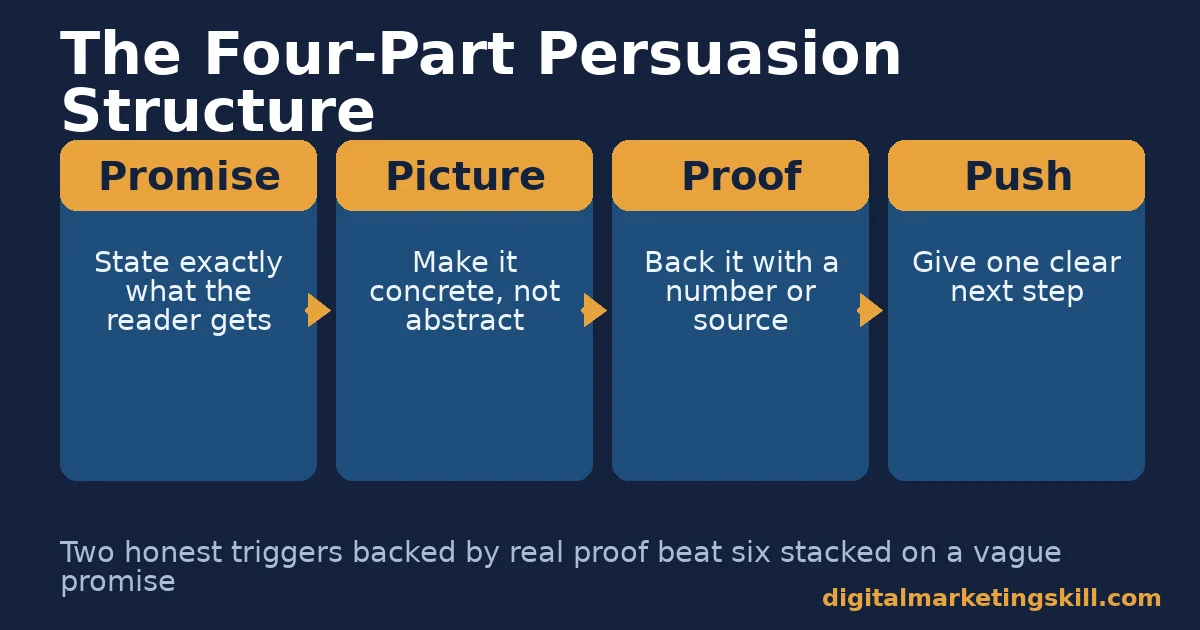
A simpler structure sits underneath most of those triggers: Promise, Picture, Proof, Push. It is easier to apply line by line than the six triggers are.
- Promise states, in the first line, exactly what the reader gets. “Grow your business” promises nothing specific. “Cut your unsubscribe rate below 0.2%” gives the reader something to check later.
- Picture swaps abstract words for concrete ones. “Outstanding results” pictures nothing. “A reply within one business day” pictures something real.
- Proof backs the promise with a number, a named source or a short case. Some readers accept a claim outright; others verify it, or argue with it by default. Proof moves the second group.
- Push gives one next step, not three. A single action-worded link beats a paragraph of options, because hesitation, not disagreement, kills most replies.
Why Social Proof Carries The Clearest Numbers
Social proof has the clearest published numbers of the six triggers. A signup page that states a specific user count is one of the most copied formats in marketing. The number is concrete and checkable, which is exactly what Promise, Picture and Proof all ask for.
Reciprocity and authority work the same way when they stay concrete. Giving away a genuinely useful template, before asking for anything, uses reciprocity. Naming the specific source of a statistic, instead of writing “studies show,” uses authority.
Both triggers fail the moment they turn vague. A free resource nobody opens builds no debt. An unnamed “expert” convinces no skeptical reader. And stacking all six triggers into one email reads as pressure, which makes a careful reader stop and re-read your claims instead of acting on them. Two honest triggers, backed by real proof, beat six stacked on a vague promise.
What Differs By Email Type
The same four-part structure needs a different lever depending on how much the reader trusts you already. A cold email, a nurture email and a win-back email are solving three different trust problems, not one.
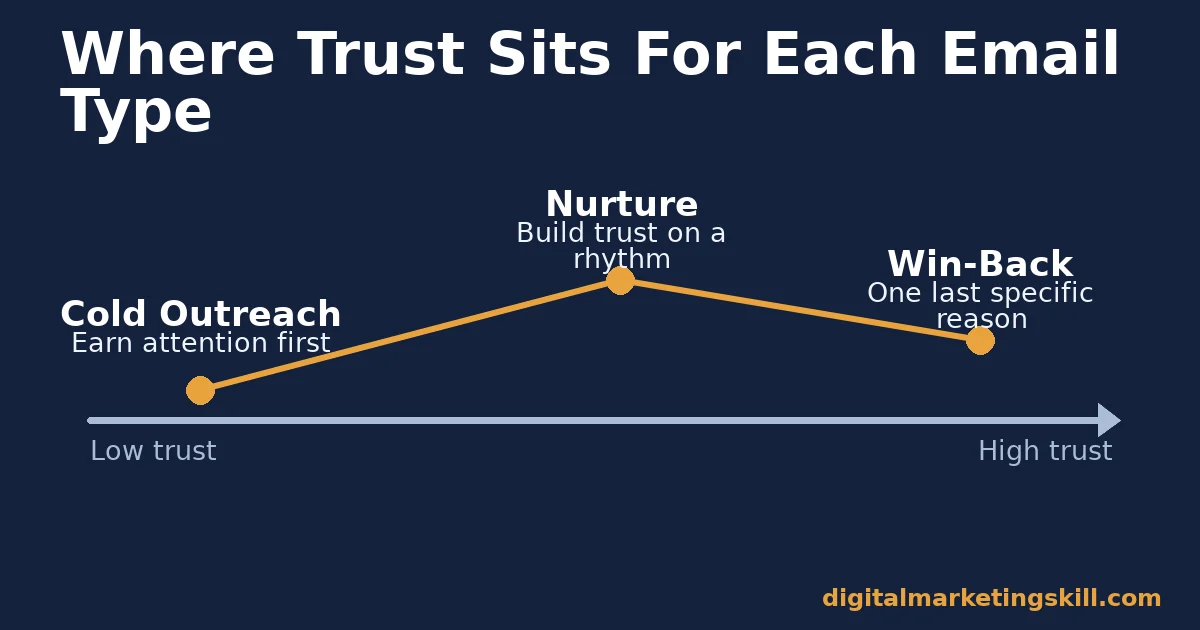
Picture trust as a line. It starts near zero for a stranger. It climbs slowly through a handful of opened, useful emails. Then it either plateaus into a relationship, or drops back toward zero after a run of unopened sends. Each email type below sits at a different point on that line.
Cold Outreach Emails: Built For Attention, Not Trust
A cold email reaches someone who has never heard of you. Its only job is to earn one more sentence of attention. It cannot ask for trust it has not yet built.
Personalization is the biggest lever here. It signals the message was not blasted to ten thousand strangers. An analysis of 5.5 million emails found personalized subject lines reached a 46% open rate against 35% for generic ones. Reply rates went from 3% to 7% over the same stretch.
Build the rest of the cold email marketing sequence around that same specific, checkable promise.
Lifecycle Nurture Emails: Built For Trust, Not Urgency
A nurture email reaches someone who already opted in. The trust problem is different here: they are deciding whether you keep the promise you made at signup.
Pushing urgency this early reads as a mismatch, because nothing urgent has happened yet from the reader’s side. A reader who feels rushed before they trust you tends to unsubscribe rather than negotiate. The job of a nurture email is simple: one useful idea, one short example, one plain next step, on a predictable rhythm.
Win-Back Emails: Built For One Last Decision
A win-back email reaches someone who opted in, then stopped opening. They are not undecided. They already decided your emails were not worth the space, so a generic “we miss you” gets ignored again.
This email needs a reason that is new, specific and time-bound. Because this reader has already shown you how little patience they have, the promise in a win-back email has to be the strongest one in the whole sequence, not the weakest.
How To Lead With The Right Lever For Each Email Type
Once the trust problem is named, the fix for each email type follows directly from it.
Cold Outreach Emails: Lead With A Specific, Checkable Promise
Replace broad claims with one number the reader could verify. “I help businesses grow” promises nothing checkable. “I cut a client’s unsubscribe rate in half within one quarter” gives the reader a fact they could ask to see.
Keep the subject line to a question, or a two-to-four-word fragment that names the recipient’s situation. Short, curiosity-led subject lines outperform long descriptive ones in most published tests. Personalize the first line of the body too, not only the subject. The same habits belong in any outbound email marketing checklist, alongside the copywriting skills that hold the rest of the message together.
Lifecycle Nurture Emails: Lead With Proof, Not More Promises
Spend the early nurture emails proving the first promise before you make a second one. A short case, a before-and-after number or a direct customer quote does more here than a new offer. The reader is still checking whether the first promise was true.
Hold urgency and scarcity back until the relationship has earned a few opens. Introducing them too early, on a list where many readers have not opened a single email yet, simply gets ignored. Once a few proof-led emails land, a single clear ask converts better than it would have on email one.
Win-Back Emails: Lead With Scarcity You Can Actually Honor
A real deadline, or a real removal from the list, works because it is checkable: the reader can watch it happen. A fake countdown that resets next week is the fastest way to lose a reader for good.
State plainly what happens if they do nothing, such as being moved to a lower-frequency list. Then give one easy action to stay. Pair that honest deadline with the single strongest piece of proof you saved for this exact moment.
How To Measure Persuasive Email Marketing
Three numbers tell you whether the copy, not just the offer, is doing its job.
- Open rate is opens divided by emails delivered. It mainly reflects the sender name and subject line. Privacy features that pre-load images can inflate it, so treat a sudden jump with caution. A deeper walkthrough of email open rates covers the other variables worth testing.
- Click or reply rate is clicks, or replies for cold outreach, divided by emails delivered. This number sits closest to persuasion itself. It requires the reader to act on the Push, not just glance at the Promise.
- Unsubscribe rate is unsubscribes divided by emails delivered. A rising unsubscribe rate next to a rising click rate usually means the copy is persuading the wrong audience. That split matters more than either number alone.
Reading The Three Numbers Together
Compare each number against your own list’s recent history first. An all-industry average open rate near 35%, and click rate near 2.6%, is only a rough outside reference point. List size, industry and send frequency all move these numbers on their own.
Track the three numbers together, not in isolation, for a true read on persuasive email marketing. A send that raises clicks while holding unsubscribes flat is doing real persuasive work. A send that raises clicks while unsubscribes also climb is usually just pushing harder on the same audience, not writing better copy.
The One Decision Rule For Persuasive Email Marketing
If your reader has not opened three emails from you yet, lead with proof. If they have opened three or more, lead with a specific ask. Before that third open, they are still deciding whether to trust you at all. A case, a number or a named source does more work than a call to action.
After the third open, trust already exists. Holding back the ask at that point wastes attention you already earned. This single rule covers most of what persuasive email marketing gets wrong in practice: asking too early, or staying too cautious too long.
A Worked Example Of The Rule
Illustrative, invented numbers: picture two versions of one nurture email sent to 10,000 new subscribers. The proof-led version leads with a specific proof point and a soft link. The pushier version leads with a bold call-to-action button and no proof.
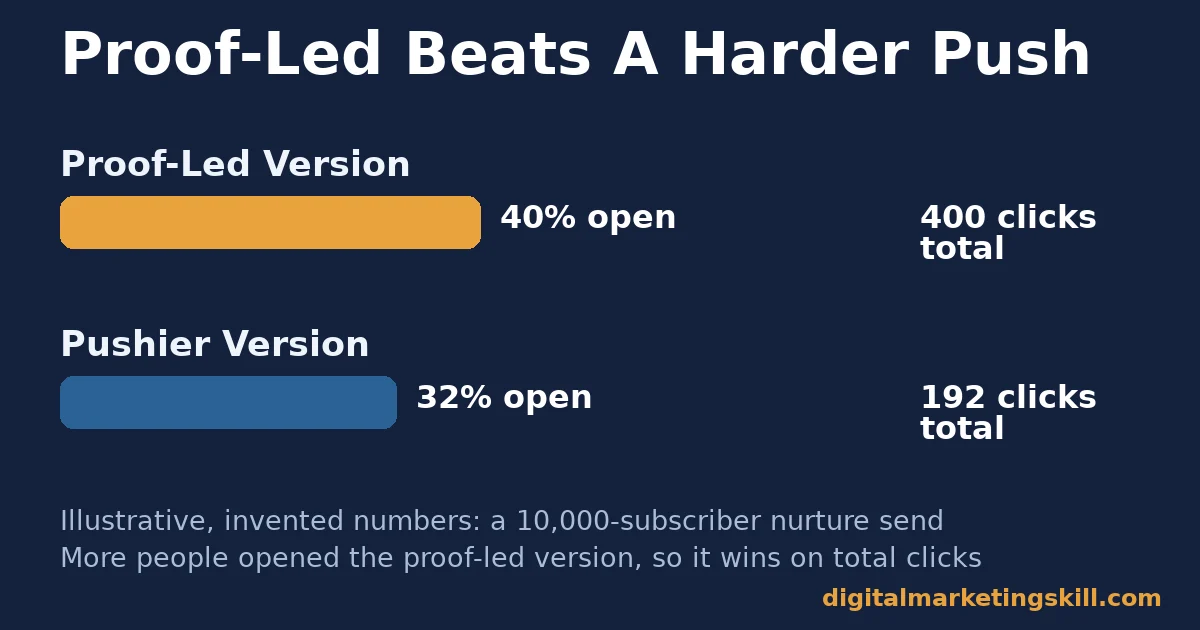
Version A, the proof-led one, reaches a 40% open rate and a 4% click rate, producing 400 clicks. Its subject line signalled a harder sell, so Version B reaches only a 32% open rate, but earns a 6% click rate among openers, for 192 clicks. The proof-first version still wins on total clicks, even with a lower per-open rate, because more people chose to open it.
The same rule explains a string of unopened emails. If three in a row go unopened, the fix is not a fourth email that pushes harder. It is a different subject line, leading with a new piece of proof.
The reader already told you the current promise is not landing. This is the quiet part of persuasive email marketing that copy alone cannot fix: listening to what silence tells you, not just what a reply does.
A Real Case: Proof Beats A Bigger Ask
Digital Marketing Skill Institute graduate Olajire Jacob moved into digital marketing from a background in pharmacy. The Institute’s published reviews page describes Jacob charging $500 to set up email marketing flows for clients in the US, UK and Canada, then scaling that work to around $5,000 a month.
The dollar figure is one person’s self-reported result, not a guarantee for any reader. What made the service sellable matters more than the number itself: a specific, checkable deliverable, a working flow a client could see run, rather than a vague promise of “better email marketing.” That is the Promise-Proof pairing, applied to a real transaction rather than a single email.
Limits: this is one published account, not an independent study. Results like it are not typical for every person or market. See the Institute’s earnings disclaimer before treating any income figure as a target.
Frequently Asked Questions About Persuasive Email Marketing
Is persuasive email marketing the same as manipulative marketing?
No. Persuasive email marketing uses true, checkable claims to help a reader decide faster. Manipulation relies on claims the reader cannot verify, or claims that turn out false. A fake countdown or an invented client count is manipulation. It tends to backfire through higher unsubscribe rates once readers notice.
What is the single highest-impact fix for a weak subject line?
Personalizing it. One recent analysis of 5.5 million emails found personalized subject lines reached a 46% open rate against 35% for generic ones. Replies nearly tripled, from 3% to 7%. Start with the recipient’s name, or a detail specific to their situation.
How long should a persuasive marketing email be?
Long enough to deliver one Promise and one piece of Proof, and no longer. A cold email usually needs three to five short paragraphs. A nurture email can run longer, but only if each added paragraph adds new proof instead of repeating the same promise.
Which persuasion trigger should a beginner start with?
Social proof and reciprocity are the easiest to use honestly. Most businesses already have a real review, a real number or a free resource to offer before asking for anything back. Scarcity should come last; it only works once trust and a real constraint both exist.
Does a stronger call-to-action button always get more clicks?
Not by itself. A harder sell with no proof can lower open rates, because readers sense the tone from the subject line before they open the email. The decision rule in this guide, leading with proof before the third open, answers this directly.
How often should a win-back email be sent before giving up?
Most lists see diminishing returns after two or three attempts, spaced a few weeks apart. Each attempt needs a different, specific reason to return, not a repeat of the same message. If none of them earns an open, move that contact to a lower-frequency list.
Sending a fourth or fifth attempt to a contact who has ignored three rarely helps your numbers. It can quietly damage sender reputation for every other email you send on the same list.
Can persuasive email marketing work without any design or images?
Yes. A plain-text-style email, with a clear Promise and real Proof, regularly outperforms a heavily designed one. It reads like a message from a person, not a broadcast. Save design effort for the rare email where a chart is the Proof itself, not decoration.
What is the fastest way to test persuasive email marketing copy?
Split your next send into two equal halves and change only one variable: the subject line, or the opening Promise, or the single Push at the end. Keep everything else identical. Testing one variable at a time is slower than changing the whole email, but it tells you which specific lever moved the open or click rate, which a full rewrite never does.
Should persuasive email marketing sound different for B2B and B2C readers?
The four-part structure stays the same either way, but the proof changes. A B2B reader usually wants a named case, a metric or a process they can repeat. A B2C reader often responds faster to a short story, a specific customer quote or a visible deadline. Match the proof to what the reader already trusts, not to a template built for the other audience.
Turn Persuasive Email Marketing Into A Full Skill Set
Writing one good email is a start. Building copy, automation and measurement into a repeatable system is a different skill, and you can build it anywhere in your country.
Digital Marketing Skill Institute’s Master Diploma in Digital & AI Marketing covers nine practical courses, including email and lead generation. It comes with unlimited one-on-one coaching and mentoring, plus real project work inside a US company. The program is dual US and UK accredited, recognised in more than 100 countries, and delivered 100% online, wherever you live.
Explore the Master Diploma in Digital & AI Marketing on digitalmarketingskill.com, read real outcomes on the reviews page, or browse more guides on the digital marketing blog. When you’re ready, go straight to apply and start building this skill set from wherever you are in your country. digitalmarketingskill.com walks you through every course in the program.
Every figure in this guide was checked against its original source before publication. Figures marked as illustrative are invented examples, not real results.
![9 Amazing Digital Marketing Skills to Make Money Online [With Proof]](https://digitalmarketingskill.com/wp-content/uploads/2019/07/9-Amazing-Digital-Marketing-Skills-to-Make-Money-Online-With-Proof-17.png)