
Word-of-mouth marketing is any effort to get people talking about your product or brand to friends, family, colleagues and followers, in person or online. Instead of the brand doing all the talking, customers pass on their own opinions, which others often trust more than an advert. It matters because research from McKinsey found that word of mouth is the main factor behind 20 to 50 percent of all purchasing decisions.
Key Takeaways
- Word-of-mouth marketing means giving people good reasons and easy ways to recommend you.
- McKinsey describes three types: experiential, consequential and intentional. Experiential word of mouth usually makes up 50 to 80 percent of the activity in a product category.
- What people say matters most. McKinsey calls it “the primary driver of word-of-mouth impact.”
- Who says it matters too. A message from a trusted person in a close network carries more weight.
- If you reward people for recommending you, the FTC expects that connection to be disclosed.
What Is Word-of-Mouth Marketing?
Think of word-of-mouth marketing as helping a natural habit along. People already share what they love and complain about what lets them down. A brand can’t control those conversations, but it can give people something worth talking about.
For example, a small café might print a handwritten thank-you note on every takeaway cup. Customers post photos of the notes, mention the café to friends, and new people come to see it. The café didn’t buy an ad. Instead, it created a moment that people wanted to share.
That’s why word of mouth sits at the heart of many marketing plans. In other words, every customer experience is also a piece of marketing, good or bad. Online, the same idea covers reviews, social posts and user-generated content.
How Word-of-Mouth Marketing Works
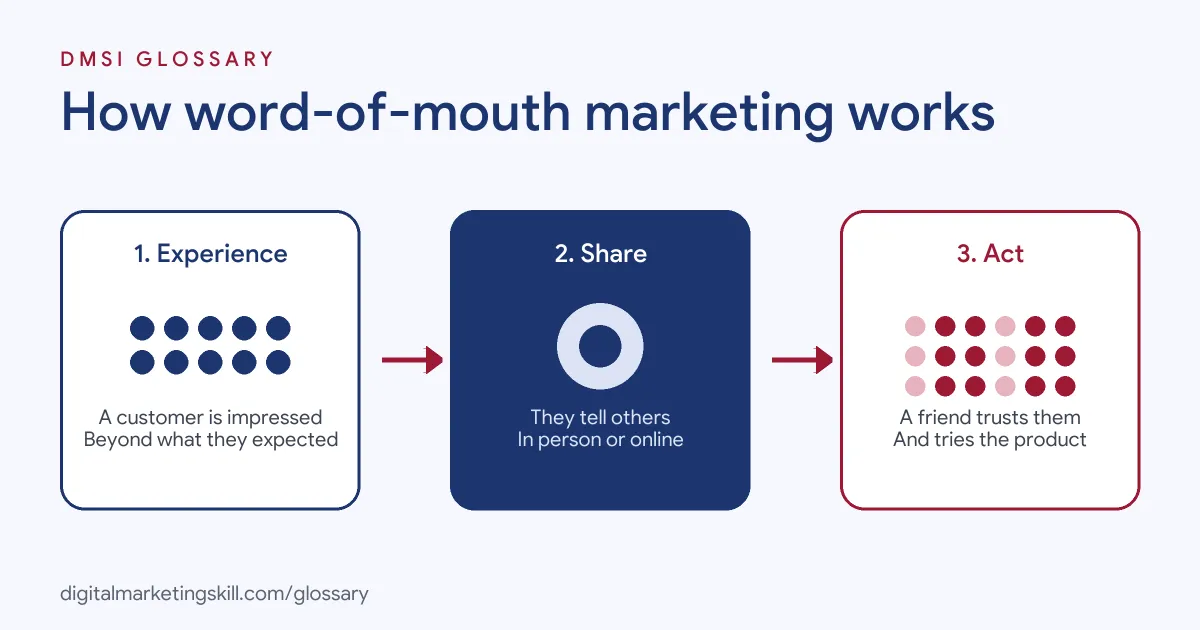
Word of mouth spreads in three steps. First, a customer has an experience that stands out. Next, they tell someone, either face to face or online. Finally, the listener trusts the message enough to try the product, and the cycle can start again.
The Three Types
McKinsey sorts word of mouth into three forms. Experiential comes from a customer’s own experience, especially when it differs from what they expected. Consequential happens when people who see a marketing campaign “pass on messages about them.” Intentional is planned by marketers, such as using celebrity endorsements to create buzz for a launch. McKinsey says intentional word of mouth is less common and harder to measure.
What Drives Impact
Not all recommendations are equal. McKinsey found three drivers. The first is what is said, which must address features that matter to the buyer. The second is who says it, because the listener must trust the sender. Finally, there is where it spreads. Messages in tight, trusted networks reach fewer people, but they have more impact than messages in loose communities.
The Role of Influential People
McKinsey also found that about 8 to 10 percent of consumers act as “influentials”. They generate about three times more messages than others, and each message has about four times more impact. As a result, a small group of keen fans can drive a large share of the conversation about a brand.
Measuring Word-of-Mouth Equity
McKinsey defines word-of-mouth equity as “an index of a brand’s power to generate messages that influence the consumer’s decision to purchase.” In simple terms, it multiplies the number of messages by their average sales impact. McKinsey also notes that a high-impact recommendation can be up to 50 times more likely to trigger a purchase than a low-impact one. So, as a made-up example, a few hundred detailed, trusted reviews can beat thousands of vague mentions.
Word-of-Mouth Marketing Examples
Here are three made-up examples of brands that earn word of mouth:
- Online shop (example): A shoe brand adds a free spare pair of laces and a funny note to every box. Customers share unboxing photos, and friends ask where the shoes came from.
- Software company (example): A booking app fixes a customer’s problem within ten minutes on a Sunday. The customer posts about it, and other small business owners sign up.
- Local service (example): A plumber texts a photo of the finished job and a short care tip. Clients forward the message to neighbours who need help.
In each case, the business created an experience that beat expectations. That surprise is what gets people talking.
Word-of-Mouth Marketing vs Referral vs Influencer Marketing
These approaches overlap, so here is a quick comparison:
| Approach | Who talks | Is there a reward? |
|---|---|---|
| Word-of-mouth marketing | Customers and fans, in their own words | Usually not |
| Referral marketing | Customers, through a tracked link or code | Yes, such as a discount or credit |
| Influencer marketing | Creators with an audience | Yes, usually payment or free products |
In short, word of mouth is the base. Referral and influencer programmes add structure and rewards on top. For the tracked version, see our entry on referral marketing.
How to Build Word-of-Mouth Marketing
- Fix the experience first. Find where customers feel let down, because unhappy customers talk too.
- Find a moment worth sharing. Look for a small surprise you can add, such as a note, a gift or fast help.
- Make sharing easy. Ask for reviews at the right time and give people a simple link.
- Look after your biggest fans. Thank them, give them early access, and listen to their ideas.
- Join the conversation. Reply to reviews and posts, both good and bad, in a helpful way.
- Disclose any incentives. If people get something for talking about you, make sure they say so.
- Measure the talk. Track reviews, mentions and new customers who say a friend sent them.
A simple way to measure it is to add “How did you hear about us?” to your sign-up or checkout form. If “a friend told me” grows over time, your word of mouth is working.
Best Practices for Word-of-Mouth Marketing
- Focus on what people will say. Because content is the main driver, make sure your product gives them something specific to praise.
- Beat expectations. Experiential word of mouth grows when an experience differs from what people expected.
- Treat staff posts carefully. The FTC says employees who mention company products should disclose their link, and “Listing your employer on your profile page isn’t enough.”
- Never fake it. Fake reviews and planted posts destroy trust when people find out.
- Respond to complaints quickly. A problem solved well can become a positive story.
Common Mistakes to Avoid
The biggest mistake is trying to create buzz for an average product. People rarely talk about things that are just fine. Another mistake is ignoring negative word of mouth, which spreads just as easily as praise. Some brands also pay people to post without telling the audience, which breaks trust and can break the law. Others chase reach and forget that close, trusted networks often matter more. Finally, many never ask new customers how they heard about the business, so they can’t measure anything.
Where You’ll Use Word-of-Mouth Marketing at Work
Few job listings name word-of-mouth marketing directly. Instead, the skill sits inside wider roles. For example, a Digital Marketing Manager plans reviews, referrals and community work. A Growth Marketer tests ways to turn happy customers into new ones. Meanwhile, a Freelance Digital Marketer or Agency Owner often helps small businesses collect reviews and build loyal fans. In each role, you need to show how recommendations lead to sales.
Learn It in the Full Stack Programme
Word of mouth touches social media, email, SEO and customer data, so it fits the Full Stack (all four tracks) programme. You take all ten courses and build one portfolio project from each track. Roles it prepares you for include Digital Marketing Manager, Growth Marketer, Freelance Digital Marketer and Agency Owner. You also get unlimited 1-on-1 mentoring and a U.S. Project Internship from day one.
Next, read our guide to customer reviews, one of the most visible forms of word of mouth online.
Frequently Asked Questions
What is word-of-mouth marketing in simple terms?
It is getting people to recommend your brand to others. You do it by giving them a great experience and an easy way to share it.
Why is word of mouth so effective?
People trust friends and peers more than adverts. McKinsey found it is the main factor behind 20 to 50 percent of purchasing decisions.
Is online word of mouth the same thing?
Yes, it is the same idea. Reviews, social posts and shared messages are word of mouth that happens online.
Can you pay for word-of-mouth marketing?
You can reward people, but then it becomes an endorsement. In the US, the FTC expects that link to be clearly disclosed.
How do you measure word of mouth?
Ask new customers how they heard about you. Also track reviews, brand mentions and referral traffic over time.
Sources: McKinsey: A new way to measure word-of-mouth marketing; FTC: Endorsement Guides, What People Are Asking; FTC: Disclosures 101 for Social Media Influencers.