
Target ROAS is a Google Ads bid strategy that sets your bids to get as much conversion value as possible while aiming for the return on ad spend you choose. ROAS means return on ad spend, so a 400% target asks for £4 in conversion value for every £1 you spend. It matters because it lets you bid more for high-value sales and less for low-value ones, rather than treating every conversion the same.
Key Takeaways
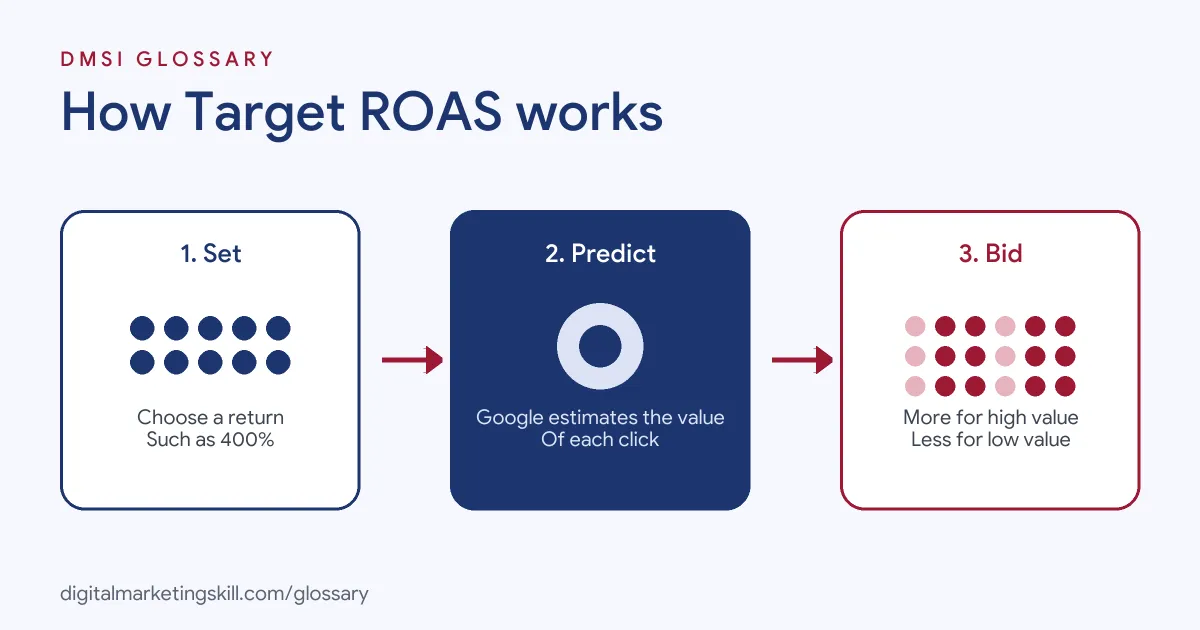
- You set a target return, as a percentage. Google then bids in each auction to reach it on average.
- It needs conversion tracking with values, such as order totals. Without values, it can’t work.
- The maths is simple: conversion value divided by ad spend, times 100%.
- Setting the target too high can limit how much traffic your ads get.
- Google suggests moving to value-based bidding once you already bid well for conversions, for example with Target CPA.
What Is Target ROAS?
Most bid strategies treat a £10 sale and a £500 sale as one conversion each. This one doesn’t. Instead, it looks at the value each conversion brings and bids to maximise that value at your chosen return.
Google explains that once you set it, “Google Ads will set maximum cost-per-interaction (max. CPC) bids to maximize your conversion value, while trying to achieve an average return on ad spend (ROAS) equal to your target.”
For example, an online furniture shop sells cushions and sofas. A sofa sale is worth far more than a cushion. With this strategy, Google can bid more on searches likely to lead to a sofa purchase, and less on searches that usually end in a small order.
How Target ROAS Works
It is one of Google’s Smart Bidding strategies. These set bids at auction time, using signals about each search and the person making it.
The Maths Behind Target ROAS
Google uses a simple example. Say your goal is $5 in sales for every $1 you spend on ads. You would set a target of 500%. The sum is: $5 in sales ÷ $1 in ad spend × 100% = 500%.
In other words, 100% means you get back exactly what you spend in conversion value. Anything above that means more value than spend. However, remember that conversion value is often revenue, not profit, so a target that looks high may still lose money once you count costs.
Values When You Don’t Sell Online
You don’t need an online shop to use value-based bidding. If you generate leads, you can give each type of lead an estimated value. For instance, a free quote request might be worth £50 to you, while a booked call might be worth £200. Base these figures on how often each type turns into a paying customer. Then review them every few months as your sales data grows.
The Signals It Uses
Google says this strategy “adjusts bids using real-time signals such as device, browser, location, and time of” day. It then predicts both the chance of a conversion and its likely value.
An Average, Not a Rule for Every Sale
Some conversions will bring a higher return and some lower. Overall, though, Google “will try to keep your conversion value per cost equal to the target ROAS you set.” So judge it over a period of time, not on a single day or order.
Target ROAS Examples
Here are three made-up examples:
- Fashion retailer: Its profit margin means it needs at least £4 in sales per £1 of ad spend. It sets a 400% target on its Shopping campaigns.
- Travel company: Bookings vary from £200 to £3,000. Value-based bidding lets it bid more on searches for long, high-value trips.
- Software firm: It assigns higher conversion values to leads from large companies. Google then bids more to win those leads.
That last example uses conversion value rules. Google lets you apply “a multiplication factor to conversion values for higher value types of customers.”
Target ROAS vs Target CPA vs Maximise Conversion Value
These strategies are easy to mix up. Here is a quick comparison:
| Strategy | What it optimises for | Best when |
|---|---|---|
| Target CPA | Number of conversions at an average cost | Each conversion is worth about the same |
| Maximise conversion value | Most value within your budget | Values vary, but you have no fixed return goal |
| Target ROAS | Most value at your chosen return | Values vary and you know the return you need |
Google has also relabelled these. “Maximize conversion value with a Target ROAS” now appears simply as “Target ROAS”. The bidding behaviour itself is unchanged.
How to Set Up Target ROAS
- Set up conversion tracking that records a value for each conversion, such as the basket total.
- Check those values are accurate. Test a few purchases and compare them with your shop’s records.
- Work out the return you need. Use your margins, not just revenue.
- In your campaign settings, open Bidding and choose to focus on conversion value.
- Set a target return on ad spend as a percentage.
- Check your daily budget. Google recommends being comfortable spending up to twice your average daily budget on some days.
- Give the strategy time to learn, then adjust the target in small steps.
A Worked Example
Here is a made-up example. A shop spends £2,000 on a campaign in a month and records £9,000 in conversion value. Its actual ROAS is £9,000 ÷ £2,000 × 100% = 450%. The owner knows the business needs at least 350% to make a profit after costs. So a target of about 450% keeps current results, while a slightly lower target could win more sales if the team wants to grow.
Best Practices for Target ROAS
- Get values right first. The strategy can only be as good as the conversion values you send.
- Don’t set it too high. Google warns that a target “that’s too high may limit the amount of traffic your ads may get.”
- Build up from Target CPA. Google says that “ideally you will already be bidding to the desired conversion goal using a Target CPA bid strategy” before you switch.
- Wait after value changes. If you only recently started reporting values, Google recommends waiting one to two conversion cycles before you adopt it.
- Use value rules carefully. Only boost values for customer types you know are worth more.
Common Target ROAS Mistakes
A frequent mistake is setting a very high target on day one, which can choke traffic. Another is tracking revenue that includes tax, delivery or refunded orders, so the return looks better than it is. Some advertisers switch strategies too often, which stops the system from learning. Others forget that ROAS is not profit, so they hit the target but still lose money. Finally, many judge results on a single day, when the strategy works to an average over time.
Where You’ll Use Target ROAS at Work
Value-based bidding is a common requirement in paid search roles, especially in e-commerce. For example, recent remote job listings ask for:
- “Deep, practical expertise with target ROAS (tROAS) bidding, portfolio bid strategies, dynamic value-based bidding, and Smart Bidding mechanics” (Paid Search Manager).
- Someone “leveraging advanced tROAS bidding strategies to maximize revenue and return on ad spend” (Paid Search Manager).
- The ability to “Manage and allocate the paid budget to hit target CAC / ROAS / payback and grow revenue profitably” (PPC Specialist).
So if you want to work as a Google Ads Specialist or PPC Specialist, expect to set return targets, check conversion values and explain results to clients.
Learn It in the Google Specialist Track
You can learn to set up value-based bidding in the AI-Powered Google Specialist track. It covers Google Ads across Search, Display, Discovery, Gmail and YouTube, plus Google Analytics. Your portfolio project is a Google Ads campaign you launch and measure with conversion tracking. You also get unlimited 1-on-1 mentoring and a U.S. Project Internship from day one.
Next, read our Google Ads strategy guide and our breakdown of Google Ads costs. You may also like our glossary entries on Target CPA and return on investment.
Frequently Asked Questions
What does target ROAS mean?
It is the average return you want from your ads, shown as a percentage. For example, 500% means £5 of conversion value for every £1 you spend.
How do I calculate ROAS?
Divide your conversion value by your ad spend, then multiply by 100%. So £6,000 in value from £1,500 of spend is 400%.
What is a good target ROAS?
It depends on your margins. Work out the return you need to break even after costs, then set a target at or above it.
Does target ROAS need conversion values?
Yes. Google says you need to set values for the conversions you track before you can use it.
Why did my traffic drop after setting a return target?
Your target may be too high. Google warns that a high target can limit traffic, so try lowering it in small steps.
Sources: Google Ads Help: About Target ROAS bidding; Google Ads Help: About Smart Bidding; Google Ads Help: About conversion measurement; remote job listings on Himalayas.