A good google ads strategy starts before you write a single ad. You match the right keyword type to the right buyer intent, then back it with a landing page that keeps the promise. Most small accounts skip that step. They buy broad keywords with no clear goal. This guide shows you the setup, the testing habit, and the three numbers that tell you if a campaign is working.
Key Takeaways
- Google’s own auction documentation confirms the price you pay is set by Ad Rank, not your raw bid.
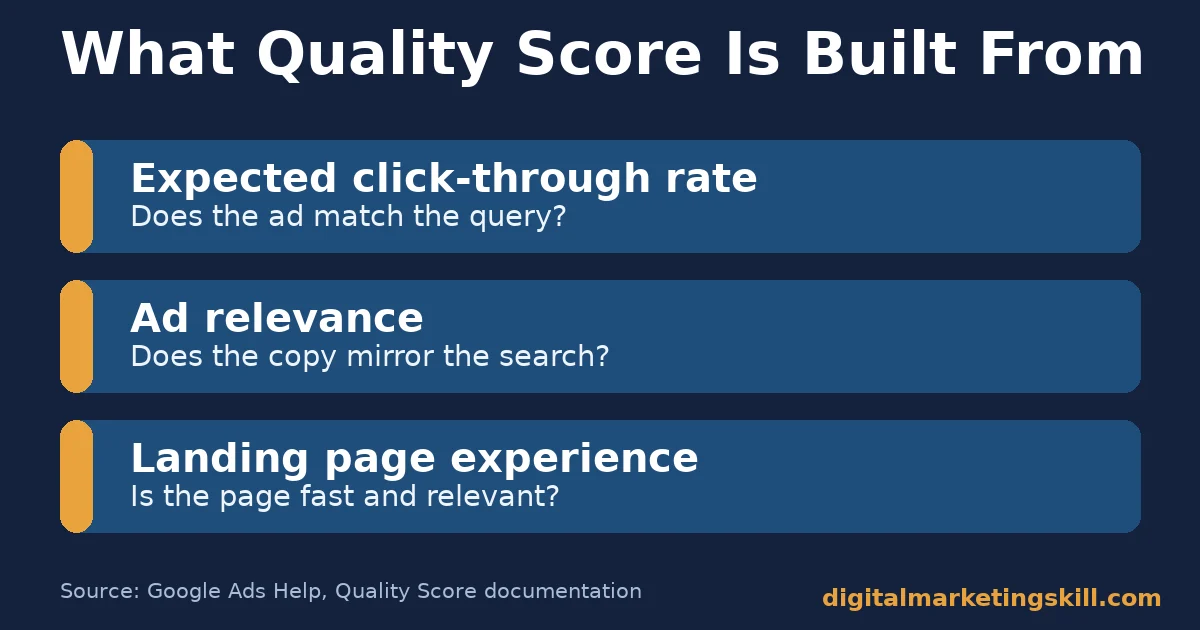
- Quality Score runs on a 1-10 scale per keyword, and it lowers your cost per click; it is built from expected click-through rate, ad relevance, and landing page experience, per Google’s Quality Score guide.
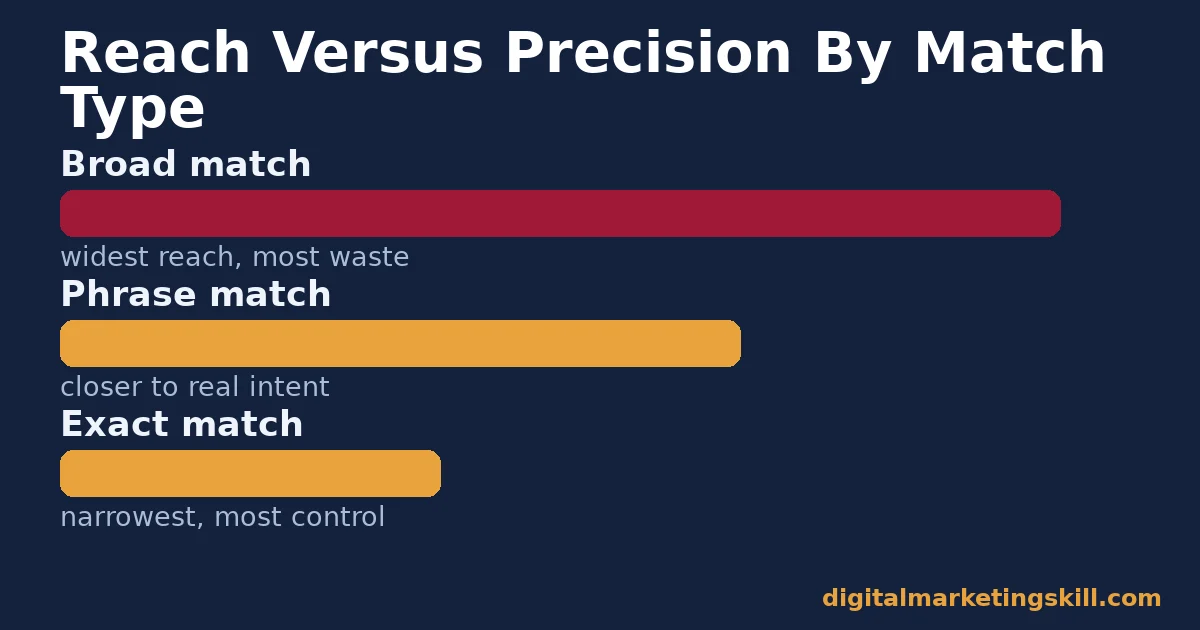
- Google Ads offers 3 keyword match types that trade reach for precision; its own keyword matching guide shows exact and phrase match stay closer to real intent than broad match.
- A clean negative keyword list is the single cheapest fix for wasted spend. Every irrelevant click still costs money.
- Smart Bidding needs past conversion data to work well. Google’s Smart Bidding guide recommends manual or enhanced CPC below that threshold.
In this guide
- Why Most Small-Business Accounts Underperform
- The Mechanism Behind Every Google Ads Strategy: How the Auction Sets Your Cost
- What Differs Depending on How You Structure the Account
- How to Fix a Low-Performing Account Structure
- How to Measure Whether a Campaign Is Working
- The One Decision Rule: Fix the Weakest Number First
- A Real Case: What a Structure Fix Changed
- Tools and Checks That Support a Google Ads Strategy
- Common Mistakes That Undermine a Google Ads Strategy
- How to Split Budget Across Multiple Campaigns
- Frequently Asked Questions About Google Ads Strategy
- Turning a Google Ads Strategy Into a Repeatable Skill
Why Most Small-Business Accounts Underperform
Search Engine Land has covered a pattern that repeats across small accounts. The structure follows a product list, not a buyer question. Ads match what the business sells. They do not match what a person types when ready to buy. That gap shows up fast. Clicks stay high. Conversions stay low. That combination is a targeting problem, not a budget problem.
This is an informed inference, not a settled fact about any single account. Every auction scores your ad three ways: against the exact query, against your past click-through rate on similar queries, and against your landing page’s speed and relevance. Skip any one of those three, and a smaller competitor who gets all three right will beat you on price.
The rules in this guide cover search campaigns run directly in Google Ads. They do not cover Shopping, Display, or Performance Max. Those formats use different signals and sit outside this guide’s scope. Everything below assumes a standard search campaign with manual control over keywords, ad copy, and bidding, since that is where most small accounts start.
The Mechanism Behind Every Google Ads Strategy: How the Auction Sets Your Cost
Every search triggers a fresh auction among eligible ads. Google Ads multiplies your maximum bid by your Quality Score. That produces Ad Rank. The ad with the highest Ad Rank wins the top spot.
The price you pay is set just high enough to beat the next-ranked competitor. It is not set by your own maximum bid. That is why two advertisers bidding the same amount can pay very different prices. This single fact is the foundation of every working google ads strategy, because it rewards relevance over raw budget.
Quality Score has three parts. Each part is rated low, average, or above average against other advertisers chasing the same keyword. Expected click-through rate makes up the first part. The second is ad relevance: how closely your ad text matches what the searcher actually wants.
The third part is landing page experience. That covers load speed, mobile usability, and whether the page delivers what the ad promised. Raise any one part, and your cost per click drops. That is why rewriting ad copy is often cheaper than raising a bid.
Match Types and Tracking
Match types decide which searches can trigger your ad. Broad match shows your ad for a wide range of related searches. It maximizes reach. It also maximizes irrelevant clicks.
Phrase match keeps the core meaning of your keyword in place. Exact match sticks closest to your keyword’s meaning, with little room to drift. A small budget does better starting narrow. Use phrase or exact match first, then widen later once you have real conversion data.
Set up conversion tracking before you spend anything on any of this. None of these decisions mean much without it, and no google ads strategy can be judged fairly without accurate conversion data underneath it.
What Differs Depending on How You Structure the Account
Broad Match: Built For Reach, Not Precision
Broad match can trigger on searches Google judges as related to your keyword’s meaning. That includes synonyms and related ideas you never typed yourself. This makes broad match useful for finding new, high-converting queries you would not have guessed.
However, it only works well with two safeguards: automated bidding tied to a real conversion goal, and a strong negative keyword list. Skip either safeguard, and broad match becomes the most common source of wasted spend in a small account.
Broad match still has a role inside a mature google ads strategy. It works best as a discovery tool, run alongside a tight negative list, never as the only match type in an account.
Exact Match: Built For Control, Not Scale
Exact match only triggers for searches that share your keyword’s meaning. That keeps relevance and Quality Score high. It also caps how much traffic the keyword can bring in. New accounts, or accounts on a tight monthly budget, usually get a more predictable cost per acquisition by starting here. Expand into phrase and then broad match once conversion tracking shows what “working” actually looks like for that account.
How to Fix a Low-Performing Account Structure
Structure: Group Ads By Intent, Not By Product Catalog
Build one ad group per distinct buyer question. One group for “emergency plumber near me.” A separate group for “plumbing maintenance plan.” Do not build one ad group per product SKU.
Give each ad group its own ad copy, written to match the query’s wording. Give it its own landing page section too, one that answers that specific question first. This single change usually raises Quality Score fastest.
Expected click-through rate and ad relevance are both measured per ad group, not per account. The same intent-first thinking should carry into the rest of your pay-per-click advertising plan, not just the Google Ads account.
Budget: Lead With Negative Keywords Before You Raise Spend
Before you raise a daily budget, pull the search terms report. Add every irrelevant query that drew a click with no conversion to a shared negative keyword list. Review it weekly for the first month, then move to monthly after that.
Accounts that skip this step keep paying for the same waste every day. Removing it often lowers cost per acquisition without touching a single bid. Raising spend on a leaky structure only makes the leak bigger.
Clicks are only half the job, too. A strong email follow-up sequence is what turns a first purchase into a repeat one, and it belongs in any serious google ads strategy, not as an afterthought.
How to Measure Whether a Campaign Is Working
Three numbers tell you most of what you need to know. Each one is defined below in a single sentence, so you can read your own dashboard correctly.
- Click-through rate (CTR): the share of people who saw your ad and clicked it. A low CTR against a high impression count usually means the ad copy does not match the query.
- Conversion rate: the share of clicks that completed your goal, whether that is a purchase, a form, or a call. A strong CTR paired with a weak conversion rate usually points to the landing page, not the ad.
- Cost per acquisition (CPA): total spend divided by completed conversions. This is the number that tells you if the campaign is profitable. Compare it against your actual margin per sale, not a generic benchmark.
Read all three together. Rising CTR, flat conversion rate, rising CPA points to a targeting problem upstream of the landing page. Flat CTR, falling conversion rate, rising CPA points to a landing page or offer problem instead.
The One Decision Rule: Fix the Weakest Number First
When a campaign slips, do not touch the ad copy, the bid, and the landing page in the same week. Find which of the three metrics above is furthest from acceptable. Fix only that one lever.
Hold everything else steady for one full conversion cycle. Then measure again. Change several things at once, and you lose the ability to tell what actually caused the result. This rule is the core of any working google ads strategy, no matter the account size.
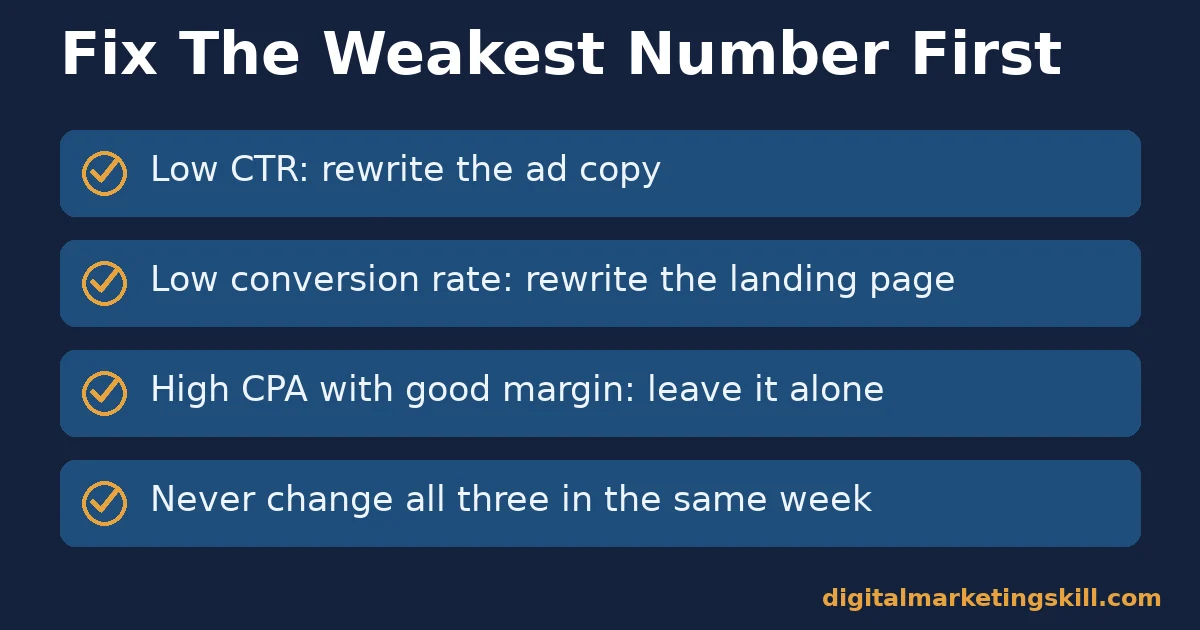
Illustrative, invented numbers: picture an account with a 4% CTR, a 1% conversion rate, and a $90 CPA against a $60 margin per sale. CTR looks healthy against typical search benchmarks. Consequently, the weakest number here is conversion rate, not the ad or the bid.
The right first move is rewriting the landing page’s opening section to match the ad’s exact promise. It is not raising the bid. It is not rewriting the ad copy. If you want proof a rewrite actually helped, run it as a proper split test against the original page, rather than guessing from gut feel.
A Real Case: What a Structure Fix Changed
Search Engine Land has documented small-business case studies where restructuring ad groups around buyer intent, rather than product lists, lowered cost per acquisition with no extra budget. The pattern repeats: Quality Score rose because ad relevance rose. That lowered cost per click on its own, independent of any bidding change.
The limit on this evidence matters too. Published case studies are self-selected successes. Results vary with how competitive an industry is and what the account’s history looks like. Treat this as a direction worth testing, not a promised outcome for your specific account.
Tools and Checks That Support a Google Ads Strategy
A strategy is only as good as the data behind it. Before you make any change, confirm three things are actually in place.
Conversion Tracking That Actually Fires
It is common for conversion tracking to be installed once, then quietly break after a site update. Test it yourself every quarter. Complete a real conversion action and confirm it appears in your account within the expected delay. A campaign optimized against broken tracking data will optimize toward the wrong goal every time.
Clean UTM Tagging Across Every Ad
If your analytics tool and your Google Ads account disagree on conversion counts, mismatched or missing UTM parameters are a common cause. Keep a simple naming convention for campaign, source, and medium, and apply it consistently across every ad you launch. Consistent tagging is what lets you trust the numbers you are reading.
A Fixed Audit Cadence, Not an Ad-Hoc One
Pick a fixed day each month to review search terms, device performance, and location performance together, rather than reacting only when something looks obviously wrong. A google ads strategy built on a regular cadence catches small problems while they are still cheap to fix, instead of after they have drained a quarter’s budget.
Additionally, keep a short written log of every change you make and the date it went live, even a simple spreadsheet row. Without that log, it becomes difficult to connect a performance shift back to the change that actually caused it, especially once several small edits stack up across a few months.
Common Mistakes That Undermine a Google Ads Strategy
A few habits show up again and again in underperforming accounts. Each one is simple to fix once you can name it.
Treating Every Keyword the Same Way
Not every keyword deserves the same match type or bid. A keyword tied to a high-value purchase decision can justify a higher bid and a tighter exact match. A keyword tied to early research deserves a lower bid and a softer landing page goal, like an email signup instead of a sale.
Running a Single Ad Per Group Forever
Google Ads needs more than one ad per ad group to learn which message performs best. Write at least two ads per group with different headlines. Let the system split traffic. Review results after you have enough clicks to judge them fairly, then keep the stronger ad and write a fresh challenger.
Ignoring Device and Location Performance
Cost per acquisition often differs sharply by device and by location, even inside one campaign. Check the breakdown monthly. Adjust bids for the segments that convert well, and pull back on the ones that consistently drain budget without returning sales. Otherwise, a single underperforming segment can quietly erode an account that looks healthy at the total level.
How to Split Budget Across Multiple Campaigns
Most small businesses eventually run more than one campaign. As a result, the next question becomes how to split a limited budget between them without guessing.
Start by ranking campaigns on two things: how well-proven the conversion rate already is, and how close the keywords sit to a buying decision. For example, a brand campaign on your own business name usually converts well and costs little, so it rarely needs much daily budget to perform. A competitive, high-intent category campaign usually needs more room to gather enough clicks for reliable data.
Therefore, give proven, high-intent campaigns first claim on budget, and treat newer or exploratory campaigns as a smaller, fixed test allocation. Review that split monthly, once each campaign has enough conversion volume to judge fairly, rather than shifting budget around daily based on short-term noise. In short, a disciplined google ads strategy treats budget allocation as a monthly decision, not a daily reaction.
Frequently Asked Questions About Google Ads Strategy
How much budget does a small business need to start with Google Ads?
There is no universal minimum. The right starting budget depends on your average cost per click in your category, and on how many clicks you need before conversion rate data becomes reliable. Pick an amount you can sustain for a full month without adjusting it daily.
Is broad match ever a good choice for a new account?
Broad match can work well once you already have conversion tracking and enough history for automated bidding to learn from. For a brand-new account with no conversion history, it is a higher-risk starting point.
What counts as a good Quality Score?
Quality Score runs on a 1-10 scale per keyword. A score of 7 or above usually means your ad and landing page match the query well. A score under 5 usually points to a relevance or landing page problem worth fixing before you spend more.
How often should I review the search terms report?
Weekly during the first month of a new campaign. At least monthly after that. Also review it right after any bid or budget change.
Should I pause a keyword with a high cost per click?
Not automatically. A high cost per click paired with a strong conversion rate and a healthy margin can still be profitable. Judge the keyword by cost per acquisition against your margin, not by cost per click alone.
Can Smart Bidding work with a small daily budget?
Smart Bidding needs enough past conversions to learn from. Very small or brand-new accounts usually get steadier results starting with manual or enhanced CPC, then moving to Smart Bidding once conversion volume builds up.
What is the difference between ad relevance and landing page experience?
Ad relevance measures how closely your ad text matches what the searcher actually wants. Landing page experience measures whether the linked page is fast, mobile-friendly, and genuinely delivers on the ad’s promise. Quality Score scores both separately.
How does a Google Ads strategy fit with a wider sales funnel?
Search ads usually sit at the top or middle of the funnel. They bring in people who are actively searching. What happens after the click, including email follow-up and retargeting, decides whether that click becomes a sale. Map this against your own sales funnel to see where Google Ads should carry the weight, and where it should not.
Turning a Google Ads Strategy Into a Repeatable Skill
A sound google ads strategy is a loop, not a one-time setup. Structure by intent. Measure the three core numbers. Fix the weakest one. Repeat.
Building that loop well, alongside the broader AI-powered skills modern marketing teams now expect, is exactly what the Digital Marketing Skill Institute‘s Master Diploma in Digital & AI Marketing is built around. The same discipline that keeps a Google Ads account honest, naming the weakest number and fixing it before moving on, is what the program trains across every marketing channel, not just paid search.
The program runs as four AI-powered tracks, built from ten execution-first courses in total, including the AI-Powered Google Specialist track for anyone who wants to go deeper on paid search. A Full Stack option lets you complete all four tracks.
Every track includes unlimited one-on-one coaching and mentoring, plus a U.S. Project Internship with a verified U.S. Work Reference Letter. The program is dual US and UK accredited, recognised in more than 100 countries, and runs 100% online, so you can study from anywhere in your country.
Review the full curriculum on the Master Diploma in Digital & AI Marketing program page, read outcomes from past graduates on the student reviews page, or go straight to the application page to start wherever you live. For more practical guides like this one, visit the digital marketing blog, or head back to exactly https://digitalmarketingskill.com/ any time.
Every figure in this guide was checked against its original source before publication. Figures marked as illustrative are invented examples, not real results.