
Ad Strength is a rating in Google Ads that tells you how relevant, varied and complete the headlines, descriptions and other assets in your ad are. It ranges from Poor to Excellent, and it updates as you write. So it works like a live coach while you build an ad. However, it is a guide to your ad copy, not a score that decides who wins the auction.
Key Takeaways
- Ad Strength rates the assets in your ad, such as headlines and descriptions.
- The ratings are Incomplete, Poor, Average, Good and Excellent.
- It covers responsive search ads, responsive display ads, App, Demand Gen and Performance Max campaigns.
- Google says it isn’t used to calculate Ad Rank or Quality Score.
- More unique assets and better keyword use usually raise the rating.
What Is Ad Strength?
When you create an ad in Google Ads, you often give the system many pieces of text and images. Then Google mixes and matches them to fit each search. Ad Strength looks at those pieces and tells you how good the mix is.
Google describes it simply. In its help centre, it says, “Ad Strength is a tool that helps you create effective responsive search ads.” Another help page adds that it “measures the relevance, quality, and diversity of your ad assets.” In other words, it checks whether your assets match your keywords and whether they say different things.
Think of it like packing for a trip. If you pack ten copies of the same shirt, you have plenty of clothes but no choice. In the same way, ten headlines that all say “Cheap Shoes” give Google nothing to test. So Ad Strength rewards variety as well as quantity.
What Ad Strength does not measure
Ad Strength focuses on your assets and keywords. For example, Google says it doesn’t look at outside factors such as landing page experience. Also, Google states that it “isn’t used to calculate Ad Rank, Quality Score, or auction wins.” So a Poor rating won’t stop your ad from showing. Still, Google says, “A higher Ad Strength will help you to maximize your ad’s performance.”
Why it matters
Why should you care about a score that isn’t part of the auction? Because it points you to gaps you might miss. For example, a busy account may have dozens of ads with only a few headlines each. In that case, Ad Strength flags them fast, so you know where to start. Also, it helps new team members learn what a full, varied ad looks like. Finally, it gives you a quick check before you hit publish. Treat it as a helpful nudge, then let real results guide your final choices.
How Ad Strength Works
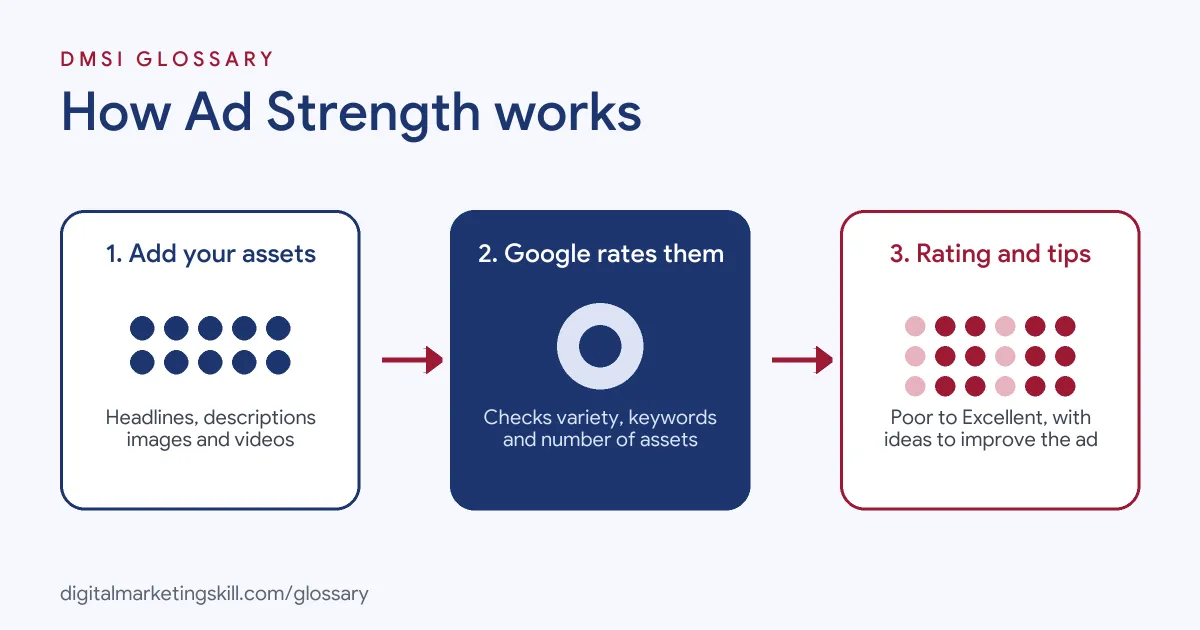
Ad Strength runs inside the ad editor. As you add or change assets, the rating moves up or down. Next to it, Google shows short tips, for example to add more headlines or to use popular keywords. Here is what drives the score.
Number of assets
A responsive search ad lets you add up to 15 headlines and 4 descriptions. You need at least 3 headlines and 2 descriptions to run it. Google advises you to “provide as many unique assets as possible, up to the limit of 15 headlines and 4 descriptions.” So filling more slots is often the quickest way to lift the score.
Uniqueness
Next, the assets must differ from each other. Google asks you to “create unique headlines and descriptions that highlight various selling points and calls to action.” For example, one headline can mention price, another speed, and another a guarantee. As a result, Google has real options to test.
Keyword relevance
Ad Strength also checks how well your text links to the keywords in your ad group. Google suggests adding your best keywords to your headlines in a natural way. However, stuffing the same keyword into every line hurts variety.
Pinning
Pinning fixes a headline or description to one position. This gives you control. However, Google warns that “pinning isn’t recommended for most advertisers and can affect ad strength.” That is because pinning cuts down the number of combinations Google can try.
Other campaign types
Ad Strength also appears for Performance Max asset groups, Demand Gen, App campaigns and responsive display ads. In each case, it checks whether you gave enough varied text, images and videos. Google notes that “each campaign type has different requirements and best practices.”
Examples of Ad Strength
- A local plumber’s search ad. The ad has only four headlines, and three say “Emergency Plumber”. So Ad Strength shows Poor. The owner then adds headlines about fixed prices, same-day visits and reviews. After that, the rating rises to Good.
- An online clothing store. The team pins every headline to stop odd combinations. As a result, Ad Strength drops to Average. So they unpin most headlines and keep one brand line pinned to position one.
- A software company’s Performance Max campaign. The asset group has text but no video or square images. Then the marketer adds a short video, extra images and more headlines. Finally, the rating moves from Average to Excellent.
Ad Strength vs Quality Score
| Point | Ad Strength | Quality Score |
|---|---|---|
| What it rates | The assets inside one ad or asset group | A keyword, based on past ad results |
| Scale | Incomplete, Poor, Average, Good, Excellent | 1 to 10 |
| When it updates | Live, while you write the ad | Over time, from real auction data |
| Part of the auction? | No, Google says it isn’t used for Ad Rank | It is a diagnostic of the quality factors that affect Ad Rank |
| Main levers | More unique assets, keywords, less pinning | Expected CTR, ad relevance, landing page experience |
So both scores matter, but in different ways. For example, Quality Score reflects how your ads have performed. By contrast, Ad Strength helps you write better ads before they run.
How to Improve Ad Strength
- Open the ad editor. Go to your campaign, choose the ad group, and open the responsive search ad. The rating and tips sit on the right.
- Fill more headline slots. Aim for 10 to 15 headlines. Then write at least 4 descriptions.
- Cover different selling points. Mix benefits, features, prices, offers, proof and a clear call to action.
- Add your top keywords. Include your main keywords in a few headlines. Also keep the wording natural.
- Vary the length. Use some short headlines and some that use the full 30 characters.
- Reduce pinning. Pin only what you must, such as a legal line. Otherwise, let Google test.
- Follow the tips. Read the suggestions next to the rating. After that, act on the ones that suit your brand.
- Check real results. Watch clicks, conversions and cost per conversion. In addition, compare ads in the same ad group over a few weeks.
Best Practices for Ad Strength
- Aim for Good or better. Google suggests at least two responsive search ads rated Good or Excellent in each ad group.
- Write for people first. A high rating means nothing if the ad doesn’t persuade a real buyer.
- Make each headline stand alone. Any headline can appear next to any other, so each must make sense on its own.
- Use real proof. Mention reviews, guarantees or awards only if they are true and current.
- Refresh assets over time. Swap out headlines with low results, then check the asset report for gains.
- Test, don’t guess. Run an A/B test when you want to compare two different ad ideas.
Common Mistakes to Avoid
- Chasing Excellent at any cost. Adding weak filler headlines may raise the rating. However, it can also lower the quality of what users see.
- Repeating the same message. Ten headlines with one idea give Google nothing new to test.
- Pinning everything. Heavy pinning lowers Ad Strength and limits the system.
- Keyword stuffing. Using the same keyword in every line hurts variety and reads badly.
- Thinking it controls the auction. Ad Strength is not part of Ad Rank, so it won’t fix high costs by itself.
- Ignoring the results. A Good ad that converts well beats an Excellent ad that doesn’t.
Where You’ll Use Ad Strength at Work
We could not find remote job listings that use the exact phrase “Ad Strength” at the time of checking. Even so, you will use it in many paid search roles. For example, PPC specialists and Google Ads managers check it every time they write or edit a responsive search ad. Also, performance marketers use it when they build Performance Max asset groups. In addition, copywriters at agencies use the tips to plan headline sets. Finally, account managers often review Ad Strength during audits of new client accounts.
Learn It in the Google Ads and Analytics Track
You can learn to write and test strong search ads in the AI-Powered Google Specialist track. Every track includes a U.S. Project Internship from day one, with unlimited 1-on-1 mentoring.
Frequently Asked Questions
Does Ad Strength affect my ad’s ranking?
Not directly. Google says Ad Strength isn’t used to calculate Ad Rank, Quality Score or auction wins. Still, better assets can help your ad perform better.
What is a good Ad Strength rating?
Good or Excellent is the target. Google suggests at least two responsive search ads with one of those ratings in each ad group.
Why is my Ad Strength Poor?
Usually, you have too few headlines, too many similar ones, or few keywords in the text. Heavy pinning can also lower it.
Can an ad with Poor Ad Strength still run?
Yes. Google says the rating doesn’t directly affect whether your ad can serve. However, it may limit how well the ad performs.
Does pinning lower Ad Strength?
It can. Google warns that pinning can affect Ad Strength, because it reduces the number of combinations the system can test.
Sources: Google Ads Help: About Ad Strength for responsive search ads; Google Ads Help: About Ad Strength; Google Ads Help: About responsive search ads.