
The marketing mix is the set of decisions a business makes about how to bring a product to market, usually grouped as the 4Ps: product, price, place and promotion. Each P is a lever you can adjust to win and keep customers. It matters because a great product still fails if the price, the place it’s sold or the way it’s promoted doesn’t fit the people you want to reach.
Key Takeaways
- The 4Ps are product, price, place and promotion. Together, they describe how you offer something to customers.
- The model was popularised by E. Jerome McCarthy and later by Philip Kotler.
- Service businesses often use the 7Ps, which add people, process and physical evidence.
- The 4Cs (consumer, cost, convenience, communication) look at the same decisions from the customer’s side.
- The Ps work together. A change to one, such as price, often means changes to the others.
What Is the Marketing Mix?
The OpenStax textbook Principles of Marketing puts it simply: having a great product is “just the first step”, because the best product “won’t translate to profits unless people know about it.” The mix is how you connect the product with the right customers.
It’s called a mix because the parts blend together. For instance, think of a recipe. If you change one ingredient, the whole dish changes. In the same way, launching a premium product at a budget price, or selling a luxury item in a discount shop, sends mixed signals.
For example, a small coffee roaster sells high-end beans. First, its product is single-origin coffee. Next, its price sits above supermarket brands. Then its place is its own website and a few independent cafés. Finally, its promotion focuses on Instagram and an email newsletter. Each choice supports the same message: quality coffee for people who care about taste.
How the Marketing Mix Works
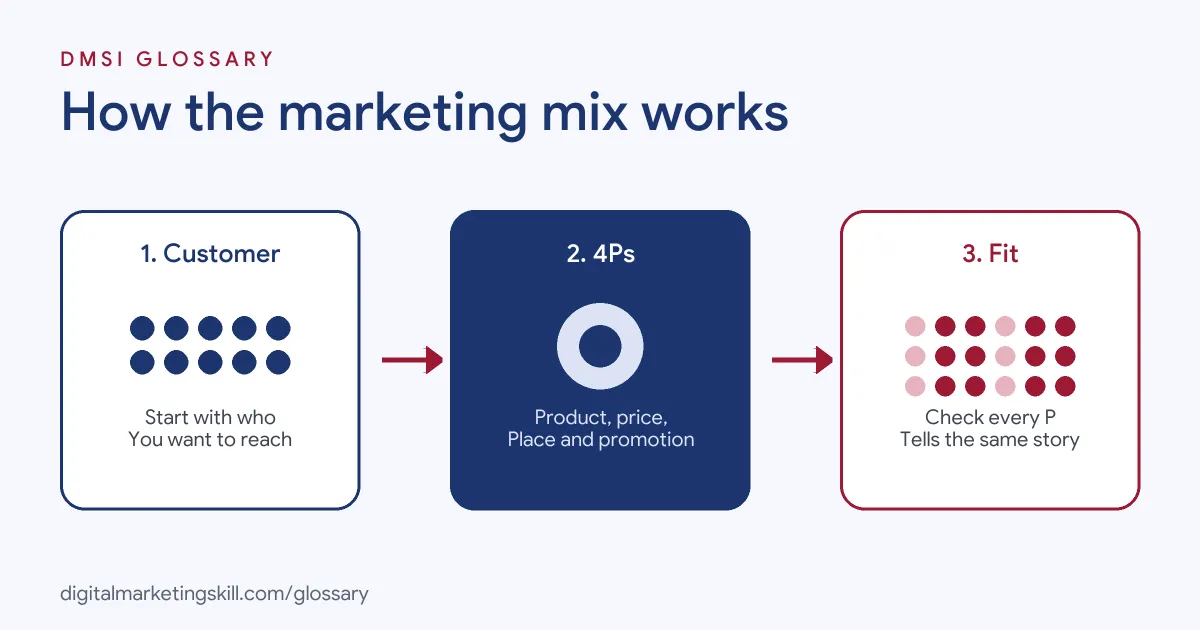
You start with your target customer, then make a decision on each P. Finally, you check that the four decisions fit together and support one clear position in the market.
Product
According to OpenStax, “The product is the good or service that the company provides.” This covers features, quality, design, packaging, branding and any support that comes with it. In digital marketing, it can also include the user experience of an app or website. So if your checkout is slow or confusing, that is a product problem, not just a technical one.
Price
“The price is what the consumer pays in exchange for the product.” Pricing decisions include the list price, discounts and payment terms, such as credit or instalments. In addition, price sends a signal. A very low price can suggest low quality, while a high one can suggest premium value.
Place
“The place is where the product is purchased.” That might be a shop, a website, a marketplace or an app store. It also covers distribution choices, such as selling through many outlets, a few chosen partners or only your own channels.
Promotion
Promotion is “comprised of advertising, sales, and other communication efforts” the company uses. Online, for example, that includes search ads, social media, email, content and influencer partnerships. It’s often the most visible P, but it works best when the other three are right. After all, clever ads can’t save a product that is overpriced or hard to find.
Marketing Mix Examples
Here are three made-up examples:
- Meal-kit start-up: Product is weekly recipe boxes. Price is a subscription with a first-box discount. Place is its website and app. Promotion is social ads and referral codes.
- Local gym: Product is classes and open gym access. Price is a monthly membership with no joining fee. Place is one site near a train station. Promotion is local search ads and a free first class.
- Online course: Product is a video course with live support. Price is a one-off fee with a payment plan. Place is the course’s own website. Promotion is a free guide, an email sequence and YouTube videos.
Marketing Mix Models: 4Ps vs 7Ps vs 4Cs
Several versions of the model exist, because different businesses need different levers. Here is how they compare:
| Model | Elements | Best for |
|---|---|---|
| 4Ps | Product, price, place, promotion | Physical products and general planning |
| 7Ps | The 4Ps plus people, process and physical evidence | Services, where staff and experience matter |
| 4Cs | Consumer wants and needs, cost, convenience, communication | Looking at decisions from the customer’s view |
Booms and Bitner proposed the 7Ps for services marketing. Robert Lauterborn proposed the 4Cs as a more consumer-oriented version of the 4Ps. In practice, many marketers use the 4Ps to plan and the 4Cs to sense-check those plans.
How to Use the Marketing Mix
- Define your target customer. Note their needs, budget and where they shop.
- Describe your product from their point of view. What problem does it solve?
- Set a price that fits both your costs and what the customer expects to pay.
- Choose the places where your customer already buys similar things.
- Pick promotion channels your customer actually uses.
- Check that all four decisions tell the same story.
- Launch, measure results and adjust one P at a time, so you can see what each change does.
A Quick Consistency Check
Once you’ve written your mix, ask a few questions. Does the price match the quality of the product? Is the product sold where your customers look for it? Does your promotion reach those same people? Finally, would a customer see the same promise in every part? If any answer is no, that P needs work.
Best Practices for the Marketing Mix
- Start with the customer. Every P should answer a customer need, not just an internal goal.
- Keep the Ps consistent. Mixed signals confuse buyers and weaken trust in your brand.
- Use data. Test prices, channels and messages rather than guessing. For example, try a small price change in one region before rolling it out everywhere.
- Review it regularly. Markets, costs and competitors change, so your mix should change with them.
- Use the 7Ps for services. People and process often decide whether customers come back.
Common Marketing Mix Mistakes
First, many businesses focus only on promotion and ignore the other three Ps. Second, others set prices based only on costs, without checking what customers will pay. Third, some sell in places their customers rarely visit. Another mistake is changing several Ps at once, so it’s impossible to tell what made the difference. Finally, many write a mix once and never revisit it, even as the market moves on.
Where You’ll Use the Marketing Mix at Work
The 4Ps sit behind most marketing plans, and a related term, marketing mix modelling, is a common analytics skill. For example, recent remote job listings ask for:
- A “Deep understanding of multichannel marketing strategies and the full marketing mix” (B2B Marketing Manager).
- “Experience with Marketing Mix Modeling (MMM) and/or Multi-Touch Attribution (MTA)” (Data Analysis Specialist).
- Someone to “Develop and implement statistical and machine learning models (e.g., attribution modeling, marketing mix modeling, churn prediction, and customer lifetime value)” (Media and Marketing Data Scientist).
Marketing mix modelling uses statistics to estimate how much each channel or activity drives sales. So whether you aim to be a Digital Marketing Manager, a Growth Marketer or an Agency Owner, expect to plan with the 4Ps and measure what each choice delivers.
Learn It in the Full Stack Track
The mix spans every channel, so the best fit is the Full Stack option, which covers all four tracks. You take all ten courses and complete one portfolio project from each track, from a paid social campaign to an email sequence, a Google Ads campaign and an SEO content plan. You also work on a U.S. Project Internship from day one, with unlimited 1-on-1 mentoring.
Next, read our guides to the marketing strategy framework and how to create a digital marketing plan. You may also like our glossary entries on marketing strategy and target audience.
Frequently Asked Questions
What are the 4Ps of the marketing mix?
Product, price, place and promotion. They cover what you sell, what it costs, where people buy it and how you tell them about it.
What are the 7Ps?
The 7Ps add people, process and physical evidence to the original four. They are often used for service businesses.
Is the marketing mix still relevant online?
Yes. The channels have changed, but every online business still decides on its product, price, where it sells and how it promotes itself.
What is the difference between the 4Ps and the 4Cs?
In short, the 4Ps look at decisions from the seller’s side. By contrast, the 4Cs, consumer, cost, convenience and communication, look at the same decisions from the customer’s side.
What is marketing mix modelling?
It is an analytics method that uses statistics to estimate how much each marketing activity contributes to sales.
Sources: OpenStax: Principles of Marketing, the marketing mix and the 4Ps; Wikipedia: Marketing mix; Shopify: The 4 Ps of marketing; remote job listings on Himalayas.