
Online reviews are public ratings and comments that customers post about a business, product or service on sites such as Google, marketplaces, app stores and review platforms. They usually combine a star rating with written feedback that other shoppers can read before they decide. They matter because most people check reviews before choosing a business, so they shape both trust and sales.
Key Takeaways
- BrightLocal’s consumer survey found that 97% of consumers read reviews for local businesses.
- The same research found that 80% say they’re likely to use a business that responds to all of its reviews.
- Google bans paid reviews and selectively asking only happy customers for reviews.
- In the US, the FTC’s rule covers fake reviews, including AI-generated ones, and review suppression.
- The best way to earn good reviews is great service, followed by a simple, fair request.
What Are Online Reviews?
Online reviews are a form of social proof. Before people book a plumber, choose a restaurant or buy a product, they want to know what others thought. A page of recent, detailed reviews answers that question far better than any advert.
Reviews appear in many places. Google shows them on Business Profiles in Search and Maps. Marketplaces and online shops show them on product pages. Meanwhile, specialist sites collect reviews for software, travel, local services and more.
For a wider look at the topic, read our guide on what customer reviews are.
How Online Reviews Work
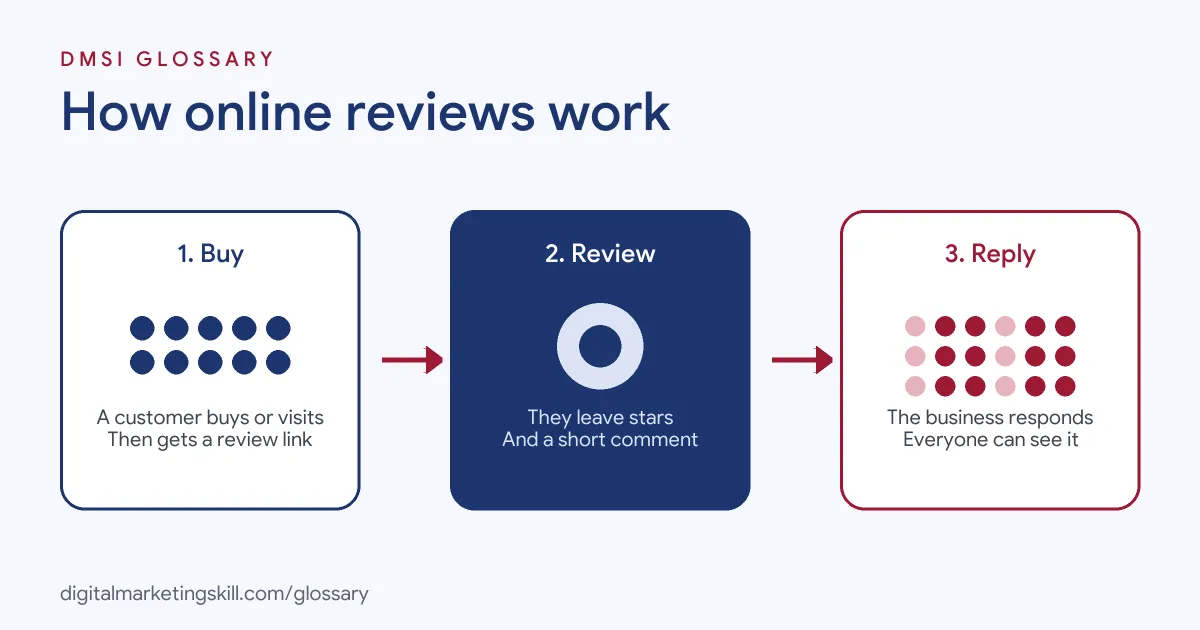
The process has three steps. First, a customer buys or uses something. Next, they leave a rating and a comment, often after a request from the business. Finally, the review appears publicly, and the business can reply.
Asking for Reviews
Many happy customers never think to leave a review, so it helps to ask. On Google, you can “share a review request link or QR code.” The key is to ask everyone, not just the people you expect to be happy.
Replying to Reviews
Google’s Business Profile help says “when you reply to their reviews, you show them that you value their feedback.” You must verify your business before you can reply. In addition, if a review breaks Google’s content policies, you can flag it.
Why Replies Matter
Replies influence future customers, not just the reviewer. BrightLocal’s research found that “80% of consumers say they’re likely to use a business that responds to all of its reviews.” It also found that trust in reviews “still sits at a significant 49%.” So a thoughtful reply can make a review more useful to the people reading it.
Online Reviews Examples
Here are three made-up examples of how businesses handle reviews:
- Hair salon: The salon texts every client a review link after their appointment. As a result, its profile fills with recent, detailed reviews.
- Online shop: A shop replies to a one-star review about a late parcel, apologises and explains the fix. Later shoppers see a business that takes problems seriously.
- Software company: A product team reads reviews each month, spots a common complaint about setup and adds a step-by-step guide.
In each case, reviews become a tool for trust and improvement, not just a score.
Review Rules at a Glance
Some review tactics are fine, and others break platform rules or the law. Here is a quick guide based on Google’s policy and the FTC’s rule:
| Practice | Allowed? | Source |
|---|---|---|
| Asking every customer for an honest review | Yes | Google suggests a review request link or QR code |
| Offering a discount in exchange for a review | No | Google bans incentives “such as payment, discounts, free goods and/or services” |
| Asking only happy customers | No | Google bans selectively soliciting positive reviews |
| Staff reviewing their own employer | No | Google bans content based on a conflict of interest, such as current or former employment |
| Posting fake or AI-generated reviews | No | The FTC rule covers fake reviews, including AI-generated ones |
How to Get More Online Reviews
- Claim and verify your Google Business Profile and any key review sites in your industry.
- Create a short review link or QR code.
- Ask every customer soon after the purchase or visit, by email, text or a printed card.
- Keep the request short and friendly, with one clear link.
- Reply to every review, good or bad, within a few days.
- Share key themes from reviews with your team and fix common problems.
- With permission, feature good reviews on your website and in ads.
Best Practices
- Ask at the right moment. Request a review when the experience is fresh.
- Make it easy. One tap or one link is better than a long set of steps.
- Reply to every review. Thank happy customers and respond calmly to unhappy ones.
- Stay honest. Never pay for reviews, write your own or ask staff to post them.
- Use the feedback. Reviews often point to the exact fixes customers want.
Using Online Reviews in Marketing
Good reviews are some of your strongest marketing assets. First, quote short, specific reviews on landing pages near your call to action. Second, use them in social posts and email. Third, mine them for language. If customers keep saying “fast” or “friendly,” those words belong in your headlines. Finally, read negative reviews for the objections your pages need to answer.
For more on why this works, see our glossary entry on social proof.
A Simple Review Request
Here is a made-up text message a dog groomer could send after each visit:
“Hi Priya, thanks for bringing Max in today. If you have a minute, we’d love your honest review. It helps other dog owners find us. Here’s the link: [review link]. Thank you!”
It is short and polite. It asks for an honest view, not a five-star one. And it gives one clear link, so the customer doesn’t have to search.
Replying to a Negative Review
Bad reviews happen to every business. What matters is how you reply. Keep it calm and short:
- Thank them for taking the time to write.
- Say sorry for the problem, without making excuses.
- Say what you will do, or have done, to fix it.
- Offer a direct way to talk, such as an email address.
Remember, you are writing for the next customer too. A fair, kind reply often builds more trust than a page of perfect scores.
Measuring Your Online Reviews
Track a few simple numbers each month: your average rating, how many new reviews you get, how fast you reply and the most common themes. If new reviews slow down, send more requests. If one theme keeps coming up, fix it. Then watch whether the next set of reviews mentions the change, because that shows customers noticed.
Common Mistakes to Avoid
Many businesses never ask for reviews, so only very happy or very unhappy customers post them. Others offer gifts for positive reviews, which breaks Google’s rules. Some argue with critics in public, which puts off future customers. Finally, many ignore reviews entirely. Even a short reply shows you are listening. So set aside a little time each week to read, reply and learn.
Where You’ll Use Online Reviews at Work
Review management is part of many eCommerce, support and marketing roles. For example, recent remote job listings ask candidates to:
- Handle “Marketplace reviews management: apply strategies to maximize positive reviews and minimize negative ones.” (Customer Care Specialist).
- “Follow up with customers to drive repeat orders, and manage product reviews and post-purchase communication.” (Shopify Store Specialist).
So as a Digital Marketing Manager, Growth Marketer or Freelance Digital Marketer, you may set up review requests, reply to reviews and turn the best ones into marketing content.
Learn It in the Full Stack Programme
Reviews connect social media, search, email and customer experience, so they fit the Full Stack (all four tracks) option. It covers all ten courses, with one portfolio project from each track. Every track is about 90% hands-on, with unlimited 1-on-1 mentoring and a U.S. Project Internship from day one.
To protect your wider image, read our entry on online reputation management.
Frequently Asked Questions
Why are online reviews important?
Because most shoppers read them before choosing. BrightLocal’s survey found that 97% of consumers read reviews for local businesses.
Can I offer a discount for a review?
Not on Google. Its policy bans incentives such as payment, discounts or free goods in exchange for reviews.
Should I reply to bad reviews?
Yes. A calm, helpful reply shows future customers that you care. Many people say they prefer businesses that respond to all reviews.
Can I delete negative reviews?
Not just because they are negative. However, you can flag reviews that break Google’s content policies.
Are fake reviews illegal?
In the US, the FTC’s rule bans fake reviews, including AI-generated ones, and lets the agency seek civil penalties against knowing violators.
Sources: BrightLocal: Local Consumer Review Survey; Google Maps: Prohibited and restricted content; Google Business Profile Help: Manage customer reviews; FTC: Final rule banning fake reviews; remote job listings on Himalayas.