
Most marketing plans fail at the goal line, not the start line. Teams pick channels before they define a customer, a funnel, or a goal. A marketing strategy framework fixes that order. It lines up brand, audience, funnel, budget, and goals so each one supports the others. This guide covers the six parts. It also covers what changes as a business grows, and one rule for deciding what to fix first.
Key Takeaways
- Marketers who document their strategy are 674% more likely to report success than those who do not, per CoSchedule’s State of Marketing Strategy survey of 515 marketers across 75 countries.
- Specific, challenging goals consistently beat vague ones, an effect Edwin Locke and Gary Latham’s goal-setting research has repeated for decades: difficult, specific goals outperform easy goals, no goals, or a generic “do your best.”
- The median landing page converts near 6.6% across industries, but the sample changes the number: Google Ads destination pages average closer to 2.35%.
- Email marketing returns roughly $36-$42 for every $1 spent industry-wide, which makes it a cheap place to test an offer before scaling the budget behind it.
- Companies that beat their revenue targets are far more likely to have a written buyer persona; one single-company case study found a 175% jump in marketing-attributed revenue after building one.
In this guide
- Most Advice Skips the Order, Not the Tactics
- The Six-Part Marketing Strategy Framework
- 1. Brand Identity: the Filter Everything Else Passes Through
- 2. Buyer Persona: a Document, Not a Guess
- 3. Buying Behavior: What Current Customers Already Tell You
- 4. Conversion Funnel: the Path, Mapped and Measured
- 5. Budget and ROI: Spending on Purpose
- 6. Marketing Goals: the Finish Line That Defines Everything Before It
- What Differs by Business Stage
- How to Lead With Data at Each Stage
- How to Measure Whether the Framework Is Working
- The One Marketing Strategy Framework Decision Rule: Fix the Persona Before You Optimize the Funnel
- What This Marketing Strategy Framework Looks Like With Real Numbers
- Frequently Asked Questions About a Marketing Strategy Framework
- Your Next Step
Most Advice Skips the Order, Not the Tactics
Search “how to build a marketing strategy” and you get the same six ingredients every time. Brand. Audience. Behavior. Funnel. Budget. Goals. The tactics are not the problem. The order is.
Most teams start with channels. They run some ads, post daily, send an email blast. They do this before writing down who they are selling to or what a win looks like. That produces activity, not a marketing strategy framework.
This sits one level below a full digital strategy: the strategy sets business-wide direction, and this framework is the repeatable plan for marketing inside it.
What follows is built from established research and this Institute’s own course material, not one settled formula. Treat the benchmarks below as a snapshot of what published studies report today. Treat the decision rule later in this guide as a starting point you adjust with your own data.
The scale of the audience is part of why skipping the order costs so much. DataReportal’s global overview report puts the number of people online worldwide at roughly 6.04 billion, a 73.2% penetration rate.
About 5.66 billion of them hold an active social media identity. That is 68.7% of the global population, spread across dozens of platforms. A strategy without a defined persona and funnel tries to reach that scattered crowd without knowing which slice of it actually buys. That is how budgets get spent wide instead of spent well.
The Six-Part Marketing Strategy Framework
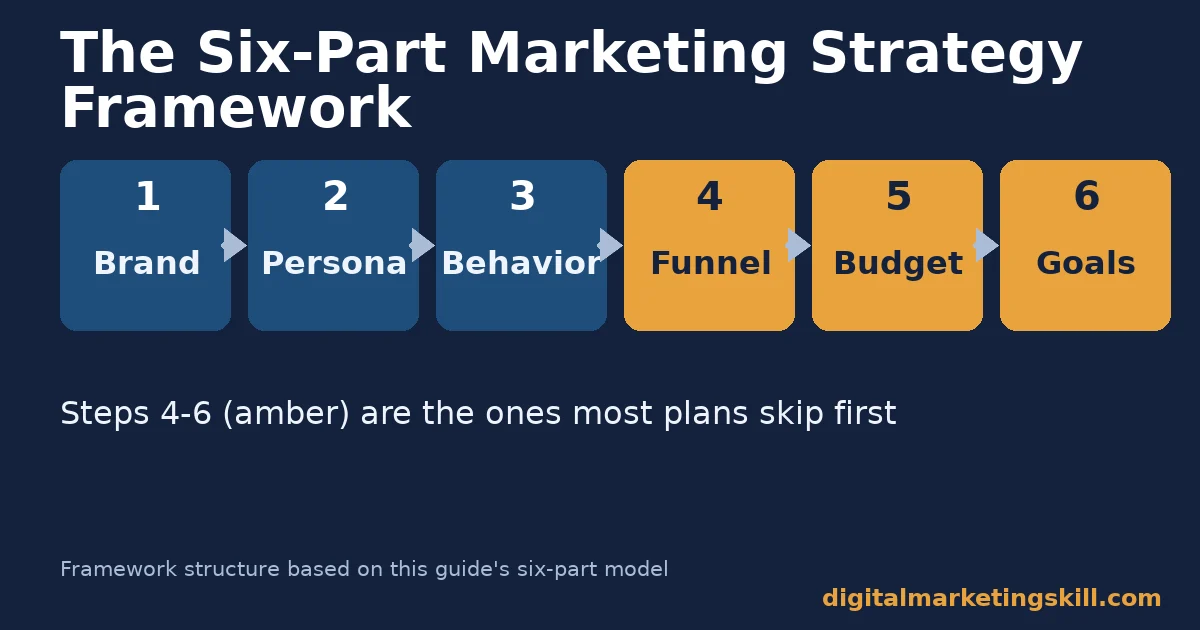
A marketing strategy framework is a written plan that connects six parts in a fixed order. A change in one part, a new offer or a new channel, gets tested against the other five instead of launched alone. The order matters because each part depends on the one before it. A funnel built before a persona exists has to guess who it is persuading. A goal set before a budget exists has no honest way to prove it was met. Here is what each part of the framework does.
1. Brand Identity: the Filter Everything Else Passes Through
Brand identity is the name, visual style, and promise a business is known for before a single ad runs. It matters because every later decision gets judged against it: which words you use, which images you choose, which channel you prioritize. Skip this step and two businesses can run the identical tactics and get different results. One has a consistent filter. The other is improvising campaign by campaign.
- Fix the name, visual style, and one-sentence promise before you write ad copy.
- Assign one person to publish consistently. Inconsistent posting is a common reason social accounts stall before they compound.
- Write content around keywords your buyers actually search. Search engines reward depth and consistency over volume.
2. Buyer Persona: a Document, Not a Guess
A buyer persona is a written profile of a real customer segment. It names their role, their goals, their objections, and the exact words they use to describe the problem. A persona turns “write something for everyone” into “write this sentence for this person with this objection.” That is the difference between generic copy and copy that converts.
The gap here is measurable. Companies that beat their revenue targets are far more likely to have a documented persona than companies that miss them.
One frequently cited case makes the upside concrete. A persona program at Thomson Reuters, reported by Demand Gen Report’s persona research, recorded a 175% increase in marketing-attributed revenue and a 72% drop in lead conversion time. Treat that single-company figure as illustrative of what is possible, not a guaranteed multiplier for your business.
3. Buying Behavior: What Current Customers Already Tell You
Buying behavior is the pattern of how existing customers find, evaluate, and buy. You learn it by tracking the channel that brought each customer in and the questions they asked before they bought. It tells you where to put the next dollar instead of guessing which channel “should” work.
Automated email and social tools make it easy to talk to thousands of people without talking to any single one. That is efficient. It can also quietly remove the human read on why someone actually bought.
- Track which channel brought in each paying customer: referral, search, social, or direct. Weight future spend toward the channel that is already working.
- Log the three questions prospects ask most before buying. Answer them directly on the page or in the pitch that precedes the sale.
- Review the stage where prospects stop responding. That stage, not the whole funnel, is usually the fix.
4. Conversion Funnel: the Path, Mapped and Measured
A conversion funnel is the sequence of steps a prospect moves through from a landing page or first contact to purchase, mapped so you can see where people drop off. A funnel copied from a competitor’s structure ignores your own sales cycle, your own objections, and your own proof points.
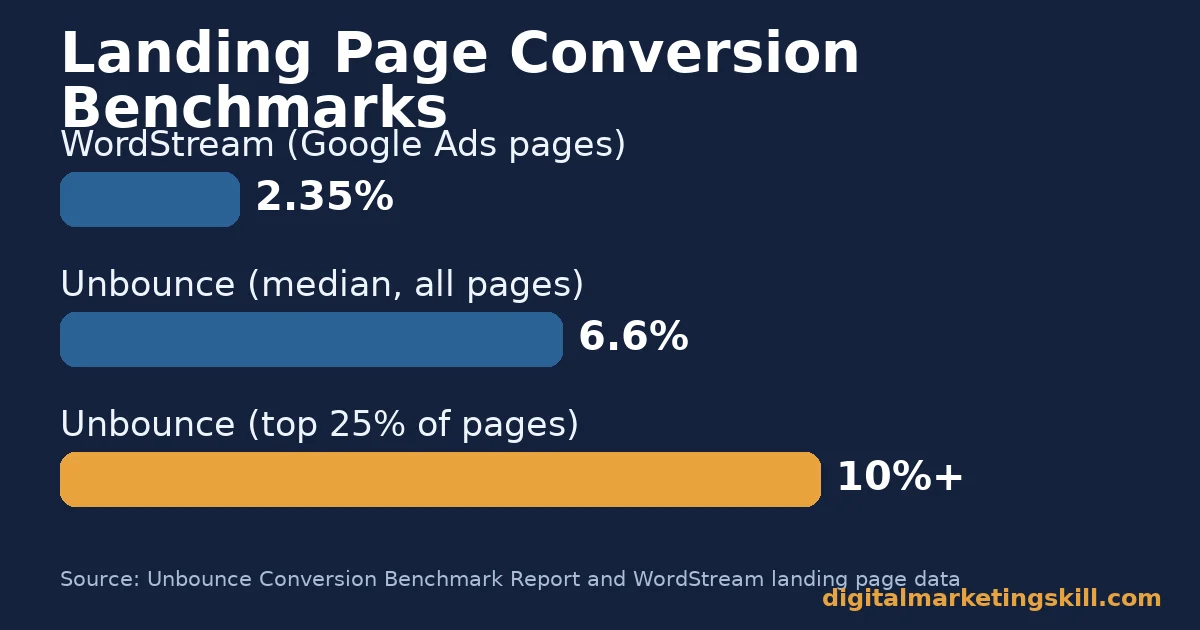
Benchmarks help you judge your numbers, but only if you compare like with like. Unbounce’s Conversion Benchmark Report draws on 464 million pageviews across roughly 41,000 standalone landing pages and 57 million recorded conversions. It puts the median landing page conversion rate near 6.6% across industries, with the top 25% converting above 10%.
WordStream’s dataset, built from Google Ads destination pages across roughly 20,000 advertiser accounts (a mix of true landing pages and ordinary site pages used as ad destinations), puts the all-industry average closer to 2.35%. Neither number is wrong. They measure different page types, so use the benchmark that matches what you actually built.
5. Budget and ROI: Spending on Purpose
Budget discipline means setting a target result before you spend, then tracking every dollar back to that result. It beats spending first and hoping the numbers work out later. Executives and business owners care about two outputs in the end: sales and profit. Every other metric is a proxy that should eventually explain one of those two.
Email illustrates the point well because it is cheap to test. Published industry data from Litmus’s State of Email research puts average email marketing ROI near $36 to $42 returned per $1 spent, with the travel and hospitality sector highest at around $53 per $1.
That is a self-reported industry average, not an audited figure, and results vary by list quality and offer. It still explains why most strategies test an offer over email first before scaling the same offer into paid channels.
6. Marketing Goals: the Finish Line That Defines Everything Before It
A marketing goal is a specific, measurable statement of the result a campaign must produce, set before the campaign launches. It is not read off a dashboard afterward. The first four parts of a marketing strategy framework only earn their keep once you know what they are supposed to produce.
The research on goal specificity is one of the most replicated findings in behavioral science. Edwin Locke and Gary Latham’s goal-setting theory research found that difficult, specific goals lead to significantly higher performance than easy goals, no goals, or a generic instruction to “do your best.” Applied to marketing, “grow qualified leads by a defined amount within a set period” beats “get more leads,” consistently.
What Differs by Business Stage
The six parts of the marketing strategy framework above stay the same. What changes is which part deserves your attention first. An early-stage business and an established one are solving different problems.
Early-Stage Businesses: Built for Discovery
A business with no purchase history has no behavior data to analyze. Steps one and two, brand and persona, carry the most weight. The honest move is a handful of direct conversations with prospective buyers. Draft a first-pass persona from them. Build a consistent brand filter and a small funnel meant to learn, not to scale.
Spending heavily on paid acquisition before the persona and offer are validated is the single most common way early budgets disappear without a lesson learned. Every dollar spent is testing a guess, not a documented pattern.
Growing Businesses: Built for Refinement
A business with a steady trickle of customers has real behavior data for the first time. It can see which channel brings paying customers, which page converts, and where prospects stall.
The job here is refining the existing funnel and persona against that data, not rebuilding the strategy from scratch every quarter. This is also the stage where budget discipline starts to matter, because there is finally enough volume to tell a winning channel from a lucky month.
Established Businesses: Built for Attribution
An established business has enough volume to attribute revenue to specific channels and campaigns with reasonable confidence. The goal-setting step and the ROI step become the priority. The risk at this stage is coasting on a strategy that worked years into the business but has never been re-tested against new goals, new competitors, or a changed customer base.
How to Lead With Data at Each Stage
Each stage above pairs with one specific first move. These are not sequential steps for a single business. Each is the single highest-leverage action for a business at that stage.
Early-Stage: Lead With Direct Customer Conversations
Talk to five to ten prospective or early customers before you write a single ad. Ask what problem they tried to solve, what they tried before, and the exact words they used to describe the problem. Draft the persona from their language, not from assumptions about their industry or job title.
Growing: Lead With Funnel-Stage Data
Pull the stage-by-stage drop-off numbers for your funnel over the last full sales cycle. Fix the stage with the steepest drop first. A 10% lift at the leakiest stage usually beats a 10% lift anywhere else in the funnel.
Established: Lead With Channel Attribution
Review which channels produced sales and profit, not just leads or clicks, over the last full cycle. Reallocate a fixed share of budget, start small at 10-15%, from the weakest-attributed channel to the strongest one. Measure again before you move a larger share.
How to Measure Whether the Framework Is Working
A marketing strategy framework is only as good as what you measure. Each KPI below answers one specific question. Track them together. Any single metric read alone can mislead you: a rising conversion rate on a shrinking traffic pool can still mean falling revenue.
- Conversion rate: the share of visitors to a specific page or funnel step who complete the intended action. Read it against a benchmark that matches your page type, because the two benchmarks above differ by roughly 3x.
- Customer acquisition cost (CAC): total spend on a channel divided by the paying customers it produced in the same period. Rising CAC on a channel that used to be cheap usually means the ad or funnel needs refreshing, not that the channel should be cut outright.
- Email return on spend: revenue attributed to email divided by what it cost to send, tooling and writing time included. Use the $36-$42 per $1 figure only as a sanity check. Your own list and offer decide your real number.
- Lead-to-customer conversion time: the average time between a lead entering the funnel and becoming a paying customer. A shrinking number usually means the persona and funnel are aligned. A growing number usually means a step is creating friction.
- Goal attainment rate: the share of defined, measurable goals hit per quarter. A rate near 100% usually means the goals are set too low. A rate under 50% means the goals or the plan behind them need revisiting.
The One Marketing Strategy Framework Decision Rule: Fix the Persona Before You Optimize the Funnel
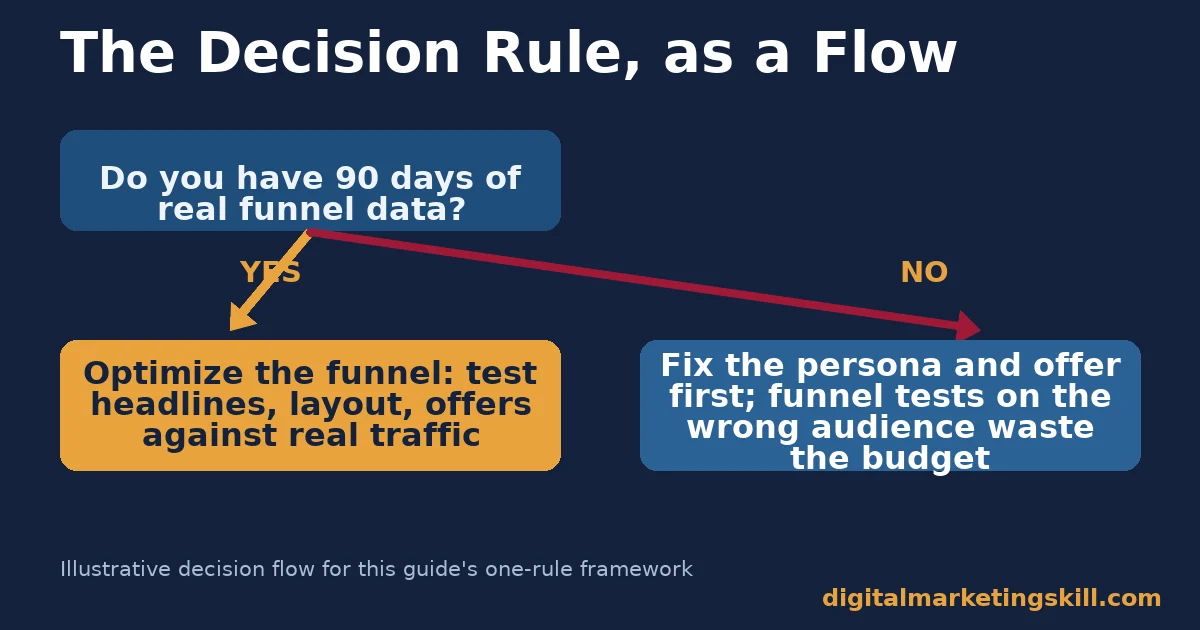
Without at least one full sales cycle of real conversion data, do not spend time optimizing funnel steps. Fix the persona and the offer first. Funnel optimization, testing headlines, button colors, or page layout, only pays off once the right person is looking at the right offer. Optimize a funnel aimed at the wrong audience and a bad fit just converts slightly less badly.
Illustrative, invented numbers: picture a service business that spends its first three months testing five landing page layouts for one offer. All five convert near 1.8%. The team pauses and interviews eight recent leads. They discover the offer solved the wrong problem for its stated audience.
After rewriting the persona and the offer copy around those eight conversations, the same unmodified page design converts at 4.1%. The lesson is not that layout never matters. It is that layout changes cannot fix a persona or offer mismatch, so diagnose which one you actually have before you spend a testing budget.
What This Marketing Strategy Framework Looks Like With Real Numbers
A Digital Marketing Skill Institute graduate, Ayooluwa Osemi, tested a small paid-ad budget against a defined offer and audience instead of running an open-ended campaign. An initial spend of $14 on social ads produced $878 in sales, as published on the Institute’s own reviews page.
That is one student’s result on one campaign, not a guaranteed return. It depended on having a specific offer and audience already defined before the ad ran, exactly the ordering this framework is built around. Read the Institute’s earnings disclaimer before treating any single result as typical.
Frequently Asked Questions About a Marketing Strategy Framework
What is a marketing strategy framework?
A marketing strategy framework is a fixed order for building a plan. Define the brand, document the buyer persona, study current buying behavior, map the conversion funnel, set budget and ROI rules, then set specific goals. Each part is tested against the others instead of launched on its own.
How is a marketing strategy framework different from a marketing campaign?
A strategy is the ongoing plan connecting brand, audience, funnel, budget, and goals. A campaign is one time-boxed execution of that strategy, such as a single product launch or a seasonal promotion with a start and end date.
Do I need a written buyer persona if my business is small?
Yes. A persona built from five to ten real customer conversations costs almost nothing. It is the step most small businesses skip, which is also why research consistently links documented personas to higher conversion and revenue than undocumented assumptions.
Which part of the marketing strategy framework should I build first on a limited budget?
Brand identity and buyer persona come first. They are nearly free to build, a one-sentence promise and a handful of customer conversations, and every paid step after them performs better once they exist.
How often should a marketing strategy be revisited?
Review goal attainment and channel attribution at least once a quarter. Revisit the full persona and funnel whenever the product, audience, or competitive landscape changes meaningfully, not on a fixed schedule alone.
What is a realistic landing page conversion rate to expect?
It depends on the page type. Standalone landing pages built for one offer average near 6.6% in published benchmark data, while paid-search destination pages average closer to 2.35%. Compare your results to the benchmark that matches what you built, and treat the top 25% figures, above 10%, as a stretch goal rather than a baseline.
Is email marketing still worth the budget compared to paid ads?
Published industry averages put email ROI near $36-$42 per $1 spent, higher than most paid channels report. That makes it a reasonable place to validate an offer cheaply before committing a larger paid budget to the same message.
Can one person run a full marketing strategy framework without a team?
Yes, at the early stage. One person can write the brand promise, interview a handful of customers for the persona, and run a small funnel to learn from. The budget and ROI step and the attribution step become harder without help once volume grows, so plan to bring in support as the business moves past the early stage.
Your Next Step
Pick the one part of this marketing strategy framework your business has never written down. Document it this week. Measure one KPI from the list above before you touch anything else. The six parts reinforce each other, so fixing the weakest one first usually improves results from every other part of the framework without spending anything new.
The Digital Marketing Skill Institute’s Master Diploma in Digital & AI Marketing walks through this same marketing strategy framework inside a structured program. It packs in ten practical courses, unlimited 1-on-1 coaching and mentoring, and real project work inside a U.S. partner company from day one. It is dual US and UK accredited and recognized in more than 100 countries, 100% online, so you can build and test a real strategy anywhere in your country.
Visit digitalmarketingskill.com to start with the Institute’s blog for more frameworks like this one, or go straight to the application page to see if the program fits your stage of business. Wherever you live, the same six-part order applies: brand, persona, behavior, funnel, budget, goals, in that order, before you spend another dollar on channels. Learn more at digitalmarketingskill.com.
Every figure in this guide was checked against its original source before publication. Figures marked as illustrative are invented examples, not real results.
![9 Amazing Digital Marketing Skills to Make Money Online [With Proof]](https://digitalmarketingskill.com/wp-content/uploads/2019/07/9-Amazing-Digital-Marketing-Skills-to-Make-Money-Online-With-Proof-17.png)






