
A portfolio in marketing is a collection of your best work, such as campaigns, ads, content and results, that shows employers or clients what you can do. Each piece usually explains the goal, your role and the outcome. It matters because a portfolio proves your skills in a way a CV can’t, and it is often what turns an application or a sales call into an interview or a signed deal.
Key Takeaways
- A portfolio shows your work; a CV only describes it.
- BrainStation calls it “your most valuable career asset,” whether you are new or experienced.
- Pair every piece with context: the platform, your contribution and the result.
- Beginners can use mock projects, freelance jobs, volunteer work and coursework.
- Always respect client confidentiality and never take credit for others’ work.
What Is a Marketing Portfolio?
Designers and photographers have always used portfolios. Marketers need one too, although it can be less obvious what to include. Wesleyan University’s career centre puts it simply: “A good portfolio shows your work, your skills and how you think.”
BrainStation, a digital skills training provider, explains the main benefit for job seekers. A portfolio “moves beyond saying you can do the work (on a resume) to showing you have done it.” That proof might come from work samples, mock projects, freelance work or coursework.
For freelancers and agencies, the same idea applies to winning clients. A clear portfolio shows a prospect that you have solved problems like theirs before.
How a Portfolio Works
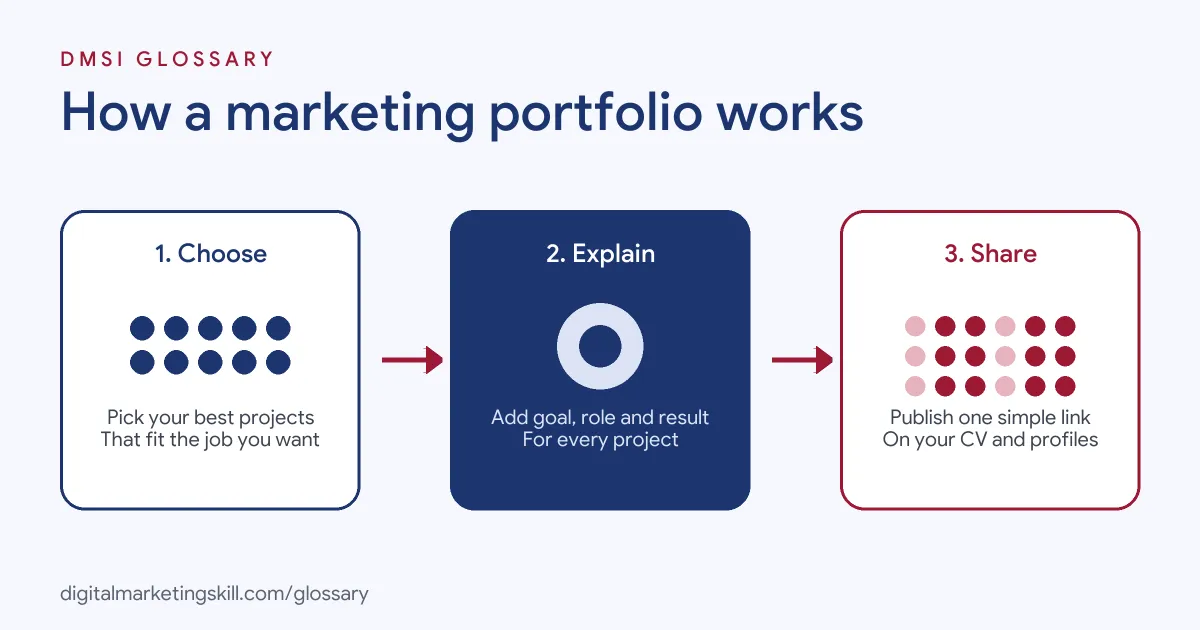
A strong portfolio works in three steps. First, you choose your best, most relevant projects. Next, you present each one with context: the goal, what you did and what happened. Finally, you share it where employers and clients will see it, such as a simple website linked from your CV and profiles.
Choose the Work
Quality beats quantity. Pick projects that match the jobs or clients you want. For example, if you are applying for paid social roles, lead with ad campaigns rather than a blog you wrote years before.
Add Context
BrainStation’s advice is to “pair deliverables with context.” It suggests answering three questions for every project: which channel you used, what you personally contributed and how your contribution affected the business goal. As a result, a reader sees your thinking, not just a pretty screenshot. The agency Hallam makes a similar point about case studies: “if you don’t have the results, you simply don’t have a case study.”
Share It
Wesleyan’s career centre recommends building a portfolio website rather than “collecting files or sending PDFs.” A single link is easy to add to applications, emails and social profiles, and you can update it whenever you finish a new project.
Portfolio Examples
Here are three made-up examples of what a project page might look like:
- Paid social project: “Planned and ran a Facebook and Instagram campaign for a local café. Role: strategy, ad copy and reporting. Result: more online orders at a lower cost per order.”
- Email project: “Built a five-email welcome series for a skincare shop. Role: copy, design and automation set-up. Result: a higher share of new subscribers made a first purchase.”
- SEO project: “Built and optimised a WordPress site for a yoga studio. Role: site build, keyword research and content plan. Result: steady growth in search visits.”
Each example names the platform, the contribution and the result, which is exactly what readers want to know.
What to Include in a Marketing Portfolio
| Item | Why it helps |
|---|---|
| Short introduction | Tells readers who you are and what work you want |
| Three to six projects | Shows range without overwhelming the reader |
| Context for each project | Explains the goal, your role and the outcome |
| Results and screenshots | Gives proof, such as reports, ads or before-and-after shots |
| Testimonials | Adds trust from clients or managers |
| Contact details | Makes it easy to take the next step |
Keep each project page short enough to scan in a minute. Busy hiring managers will thank you for it.
How to Build a Marketing Portfolio
- Decide your target role. Choose the jobs or clients you want, so every piece points in that direction.
- Gather your work. Collect campaigns, posts, emails, reports and any results you can share.
- Fill gaps with practice projects. BrainStation lists mock projects and coursework as valid options when you lack experience.
- Write each case. Next, explain the goal, the platform, your role and the result.
- Check permissions. BrainStation says you can feature client work, but you must be careful about confidentiality.
- Build a simple website. Use a clean template with one page per project.
- Share and update. Finally, add the link to your CV and profiles, and update it after each new project.
A Simple Project Page Template
You can use the same short structure for every project, so readers know where to look:
- Title: lead with the result, such as “Cutting cost per lead for a dental clinic.”
- The brief: one or two sentences on the client, the goal and the problem.
- What I did: your exact role, the channels and the key decisions.
- The result: the numbers, plus a screenshot of the report if you can share it.
- What I learned: one line on what you would do differently next time.
A Worked Example: Starting From Zero
Here is a made-up example. Amira wants her first paid social job but has never worked in marketing. So she offers to help a friend’s bakery for free. Over six weeks, she plans a small campaign, writes the ads and tracks the results. She also builds a welcome email series and a simple landing page for a holiday offer.
At the end, she has three real projects with real numbers. She writes each one up using the template above, puts them on a one-page site and adds the link to her CV. Now, when an employer asks what she can do, she doesn’t just tell them. She shows them.
Best Practices
- Lead with your best project. Many readers only look at the first one.
- Show numbers. Even small, honest results are more convincing than vague claims.
- Credit your team. BrainStation warns, “Don’t take credit for content that’s not yours,” and notes that crediting collaborators shows teamwork.
- Keep it current. BrainStation suggests updating your portfolio regularly, even while employed, so you don’t lose track of your wins.
- Tailor it. For instance, reorder projects to match each job you apply for.
Common Mistakes
A common mistake is showing work with no explanation, so readers can’t tell what you did. Another is including everything you have ever made, which buries your best pieces. Some people also share private client data without permission. Others pick a design so busy that the work gets lost, when a clean layout lets the results speak. Finally, many wait until they need a job to build one. By then, the details and numbers are often hard to find.
Where You’ll Use a Portfolio at Work
Many marketing job ads ask for one directly. For example, real remote job listings include lines like these:
- “Must provide a portfolio of marketing-focused web copy” (Copywriter).
- “Strong portfolio demonstrating writing quality, versatility, and consistency.” (Content Writer).
- “A portfolio showing bilingual digital work, ideally covering both UX/microcopy and marketing or communications” (Senior Arabic and English Copywriter).
So whether you aim to be a Digital Marketing Manager, a Growth Marketer, a Freelance Digital Marketer or an Agency Owner, your portfolio will be one of your main tools for winning work.
Learn It in the Full Stack Programme
The Full Stack (all four tracks) programme covers all ten courses, with one portfolio project from each track. That means you finish with real projects across paid social, email, Google Ads and SEO. You also get unlimited 1-on-1 mentoring and a U.S. Project Internship from day one.
For a step-by-step guide, read our blog post on how to build a marketing portfolio. To write up each project, see our glossary entry on the case study.
Frequently Asked Questions
What is a marketing portfolio?
It is a collection of your best marketing work, with context and results, that shows employers or clients what you can do.
What if I have no experience?
Use mock projects, coursework, volunteer work or small freelance jobs. BrainStation lists all of these as valid ways to show your skills.
How many projects should a portfolio include?
There is no fixed number. A few strong, relevant projects usually work better than many weak ones.
Can I show client work in my portfolio?
Often, yes. However, check confidentiality first and ask permission before you share names or numbers.
Should my portfolio be a website or a PDF?
A website is usually easier to share and update. Wesleyan’s career centre recommends a portfolio website over sending files.
Sources: BrainStation: How to build a digital marketing portfolio; Wesleyan University Gordon Career Center: How to create a marketing portfolio; Hallam: How to write a case study; remote job listings on Himalayas.